
Meditation for Memorial Day

As regular readers of Living on the Diagonal may know, I’ve been working rather furiously on a deeply personal book project for almost eighteen months. It is about David Rae Smith, my dad’s first cousin. Rae spent his entire career as a professional singing actor, and my goal is to tell the story of his life and the world surrounding him. One ‘side effect’ of my research is that I’ve come up with lots of fascinating material which simply could not find a place in the manuscript. But it is impossible for me to ignore it, so I thought I’d share some of those amazing extras through this blog. Maybe you’ll find them as engrossing as I do. This week’s entry seems an appropriate way to prepare for Memorial Day when we commemorate those who died while serving in the United States military.

Though most of Rae’s career was spent on the opera stage, he also had numerous appearances in regional and touring musical productions as well as concerts. Among the latter was a performance of British composer Benjamin Britten’s War Requiem.

File:Benjamin Britten, London Records 1968 publicity photo for Wikipedia crop.jpg
Benjamin Britten
(Photo by Hans Wild for High Fidelity magazine, public domain, via Wikimedia Commons)

Don’t let the title fool you into thinking Britten composed this piece as some kind of glorification of war. It was quite the opposite. Britten’s anti-war sentiments were strong. As stated by the California Institute of Technology, the piece was “a denunciation of the wickedness of war, not of other men.” Britten made that point rather powerfully by writing War Requiem to be sung by three specific soloists: one German, one British, and one Russian. Cal Tech says, “The piece was also meant to be a warning to future generations of the senselessness of taking up arms against fellow men. (Source: http://www.cco.caltech.edu/~tan/Britten/britwar.html)

Britten composed the nearly-90-minute piece 61 as a commission for the consecration of the rebuilt Coventry Cathedral. The original, built in the fourteenth century, had been destroyed in a World War II bombing blitz. At around 8:00 on the night of November 14, 1940, the cathedral was bombed the first time. Fire fighters managed to put the resulting fire out, but more direct hits created new fires which, in turn, created a firestorm. Meanwhile, the attack had set fire to more than two hundred other buildings in the city. Firefighters were overwhelmed not only by the fires but by damaged water mains as well as a crippled phone network which prevented them from knowing which fires needed to be attacked first. Citizens—those who survived—huddled wherever they could during the surprise attack as 500 tons of high explosive bombs, 30,000 incendiaries, and 50 landmines were dropped on their city. Eleven hours following the initial attack, they finally heard what they’d been waiting for, a siren signaling the all clear. They climbed into a dreary, smoky daylight to discover the medieval cathedral; the library and market hall; the 16th-century Palace Yards; hundreds of shops, factories, and public buildings; and 43,000 of their homes—more than half—destroyed. Imagine the shock and overwhelming helplessness they felt walking out into that scene.

File:Operation Moonlight Sonata- Bomb Damage in Coventry, November 1940 H5599.jpg
Soldiers march in the aftermath of the Coventry blitz. (War Office official photographer, Taylor, E A (Lieutenant), Public domain, via Wikimedia Commons)
BE037585

Prime Minister Winston Churchill and Coventry Mayor Alfred Robert Grindlay survey cathedral remains. (Photo: “BE037585” by Sabatu is marked with CC PDM 1.0)

Though the ruins of the original cathedral were left to serve as a reminder of the bombing, a new cathedral was built alongside it the following decade. Along with the cathedral’s 1962 consecration, the Coventry Cathedral Festival was held as a national celebration to symbolize an international act of reconciliation, and Britten was commissioned to write a new piece for the occasion. He readily accepted the challenge and composed War Requiem as “an act of reparation,” according to the English National Opera website. (https://eno.org/discover-opera/an-act-of-reparation-the-story-behind-brittens-war-requiem/)

Britten’s approach was to juxtapose traditional Latin texts with nine poems about war written by Wilfred Owen. Owen’s poems on his World War I reality of trenches and gas warfare stood in stark contrast to the era’s public perception of war and to the haughty, chauvinistic works of poets from earlier wars. Owen, who had already witnessed many war horrors, suffered a concussion after falling into a shell hole in March 1917 and was caught in the blast of a mortar shell. Following several unconscious days lying on an embankment amidst the remains of fellow officers, he was hospitalized and treated for ‘shell shock.’ He returned to duty a year later.

Twenty-five-year-old Owen was killed in action in France on November 4, 1918. Those who know their history realize the date preceded the signing of the November 11 Armistice by precisely one week—and almost to the hour. All but unknown in life (only five of his poems were published before his death), Owen has since become recognized as one of the great war poets.
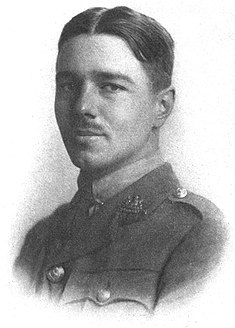
Wilfred Owen

In the March/April 2020 issue of St. Austin Review, Dana Dioia wrote, “The First World War changed European literature forever. . . . For poets, the unprecedented scale of violence annihilated the classic traditions of war literature—individual heroism, military glory, and virtuous leadership. Writers struggled for a new idiom commensurate with their apocalyptic personal experience. . . . Their work, which combined stark realism and bitter irony with a sense of tragic futility, altered the history of English literature.”

Britten’s War Requiem was an immediate success, praised by both critics and the public. The Library of Congress has preserved the work in its National Recording Registry for being “culturally, historically, or aesthetically significant.” According to the English National Opera website, War Requiem’s reception was “more than its creator originally bargained for: it soon took on the mantle of a public statement of outrage against war, conflict and violence, sentiments that were only intensified in 1964 with the 50th anniversary of the outbreak of the First World War and the growing international discomfort with the atrocities unfolding in Vietnam.” I suspect Britten was not disappointed by that.

Britten dedicated his masterpiece to five men: two who died in World War II, two who remained missing, and one who survived the Normandy landings, though he died by suicide in 1959 two months before his wedding. The composer said his goal in writing the work was to make people think. He quoted Wilfred Owen on the score’s title page: “My subject is War, and the pity of War / The Poetry is in the pity . . . / All a poet can do today is warn.”

A full-length screen adaptation of War Requiem was made in 1988 using the original soundtrack and featuring Laurence Olivier in the role of an aging veteran.. The experimental film can be seen at https://www.youtube.com/watch?v=gOVIjKvOcE4/.

In 2010 the musical Bullets and Daffodils, set to Owen’s poetry, told the story of the poet’s short life. It can be seen at https://www.youtube.com/watch?v=xRAzY310wYQ.

Anthem of Doomed Youth

by Wilfred Owen

What passing-bells for these who die as cattle?

—Only the monstrous anger of the guns.

Only the stuttering rifles’ rapid rattle

Can patter out their hasty orisons.

No mockeries now for them; no prayers nor bells;

Nor any voice of mourning save the choirs,—

The shrill, demented choirs of wailing shells;

And bugles calling for them from sad shires.

What candles may be held to speed them all?

Not in the hands of boys, but in their eyes

Shall shine the holy glimmers of goodbyes.

The pallor of girls’ brows shall be their pall;

Their flowers the tenderness of patient minds,

And each slow dusk a drawing-down of blinds.

(retrieved from https://www.poetryfoundation.org/poems/47393/anthem-for-doomed-youth)

Six Degrees of Separation

Living for more than a year in the reality of COVID-19 with its forced separation from people we love and things we care about and with its attendant anxieties and frustrations, most of us, I hope, have still managed to discover some good. Maybe it was the kindness of strangers or the inventiveness of our educational systems and workplaces. Maybe it was learning to live gracefully with quietness and solitude. Some of those discoveries have been life-changing, others insignificant. They all matter. I have been struck by a couple of things which definitely fall in the insignificant, though fascinating (at least to me), category. For instance . . .

Surely Midsummer Night’s Dream was among the plays we studied in my college Shakespeare class with Dr. Edward Pinckney Vandiver, who seemed to go into a swoon—ambling ever so slowly across the classroom to stand gazing out a window, holding his beloved book in his hands, to quote from this or that play. Why he carried the book I have no idea, because his eyes were closed and he entered a near trance every time he, oh, so lovingly quoted the great poet—and that was many times a day. I think dear professor was mind-traveling to far away places in far away times, across miles and centuries, picturing himself on the apron of the Globe theater stage with the bard himself standing in the wings or perhaps sitting in the center of the front row. Or maybe Dr. Vandiver transported himself directly into old Will’s brain.

Dr. Vandiver I remember, but I don’t recall learning anything about Midsummer Night’s Dream from my time at Furman University.

A Midsummer Night's Dream
The Quarrel of Oberon and Titania by Joseph Noel Paton, 1849.

About ten years later, I auditioned for and was selected to portray Hermia in a Louisville Shakespeare in Central Park production of the play. Wemust have had discussions about the plot, but I don’t remember that either. Maybe it was just assumed we knew it. I do remember the character Puck and the actor who played him. And (unfortunately) I remember the less-than-stellar review of my performance. But that’s about all.

I think, however, that I have finally gotten a handle on the play.

For all of 2020—and so far for most of 2021—I’ve been learning and writing about my dad’s cousin Rae, an operatic baritone long associated with the New York City Opera Company. I have yet to set foot in an opera house, but I’ve been learning a lot about the art form from my living room. Lately, I’ve been studying up on the storylines of the operas Rae performed in so I can include short but accurate descriptions of their plots in my book.

Rae played Starveling in Midsummer Night’s Dream so I recently used a big chunk of one day to learn—or maybe relearn—the gist of the thing. If I got it right, Starveling and his fellow ‘rustics’, or skilled laborers, plan to produce a play for the wedding of Theseus and Hippolyta. So, with Midsummer, we have a fantasy featuring a play within a play, always a mind-bending theatrical convolution.

I’ve made some other discoveries while working on Rae’s book. One is a reminder of how small our world really is and how closely we are all connected. You’re probably familiar with the six degrees of separation concept—that everyone is connected to any other person through a chain of acquaintances with no more than six links. An article in The Guardian a few years back confirmed that as unlikely as it sounds, the theory is probably about right—that each of us is only six introductions away from any other person on the planet.

Rae is separated from me by two degrees with my dad as our point of connection. Rae performed with many opera stars, including Placido Domingo and Beverly Sills, each of them three degrees from me. And Beverly Sills—well, she met just about everyone. So, through Dad, then Rae, then Sills, I am separated by only four degrees from, for instance, Pat and Richard Nixon, Jimmy Carter, Rose Kennedy, Carol Burnett, Miss Piggy, and who knows how many other famous personages. In fact, because of Rae I am separated by a mere three degrees from Leonard Bernstein, Aaron Copland, Robert Shaw, and maybe Kristin Chenoweth.

Joe DeNardo, band director at Rae’s junior and senior high schools, was one of Rae’s music teachers. DeNardo was one-time student of Italian opera composer Giuseppe Verdi. One of Rae’s voice teachers was Sol Cohen. Cohen was coached by one violinist who had been composer-pianist Franz Liszt’s touring partner and by another who had performed one of Johannes Brahms’ concertos under the baton of the composer himself. So I’m connected to both Liszt and Brahms by five degrees and Verdi by only four. How about that!

Will Smith starred in the movie Six Degrees of Separation.

It’s just a silly pastime and means nothing about who any of us are, neither adding nor subtracting from our inherent value, but it’s still a fun little game, and it does manage to show what a small world we live in. And how the pandemic has led to new discoveries—of all sorts.

If you’d like to share some of your degrees of separation, drop me a line in a comment below. I’d love to hear about them.

I’m Back!

Dear Friends, Sorry to have been absent from this space for so long. I really do have a good reason. You see, I’ve been working non-stop on my next book. Very single-mindedly. It has required tons and tons of research, made a little more challenging–in some ways, at least–by the pandemic. More about that, later. The good news for Living on the Diagonal is that I am rounding a corner and hope to be a more reliable blog writer soon.

I’ve also been delinquent with my local writing group, even though it is now meeting remotely. But I got a prompt today which was easy to do, and I was in a mood to have my attention diverted. Thought it might be fun to share. We were asked to come up with our own list of ten fortune cookie fortunes. Now, if you’ve been on the receiving end of fortune cookies anytime lately, you know they rarely contain actual ‘fortunes’ anymore. Instead, we get aphorisms. I liked the old days when we could laugh at the predictions. My prompt response was a little of both and very few are original, but they are things that have stuck with me.

File:Fortune cookies.jpg

The first four come from the movie Elizabethtown—it is a fun, mostly light-hearted movie but full of great lessons, and these lines have stayed with me for years.

  • If it wasn’t this, it would be something else.
  • Have the courage to fail big and stick around.
  • Give yourself five minutes to wallow in your delicious misery. Enjoy it, embrace it, discard it. And proceed.
  • No true fiasco ever began as a quest for mere adequacy.

The next one has often been attributed to Maya Angelou (and others), but I first read it in a Christmas letter I received one year. Ever since, it’s been one of the few things I keep on the top of my dresser, so I can be reminded of its wisdom every day:

  • Life is not measured by the number of breaths we take but by the moments that take our breath away.

Now comes one I developed from a post and comment on Facebook. It is my new mantra.

  • Before you freak out [substitute whatever verb works for your situation], ask yourself, “Will this matter in five years?”

Next come two of my own:

  • Laugh.
  • Everything is hard–until you learn how to do it.

The last two are song titles from poet-songwriter Carrie Newcomer—if you don’t know her, you should. She can put a troubled mind to rest. (Maybe that is my 11th ‘fortune.’)

  • If not now, when?
  • Learn to sit without knowing.

Now, here’s a fun thing. Back when I got paid for the hours in my day, we occasionally had a catered meal at work—usually when someone was leaving. One time it was Chinese and everyone got a fortune cookie. One of my colleagues told us about a game she had learned. Maybe you know it, too, but I didn’t. She told us to tack on “in bed” at the end of our fortunes. It doesn’t always work, of course, but more often than not the result is rib-ticklingly hilarious and, after all, one of my bits of fortune cookie advice is “Laugh.”

How about you? What fortunes or advice would you put in a fortune cookie?