Daily Life: Early Days on the Diagonal, Part 5

Daily Life: Early Days on the Diagonal, Part 5

(If this is your first time visiting the Early Days series, may I suggest you start here and work your way forward?)

Everyday life is a wee bit different when you have neither electricity nor running water, but we’re finding our way. To get water for our daily needs, we fill two five-gallon containers every couple of days from an enclosed spring with an overflow spout by the side of the state maintained road about three-quarters of a mile away.

Sometimes, we take sponge baths, and sometimes we take advantage of the almost daily rain for a brief shower. (Brr-r-r!) When we feel especially in need of a good cleansing, we trek deep into the woods for an exhilarating 40-degree creek bath. Our secret site is decorated with rhododendron flowers and boasts a convenient mountain laurel towel rack. We always leave with a strange sensation of lightheadedness, especially when we wash our hair in that cold, cold water.


On occasion, we take a trip to town for a dip in the county pool preceded by a real shower with hot, running water. It’s the only time we feel really and truly clean. Eventually, these trips become a twice-weekly routine that provides us with a time for family play as well as some good exercise. Not that we don’t get plenty with all the digging and tree-cutting, but this feels different—and a lot more fun.

We spend evenings and rainy afternoons (plenty of those) reading stories aloud from our stash of books from the county library. We especially enjoy Ramona and Clifford the Big Red Dog books. Other favorites are That Quail, Robert and the iconic raccoon tale, Rascal. We’re also fascinated by Eric Sloane’s Diary of an Early American Farm Boy, a pioneer-days real-life story that seems to parallel our own experiences at the moment. When we’re not reading, we pass the time creating themed crossword puzzles for each other to complete.

One of the joys of building our house ourselves is getting to be out in nature and getting to know our little corner of paradise on an intimate basis. As we dig, we find all sorts of interesting creatures: a golden-eyed spade-footed toad, black and red salamanders, and shrews that can’t seem to stay out of the holes.

Each morning brings an untold number and variety of spiderwebs, with dewdrops making them sparkle in the sun. The geometric masterpieces can be found on fences, in trees, and just about anywhere else one can imagine. I stalk these works of natural art with camera poised.


Now that we’re out here in the country so far away from city lights, we can really appreciate the night sky. In August, we ‘re treated to the Perseid meteor showers. We’ve never seen anything like it.

Mid-August heralds the beginning of the school year, which always coincides with the blooming of the touch-me-nots (or jewelweed) that line the long gravel drive to our house. Afternoon walks from the bus stop are always slow because our children can’t resist stopping to pop every seed pod they spy.

What a delightful surprise it is to discover wild blueberry and blackberry plants on our land. It’s a charmed life we’re living.

(More of the Early Days on the Diagonal series coming next week. Stay tuned.)

Getting to the Nitty Gritty: Early Days on the Diagonal, Part 4

Getting to the Nitty Gritty: Early Days on the Diagonal, Part 4

(If you’re just now joining this conversation, you may want to start here and work your way forward.)
It’s now been two weeks since we moved here. Now that we’re settled in the shed, things are happening faster. As I continue to chop trees, sling weeds, and shovel clay and gravel, the Gnome swelters in the shed poring over reference books and drawing house plans. We want every detail to be just so—we’ve read horror stories about inspectors who give newbie builders a hard time, so we expect to be unduly scrutinized. The whole building thing is the Gnome’s forte, but we decide I need to get better versed in this area, too, so we can jointly think through design issues.

In retrospect, 2017: Glad we figured this out back then. The second opinion/sounding board role has been essential through the years. We now laughingly say that my job, whenever the Gnome is tackling a big project, is to say, “Isn’t there a simpler way?”

We want large fixed-glass windows across the south-facing side of the house to provide passive solar heat. A local company will make insulated glass panels to our specifications. Our reference books tell us it will be no problem to mount, cushion, caulk, and trim them ourselves.

In retrospect, 2017: Big mistake. Silicone caulking didn’t do the trick; our windows weren’t water- and airtight. Nor did we accommodate for natural expansion and contraction. Within months, several of our big glass panels cracked. We lived with them—unhappily—for years.

A long week later and our plans are finally ready. We nervously deliver them to the building inspector. He approves our permit on the spot, no questions asked.

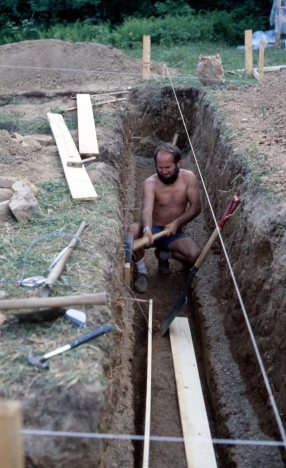
We start work right away, first measuring our footprint, then digging trenches for the foundation. Before long, the dirt is flying. Literally—we’re digging with only shovels and muscle power. This is more like it!


Cuddlebug digs digging, but it’s a challenge when the holes become as deep as he is tall.

img036

Building forms for our very carefully dug footings.

It’s pretty smooth sailing till we get to the third corner and find nothing but rock. There’s just enough wiggle that we don’t dare incorporate the rock into the foundation. It takes days and a big dose of creativity to break it up and leverage out the biggest pieces. The Gnome demonstrates Archimedes’ physics lesson: “Give me a lever long enough and a fulcrum on which to place it, and I shall move the world.” We feel like we’ve moved the world by the time we get the trench cleared.


We’ve been here exactly one month when my parents come up for a weekend of help. Cuddlebug and Punkin make miniature dams and ponds in the creek while the men dig out the nearby spring that we hope will provide our water supply.


They’ve determined, none too scientifically, that the spring should easily produce enough water to meet our future plumbing needs. That’s great news—there’s something about the idea of getting our water from a spring that feels natural and pure.

In retrospect, 2017: After 38 years, our spring’s still doing its job. It’s never run dry. On the other hand, we’ve had to repair or replace more pumps than we can remember, some due to lightning, some . . . well, we don’t rightly know. We do know it’s no fun to find yourself soaped up in the shower when suddenly there’s no water. Because we’re hardcore do-it-yourselfers, this often means a week or so without water while we figure out and fix the problem. Having gone much longer without running water and survived it, at least we know we can do it again.

(Stay tuned for next week’s Early Years on the Diagonal adventure.)

Off the Ground: Early Days on the Diagonal, Part 3

Off the Ground: Early Days on the Diagonal, Part 3

(If you’re just joining this series, you really should read this first and work your way forward.)
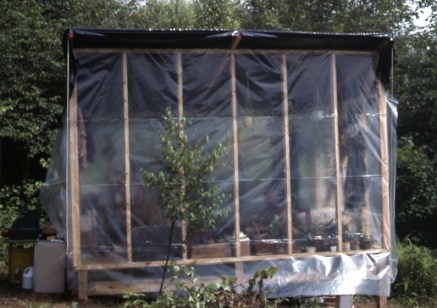
July 10, 1979: The day we move to the shed. Small as it is, the shed feels immense compared to the tent. And it’s still standing, so perhaps we really can build a whole house.

In retrospect, 2017: We didn’t know how much ahead of the times we were. We built one of the world’s tiniest tiny houses way before tiny-house-living was a thing.

An army cot across one end with another along one side for the children gives us just enough room to lay a double sleeping bag on the floor for us. Putting it out of the way each morning gives us room to dress, eat, play board games, and draw house plans—as long as we coordinate. The cots do double duty as daytime seating. Improvised single shelves along two walls keep some of our stash off the floor. We have no door, just a three-foot wide doorway.

In retrospect, 2017: I wonder why the possibility of intruders never occurred to us. We felt perfectly safe from the human type, but why weren’t we concerned about wildlife? In the years since, we’ve seen everything from snakes to bears. We must have been crazy!

img009

Our “kitchen” is just outside the shed on left end. The doorway is also on the left end. Suitcase and canned goods are lined up along our front “wall.”

With all outdoors for living, our little enclosure doesn’t feel cramped. Our “bathroom” in the woods boasts incredible scenery with its huge rhododendron walls for privacy—not that we need all that much privacy up here.

The shed’s plastic walls and roof provide plenty of natural light, but we discover the obvious—it’s either a steam room or a sauna, depending on the weather. No place to spend daylight hours, especially when it’s sunny. Yet, it’s the only suitable spot for drafting house plans.

July 11, 1979: The water inspector okays our septic tank, our first official approval of any kind. It feels like a huge accomplishment. But with one hurdle out of the way, we stumble onto another: the car won’t start. Fortunately, we find the problem and it’s an easy fix, but this experience magnifies our isolation. With only one car, no social support system, and no phone, our existence here is fragile and hinges on lots of things going right. We’ve already discovered they don’t always.

It’s only our second night in the shed and we have yet another heavy rainfall. The accompanying strong wind, which we’re coming to expect as normal, blows up under our plastic “roof” and tears holes where the plastic is strapped to the rafters. We get soaked. (It won’t be the last time.) A few repairs get us through the night.

July 12, 1979: We add a second layer of plastic, hoping it will be enough to protect us during the next big windstorm. We know there will be one.

While the Gnome works on the house plans we’ll have to submit to the county building inspector so we can actually start building, I chop down the few hundred black locust saplings covering our construction area. Everything’s happening a lot more slowly than we’ve anticipated. But it’s all progress.

img010

The Gnome’s drafting table with stacks of reference books to the right. Too hot for a shirt in here. Note upper left of picture where plastic is raised to let in a tiny bit of air. Sleeping gear in background.

(Tune in next week for more adventures in Early Days on the Diagonal.)

Confessions of a Groupie

Confessions of a Groupie

I admit it—I’m a groupie. But maybe not the kind you’re thinking of. My fanaticism lies with the Mother Earth News Fair. I first learned about this terrific event back in 2013, a couple of years after I’d hit the retirement button on a public service career that had taken all of my energy. The Gnome and I thought going to the fair would be a great way to get our modern homesteading grooves back.

No ferris wheels or cotton candy at this fair. It’s all about sustainability and self-reliance. A perfect fit for two old, would-be hippies who wanted to get back to basics. Not that the fair’s attendees are hippies. It’s a broad spectrum of folks who fill the workshops and exhibit halls: young, old, rich, poor, hip, not so hip. They come for different reasons. I’m betting they all leave with new purpose and enthusiasm.

We took off to the fair in Seven Springs, Pennsylvania, for what turned out to be the beginning of a great new passion for gardening, food preservation, and more. I had gardened years ago back in 4-H, and the Gnome and I had tried our hands at before we moved here, but it had been a really long time. We needed some remedial education.

I can’t begin to tell you how excited we were to discover that they planned one for the next year in nearby Asheville, NC. We’ve been every year.

Here’s just a sampling of what I’ve learned at these events. From great garlic guru Ira Wallace, I learned all about growing garlic. Haven’t had  store bought since. Sherri Brooks Vinton put pizzaz in canning. When the holidays came, we bought a box of grapefruit from the Rotary Club just so I could whip up some jars of her grapefruit in lavender syrup. Yum!

Lisa Kivirist and John Ivanko shared their passion for community and reinforced what I already knew about the importance of prioritizing values when you’re striving to achieve an important goal. Deborah Niemann let me in on the secret that quiche is not just elegant, but a simple way to wow guests (and other ecothrifty ideas). Philip Akerman-Leist honestly laid out the good, the bad, and the ugly about homesteading in modern America. North Carolinian Linda Watson, who set out to teach people how to eat well on a food stamp budget, wowed me with inexpensive, delicious, and nutritious recipes. That’s a combination that’s hard to beat.

Niki Jabbour introduced me to all kinds of new vegetables and extolled the virtues of year-round gardening. If she could do it in Nova Scotia, surely I could in North Carolina. Craig LeHoullier, another Tar Heel, taught how to grow heirloom tomatoes successfully, always a tricky business up here in the mountains.

Well, you get the idea. At the Mother Earth News Fair there are workshops on things like foraging, wind and other alternative energies, animal workshops (raising, butchering, processing—not my thing), herbalism, composting, mushrooms, marketing your small farm or home-based business, edible landscaping, permaculture, cheesemaking, vermiculture, fermentation, ecology. There’s even a series of workshops for kids. There are exhibits and demonstrations and books. Oh, the books! We always bring home an armload.

Every year for the last five years, the fair has added a new location to its offerings. This year there are fairs in Vermont, Oregon, Texas, and Kansas as well as the ones in Pennsylvania and North Carolina. And the best part is it’s just about the most reasonably priced event you could hope to attend. A two-day ticket only costs $20 in advance ($30 at the gate). The same money gets you three days at the premier Pennsylvania fair—it’s HUGE!

This year’s Asheville fair is May 6th and 7th at the Western North Carolina Fairgrounds. I highly recommend it.

Our First Week: Early Days on the Diagonal, Part 2

Our First Week: Early Days on the Diagonal, Part 2

(If you’re just joining this series, may I suggest you start here.)

July 2, 1979: We arrive at what will be our forever home around mid-afternoon. We’ve not seen it since things turned green. What a surprise to be greeted by acres of my favorite flower, wild daisies.

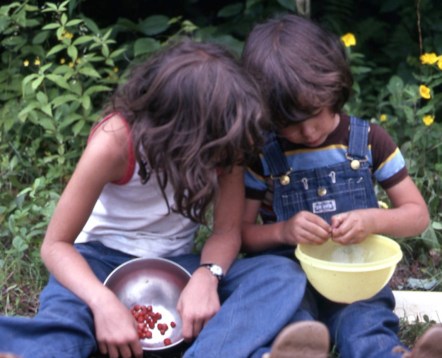
We hop out of the car and sit on the ground to take in the beauty that surrounds us. And what do we discover? Scrumptious little wild strawberries—so much sweeter than the hybrids you find in the grocery store or even in a well-tended garden. We’re in heaven!

img048

Wild strawberries!

It’s almost impossible to comprehend that we’re able to sit among these flowers and berries in a giant meadow against the backdrop of the Blue Ridge Mountains able to say, “It’s ours!” Butterflies dance through the air from one wildflower to another, fluttering around us as if we’re not here.

We set up our 8×8′ canvas tent. Punkin and Cuddlebug thrive in the adventure of it: being outdoors in pajamas, cooking over an open fire, teasing each other when the wind changes direction about whether smoke follows beauty or weirdness.

img001

Punkin (red) and Cuddlebug (blue) investigate smoke in front of our first home on the diagonal

We get the lay of the land, set up outdoor toilet facilities, check out our creek and spring, and generally adjust to living in the wild.

dscf0061

Our creek in the woods is too far away to hear its burbling but it will become a crucial part of our new lifestyle.

It rains almost every day. We’re soaked, the tent’s soaked, our sleeping bags are soaked. It takes a trip to the laundromat half an hour away to dry them—over and over again.

img024_edited-e1487468924318.jpg

Soppy kid; soppy tent (upper right), soppy soil

There’s lightning, too. When that happens, the only safe place for us is inside the steamy car.

We’ve been here barely a week, and already we have to reprioritize. We need more protection from the weather, and fast. Instead of clearing land for the house, we have to do it for our temporary living quarters, which we dub “the shed.” But boy, oh boy, does it have to be simple: just 8×12′, plywood floor, studs, and rafters—all to be covered in nothing more than plastic. Barely a shelter at all, but cheap, quick, and off the ground.

img004.jpg

Cuddlebug tries his hand at digging post holes.

img006

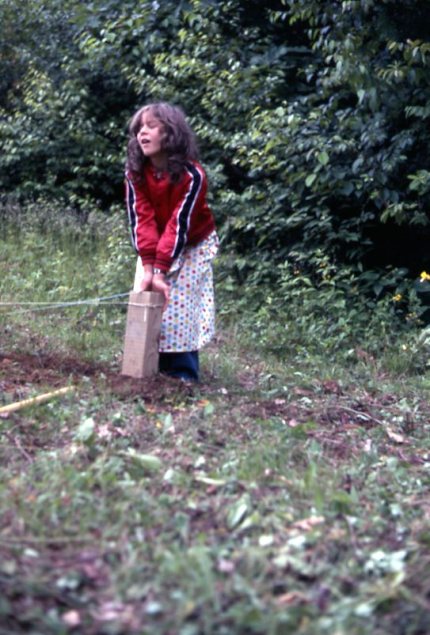
“Hold that post steady, Punkin.”

img003.jpg

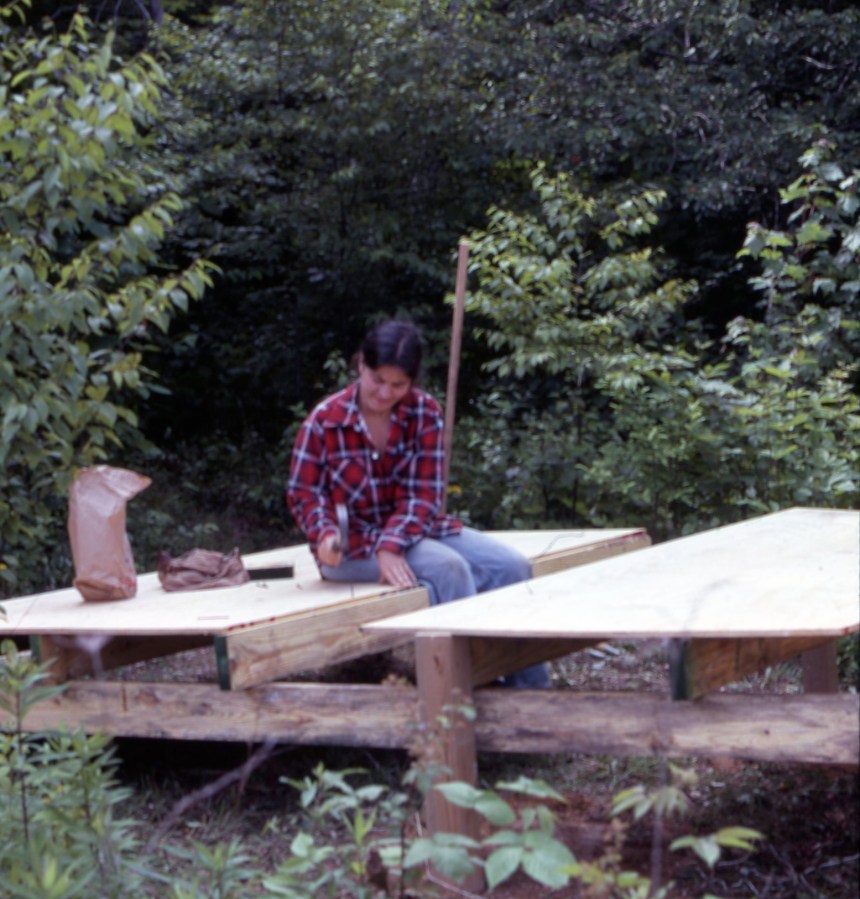
With posts and joists in place, it’s time for the floor.

All this work is with human-powered tools; we have no electricity. And we’ve just discovered that the site for our septic tank must be approved before we can get a temporary power pole installed. We schedule the inspector for next week.

img009

Ready to move in.

In Retrospect, 2017: In general, we’re not big risk-takers, but this risk turned out to be a life lesson about what’s possible—not just for us, but also to our children. They got to see creativity in action, how to make do, and how to forge ahead, unafraid, in the face of the unknown. 

(Stay tuned to see what happens next in Early Days on the Diagonal.)

These Beds Are Not for Sleeping

These Beds Are Not for Sleeping

With the unseasonably warm weather we’ve been having lately, folks are getting a head start on the gardening season. I’ve seen quite a few newly tilled garden plots in the last several weeks.

It makes me cringe. Not only is tilling bad for the soil (something for another post), but it has to be done year in and year out. Even worse, weeds will pop up as soon as you turn your back, and weeding will become your full-time job and your worst enemy.

Now that I’ve experienced raised beds, I couldn’t bear going back to in-ground gardening. I hardly ever have weeds. When I do, they slip out with ease. To be sure, building raised beds can take time and can be expensive, but neither has to be the case. (And even if you go the time-consuming and/or expensive route, it’s a one-time—or at least an occasional—thing.)

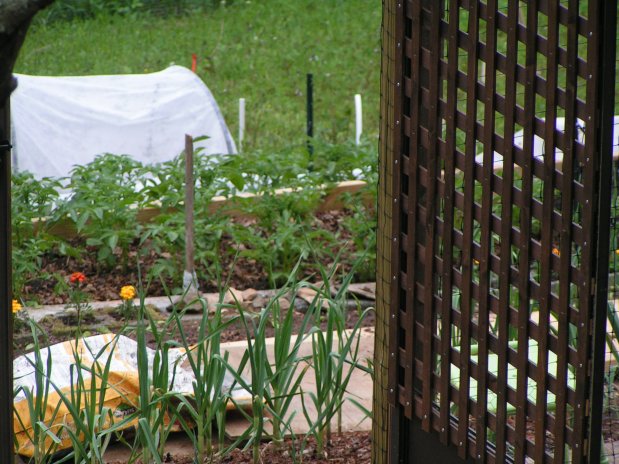
Making your own raised bed can be as easy as laying several layers of newsprint or some heavy-duty cardboard right on top of the grass; edging with field stones, twigs and branches, concrete blocks, or whatever else you have on hand; then filling the interior with gardening soil (not potting mix). With this method, the soil is your biggest only expense.

If you’re going small (always a good idea if you’re a rookie), simple pots or flower boxes are the easiest possible way to build your garden. And you need no more space than a patio or deck. You may already be doing this without even realizing it makes you a raised-bed gardener.

There are inexpensive but sturdy lightweight fabric beds like this one  (no assembly required) or this one. If you have a drill, you can even use galvanized steel tubs, anything from a washtub to a cattle trough. There are lots of possibilities out there.

If you’re in a position to spring for it, there are some terrific-looking, easy-to-assemble boxes that should last for years, like this cedar one  or this composite one. You can also find elevated raised beds  and vertical ones. With either of these, you can garden without bending a single vertebra, an especially good option for older or disabled gardeners. Raised bed kits come in many shapes and sizes. To be clear, I’ve used none of these, because . . . we build our own. (Of course!)

MINOLTA DIGITAL CAMERA

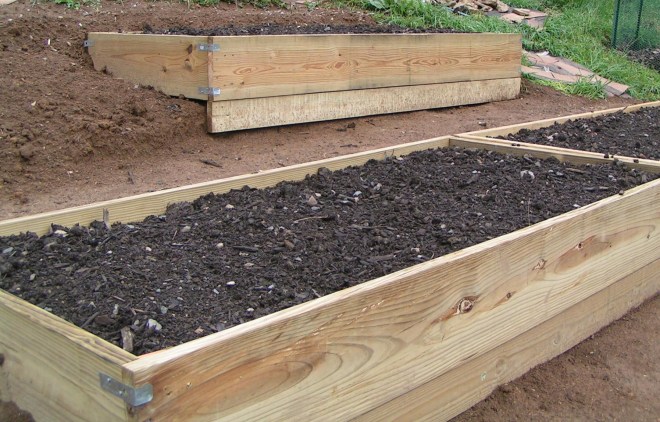
You can, too, if you have the tools and the inclination. Cedar, redwood, and hemlock all stand up well to the weather, but will cost you, and they still need to be replaced after a few years. We chose, instead, to use treated lumber. Lots of gardening gurus say this is a very bad idea. Their concern is usually about leaching from the chromium and arsenic that used to be used to treat lumber.

That hasn’t been true for almost fifteen years, though. Reliable sources say today’s chemicals and the process used to inject them into lumber make them safe around food, animals, and humans. We made an informed decision that was right for us. If you don’t want to take that chance but still like the idea of treated lumber’s longevity, you could line your beds with heavy duty black plastic.

With so many raised bed choices, it’s hard to know where to start. Try it; you’ll like it.

Happy gardening!

MINOLTA DIGITAL CAMERA

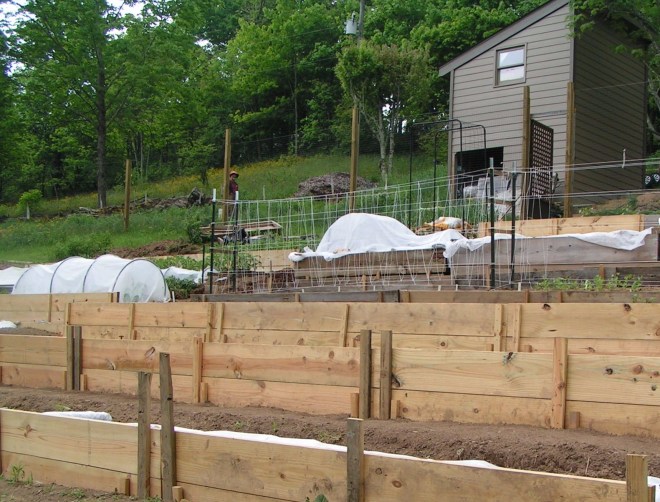
Gardening on the diagonal (terracing) even eliminates the need to completely box in our raised beds. In some cases, we built simplified “retaining walls” on the downhill side using driven stakes to support horizontal boards.


Livingonthediagonal.com is a participant in the Amazon Services LLC Associates Program, an affiliate advertising program designed to provide a means for us to earn fees by linking to Amazon.com and affiliated sites.

Early Days on the Diagonal: Part One

Early Days on the Diagonal: Part One

(The first of an eight-part series on our first steps toward modern homesteading.)

It had been building for years, this desire to make a bold move. The mountains had long ago wrangled a home in my heart, and they weren’t moving out. I yearned to make my physical home in the mountains, too. The Gnome’s long-term fascination with architecture was just itching for some creative expression.

We both imagined a bucolic life in the country, away from little houses all in a row where bedrooms were so close to the neighbors’ living rooms that they could hear every snore. We were two introverts leaning hard into recluse territory. The Gnome wanted to give our children an outdoor life, and he wanted to play in the dirt and build things. Me? I’m my mother’s daughter: I needed some elbow room, a place where no one was likely to drop in to borrow sugar or gossip over coffee. I dreamed of the freedom to roam the land, to run around outdoors naked if I wanted to (which makes me my father’s daughter, too).

So it was really no big surprise that in early 1979 we decided to make all our dreams come true at once. The only surprise was how long it took. But we’re not innately risk-takers. It was a slow, labored journey to convince ourselves we could make such a big change in our lives.

Once we got ourselves on the change bandwagon, the big question was where. Ultimately, we settled on western North Carolina, much closer to family than our current twelve and sixteen hour drives from our home in Louisville, KY, but still far enough to maintain our independence. The Gnome recalled a summer science camp he attended at a mountain college. That sounded like a good beginning point.

In April, we took a week’s vacation to look for land. Our good friends marveled at our daring—to leave secure jobs with no prospects, to take on a major designing and building effort with only books for guides, to move where we knew no one and had no support system. Yet, more than one of them admitted some envy and a secret wish to do something similar.

The local realtor who specialized in rural land took us all over the place, but nothing satisfied. Too steep, too near the highway, too close to neighbors. We were feeling pretty let down. It had never occurred to us that we might be unable to find anything suitable during our one-week window of opportunity.

We were ecstatic when Realtor John remembered one more piece of property. It met all our needs. At almost ten acres, half woods and half open meadow, we could count on privacy. The place was about a third of a mile from the graveled state-maintained road.

img001_edited_2

Portion of the meadow. In April, Spring’s still waiting in the wings.

Not a house to be seen. Exactly as we’d imagined. We had just enough time to sign on the dotted line before heading back home to prepare for the biggest move of our lives.


All manner of mosses, mushrooms, and lichens awaited us in our woods-to-be.

img005_edited_2

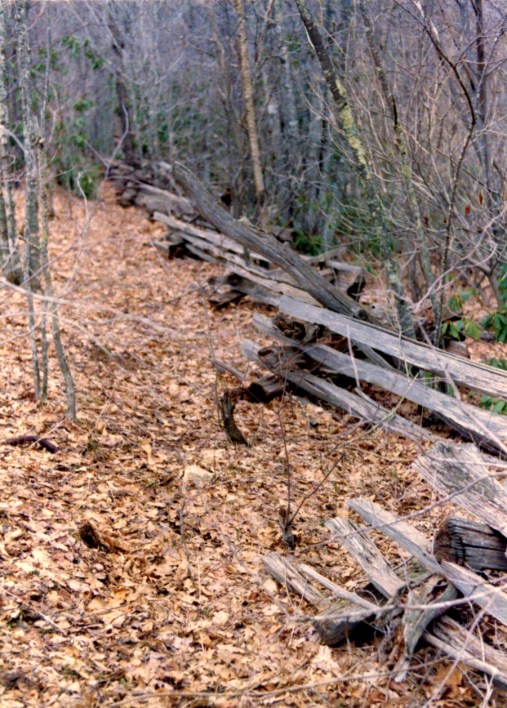
The locust rail fence along our eastern boundary captivated us.

dscf0061

We were delighted to find this creek on our property.

(Stay tuned for the next installment of Early Days on the Diagonal.)

Food in the Forest

This is the time of year when the Gnome and Crone’s fancy turns to thoughts of maple syrup. Yes, we make our own. It’s foraging at its sweetest and just one more door to modern homesteading.

It’s no way to save money, though. There’s a reason real maple syrup costs more than the gooey stuff made with corn. We figured our first cup cost us a hundred dollars in materials alone. If we factored in labor, the real cost would quadruple—or more.

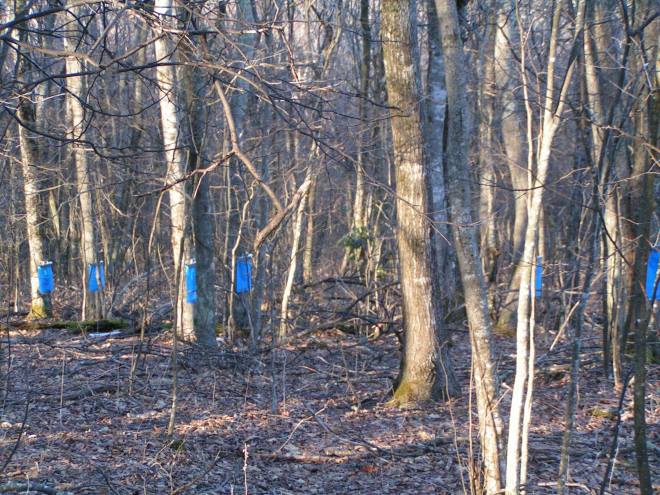
First we had to buy taps (or spiles), blue sap collection bags, and metal bag holders. There are cheaper ways, like making your own spiles with sumac stems and hanging buckets under them to catch the sap. We tried that, but the buckets filled with bugs and bits of bark, and the sap didn’t always make it into the buckets. So we opted for a closed system.

MINOLTA DIGITAL CAMERA

Our sap-collecting system at work

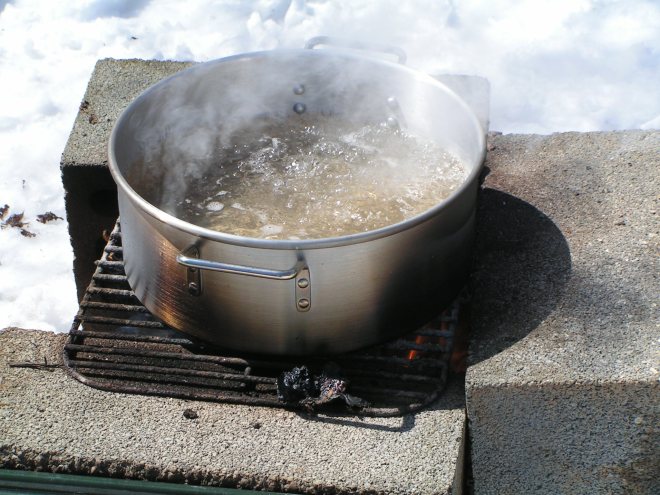
Nor did it take many days of standing in the rain, wind, cold, and snow to decide that there had to be a better, if more expensive, way to monitor the heating and evaporation process.

MINOLTA DIGITAL CAMERA

Boiling sap in the snow didn’t last long.

We bought a turkey fryer and a couple of twenty-pound propane tanks and moved the operation to our covered deck.


With glass doors leading to the deck, we’re able to check on the syrup-making progress from the warmth of indoors, and it also allows us to do a few other chores during the hours and hours of watching the pot boil. It takes a lot of boiling to turn tree water into syrup. Ten gallons of sap will make only one quart or so of syrup.

MINOLTA DIGITAL CAMERA

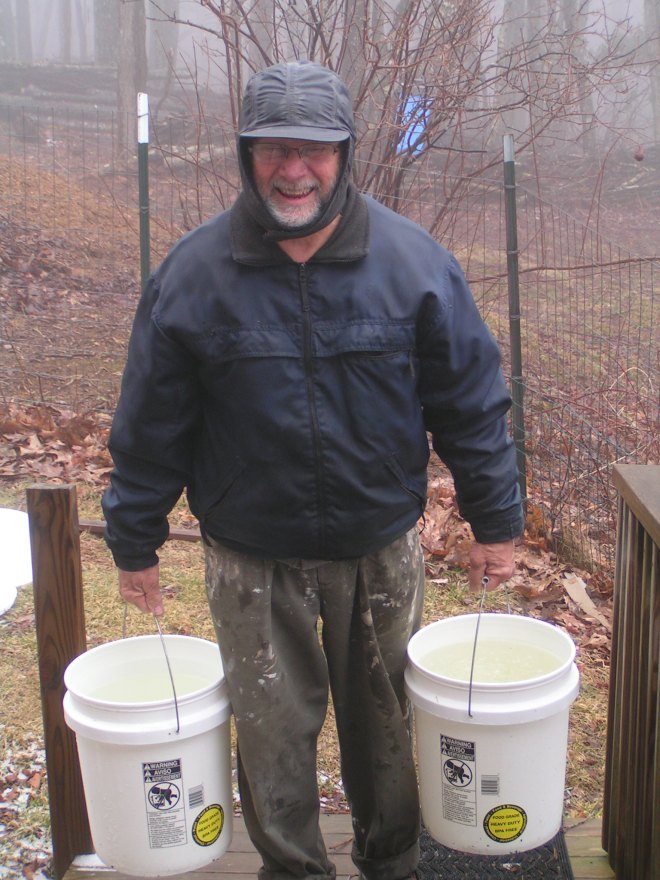
The Gnome hauls eighty-five pounds of maple sap with each trip from the woods to our deck where it goes into the pot to boil. This amount will yield about a quart of syrup.

But you can never take your eyes off the pot for very long, especially as the sap begins to thicken, or you’ll find yourself with burnt caramel seriously stuck to the bottom of your pot. (Ask me how I know.)

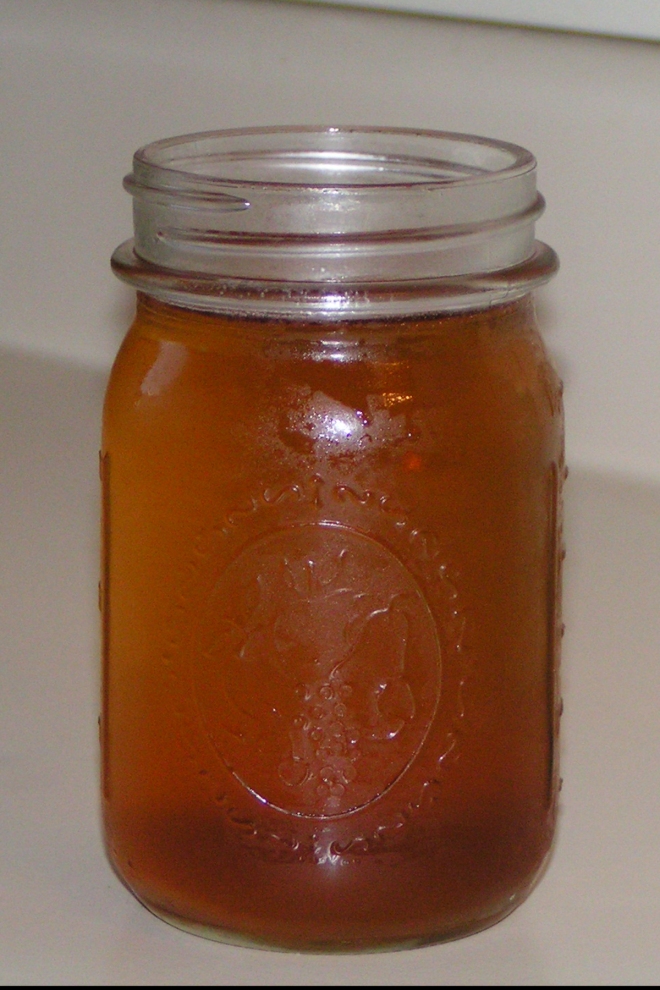
Of course, our cost has dropped with each batch since most of those supplies were a one-time expense. Our method will never win any awards for efficiency, though, partly because of the on-going propane expense. Still, we keep at it. At the end of a good season, we find ourselves with twenty or thirty pints of that sweet amber liquid, enough to enjoy a year’s worth of maple syrup over pancakes, on yogurt, with acorn squash, in smoothies, and still have plenty to share with friends and relatives.

The syrup-making season is short and unpredictable, especially where we live. Conditions for collecting sap have to be just right: night temperatures in the 20s and sunny days in the 40s, all before the trees begin to bud. The last couple of years haven’t been good ones.

So, why do we do it? While living frugally is part of our mantra, homesteading—modern or not—isn’t always about frugality. It’s more about being in touch with nature, about discovery, about doing for oneself, as well as the self-confidence, knowledge, and self-awareness that go along with all that. We like knowing that if we have to, we can. Whatever it is.

Besides, there’s nothing quite like the light, sweet taste of warm maple syrup you’ve cooked up yourself.

MINOLTA DIGITAL CAMERA

One pint of  homemade maple syrup coming up

World’s Best Granola

I love it when someone shares a favorite recipe and it turns out to be one of my faves, too. I always include the name of the giver, in this case Becky B, when I rename it. That way, I always think of these special people when I’m preparing or eating the dish they brought into my life.

This is a seriously delicious and seriously easy recipe. The hardest thing about it is melting the butter. The most time-consuming—and most crucial—task is checking it every five minutes while it’s in the oven. You don’t even have to be all that great at measuring because exact measurements just aren’t all that important.

dscf5476

Becky B’s granola with yogurt and berries

If you have a nut allergy or they’re too expensive at the moment, just substitute with more seeds. You might want to use different nuts or seeds. It really doesn’t matter. For instance, I’ve rarely added almonds just because they don’t happen to be in the house when it’s time to mix up another batch. I’ve also tossed in a couple tablespoons of chia, sesame, or flax seed at one time or another.

In truth, the recipe didn’t originate with Becky. The copied piece of paper she handed me said it came from her uncle who apparently got it from Emeril Lagasse. I have no idea how many iterations it’s been through, but here’s my take.

Becky B’s Granola

Preheat oven to 325.

Mix together the following:
3 c old-fashioned rolled oats
½ c slivered almonds
½ c shredded coconut (sweetened or unsweetened)
¼ c hulled pumpkin seed
¼ c sunflower seed
½ c chopped pecans and/or walnuts (I always add more, sometimes as much as double)
1 tsp cinnamon

In a small pan on low heat, melt
4 T butter mixed with
1/3 c honey
(You could also do this in the microwave, but be sure to cover your container to keep the liquid from spattering.)

Add: ½ – 1 tsp vanilla, depending on your preference.

Pour liquid mixture over dry and mix well.

On large baking sheet, spread granola evenly in thin layer. I find it works best to use two baking sheets (with sides). Otherwise, it’s too easy to make a mess each time you need to stir.

dscf5345

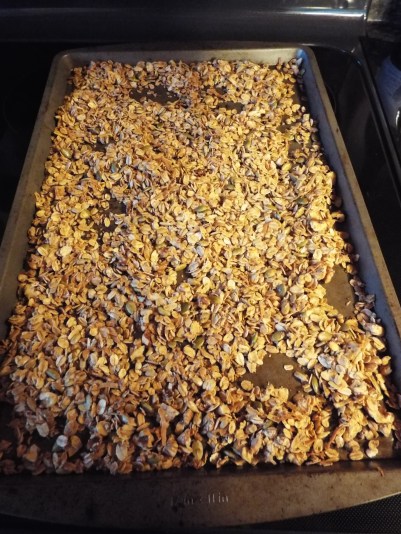
After five minutes in the oven

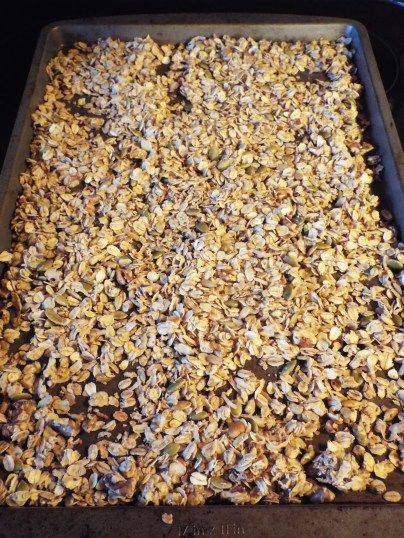
Bake, stirring every 5 minutes to keep from sticking or burning, moving the outside edges (which will cook faster) to the inside each time you stir. Bake until golden brown and crisp, about 20 minutes. Important: do not overcook. Unless you oven cooks lower than the temperature you set, it’s better to remove the pans from the oven after 20 minutes even if the mixture doesn’t look quite done. The granola will continue to crisp as it cools.

dscf5347

Crisped perfectly

Now, right here is where I part ways with the recipe that was given to me. The instructions say to add ½ cup raisins and ½ cup dried cranberries or blueberries or both at this point. But if you do that, all that wonderful crispiness disappears almost overnight. I’d much rather add my fruit when it’s time to eat. Bonus: if you do it my way, you can use your choice of dried, fresh, or even frozen fruit.

Cool granola on pan. Keep in airtight container. Recrisp if needed.

Note: I’ve never needed to recrisp once I started omitting the dried fruit. Even though this tasty mixture usually goes pretty fast in our house, on occasion we’ve still had some after several weeks—still no recrisping needed. It keeps really well. It’s a terrific topper for your favorite yogurt, too.

dscf5349

This recipe makes about four cups of granola. If you leave out the dried fruit, the granola stays fresh for weeks–but it rarely has that chance at our house.


Modern Homesteading–What’s That?

Modern Homesteading–What’s That?

We learned about them in school–those sturdy pioneers of the 1800s who headed west in their covered farm wagons to build little cabins and eke out a  living on land provided to them at no cost by the government. They were traditional homesteaders. Oh, those were the days! The Gnome and I made our own trek out west last fall (not in a covered wagon, mind you) and happened upon the Oregon Trail Ruts near Guernsey, Wyoming. Oh, my!

dscf4266

See that?  See what 500,000 (that’s right–500,000!) people traveling across solid rock with their horses and wagon wheels did to that rock? In places, these ruts cut five feet deep! Can you imagine?

Now, those people had it rough, no doubt about it. They left all they knew behind, faced both known and unknown hazards, all to make a hard life in uncharted territory.

The back-to-the-land homesteaders of the 1960s and 70s faced a different scenario, not nearly so hard, but still pretty rough. To generalize a bit, the movement toward subsistence living was a rejection of modern life as folks strove to get back to basics. They were idealists, but typically without any understanding of what they were getting into or the experience they needed to succeed. Going back to the land often meant no running water, no electricity, insufficient heat in winter, and certainly no air conditioning in summer. Yes, it was plenty hard.

Modern homesteading is something else again. There’s a healthy segment of people who still opt to plow their fields with real horsepower instead of machines. There are those who eschew electricity (unless it’s off the grid). But these days there are many avenues to a new kind of homesteading.

People who call themselves modern homesteaders are usually people who want to live closer to the earth; to do more of the work of daily living with their own hands–like growing and preserving their own food, sewing or knitting their own clothes, cooking their own meals. They want to learn the practical skills to live more simply. They want to be resilient: not necessarily completely self-sufficient, but to develop the philosophy and skills to become more self-reliant.

In short, modern homesteading is a way of finding your own path to a simpler, more self-reliant life. Not everyone agrees with this definition, but it seems to be the majority position. Modern homesteading allows a person to weave old-fashioned skills into modern life. To find what, for you, is the best of both worlds. City slickers, even apartment dwellers, can be homesteaders by this definition. Personal values, circumstances, and demands make the path–and the destination–different for just about everybody. But anybody who wants to can give it a try.

Some people like to call the Gnome and me farmers. I have far too much respect for real farmers to let that go by unchallenged. Farmers are up well before dawn day in and day out. They work outside all day, summer and winter. We’re gardeners. That’s all. Modern homesteaders, though–I’ll take that. Our path? We built our own house with our own hands. We have electricity, but half of it these days comes from a community solar garden. For all sorts of reasons that make sense to us, we don’t heat with wood. But we do have lots of south-facing windows for passive solar heat, and our walls are almost twelve-inches thick, so even in our sometimes frigid climate, our house stays pretty cozy with very little heating expense, relatively speaking.

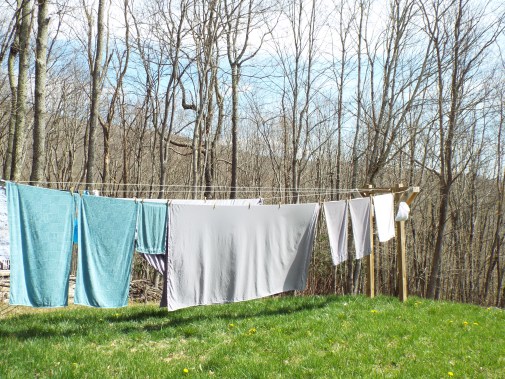
Our piped-in water comes from a spring back in our woods. We tap our own maple trees and boil the liquid down to syrup. We recycle. We’re inveterate do-it-yourselfers. To the extent our skills and tools allow, we do our own maintenance and make our own repairs. We grow and preserve enough vegetables to pretty much get us through the year. We wash our clothes in a modern electric washing machine, but to dry them we usually use our solar clothes dryer.

dscf0392

Our solar clothes dryer

So, we’ve cobbled together a life that works for us. One that teaches us resilience. One that keeps us closer to the land even as we type on our computers, drive our car, and use electric tools and appliances. One that gives us vast satisfaction, as well as the confidence that, should circumstances dictate, we might actually be able to be self-sufficient–at least for awhile. Our own middle ground. And, for us, that’s modern homesteading.