A Couple of Nova Scotia’s Historical Sites

(I’m reposting a travel series from a couple of years ago. If you’re like me, you are patiently (or maybe not so patiently) waiting for a safe return to the road. If so, how about traveling along with me on a virtual road trip. To read about our Nova Scotia travels from the beginning, start here.)

In previous posts about our visit to Nova Scotia, I’ve mentioned a couple of sites that deeply moved me, promising to delve into them later. Today, I’m keeping that promise with memories and photos of our visits to Grand Pre, a UNESCO World Heritage Site, and the Canadian Museum of Immigration.

A little history is called for here. The Canadian encyclopedia entry about the Acadians of Grand Pré begins this way: “Soldiers rounding up terrified civilians, expelling them from their land, burning their homes and crops ‒ it sounds like a 20th century nightmare in one of the world’s trouble spots, but it describes a scene from Canada’s early history, the Deportation of the Acadians.” The story of the expulsion of Acadians from Grand Pré is painfully evocative of our own Trail of Tears history, when the Cherokee were led on a forced march from the east to Oklahoma.

In French, the forced deportation was known as le grand dérangement. Sounds fitting. Since 1604, Acadians had created a thriving, peaceful community in the Bay of Fundy area. During their 150 years here, they developed an impressive dyke system to control the bay’s high tides, a method still in use today; they developed and maintained a rich agriculture; they created a massive and gorgeous landscape

The arduous task of building earthen dykes to hold back the Bay of Fundy’s high tides

A  typical Acadian farmstead
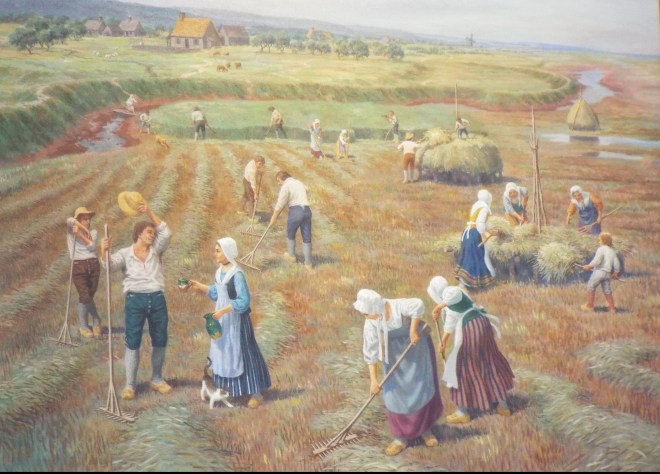
An image of  an Acadian day in the fields

A portion of the 3200-acre landscape of Grand Pre’

Meanwhile, the British and French were engaged in a long tug of war over Nova Scotia. The Acadians had sworn neutrality in any conflict between the two countries, but that wasn’t enough for the British governor. In 1755, he hatched a plan to surround their churches, threatening entire families with bayonets, while breaching the dykes and burning homes and crops. The first 3,000 deportees were sent to Pennsylvania, South Carolina, and Georgia while 7,000 more were shipped to other British colonies, France, and the Caribbean during the next seven years.

Try putting your family in this scene:  panicked flight, trying to stay together, leaving everything–everything–behind forever.

People found themselves left, like Longfellow’s Evangeline, to wander fruitlessly in search of the families they’d been separated from. That, too, sounds all too familiar in today’s troubled times. (Only later did Acadians find their way to Louisiana because of their familiarity with the language. Thus did the Cajun culture become established.)

Detail of the statue of Henry Wadsworth Longfellow’s heroine, Evangeline. It graces the entrance to the memorial church built in the early 20th century which serves as a museum today. It was a church at this approximate location where British soldiers set up headquarters, rounded up the village’s men and boys, and told them their land, livestock, and almost everything they owned were to be forfeited to the Crown, and that their families were to be deported.

By 1764, the British government allowed small groups of Acadians to return, but they didn’t return to their former lands—nothing was left for them there. Instead, those who returned settled on the mainland and in Cape Breton. It was, indeed, as the Acadian Shores restaurant patron we overheard had said, a shameful moment in Nova Scotia’s history.

But Nova Scotia can at least be proud of how it owns up to inglorious historical moments. I was impressed by this trait both here and at the Canadian Museum of Immigration, located in Halifax.

Even before you pay your admission fee to the immigration museum, the Wheel of Conscience almost smacks you in the face with its raw power. A circular steel structure about six feet in diameter, the wheel includes names of the approximately one thousand Jews who were aboard the MS St. Louis in May 1939, the eve of World War II. They were fleeing Nazi Germany, seeking and being refused entry into Canada and other countries, including the United States. With nowhere to go, the ship was forced to return to Germany where a quarter of its passengers ultimately died in concentration camps. 

 The kinetic sculpture also features four rotating, interlocking gears, each one larger than the one before and each emblazoned in red with a single word—from smallest to largest: hatred, racism, xenophobia, anti-Semitism. As visitors study the sculpture, they can’t help but see their own reflected faces looking back at them.

Inside, the exhibits are equally powerful. The museum is located in the very place, Halifax’s Pier 21, where more than a million immigrants came into Canada between 1928 and 1971. It’s logical that the museum would tell what that experience was like.

But the museum is more than that. It also tells the story of 400 years of immigration to Canada, and it takes an even broader approach, looking at refugee life as a whole, documenting through both visual and oral exhibits the horrors that force people to leave their home countries.

What horrific conditions would cause you to make this kind of journey? For how long? To what unknown future?

Imagine living in a tent this size with your entire family and all your very limited possessions, buckets for washing yourselves, your food, your dishes, and more. Imagine living here for up to eighteen years–or more? What would have brought you here?

Some of these painful exhibits come with a warning: “Not suitable for some visitors.” I tend to shy away from such stories, but I think we should force ourselves to face them so we can remember—cannot forget—the realities that send people fleeing all they know in hopes of finding a better life, a safer place, for their families. I did not photograph them.

Among other displays we visited were life-size replicas of a ship’s cabin, a life raft meant for eight that carried as many as thirty refugees, a child’s trunk, a family’s crate carrying everything they could cram in.

You can read notes handwritten on cardboard luggage tags from previous museum visitors who had immigrated, and you can watch videos of immigrants telling their personal stories. As moving as these exhibits are, what touched me most was finding myself in the company of a number of immigration ‘veterans,’ individuals who had landed at the immigration center in Halifax—at this very site when they were mere children. Other visitors were children of immigrants who had come through the port of Halifax. It was truly humbling to hear their stories, to be in their presence.

We didn’t want our visit to Nova Scotia to be touristy; we didn’t intend to spend much time inside museums. Our trip was meant to be about getting a feel for day-to-day life in the province and getting to know real-life Bluenosers while soaking in the phenomenal natural beauty of this place. But I’m really glad we took time out to visit these two sites. They, too, tell a story about the real Nova Scotia. And the rest of the world, in the past and, unfortunately, the present. They remind us about ‘man’s inhumanity to man’ as well as hope and the possibility of redemption.

This moving piece of public art, “The Emigrant,” near the Immigration Museum, pays tribute to those who have said goodbye to their families, hopefully temporarily, in search of a better life for all of them.

(Check back next time for more of our Nova Scotia travels.)

Annapolis Valley

((I’m reposting a travel series from a couple of years ago. If you’re like me, you are patiently (or maybe not so patiently) waiting for a safe return to the road. If so, how about traveling along with me on a virtual road trip. To read about our Nova Scotia travels from the beginning, start here.)

We weren’t even going to go. We’d been to this region long ago, and compared to the spell Peggy’s Cove and Cape Breton had cast, it was a mere wisp of a memory. But then Haligonian gardening guru Niki Jabbour said, “You simply must see our gorgeous Annapolis Valley” (or words to that effect). She’s a convincing ambassador for her maritime corner of the world, so we spent a few hours rearranging our itinerary. Another decision I’m glad we made. Thanks, Niki.

The Gnome and I scheduled a couple of days in the Annapolis Royal/Granville Ferry area and another in Canning and Wolfville. We spent a wet but happy half-day in the Annapolis Royal Historic Gardens—a little rain wasn’t going to dampen our spirits, where we enjoyed waterfalls and ponds and statuary, trees and grasses and shrubs and flowers. So many flowers!. I was amazed at how many plants were still in bloom at the tail end of September!  (Click on individual pics below for larger images and, in some cases, captions.)

We drove out to Digby Gut (yes, Gut with a G), a narrow channel that connects the Bay of Fundy (highest tides in the world, y’all) and the Annapolis Basin, where we saw this lighthouse and an enlightening marker.

Nova Scotia has 150 working lighthouses—one hundred and fifty! Imagine if you tried to take them all in on a lighthouse tour. At fifteen a day, which I imagine is an impossibility, it would take ten days to see them all. This one at Schafner Point near Victoria Beach is not one of them. Though no longer in use, it’s still historic and ever so picturesque.

If you think of Old West cowboys and outlaws when you hear the words Pony Express, you don’t know the whole story. We sure didn’t. Turns out that the way we folks south of the border got news from Europe was through a complex process including dispatches from European ships coming to Halifax, then via Halifax Express riders to Digby Gut (146 miles in eight hours), at which point the news was shipped to the telegraph station in Saint John, New Brunswick, and finally relayed to American seaboard cities, all funded by the Associated Press. How about that!

Wine is pretty much wasted on my unsophisticated palate, so we skipped the tours this fertile region is famed for. But we did make it to the Annapolis Cidery in Wolfville, much more our style. We left with several intriguingly named bottles to enjoy on our travels and back at home. (Factoid: Nova Scotia was one of the first areas in North America to cultivate grapes.)

Wonder how long it takes to cover all those grape vines?

From Wolfville, we took the Evangeline Trail to the Grand Pré National Historic site, another UNESCO World Heritage Site located in the province. You may remember Henry Wadsworth Longfellow’s epic poem Evangeline, or at least its first stanzas, from high school English class. If you can’t conjure it up right away, perhaps you recall the first words: “This is the forest primeval.”

Longfellow tells the tragic story of the Acadians via his imagined heroine. We knew a bit about the Acadians, but we learned more during our time along the Acadian Shores and Annapolis Valley, and I’ll be devoting more time to this story in a later blog post.

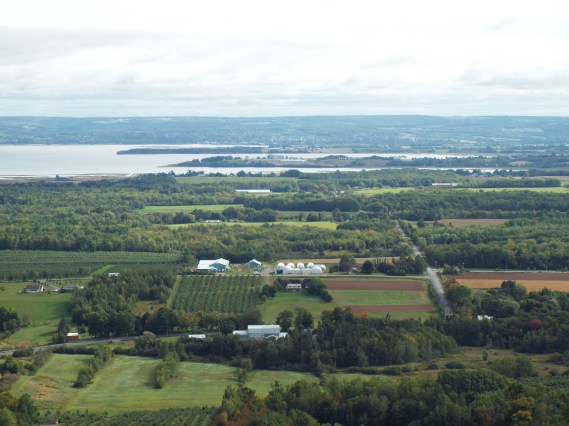
At the Blomidon Look Off, we were gawking and snapping the phenomenal views of the valley’s Minas Basin and lush farms when a New Brunswick couple also enjoying the view started up a conversation. We hit it off right away and chatted for at least a half hour, discussing everything from apples to politics. (I told you those Canadians are friendly.) They make the trek from Fredericton every fall to fill their trunk with “the world’s best apples.” And to think we wouldn’t even have known about this phenomenal viewing spot if it hadn’t been for the friendly folks we met on the beach near Mahone Bay a few days before.

What a sight!

It was another misty day, but with such gorgeous views, who cares! Besides, we could hardly begrudge the Nova Scotians a little rain. Due to an extended drought, wells have dried up all over the province. It’s been so dry that the provincial government has dispatched tanker trucks filled with bottled water to some parts. In fact, before we left home, one of our Airbnb hosts called to suggest we make other arrangements for that very reason.

By the way, every one of our eleven Airbnb experiences was delightful and unique, but our Granville Ferry spot may have been the most unusual. Billed as a former bed and breakfast honeymoon suite, it sported a Jacuzzi which filled via this waterfall feature. And in Canning, the resident cat warmed our laps and hearts.

Our Airbnb was right on river’s edge in Granville Ferry. This slightly foggy view is from Annapolis Royal across the Annapolis River.

Until next time, as we make our way toward the extravagantly gorgeous Cape Breton Island. You don’t want to miss it!

Yarmouth and the Acadian Shores

((I’m reposting a travel series from a couple of years ago. If you’re like me, you are patiently (or maybe not so patiently) waiting for a safe return to the road. If so, how about traveling along with me on a virtual road trip. To read about our Nova Scotia travels from the beginning, start here.)

We didn’t know it when we settled in at our Lower Argyle Airbnb, but we’d left Nova Scotia’s South Shore for the Yarmouth and Acadian Shores region of the province. Our first clue came at dinner that night. Another table of patrons included a local couple and their guests, possibly from someplace as far-flung as ours.

In response to a question from one of her visitors, their host said, “It was a shameful moment in our history,” and went on to discuss her admiration for Acadians, noting they are a hard-working group of people who strive to maintain their historical identity. We weren’t exactly eavesdropping, but this foursome’s reunion was ebullient; it was hard not to overhear.

The visitor’s question may have been prompted by the flags flying from so many homes in the area, the same ones that would pepper the landscape on our next day’s travels. It definitely wasn’t the Canadian maple leaf nor the Nova Scotia coat-of-arms flag. This one had vertical bars of blue, white, and red. You might think it was the French flag except for the gold star in its blue third. The Gnome knows flags, but he wasn’t familiar with this one.  

We came upon this interpretive sign and the picturesque Sainte Anne-du-Ruisseau Church near Rocco Point in Argyle. According to the sign, “The main feature of this church is invisible. After the exile and return of the Acadian people, the church provided hope and spiritual renewal. It became the heartbeat of the community—and remains so today.” (I’ll be writing more about the Acadians and their tragic expulsion in the mid-1700s in a later post.)

We soon found ourselves in Yarmouth, another colorful town and the port where the big CAT ferry brings people and their cars into Canada from Maine. We spent a couple of hours on a self-guided walking tour—blocks of shipowners’ and sea captains’ homes built in the second half of the eighteen-hundreds.

Downtown Yarmouth

It’s the detail I can’t get over.

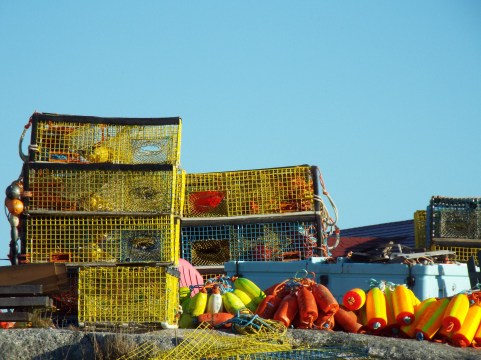
The Yarmouth area, home of the world’s richest lobster-fishing grounds, is unsurprisingly also home to Atlantic Canada’s largest fishing fleet. It has suffered its own losses at sea.

The first launching in Yarmouth County took place at this site, now a memorial to the county’s seafaring folks “who  ‘going down to the sea in ships,’ by their outstanding seamanship and valour, brought undying honour to Yarmouth in every port around the world” according to the memorial’s plaque.

Staff at the Yarmouth visitor center encouraged us to drive out to Cape Forchu, west of Yarmouth. It had been on our list once, but in the interest of time, we’d crossed it off. Back on it went. Cape Forchu, home of the first ‘apple core’ style lighthouse, is surrounded by nineteen acres of beautiful walkable space and has been named one of Canada’s greatest public spaces. I can understand why.

At Cape Forchu, we learned about rockweed, that stringy, brownish-green stuff you see in this picture.  Each fall, fishermen fill their deep-bottomed boats with it using handheld cutter rakes. Rockweed is important to the local economy, exported worldwide where it’s used as a stabilizer and thickener in products as varied as salad dressing, lipstick, and ice cream. Think about that the next time you put a spoonful of your favorite frozen dessert in your mouth.

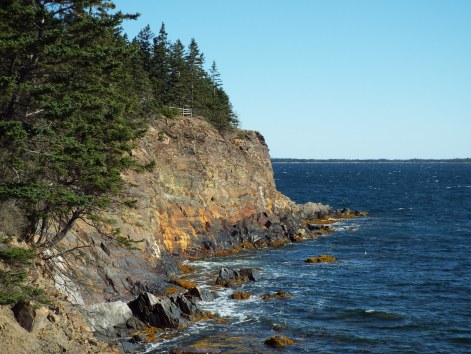
We also learned about dumping day—probably not what you think. Dumping day occurs at different times in different parts of the province. For southwestern Nova Scotia, it comes on the last Monday in November, the day Southwestern Shore fishermen go out in boats to ‘dump’ their lobster traps. In the wee hours, entire communities line the shore to see them off, a blessing of the fleet is recited, and the brightly lit boats head out to sea in a parade of colorful vessels. Now, that’s something I’d like to see.

After spending a couple of hours at Cape Forchu, we really did have to mark some things off our list to make it to the Annapolis Valley area before nightfall. More about that next time. Hope you’ll keep traveling with me.

Surprises on the South Shore

((I’m reposting a travel series from a couple of years ago. If you’re like me, you are patiently (or maybe not so patiently) waiting for a safe return to the road. If so, how about traveling along with me on a virtual road trip. To read about our Nova Scotia travels from the beginning, start here.)

Our original travel plans included another very short trip, this one theoretically a ninety-minute drive from Lunenburg to Shelburne. We knew it would take longer since we wanted to peruse every nook and cranny—and there are a lot of them among the coves and harbors of Nova Scotia’s South Shore.

Shelburne interested me because it’s home to the Black Loyalist Heritage Centre. I learned about Black Loyalists from watching the series TURN, available on Netflix. (If you haven’t seen it, you may want to. Not only is it riveting, but educational—and surprisingly true to historian Alexander Rose’s book, Washington’s Spies: The Story of America’s First Spy Ring.)

As the British were facing the loss of the Revolutionary War, its military leaders offered freedom and land to anyone who escaped slavery and came over to the British side. It was a big risk, but some 30,000 successfully made it to the British lines. As the war ended, about 2,000 Black Loyalists were evacuated to Nova Scotia, most of them landing in Shelburne, which became the largest settlement of free blacks outside the continent of Africa. Shelburne was home to other British Loyalists, moneyed ones, and many of those homes are still intact today.

However, a few weeks before our trip began, we got a phone call from the Nova Scotia area code. Our Shelburne Airbnb host told me the well had run dry so we’d have to find another place to stay. We decided our best bet was the ‘Lobster Bay Loft’ in Lower Argyle. (Don’t you just love that name?) It was on our route and only added another half-hour to our driving day. We figured we had plenty of time to take in Shelburne and all its sights and still arrive at our final destination by 3:00 pm, the earliest time we could check in. I was thoroughly exhausted and looked forward to a few relaxing afternoon hours in our Airbnb.

But . . . within minutes of leaving Lunenburg, we came upon a sign for The Ovens Natural Park, another place on our must-see list with its cliffside walking trail and sea caves, aka ovens.

We turned off our scenic highway route toward the park. The young woman who took our admission fee explained about the sea cave trail and said most people make the round trip hike in about forty-five minutes. She must not have had many photographers pass through. It was a good two hours later when we returned to the parking lot, chilly and windblown (it was so windy)—but exhilarated.

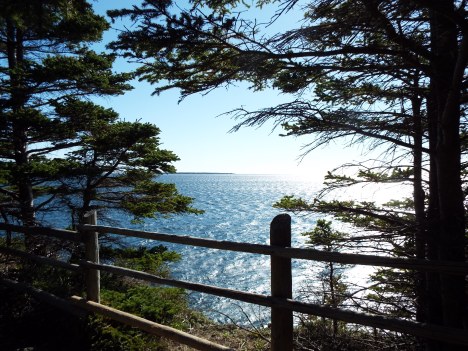
Can you see the wooden rail way up there where there’s a gap between the trees? That’s how close we were to the rocky cliff on most of our walk through the park.

Trailside view

I got a new spiky hairstyle thanks to the wind.

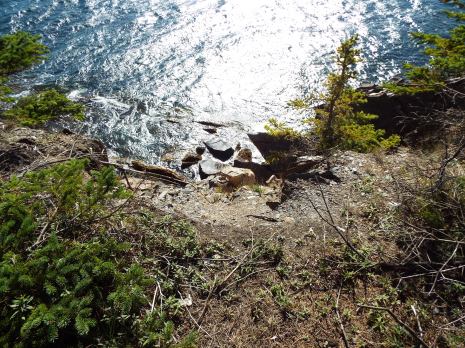
So far down

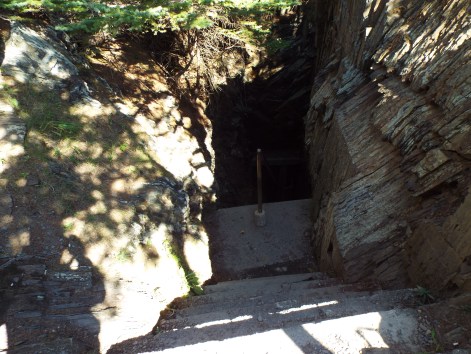
Beyond the platform (in that dark hole) is yet another set of steep, narrow steps into Tucker’s Tunnel, a natural cave that was extended during the gold rush era. The Gnome went down there; I didn’t.

View  from inside Tucker’s Tunnel

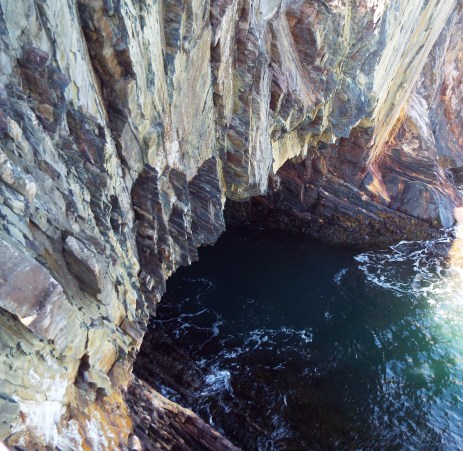
Looking into an oven, or sea cave, from above

I did venture down many, many steps into Cannon Cave. When waves enter this cavern, you can both hear and feel the resounding boom. Eerie!

After we returned to the parking lot, the Gnome was intrigued by the folks on the beach below searching for remnants of gold that may have been left from the 1861 gold rush. He climbed the ladder down to the rocky shoreline. I stayed up top and had a delightful chat with a couple of Scottish fellows.

I’m so glad we put The Ovens on our itinerary. In spite of the high winds, the sometimes frighteningly-close-to-the-cliff trail, and the zillions of steps to get to and from the astounding views, our time there was worth every moment. And when we saw some of the waters-edge campsites, we immediately began planning a return here with a tent— just so we can watch the sunrise over the ocean just outside our tent flap.

Now, the only thing that lay between us and Shelburne was the Kejimkujik National Park Seaside near Port Joli.

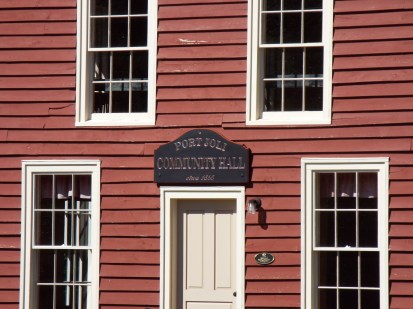
Every community in Nova Scotia, no matter how small, seems to have a community hall. Wish we’d timed it to make one of the cakewalk or bingo or fiddle-playing events. Oh, well–something for next time.

We didn’t realize quite how far off the main road we had to travel to get to Keji, how slow the going would be, nor that we’d still have a 3.2-kilometer hike (one-way) to the coast when we reached the park’s parking area.

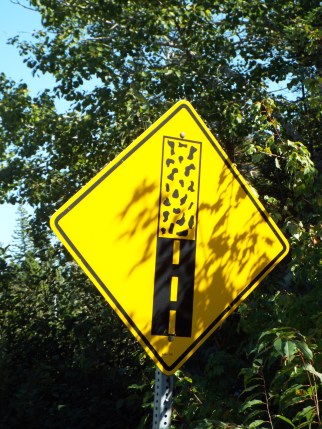
Sometimes it was a challenge interpreting Canada’s highway signs. We found out soon enough that this one meant we were leaving the paved road for a far bumpier and much slower gravel road.

We really wanted to make that hike—after all, we might get to see seals at the end of it. But we would barely have time for a quick drive-through at Shelburne in order to get to meet our Airbnb host at five o’clock—two hours later than we’d originally told her.  Thank goodness for cell phones.

These Sherburne buildings date from 1785 or so. I love the doorways.

Sherburne, as well as virtually every other fishing village, has a monument to its fishermen and other seafarers who have been lost at sea, sometimes in only the last couple of years. It gives one pause.

Not only did we have to nix the Black Loyalist Centre, we regretfully left the scenic route in favor of the faster highway for the remainder of the day’s trip.

We had the whole place to ourselves in the loft of this former museum dedicated to all things nautical. Oh, how I looked forward to falling into this inviting bed after our busy day . . .

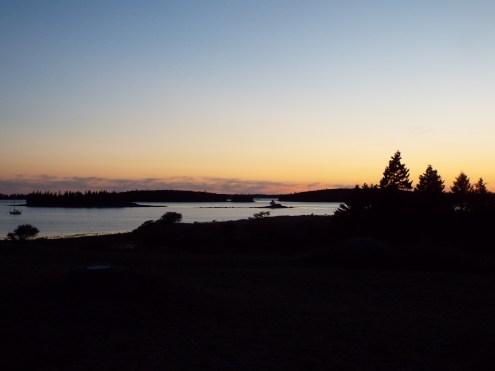
    but not before sitting on the deck with a glass of ginger wine and wrapped in quilts (there was a real brr factor that evening) to watch the sun set across the bay.

Next up: Yarmouth, the Annapolis Valley, and more. Come back next week, won’t you?

Along Nova Scotia’s South Shore

(I’m reposting a travel series from a couple of years ago. If you’re like me, you are patiently (or maybe not so patiently) waiting for a safe return to the road. If so, how about traveling along with me on a virtual road trip. To read about our Nova Scotia travels from the beginning, start here.)

It’s not every day the Gnome and I plan an overnight stop just an hour from the previous night’s lodging, but that’s just what we did on much of our Nova Scotia journey. It’s a good thing we did, because a one-hour drive anywhere else easily turns into an eight-hour adventure of the senses in this maritime province, especially when you decide to take the slowest, most scenic route, traveling out to this cove and that one, and stopping at every photographic opportunity you see. That’s approximately one per minute along the South Shore of Nova Scotia!

We had already made a sunrise visit to tiny, picturesque Peggy’s Cove on one of our Halifax days. Peggy’s Cove was one of our most delicious memories from our first visit forty-nine years ago, even though we were shrouded in fog. We could barely wait to see it again. It did not disappoint.

Our destination today was Lunenburg, stopping at the villages of Chester and Mahone Bay along the way. Chester’s waterfront is nothing less than stunning.  (Click on images for a larger view.)
The village sports a small park with a couple of stirring war memorials. One features a Nova Scotia Highlander atop a monument honoring the 54 area soldiers killed during World War I. The other is a thank you from Norway. During World War II, more than 1,000 Norwegian merchant ships were at sea when Nazi Germany invaded the country. The ships sailed to the nearest allied ports. Thus, Chester’s Hackmatrack Inn became a convalescent center for the sick and injured Norwegian seamen who headed for safe harbor in Nova Scotia.

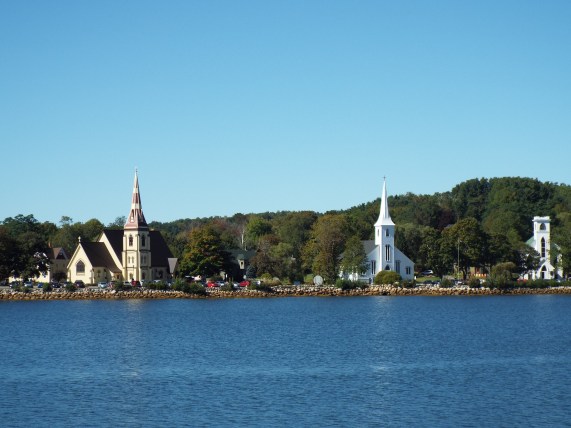
We wanted to stop in Mahone Bay to see its photogenic ‘Three Churches.’ Though we never found the best spot to photograph them, we still enjoyed their beauty—along with three or four tour busloads of other folks. DSCF3596

Quite by accident, we happened upon other visual entertainment, as well. The village was preparing for its annual Scarecrow Festival, which was set to begin in five days. Everybody gets in on the act from families to churches to dentists. (Look closely—can you see the braces on the dentist’s patient, bottom right. These characters were, of course, in front of a dentist’s office.)

We discovered a small nearby beach for a picnic lunch where a couple of folks from the area recreation department had set up shop encouraging residents to visit this little-known treasure. (Nova Scotia has few sand beaches, but this is one of them—sort of.) 

They invited us to fill a jar with sand and shells as a memento of our trip. And here is where we found, as we did over and over, the very best thing about the province—its people. They asked where we were from, commiserated over Hurricane Florence (which was on every Nova Scotian’s mind), found out where we were headed, and filled our heads full of not-to-be-missed places to visit on our journey. It was great fun meeting them.

Next on our agenda was Blue Rocks, Lunenburg’s ‘answer to Peggy’s Cove,’ even tinier and just as much off the beaten path. 

Downtown Blue Rocks

And, finally, just around suppertime, we made it to Lunenburg, whose Old Town is a UNESCO World Heritage Site as the best surviving example of a planned British colonial settlement in North America. In spite of its tourist appeal, this fishing village has managed to retain its authenticity since its founding more than 250 years ago. Quite a feat.

Lunenburg streetscape

Old Town Lunenburg’s buildings are not reproductions. These are the real deal.

Detail, detail, detail!

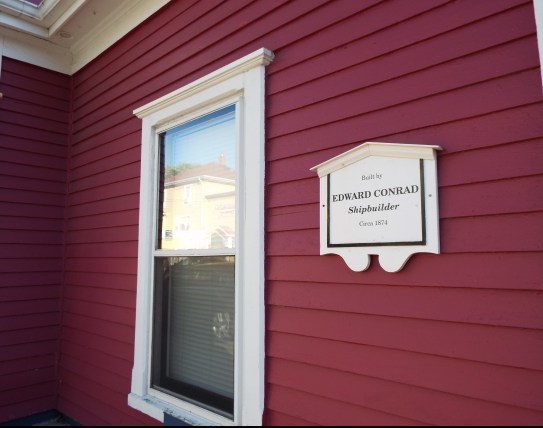
A 1870s shipbuilder’s home

Nova Scotians sometimes refer to themselves as Bluenosers and here’s their proud reason why, I’m told: the Bluenose schooner, launched in 1921, raced undefeated in international competitions for 17 years. The Bluenose II, a faithful replica, was born and lives in Lunenburg just like her predecessor.

Complete with passengers

Just as we expected, our ‘one-hour’ trip turned into a long and busy day, and we were definitely ready for an early bedtime before the next day’s activities. Stop by next week to see what we discovered next.

Touring Halifax

(I’m reposting a travel series from a couple of years ago. If you’re like me, you are patiently (or maybe not so patiently) waiting for a safe return to the road. If so, how about traveling along with me on a virtual road trip. To read about our Nova Scotia travels from the beginning, start here.)

Nova Scotia redux began for us in Halifax, a fitting first stop. The province’s capital and by far its largest city, Halifax is vibrant and cosmopolitan, but with a cozy feel. It never felt overcrowded—at least as the first stop on our provincial travels. After a couple of weeks touring the coastline and running into people in only twos and threes, even a city as welcoming as Halifax might have seemed jarring.

We were surprised at how easy it is to navigate Halifax. Though we were staying in an Airbnb condo in a residential area, a short one-block walk took us to a large grocery store (liquor store, too); we found numerous local restaurants in easy walking distance; and we were never more than a five-minute drive from anywhere we wanted to visit.

Our days in Halifax were by far the most ‘touristy’ part of our Nova Scotia visit. Our first stop was the Halifax Citadel National Historic Site, a star-shaped fortress first constructed in 1749 to protect the harbor. The Citadel was never engaged in battle. It didn’t need to be; its mere presence was deterrent enough to would-be invaders. We watched the hourly sentry change, as well as cannon and rifle-firing demonstrations, all performed in full military regalia of the era. With the national parks passes we purchased prior to our travels, this was a freebie.

As avid gardeners, we could hardly pass up the sixteen-acre, Victorian-era Public Gardens, occupying a large city block in the heart of downtown. We took our time exploring its fountains, bridges, statues, pond, and its massive floral displays including exhibits like these

and carpet beds like these.

They even have tropical plants on display. How do they do that?

Not every public library is a tourist destination, but Halifax’s new Central Library certainly is, with its five-story, 112,000 square foot award-winning architecture. It even boasts a green roof, a cafe where patrons can buy coffee or a meal, and a rooftop garden for enjoying their purchases. The library is even LEED-certified, a high-performance green building designation.

Among its many sustainable features are a green roof sustained by rainwater, electric vehicle charging stations, rainwater harvesting for flush features, solar heating, and use of recycled, local, and low-emission building materials. All that and stunning, too. So stunning that in 2014, CNN named it one of ten ‘eye-popping’ new buildings of the year. I wonder why.

Photo attribution: Citobun [CC BY-SA 4.0 (https://creativecommons.org/licenses/by-sa/4.0)%5D, from Wikimedia Commons

While we knew we didn’t want to spend our precious time in Nova Scotia inside museum walls, the Canadian Museum of Immigration at Pier 21, Canada’s last ocean immigration shed, was a notable exception. I was humbled to find myself in the presence of other visitors who were ‘veterans’ of Pier 21, people who themselves had come to Canada by boat via Pier 21. (I’ll be writing more about this phenomenal experience in a future blog post, so stay tuned.)

(Speaks for itself)

She doesn’t know it, but a primary reason Halifax was one of our destination points was folk artist Shelagh Duffett, whose brightly colored, playful prints (mostly of cats) adorn our walls. The weekend we were there, she was selling at the Maritime Makers’ Market. We were excited to meet her in person and to purchase even more of her smile-producing fanciful artwork.

Typical of Nova Scotians, Shelagh was genial and generous, giving us tips on vegetarian restaurants and an important site to visit, one we weren’t familiar with. We went straightaway to the historic Hydrostone District, a lovely neighborhood with a tragic history. (I’ll be writing more about that in a later blog, too.)

The tree-lined boulevards in Halifax’s historic Hydrostone District feature wide, grassy strips for community use.

But the best part of our stay in Halifax was strolling, whether through parks, neighborhoods filled with lovely Victorian homes, shopping districts, or the boardwalk at the harbor, a place we found ourselves every day of our visit, sometimes more than once. Day or night, it was safe, relaxing, and yet spirited, filled with people, public art, and a few surprises—like the hammocks just waiting to be used by anyone. What a delightful way to pass the time: swinging in a hammock while reading, watching seagulls, or gazing at sailboats on sparkling water.

Yes, Halifax was a good place to start our journey. Stay tuned for more about our Nova Scotia travels.

Return to Nova Scotia

Two years ago, we had just returned from a long-awaited trip to one of our favorite place—Nova Scotia. That was back in the long-ago when we could go places. Since most of us are stuck at home these days, I thought you might like to take a virtual fantasy tour with me in this ‘classic’ (or rerun) travel series of words and pictures. 

Forty-nine years later, the Gnome and I have fuzzy but memorable impressions of our first visit to Canada. They go something like this—Ottawa: old-fashioned officialdom; Toronto: sleekly professional with more traffic lanes than we’d ever seen; Montreal: sophisticated, Euro-cosmopolitan; Quebec City: old-world charm; rural Quebec: rolling green farmland; New Brunswick: waves of amber; Prince Edward Island (PEI): verdant romanticism.

And then there was Nova Scotia, a place I’d seen in my dreams, a place where the mountains meet the sea, a place of blues and greens, a place that inspires the imagination, a place of calm and peacefulness.  I’d always imagined living someplace where I could open my front door to the ocean and my back one to the mountains. I assumed it was a mythical place, attainable only through my fanciful visions.

Yet, here it was, right before my awestruck eyes. But our trip was at its end. We only had a fraction of two days to soak in this magic. Still, Nova Scotia managed to grab a little piece of our hearts.

So, how come it took almost fifty years for us to return to this bewitching land? We’d managed to revisit some of the other provinces and explore them further, making a five-hour, 186-mile train trip to (what we thought was far north) Moosonee, Ontario, on the Polar Bear Express. (Rail is the only way to reach Moosonee by land.) And we camped on Quebec’s Gaspé Peninsula, home of Forillon National Park and the Chic-Choc Mountains, a continuation of the Appalachian chain.

Maybe we stayed away so long out of an unconscious fear that reality couldn’t possibly measure up to our happy memories. Or maybe we instinctively knew the longer we yearned, the more phenomenal it would all be when our dreams finally turned to reality.

And so it was that in mid-September we made our way back for a long-planned and even longer-imagined visit to the place that had held on to our hearts for so long. A twenty-six-day road trip, eighteen of those in Canada’s second smallest and second most densely populated province (coming in after PEI in both cases).

Eighteen days, especially compared to the barely two of our previous visit, should be enough time to get to know a place so small that it’s a mere 360 miles from tip to tip, so small that nowhere in the province is more than 42 miles from the ocean, right? Hardly. That was clear after only a couple of days.

We weren’t so much interested in visiting museums and traditional tourist sites, though we did take in a few. Instead, this time around we wanted to get to know the real Nova Scotia—her people, places, and culture. We didn’t want to just see the place; we wanted to feel it. We thought we could accomplish that by visiting community after community. But each locale has its own unique story and demands more than a quick pass through. Before we knew it, we were busy planning our next trip, one that keeps us in fewer places, but for a longer period of time in each.

Was it all we’d imagined? Oh, yes! In the next few weeks, I’ll be writing about some of the special places we saw, people we met, and things we learned. In the meantime, to tantalize you, here are just a few of the 3500+ pictures we took along our journey.

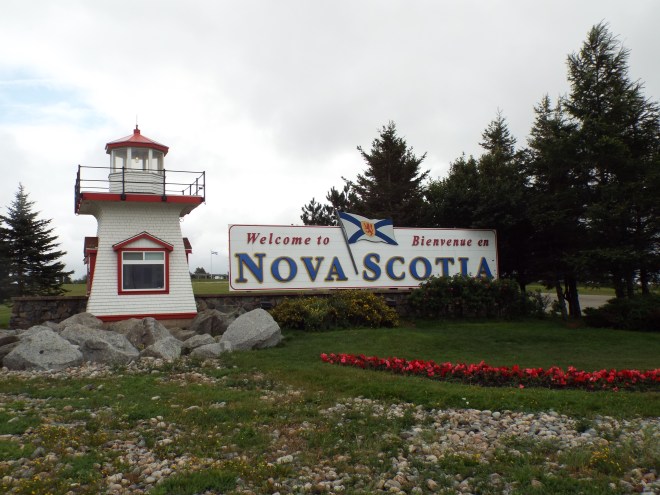
Long-awaited welcome

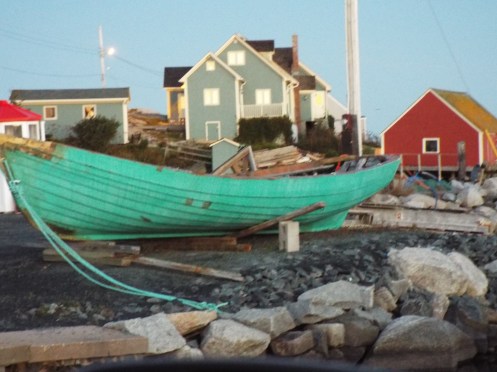
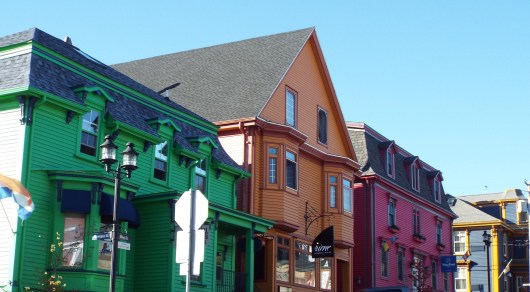
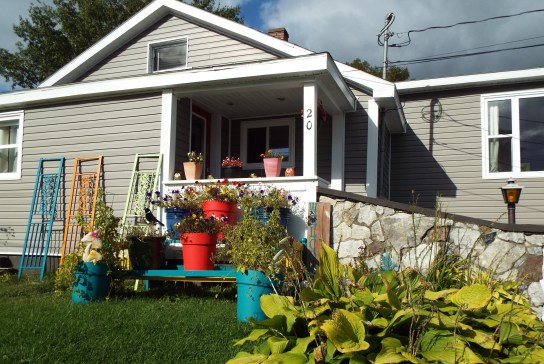
So many colorful houses everywhere–you’re as likely to see red, purple, or orange as you are white.

Early morning in Peggy’s Cove

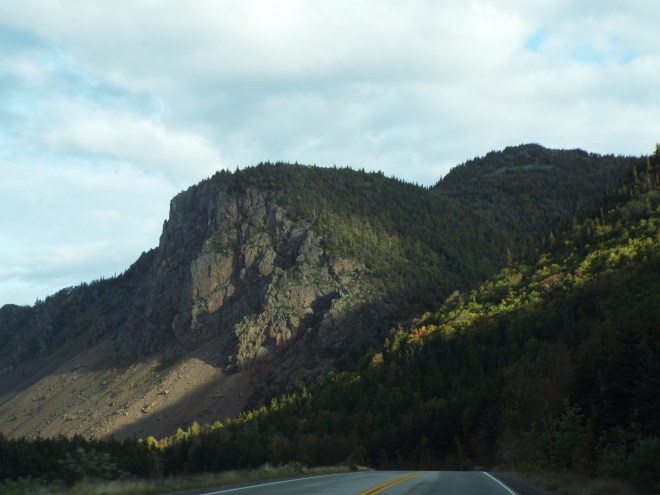
Beautiful Cape Breton

DSCF5984

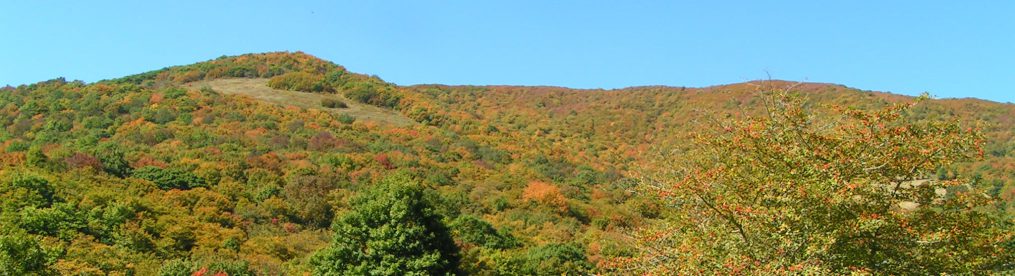
We even got to see the beginning of Cape Breton’s fall colors.

DSCF3865

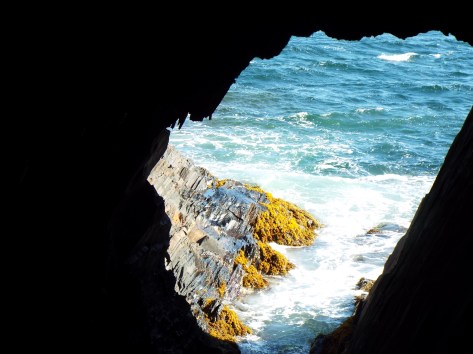
Looking out from a sea cave at Ovens Natural Park

DSCF4047

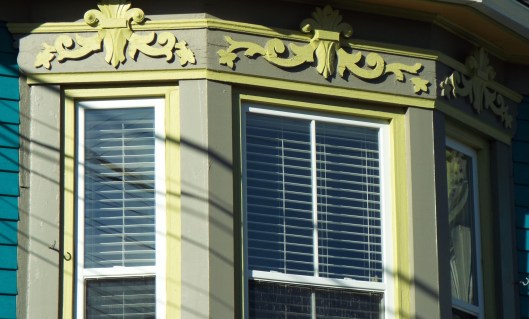
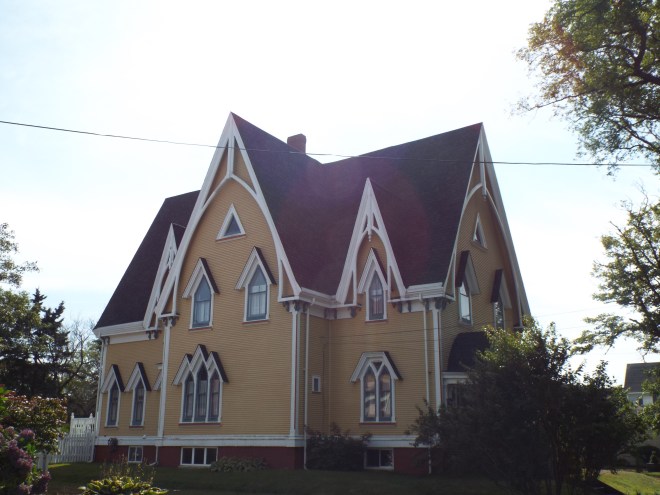
So many striking homes. So much detail.

Annapolis Valley

DSCF4332

Example of an 18th century  Acadian home

Oh, Canada!

The Landscape of Grand Pre, a UNESCO World Heritage Site

And here are a couple of Nova Scotia factoids: The distance from Nova Scotia’s southernmost tip to its northernmost is 360 miles, almost two hundred miles less than the distance across my home state of North Carolina. In land area, it is closest to, though smaller than, West Virginia, which is ranked 41st among our 50 states.

To join me on my journeys stay tuned for more stories and pictures.

Nothin’ But a Hound Dog (Or a Hundred or So)

The Gnome and I took a day off last weekend. In theory, we can do that every day of the year now that we are repurposed. Reality is a bit different. We’re each working on major projects, and we push ourselves as if the world will end if we don’t finish sooner rather than later. Actually, that’s the truth—we have way more days behind us than we could ever hope to have in front of us. One day our time will run out and chances are we’ll still have more than a few unfinished projects lying about.

I think that’s the way I prefer it. Much better to be in the middle of something I care about, anticipating the results, than twiddling my thumbs feeling that there’s nothing left to do.

But back to our day off. We decided to visit a small, picturesque waterfall in the small county that borders ours. I’d never seen it, never in our almost forty years here even heard about it until a few months ago. In his work, the Gnome had driven past but, zipping by in a car, he hadn’t had a chance to stop and enjoy it, either.

Falls and a swallowtail at Newland’s Waterfalls Park (Photos by Ron Wynn)

After soaking in the beauty of the place for half an hour or so, we decided to continue on the same rural road to a popular general store, dipping and climbing on curvy mountain roads. Our route took us through the unincorporated community of Cranberry, population 500 or so. (Even before it was settled in 1850, Cranberry was known for having one of the largest veins of iron ore in the United States.)

We passed the grounds of the former high school, which is now being used for occasional community events. The place was crammed with cars and trucks, mostly trucks. A metal yard sign next to the road read, “Heritage Day.”

That sounded like fun. We whipped the car around and headed back. As we drove onto the property, our ears were assaulted with barking, howling, yelping,  baying. We found ourselves surrounded by dogs, dogs, and more dogs. More than a hundred, we were sure. Dogs with their wiggly noses sticking out of car windows, crated dogs in pickup truck beds, dogs pulling people on leashes, dogs tied to fence posts on the shaded lawn. They were not, not a one of them, sleepy yard dogs. These dogs were on the alert. They were, in the truest sense, rarin’ to go.

Hound dogs.

Have you ever heard a hundred hounds baying simultaneously? Well, let me tell you, it’s deafening, each dog with a distinctive and  urgent voice. We couldn’t help but smile.

This was a very particular breed of hound, a scent dog known as the Plott Hound. If you’re not a North Carolinian, maybe just a Western North Carolinian, you may not be familiar with this breed. The dogs were brought to North Carolina by Johannes Plott when he emigrated from Germany in the 1700s. In the early part of the next century, his son Henry moved with his family to the mountain range that bears the family name: the Plott Balsams in Jackson and Haywood Counties in the southwestern corner of the state. Henry continued to breed the dogs, mostly for bear and wild boar hunting. The Plott Hound was named the state dog of North Carolina in 1988.

As it turns out, my mother was born and raised in the shadow of the Plott Balsams, and I’m interested in anything related to that heritage.

plott balsams wikimedia commons

View of the Plott Balsams (courtesy of Wikipedia Commons (wikimedia.org/wikipedia/commons/7/70/Plott-balsams-pb-ll-nc1.jpg)

Somehow, we had landed in the middle of a Plott Hound barking competition. (Never heard of that before.) What a stroke of luck! We followed the dogs.

In the far corner of a temporarily fenced-in section of the school grounds stood a cage, ever so slightly camouflaged. Inside the cage was a bear. Not a real one, thank goodness. But it moved. And it growled. I’m willing to bet bear scent had been sprayed around the cage, too.

In the near corner, dog handlers were hanging on to the leashes of their dogs. From the looks of it, that was some kind of hard work. When the whistle blew, three dogs at a time were turned loose and inevitably flew straight to the cage where they positioned themselves, barked, repositioned, and barked some more, stopping only when the timer blew his whistle and the keepers releashed their dogs, leaving the arena for the next trio to advance.

We didn’t fully understand how the process worked and we left before trophies were awarded. But from what we observed and overheard, we gathered this much. The event is timed. There are three judges. The judges are looking for degree of aggression, number of barks, and focus.

We looked, but if there was anything to Heritage Day other than the dog competition, it was well hidden. Never mind. Listening to the baying of a hundred eager hounds left us buoyant.

We almost always manage to come across some bit of serendipity—chance magic—when we’re out and about. Maybe a four-leaf clover, a funky art gallery, or longhorn cows in a meadow of buttercups. What a treat to happen upon a Plott Hound barking competition.

Have you encountered a bit of serendipity this week?

(Take a listen to the Plott Hounds.)


Selecting the Airbnb that’s Right for You

(Read this to see why I like traveling with Airbnb.)

If you’ve wondered about Airbnb but been too uneasy to give it a go, read this post for tips to make traveling with Airbnb safe, easy, and fun. (Airbnb’s website changes from time to time, so things may be a little different when you try it, but these guidelines should still be useful.)


What a cheery studio apartment this was, attached to our host’s home but with a private entrance.

1. In the search bar at the top of the page, type the name of a location. (You can go through the entire process up to reserving a space to see how it works.) Additional options will appear including number of guests, type of place you’re looking for, and price range. These options help narrow your search, saving considerable time.

2. A list of places matching your needs will pop up along with a map showing the general location of each rental. So, if you’re looking for a place in the heart of a city, you won’t accidentally end up thirty miles away. You’ll see the per night price and, in smaller print, the total price, which accounts for cleaning, service fees, and taxes, so it’s all inclusive. Keeping this in mind, don’t let the nightly rate fool you. Sometimes the one that looks more expensive at first glance costs less overall because the fees can vary significantly.

3. When you select a property, click on the photo at the top of the page for a slideshow of the place. I don’t advise staying somewhere that doesn’t provide enough pictures—interior and exterior—to size up the place.

4. Close the slideshow to read the description and list of amenities. Each has a ‘read more’ option. For the record, all the Airbnbs I’ve stayed at had all the promised amenities and often others missing from the written list.

5. Scroll down fora diagram of sleeping arrangements. In addition to the slideshow, this shows where and what type of sleeping arrangements are available (bed, futon, air mattress).

6. Even farther down the page are guest reviews. I’m highly unlikely to stay in an Airbnb so new that there are no reviews. Sorry, but I don’t want to be the guinea pig. In fact, I like to see plenty of reviews. That way, I’m guaranteed a good cross section of experiences and perspectives.

7. The listing also has a host photo and usually a brief host bio. There’s even a place where you can contact the host if you have questions or need any clarification.

8. Lastly, you’ll see a neighborhood description. What you won’t find, for security reasons, is a street address. That’s provided one or two days before your arrival, along with instructions on how to get in. Some hosts will greet you in person to show you around. Others offer a keypad or lock box.

9. Read it all. Reread it. Just like real estate ads, you might find code words. If they give you pause, jump to the next listing. However, I’ve almost always found that the pictures and descriptions are entirely accurate. Hosts have a vested interest in portraying their sites accurately. After all, if you arrive with a set of expectations that aren’t met, your host can expect a negative review for all to see.

10. On the right side of the page you’ll see pricing detail and the chance to book. It’s an easy process.


This New Mexico casita was one of our early Aibnb experiments. We were astounded at the low price. Fresh, airy, filled with original art, it’s a mother-in-law home which the host rents out when she isn’t visiting. The patio was  perfect for taking in the mountain view. 

11. For each rental, there is a heart at the top right. Click on that if you’re interested but not ready to make a commitment. You’ll be creating a sort of wish list to choose from. By the way, each time you click on a listing, it opens a new tab, so you don’t lose the original.

12. Another menu item, ‘Trips,’ shows the places you’ve stayed before in case you want to return. Still another lets you message your hosts as your arrival date nears or even when it’s over. Who knows? You might start up a lifelong friendship.

13. A day or so after your visit, Airbnb will ask you to complete a questionnaire and review. Please do this. It helps others like you. All reviews are posted on the listing’s site. If you have a complaint, the host may respond. You also have a chance to give Airbnb private information which allows them to follow up.

More Tips

Consider your ethos. If green is paramount, you may be able to find it. If it’s community investment, you’ll want to shy away from hosts who hollow out neighborhoods by buying up multiple properties for short-term rentals. How about diversity? Airbnb hosts can’t state that they discriminate, but some make abundantly clear that they don’t, stating for instance that they’re LGTB-friendly.

You can change or cancel a reservation, though hosts have individual rules for when and whether you lose some portion of your payment. Airbnb may also deduct the service fee. Most of the time, nothing is paid up front. These details are on the website.

Respect the host’s rules, also posted. If something doesn’t appeal to you, simply pass.  Sometimes, hosts may want you to strip the bed or put used towels in a designated spot before you leave. If you rent an entire house, they’ll certainly want you to wash any dishes you use. They won’t ask you to vacuum or actually change the linens, but they’ll want you to leave the place basically as you found it—as you would with family or friends, right?

The view from our Ingonish Beach, Nova Scotia, Airbnb included  both water and mountains. Best of all worlds.

Always, always remember that you’re staying at someone’s private property, whether or not they’re in the next room, and treat the space with the respect you want your own home to receive. If you accidentally break something, say so. Your host will probably be understanding, certainly more so than if you slink off without saying a word.

Planning a trip with Airbnb may take a while longer than making a reservation with your favorite hotel chain. But if you’re someone who comparison shops for lodging anyway, one process may not take longer than the other, though it’s easy to become infatuated with some of the Airbnb options. You may find so many desirable choices that you forget the original purpose of your travels.

In the end, Airbnb is a means, not an end. At some point, you may need to rein in your impulses and remember your travel goals. But if unique travel opportunities and adventure figure into those goals, Airbnb is one way to realize them.

Almost all the Airbnbs we’ve visited cost less—often significantly less—than any hotel or roadside motel we could have found, and were ever so much more interesting.


A few more places we’ve stayed with Airbnb. Sometimes you get amazing views, sometimes a hammock or even your own Airbnb cat. (Don’t worry, hosts make it very clear if animals are on the premises, at least in our experience. But you can always ask in a message, a good idea if you have allergies).

Have you tried Airbnb?

Why I Use Airbnb—Sometimes

Does the notion of using Airbnb sound a little scary to you? It did to me. But a couple of years ago when the Gnome and I took an adventurous cross country road trip, we decided to add one more adventure and selected three Airbnbs to add to our nights with relatives, old-fashioned Bed and Breakfast inns, and roadside motels.

We found we liked this relatively new lodging alternative and used it another time or two with equally good results. So, when we made another road trip last fall, this time to Nova Scotia, we decided we could happily and safely use Airbnb almost exclusively.

Airbnbs may be chic, quirky (waterfall Jacuzzi, anyone?) or rustic. (Click individual pictures to see a larger image.)

Happily and safely—those are the key words. The trick is to know how. In this post, I share a few of the reasons we sometimes choose Airbnb. But first, a disclaimer: I have absolutely no stake, financial or otherwise, in Airbnb—except to give it money in exchange for a good night’s sleep.

1. In our experience, Airbnb is a less expensive form of travel with a higher comfort level than hotels.

2. We’ve found Airbnb to be a homier option. There’s usually a choice of comfy upholstered furniture to relax your tired bones. We specifically look for this benefit.

3. Meeting Airbnb hosts is a good way to get to know the area. They’ll give you the local lowdown. If you’re in town for longer than a night or two, getting to know some locals gives your stay a whole new dimension. What better way to do that than stay in someone’s home? (However, if privacy is what you crave, hosts generally respect that.) Sometimes, the hosts don’t live on site, and you may never see them. Even so, many provide brochures or other information about areas of interest, nearby restaurants, etc. Some even have a three-ring binder chock full of helpful info.

4. Depending on your needs and wants, you can rent an entire house, a bedroom in a private home (with or without a private entrance), or even a shared room. Haven’t given that last one a try; don’t intend to. I’m not that adventurous!

5. If you’re traveling with family or friends, sharing a house, apartment, or condo cuts the price even further, and it’s so much more fun to spend your evenings relaxing together in a living room than stuffed into one or another’s hotel room.

6. Depending on your Airbnb selection, you can prepare your own meals. You can eat in your pjs if you want and even save a little extra money and time. Often, the hosts stock the fridge or pantry with a few essentials, but don’t count on more than coffee makings and maybe salt and pepper. Previous guests sometimes leave what they didn’t use, so you might find cooking oil, mayo, or other condiments. You never know.

7. Airbnb hosts provide most, if not all, the amenities hotels do: bed linens, towels, soap, shampoo. In my experience, hairdryers and irons have also been universally available. One place even had a selection of condoms and feminine hygiene products. (Again, you never know!) Sometimes there’s a washer and dryer, a real convenience on longer trips.

8. Typically, Airbnb hosts do not provide a hot breakfast, though we’ve experienced a couple of happy exceptions. However, they almost always provide a coffee maker with coffee and tea bags as well as breakfast bars and sometimes fruit or other snacks. You might even find a choice of yogurts, instant oatmeal, or muffins. We stayed at one place that stocked the fridge with soft drinks, and had an entire tray full of prepackaged baked goods on the counter. Another host left us some homemade whole wheat rolls. Yum!

9. With Airbnb, you’re almost certainly putting money into the local economy, often helping a self-employed craftsperson or a young family supplement their income. That feels a lot better than lining the pockets of faceless corporations to me.

10. Airbnb is always an adventure, in our experience a happy one filled with little surprises, homey touches, unique decorating styles, and other treats. Think about how different the homes of your various friends and family are; be prepared for a quirk or two. It all makes for much more interesting travels. If you’re not a person who can go with the flow, the Airbnb experience may not be for you.

This welcoming two-bedroom home is one of the least expensive places we’ve stayed, even though we had the whole place to ourselves.

To be sure the experience is a positive one, it’s important to do your homework and make your Airbnb selection judiciously. In my next post, I’ll share tips on selecting an Airbnb site that fits you to a T. Stay tuned.