Needles and Thread, Part II: MaMa’s Treasure

(Part of my Blowing on Embers series)

I never knew my paternal grandmother. She died in 1942, about two and a half years before my parents married. After still another year, Grampa married Carolyn Usher Johnson, the woman I always knew as MaMa.

When Grampa and MaMa married, she moved into his three-bedroom home. As I was growing up, I thought the house was hopelessly old-fashioned with its mahogany furniture, Oriental rugs, ornate cuckoo clock, and velvet upholstered sofa and chairs adorned with crocheted antimacassars. An old wind-up Victrola, complete with its puzzled-dog-staring-into-the-horn icon and wax cylinders, always a fascination to us grandchildren, stood in the hall.

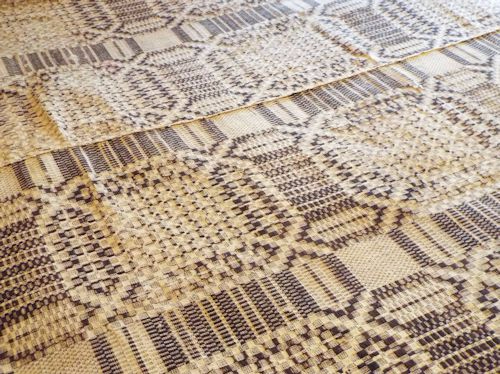
Once the last of the nine sons and stepsons was out of the house, two of the three bedrooms were reserved for company. When our family visited, we usually stayed in the front bedroom, which featured a porcelain pitcher and bowl on the antique washstand and a brightly colored, velvet crazy quilt on the bed. The bedspread in the second bedroom was much more sedate: a thin woven cotton spread in muted shades of brown.
After I was married with children of my own, I was happy when our young family moved to North Carolina because it meant being nearer both my husband’s and my extended families. I was especially eager for our children to get to know their only living set of great-grandparents.

When we went to see Grampa and MaMa in the summer of 1981, the term Alzheimers’ had only recently entered the popular lexicon to describe the most common form of dementia. MaMa had been diagnosed with this horrid disease not long before our visit. Her diagnosis came after she was found walking along the highway near their home in the middle of night, wearing nothing but a nightgown, unsure where she was or how she got there. But when we visited, she was perfectly lucid, even joking about that nighttime misadventure. She seemed quite competent.

We stood in the front yard saying our always stretched-out goodbyes when MaMa asked us to wait a few minutes more and disappeared into the house. She returned a few minutes later, carrying the brown bedspread I remembered from my childhood. As she presented it to me, she explained that her grandmother had woven the spread during the Civil War.

I was touched, but I demurred. Surely, she should give it to one of her sons’ children. It was their birthright. She was quick to say, “Oh, they’d just pack it away in a cedar chest. I know you’ll use it the way it was meant to be used.” Grampa, standing beside and ever so slightly behind her, silently gestured that we shouldn’t belabor the point. MaMa knew what she wanted and would be unduly upset if we declined. We accepted the spread.

It was the last time we saw her. MaMa died before we were able to make another visit to eastern North Carolina. We were even more honored,and now sobered, to be in possession of the spread with its rich heritage. But how were we to honor it?

It had been in regular use for over a hundred years and simply wouldn’t stand up to much more wear, especially in a house filled with cats, dogs, and active children. Yet, we knew we couldn’t let the spread spend the remainder of its days in the dark recesses of a cedar chest, no matter how much longer it could be preserved.

We had to find some other way to care for the special piece of history entrusted to us. Today, the treasured spread is folded over the loft rail overlooking our bedroom, a compromise that keeps it in sight but protects it from the risks of everyday use. We’re careful to keep it out of direct sunlight, to fold it loosely, and to rearrange its folds every so often to keep the fabric from weakening at fold points.

We honor it. We tell its story. I hope that’s good enough.
Move-In Day

Move-In Day

(Written on Saturday, August 19, 2017)

move in 5 better

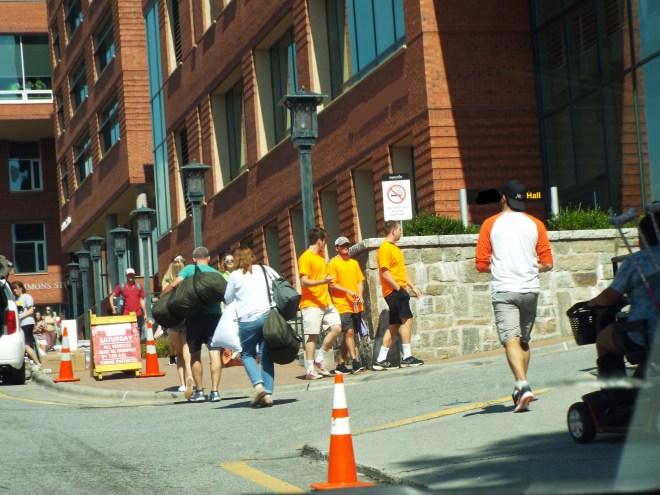
It’s Move-In Day at the local college. Traffic has been a mess all week as students who live off campus, as well as student advisors and others with pre-move-in responsibilities, clog the roads for miles around. Roadside signs directing parents and new students to this or that area of campus begin several miles beyond town.

The campus itself is dotted with temporary identification and directional signage. Campus security personnel and ROTC students direct on-campus traffic while other staff, including my nearest neighbor, are on hand to help carry suitcases, boxes, and carts full of bedding and other necessities to dorm rooms—this being their fourteenth straight day on the job. They’ve been hectically sprucing up those same rooms and making sure all maintenance issues have been resolved in preparation for this weekend for weeks. 

Dorm parking lots are full of loaded pick-up trucks and rental trailers as parents help their fledglings move in. I’ve seen license tags from places as far away as New Hampshire, Texas, and Colorado. We’re used to out-of-staters. After all, we’re a tourist town as well as a college town, but the prevalence of far flung tags has been greater for the last few days. DSCF9247_LI

Students fill the campus and downtown sidewalks in groups of twos, threes, and fives. It’s an exhilarating time. Freshmen are getting acquainted with their roommates and other newbies. Their shared excitement, nervousness, and uncertainty creates an instant and strong bond. Upperclassmen are eager for reunions with friends. Some are all aflutter at the prospect of being back together with sweethearts after months apart. For a few, the start of the new year is bittersweet, having said sad good-byes to their steadies back home, but eager to greet friends and decorate their rooms.

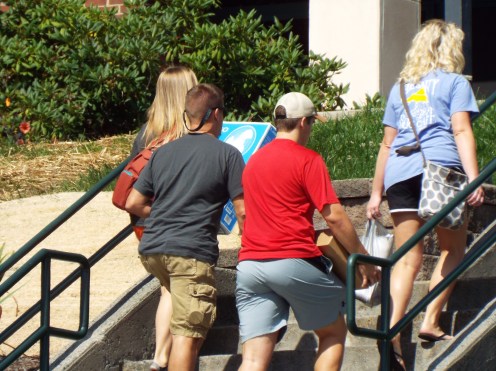
Parking lots and dorm rooms are scenes for a fair share of teary-eyed goodbyes, but for the most part the damp cheeks belong to parents. More students than not are virtually shoving their families out the door. They want Mom and Dad to stop with the bed-making and drawer-filling and advice-giving. They want to get on with it. This is their time.

It’s a weekend unlike any other. No classes, no assignments. It’s get-acquainted time. Settle-in time. A few hours of relaxation with no academic stresses. Still, minds are a little muddled for many freshmen, who have more-than-ever moments of feeling like little kids on the inside while trying with all their might to be all grown up on the outside. Their innermost feelings and fears will not be spoken aloud.

Today is all about hope. It’s the beginning of a fresh start. Freshmen, especially, have a chance to make themselves anew, if they choose. No baggage follows them here. No one knows their academic, family, or personal backgrounds. They can scout out other like-minded folks; there are clubs and organizations aplenty for exploring new ideas and finding expression for their deepest interests. (In fact, some of these kids will be unrecognizable on their first weekend home—with radical hair colors and styles, tats in unlikely places, piercings on improbable body parts, and strange new ideas. They may sport heretofore unknown wardrobes to announce their current status.)

Meanwhile, vendors conglomerate just beyond the school’s boundaries to hawk mini-fridges, carpet remnants, and college-themed products for student rooms. Restaurants, retail stores, and churches display signs that say things like “Welcome Back” or “Welcome, Students.” One was different. It simply said, “Welcome Home.” In a microsecond I was transported to my own college days, and I realized this was the sign that got it right.

Even as a butterflies-in-the-stomach freshman, it was only a matter of days until I understood I’d found my home at my now alma mater. As I returned from semester and summer breaks for my next three years, I knew for certain I was coming home—home to roommates, classmates, hall parties (held for any reason or no reason at all). Home to favorite professors and classes for which I had a passion. Home to love interests, ball games, dances, bonfires, and concerts. Home to learning and my still unknown future. Of course, I still referred to that place from which I hailed as home, too, but it was my parents’ home. This was mine. All mine.

Welcome home, students! 


No Touching

(Part of my Blowing on Embers series)

About this time of year I’m overcome with nostalgia. What brings it on is the flowering of touch-me-nots. My now grown children groan in exasperation whenever they hear me mention these wildflowers—they know what’s coming next.

It’s the story of how these jewel-toned flowers remind me it’s time for the school year to start in these parts. How I fondly remember watching the two of them emerge from a heavy fog as they walked up our newly-graded and graveled road after their first day of school barely more than a month after we moved up here on the diagonal. (Punkin was a fourth-grader, wishing she was back in the Brown School in Louisville. It was Cuddlebug’s very first day of school anywhere.) How their arrival home from late-summer school days was often delayed because they couldn’t resist the urge to stop along the way to do exactly the opposite of the warning implied by the plant’s name and pop the flowers’ seedpods. It’s an addictive pursuit, and it was a fun way to end the school day.

Handling a touch-me-not is a uniquely rewarding and giggle-worthy experience. The seedpods don’t look particularly fragile, but when they’re mature, the slightest movement causes a virtual explosion, with tiny seeds catapulting onto the landscape—no doubt the reason this wildflower is so prevalent in territory friendly to its needs. The steep banks along our country roads are saturated with touch-me-not plants right now.

Predictably, with all those explosive seedpods, touch-me-nots have taken over the roadsides.

Also known as jewelweed, this prolific wildflower may be either yellow or orange, each variety’s flowers freckled with deep reddish-brown spots near and in their deep throats. Their nectar-filled spurs make them attractive to hummingbirds, butterflies, and other pollinators. In appearance, they strike me as a cross between miniature orchids and larkspurs.Touch-me-nots are common throughout all of the U. S. with the exception of a few western states. They’re fascinating plants—beautiful, useful, quirky, and irresistible to kids of all ages. Once you’ve popped a few seedpods, you never outgrow the urge when you come upon a patch of these intriguing plants.

When a seedpod bursts open, either on its own or with a little human help, the hull instantly curls up into tight coils, like small, green springs. It’s all so fast you can’t see it happening. A captivating sight in itself. And even though you know that little explosion is coming and are waiting for it, it will inevitably make you jump in startled surprise.

The leaves are just as intriguing. If you find yourself in a patch of jewelweed on a dewy morning or just after a rain, its leaves will be the only dry thing around, displaying little beads of water on their surface. Dancing in sunlight, the water glistens like diamonds.

Submerge a leaf in water with its underside facing up and it turns silver. Pull it out and it will be dry, with only a few droplets of water here and there.

Touch-me-nots also have medicinal uses. The best-known and most practical use is as a remedy for itching. In fact, they’re often found in conveniently close proximity to itch-inducing poison ivy and stinging nettle. By breaking open the liquid-filled stems and spreading the watery sap on skin that’s been exposed to these plants or to insect bites or stings, you’ll most likely experience immediate relief.

And you can even eat the little seeds. They taste a lot like walnuts–really! Granted, it would take a lot of collecting to get enough to bake into a dish, but it’s a handy thing to know if you happen to find yourself lost and hungry in the midst of these delightful plants.

All this and nostalgia, too.

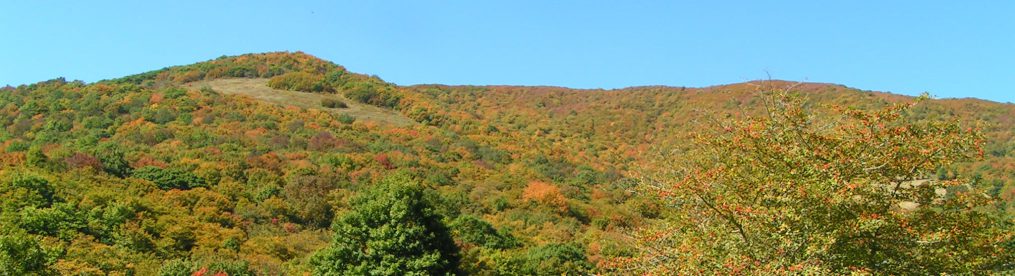
The sight of touch-me-nots, the start of the school year, the long held vision of our children in their first-day-of-school finery, the hint of autumn in the air, the memory of those first days of house-building—all these things represent the beginning of our life on the diagonal.

Kids, if you didn’t already realize, you might as well get used to it because whenever touch-me-nots are in bloom, I’ll continue to reminisce aloud about this giant tangle of sweet memories.

Blowing on Embers

Blowing on Embers

Blowing on Embers: I came across this lovely phrase the other day.

Have you ever sat around an evening campfire? Remember how when it started to die out and you weren’t quite ready to call it a night or maybe you wanted just one more toasted marshmallow, you blew on the embers to keep the fire alive?glowing coalsWell, Johanne from www.sunnysideheanne.com has  put a new spin on that old tradition. After she lost her father, mother, and a special aunt, all within a year, Johanne and her sister wanted to make certain they wouldn’t forget their own story.  They began a new family tradition—trading stories of childhood memories. In other words, they began blowing on embers of the dying fire of their family’s personal history.

Reading Johanne’s story, I immediately identified with the concept. Recalling memories is a favorite pastime around here. It’s why I create and peruse photo albums and scrapbooks. And it’s what I do with much of my writing.

I’ve told children and grandchildren about memories from when I was no more than two years old, one from even earlier in my life. These “memories” are actually no more than snapshots in time, and I’ve come to realize I don’t so much remember them as I remember the remembering of them from stories told and retold. But that’s the point, and it’s why it’s so important to keep recounting them.

Reminiscing is a social activity that gives meaning and coherence to our personal narratives. It keeps family history alive. It triggers nostalgia, and nostalgia gives us an endorphin boost, improving our mood and making us feel better able to tackle whatever challenge we face at the moment.

Memories, especially childhood ones, are fragile. Without jogging them, they fade, ultimately dissolving, like a morning fog, into nothingness. Yet, our early moments are powerful ones, shaping our lives. As we weave the vignettes into a whole, our life stories emerge. We better understand who we have become.

The accumulation of childhood memories, even those enhanced by retelling, also influences our on-going behavior. There’s evidence that when childhood memories are triggered, we behave more kindly and ethically towards others. Our memories, it turns out, serve as a moral compass.

So let’s get to work. I’ll be blowing on my own embers on this blog. Maybe the glowing coals of my stories will spark some of your fondest childhood memories. Share them. It will do you—and the world around you—good. I’d love to hear your stories. Feel free to share them in comments beneath each post.