So Beautiful It Changed My Life

What an amazing concept—something so beautiful it could change a life. Most of us, if we’ve lived long enough, have had at least a couple of life-changing experiences. But by nothing more than beauty? That was the writing challenge I was presented recently: a time when something was so beautiful it changed your life. It took me aback for a moment. But only for a moment. As I scoured my memory, it came to me.

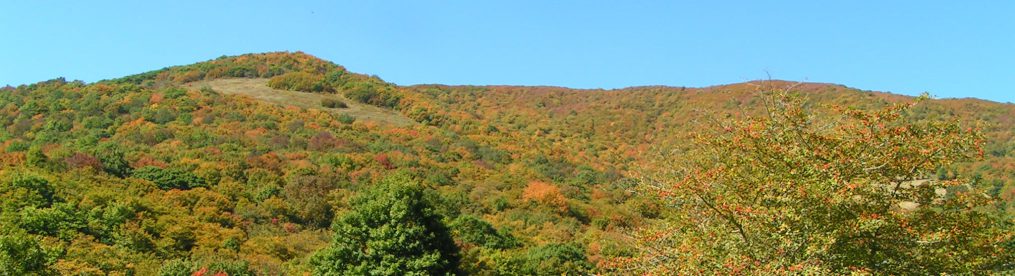
Driving from Kentucky to the mountains of North Carolina in 1979, after the Gnome and I had made the mental decision to move but before we had actually taken action to make it happen (in other words, it would be easy enough to back out), I looked at the mountains on the horizon with new eyes. It was as if they were cloaked in blue-green velvet.

Their apparent softness overwhelmed me. Though I didn’t have words to articulate it, I sensed something magnificent. Those ancient rocks, some of the oldest in the world, had been worn down by eons of rain and wind; in the process, they had been reshaped from the haughty cragginess of youth into the gentle wisdom of age. Their strength lay in their graceful endurance. I didn’t want to back out.

We spent a week searching for a spot to call home Discouraged by all the not-right-for-us places we’d been shown, we were about to head back to Louisville with unfulfilled dreams. At the last minute, our realtor recalled a secluded piece of land tucked away on a mountainside, and our decision was made. In early April, things were still pretty barren; still, we were confident we’d found what we were looking for. We signed some papers and went back to Louisville to prepare for the big move.

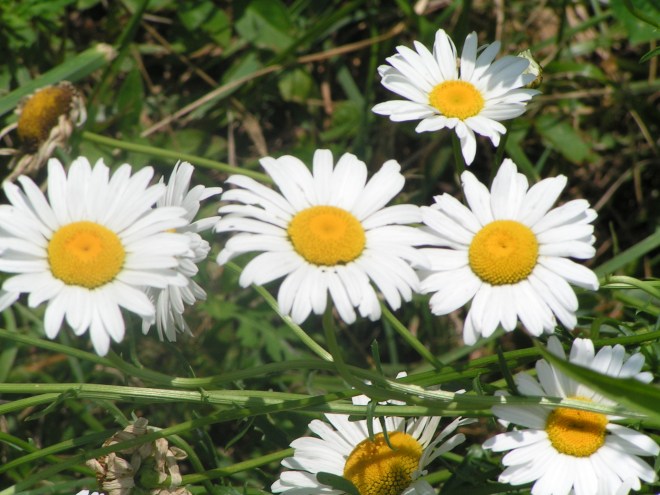
When we returned to our mountain with all our worldly goods not quite three months later, my heart stopped as we drove into a meadow bursting with daisies. (How did the universe know to greet me with this outsize bouquet of my favorite flower?) 

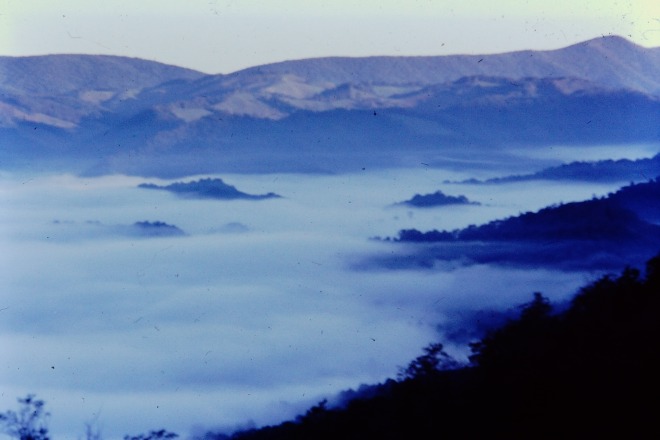
It stopped again the first time I looked over a cloud-filled valley, mountaintops peeking out like islands in a sea of snowy foam.

I knew I’d never leave.

pict0068

(To read more about our adventure of moving and building a home with our bare hands while living in the wild, begin here.)

Here’s to What We Don’t Know

Another quick assignment in my Wednesday writing group—you’ll find the prompt in the last nine words of this post. (Unh-uh! No skipping to the end!)

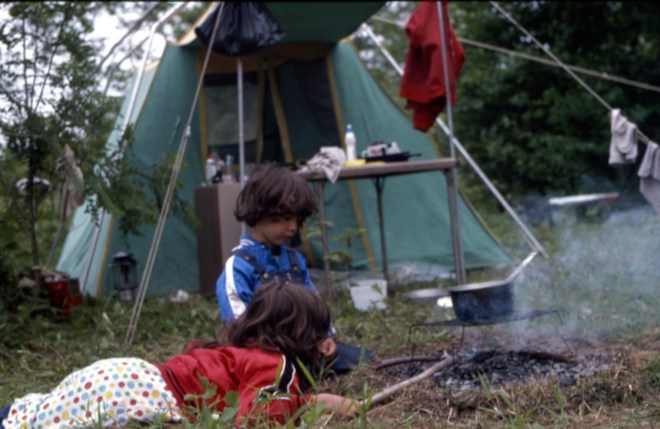
Living in a tent on ten acres of land in a strange place with no water, no electricity, no phone access, no knowledge of local weather conditions—like that severe thunderstorms could and would pop up daily with no warning, no jobs, and no money but with two elementary-aged children, two neurotic cats, and a notion we could live this way for as long as it took to design our own house, get planning approval, and build the entire thing with nothing more than our own four hands and a few hand tools . . . well, it seemed like a good idea at the time.

Little Things Mean A Lot

Little Things Mean A Lot

Have you ever looked around your home and thought about which things are especially meaningful to you? If you’re like me, it won’t be the big-ticket items, whatever they are. Instead, it will be the little things, sometimes things you’ve held onto for no apparent reason, things to which no one else would attach any importance.

I took a virtual house tour recently and came up with a few special items.

1. The one I’ve had the longest is a Little Golden Book, Busy Timmy. I have a few others, too, but this one captures my imagination for a variety of reasons. Stereotypical as these books were when I was an impressionable tyke, they were my ticket to the wonderful world of words. Timmy could do anything, it seemed. I was just as proud when I could do something on my own—that was the whole idea, after all. I loved the illustrations. And I learned to read. I’ve had this book for close to seventy years. (How is that even possible?!) It never gets old, and it tickles me no end to share it with my grands.

These books are well worn!

2. You’ve surely been asked the question, “If your house was on fire and you could save just one thing, what would it be?” Though I’m sure the true answer lies only in the experience of the moment, my answer to the hypothetical has always been “my photographs.” I’m addicted to picture-taking. I get even more joy from perusing old photos—snapshots of friends and family, vacation scenes, nature photography. I love it all. Of course, I’d never succeed in my photo-saving quest—my albums fill close to ten linear feet of my bookshelf real estate. And that’s not counting the boxes full of loose snapshots or the photos on external drives and SD cards. But I’d do my best. They’re memories of the richest sort. Visual links to time and place that only exist in memory. Treasured keepsakes to share with next generations whose only tie to their past lies in pictures and words.

3. A large, two-tone brown mixing bowl was a fixture in Mom’s kitchen for as long as I can remember—the kind you might find in an antique consignment shop these days. Everything from meatloaf to cake got mixed in that bowl. It’s long had a hair crack down one side, but I still use it almost daily. It wasn’t just part of my childhood; it was part of my learning to cook, an essential item in my 4-H foods project. I mixed up my prize-winning cornbread in it, and I still do today.

4. Growing up, I never cared all that much for framed crewel, embroidery, or cross-stitched pieces. They were too old-fashioned for my taste. But when my mother was breaking up housekeeping, I grabbed a few for old times’ sake. Today, they hang on my walls in places of honor. Each one has a story. This one’s my favorite.

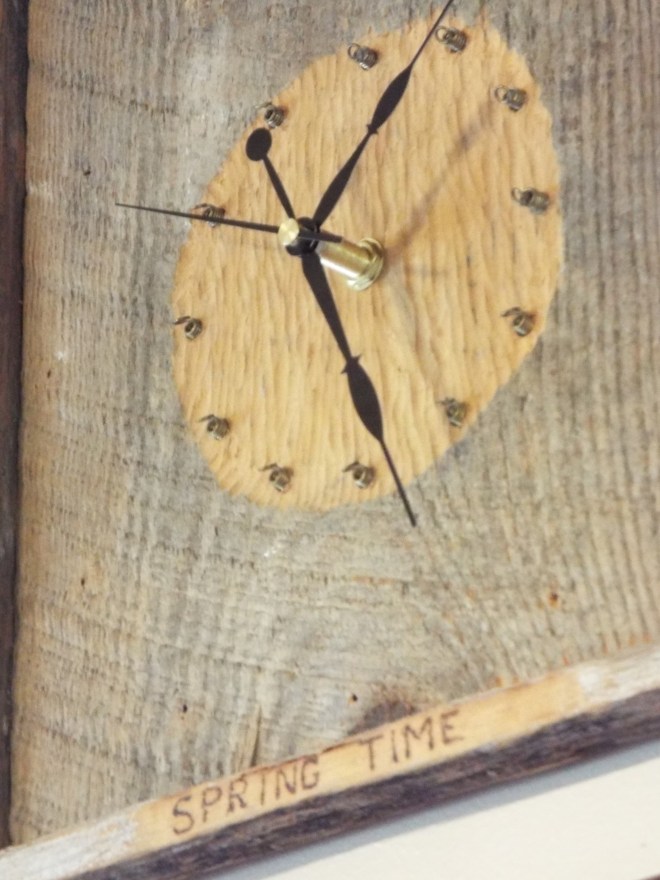
5. My dad took up woodworking in retirement, following in the footsteps of a couple of his brothers. He carved walking sticks, made wooden chimes, turned earrings from exotic woods. I especially liked the clocks he made of aged barn wood. He enjoyed coming up with corny themes for them. (Corn was one of his specialties.) On the frame of mine, he etched, “Spring Time.” Each numeral is represented by a small metal spring. It makes me chuckle. It’s just so Dad.  

6. After decades of filling up precious bookshelf space with my old college textbooks (not to mention hauling them move after move), I finally admitted I no longer had a use for them. Gosh, the psychology texts were embarrassingly outdated. But there’s just something about those old books: their look, their heft, their scent. The slick pages alone send me into paroxysms of nostalgic joy. No doubt part of the allure is the childhood memory of my dad’s sole surviving college text. When I was eight years old, I tortured my younger brother with “school,” while I, as teacher, busily underlined sentences full of words I didn’t understand in that chicken husbandry book.

Still, I knew it was time. Wistfully and semi-regretfully, I began packing my old books in a donation box. Then I came upon my treasured Milton text. I temporarily set it to the side. Not for its content—I tried rereading a few lines. Crikey! No, it was for what it represents: a small seminar class where I was fully present. I loved the challenge of it. I dared to speak out. I got listened to, I belonged, I thrived.

I kept the book.

I could go on and on, but you get my drift. Sentimental trinkets, whose meaning often lies in what they represent rather than the objects themselves—these are the things I value. One of my favorite Top 40 hits during my teens was the song, “Little Things Mean A Lot,” sung by Joni James. “Blow me a kiss from across the room/Say I look nice when I’m not/Touch my hair as you pass my chair/Little things mean a lot . . . Don’t have to buy me diamonds and pearls/champagne, sables, and such/I never cared much for diamonds and pearls/’cause honestly honey they just cost money.” In spite of some fingernails-on-the-blackboard grammar, the song’s theme aligned with my ethos then and now.

I guess it shows.

What about you? Have you taken inventory of your most precious things? Where do they rank on the scale of monetary value? Do you love them for what they are or for what they signify? Or is it just me? Feel free to share in a comment.


Remembering the Forgotten

I’ve been participating in a social media challenge called 52 ancestors in 52 weeks. It’s an effort to encourage learning about and sharing our various family histories in small, doable chunks. Participants are given a weekly prompt to start them on their way. Earlier in the year, one of the prompts was “census.” This is what I wrote.

(Disclaimer: I am not descended from Hardy Watkins. In fact, it’s unlikely he had any descendants. That’s why I want to tell his story. When Granddaddy became the superintendent of the Johnston County, NC, County Home (aka poorhouse) in 1930, Hardy was already there.)

If Hardy was like most folks who were relegated to the poorhouse, no one ever came to see him. Maybe he had no family at all. But neither the absence of visitors from the outside world nor his developmental disability did anything to dampen his enthusiasm for life. He was a good-natured, cheerful sort—until he was pushed too far. Then he’d curse a blue streak. He never missed a service at the nearby church—always sat in the front row. He couldn’t carry a tune in the proverbial bucket, but he sang his heart out on every hymn, always with hymnal in hand, even though he couldn’t read the words.

I grew up hearing tales about Hardy from my dad and his brothers, who lived in the poorhouse during Granddaddy’s tenure there. Whenever our family gathered for reunions, Hardy’s name inevitably came up. He was discussed with animated affection.

This is the tale they shared most frequently. On the rare occasion the boys could scrape a few coins together, they thought it was a hoot to offer Hardy a choice between a penny and a dime. He always chose the penny because it was bigger. At least that’s what they thought. They were grown before they figured out what he surely had understood all along: if he’d ever taken the dime, they’d have stopped playing the game. Instead, he maintained a growing collection of their pennies. It took a while, but with that realization, the brothers finally got their comeuppance.

I got curious about Hardy. I asked my genealogy-savvy husband to check the poorhouse census records. All these years I had thought Hardy was a kid near my dad’s age. But we discovered that when my then nine-year-old dad showed up at the County Home with the rest of his family, Hardy was forty-seven. He was born in 1883. Why, Hardy was even older than Granddaddy! We also learned that Hardy had arrived at the poorhouse long ago—sometime between 1900 and 1910. So, he had been there at least twenty years, perhaps closer to thirty, when Daddy’s family moved in.

According to newspaper reports, poor nutrition marked poorhouse fare in the early years of the twentieth century. Before Granddaddy took over management of Johnston County’s poorhouse, fruits, eggs, milk, and other dairy products were a rarity for the residents. Surely, such a diet would have a negative effect on one’s longevity. I already knew that for the average person born in the late 1800s, like Hardy, the average life expectancy was only forty-two or forty-three years. That got me to wondering what happened to Hardy.

Census records from 1940, the most recent available, showed Hardy was still living at the County Home. He would have been fifty-seven at that time. He had already defied the odds. Further exploration led to the discovery that, in spite of all the cards stacked against him, Hardy lived to the ripe old age of eighty-nine.

At the time of his death, Hardy was still in an institution. The poorhouse was no more. But the building was still there, having transitioned to a privately-operated care home for the aged and infirm in the mid-1950s. So, though the operation of the facility changed hands, it’s quite possible that Hardy stayed put. My bet is he lived all his days since arriving at the poorhouse in the same place, maybe even the same room. (Well, not quite. A new building had been constructed in the early 1920s so he would have moved at least once, though only a few hundred feet.)

Over time, poorhouse records seem to have disappeared. Only the rare newspaper article and a few official reports remain to provide any poorhouse history at all. Hardly anyone is left to tell the stories of the people who lived there.

If he’d had a chance, I wonder what Hardy might have told me about his life at the poorhouse, about his family, about his relationship with my dad and his brothers. About how he defied the odds. What was the rest of his story? Just like the rest of us, Hardy—and everyone else who lived at the poorhouse—had stories to tell. We’ll never know what they were. But they deserve to be honored.

The former County Home in Johnston County, NC, is currently an assisted living facility. You can learn more about Hardy, other poorhouse residents, and the County Home itself in my book, Boyhood Daze and Other Stories: Growing Up Happy During the Great Depression.


Miscellany of Memories

In honor of my Dillard grandparents on the hundredth anniversary of their wedding day, June 2, 1918:

Miscellany of Memories

No typical grandmother, she,
playful as a kitten in clover,*
cheating at cards, giggling
behind cupped hands at her own subversions.

I gathered warm eggs from the nests
while she rounded up a hen to chop off its head.
Together we plucked pinfeathers
before the evening’s fried chicken dinner.

Gizzards she kept for herself alone
as if I might want such awful offal.
Or was she claiming
sacrifice as privilege?

She practically forced me to be creative.
Sometimes I balked, but I still have
my embroidered aprons and copper tooling
to share with another generation.

Taciturnity described him,
but I knew—I knew he adored me.
With his twinkling eyes and gruff nuzzle
against my cheek, no words were needed.

He teased me with his cow jokes:
Black cows give chocolate milk.
Mountain cows have two short legs
and two long—keeps ’em from falling.

It’s late! Time to get up, he bawled
when dawn had hardly cracked.
Why? I laughed and pulled the covers higher.
He couldn’t sleep—why should I?

Was he lonely, awake alone?
Or did he want to cram
every possible moment with me
into our too-short weekends?

Her father spent his last days
with them, mind long gone, bedridden.
Wasn’t Boston Blackie on the radio
when the final call came?


My grandparents, William Garland and Georgia Olive Stillwell Dillard at their fiftieth wedding anniversary celebration


(* With thanks to my cousin, Jan Lazurri, for this perfect line unrepentantly lifted from her poem honoring Georgia)


Just Wondering


My grandfather, Joseph Bezzel Coates, b. 05/21/1895

My grampa was a fiend for learning.
Immediately he knew
radio’s potential
for education,
calling his boys
from their play
when “Music Appreciation Hour” aired.

Grampa was a fiend for hard work, too.
Too little of it
and the devil might
set up his workshop—
that’s the way Grampa saw it. Besides,
too much work needed doing
to trifle with idleness.

Hard work was like play for him
so he was known to say,
during an afternoon break from working in tobacco
or cotton or corn and the heat from the sun
blew the top off thermometers,
“Boys, while you’re resting,
let’s go shuck some corn.”

So, I wonder how Grampa would handle
the age of social media.
Surely he’d see the potential for good,
the opportunity for learning.
But day after day, hour upon hour
playing games on smartphones, scouring Facebook, or texting friends?
Would Grampa put up with that?

WWGD?
(What would Grampa do?)

Resilience and Grace

She never asked to be a widow—hoped not to be. Yet, she fully expected it. She was up on gender and life expectancies, so she knew the odds were strong that she’d outlive him by some years.

It wasn’t that she was happy about it, but I wanted to stamp my feet every time Mother made some comment about living longer than Dad. To me, it felt like a self-fulfilling prophecy, and one I didn’t want to think about. But Mother was simply being realistic.

And though she went straight from her parents’ home to sixty years with him, she somehow knew how to survive on her own when at eighty-one she found herself alone for the very first time in her life. They’d been married for sixty years.

A couple of years later when she broke her hip and had to spend more than two days in a hospital bed awaiting surgery, she found the tiniest movement excruciating. Yet, she was loath to press her buzzer regardless of her need—didn’t want to bother anyone. She couldn’t help emitting a groan, though a tiny and apologetic one, when it was time to change the sheets or reposition her. But instead of complaining and bemoaning her constant pain, she made it her purpose to bring laughter to the nurses, aides, and others who looked after her. One nurse aide regularly took refuge in Mother’s room because it was such a pleasant and safe place to be.

My mom has always looked life straight in the face and taken it on wholeheartedly. Tears are so rare I can count the times I’ve seen them on one hand and still have a finger left over. The first was when I was six years old; the last more than fifty years later when Dad’s ashes were delivered to her. Instead of focusing on what’s sad, she looks for things that bring delight—a sunset, a newly discovered flower, a snowfall. I remember her saying she couldn’t imagine anyone being unhappy—sad, occasionally, but not unhappy.

The last thing she ever wanted to do was leave her home for assisted living, but once the decision was made she never complained, never looked back. Again, she began looking around her to see which worker needed a smile or a word of encouragement. (Needless to say, she’s a staff favorite.)

Once, on the phone from her one-room confines, she said to me, “I’ll bet there aren’t many ninety-two year-olds as lucky as I am,” reveling in the birds at her feeder, her books, her crossword puzzles, the cats who frequent her room, and memories of her family and happy marriage. She continues to offer similar sentiments two years later. If she’s ever had a regret, I don’t know about it.

Her job as a mother is never-ending. Though in many ways over the last few years our roles have reversed, she’s still teaching me, especially in the art of aging well and with joy. May I learn her lessons well.


Shattered Dream

(I was recently challenged to write about a real-life adversity, mine or a family member’s, and the response to it. This is my story. What about you? Care to share an adversity you or someone in your family experienced? You can do it in the comments section)

All Daddy ever wanted was to be a farmer. Knee high to a mosquito, he helped with farm chores. In grade school, his days began before dawn, milking cows and chopping wood.

After high school, Daddy continued to work the farm with his dad. Two years later, he met Mama.

Lovebirds

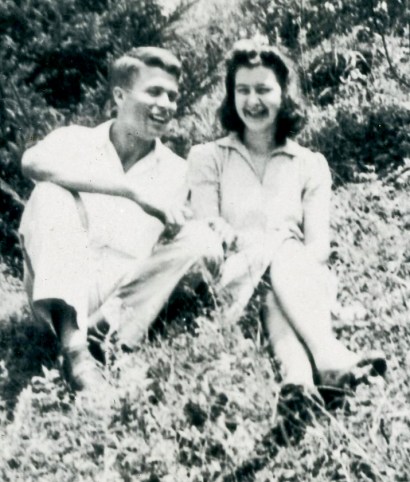
She was heading to Western Carolina Teachers College. He quickly enrolled at North Carolina State. His dreams of farming followed him; he would major in agricultural economics. In one of the many letters that flew between them, he wrote, “I aim to own a farm someday.”

World War II interrupted Daddy’s studies when his ROTC unit was activated. After only a few weeks at Fort Bragg, however, he was honorably discharged—the Army had too many new recruits. Daddy didn’t return to school. The military had taken over much of the campus. Besides, his patriotism demanded he find another way to help the war effort. First, he worked in the Newport News shipyard, then at Union Carbide in New Jersey.

That was too far from Mama. When Daddy was offered a transfer to the new “Secret City” of Oak Ridge, Tennessee, he leapt at the opportunity.

Daddy and Mama married. The war ended. I was born. A year later, Daddy’s farm-owning dream came true. With help from Mama’s parents, he and Mama purchased a mountain farm on the banks of the Tuckasegee River just a few miles from where she grew up.

View of the Webster farmhouse from the rear. The hillside beyond is on the other side of the Tuckasegee River. The original part of the house was built in the 1850s with the two-story addition added in the 1880s,

Disaster struck almost immediately. Daddy kept a hundred chicks in a brooder box on the back porch. One frigid morning, he found all of them frozen. He couldn’t afford more.

Daddy tried growing sweet potatoes at river’s edge. It worked back home. (Did I mention that Daddy grew up in eastern North Carolina?) The old man who came with the place told him it was no good. But Daddy, with the ignorant arrogance of youth, paid him no heed. After all, he knew farming. He’d studied the latest techniques.

The old man was right, of course. The soil, the rainfall, the temperature—they all were different here. The crop failed. The old-timer’s thoughts must have run along the lines of Olive Tilford Dargan’s neighbor in From My Highest Hill when he said about a certain “book-farmer” from Raleigh, “Maybe he knowed all about flat-land farmin’ but the world couldn’t hold what he didn’t know about raisin’ corn in this ‘jump-up’ country.”

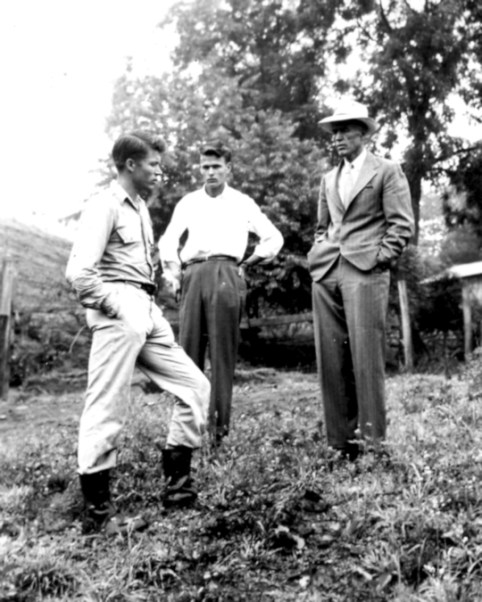
Bryan, Daddy’s youngest brother, came to help out for a couple weeks after his freshman year at Mars Hill College. When Granddaddy came to pick him up, Bryan took another look around, recalled how desperately poor our little family was, knew how urgently Daddy needed help, turned to his father and said, “I can’t leave.” In exchange, Daddy offered to pay Bryan’s bus fare back to school come fall.

Daddy, Bryan, and Granddaddy finalizing summer plans from a hilltop on the Webster farm.

Daddy grew rye and wheat. The previous owner had left an old combine behind. None of the nearby farmers had such a machine. With a lot of elbow grease and some baling wire (a farmer’s best friend), Daddy and Bryan got the combine in working order. Bryan hired out to cut the neighbors’ fields. But there was no demand for grain that year. All the farmers could offer in payment was the one thing Daddy didn’t need—more grain. He didn’t have two nickels for Bryan’s return trip.

It took only a year for Daddy to figure out his farming dream had died, and ever after, it pained him to talk about that year. But without another source of income, we’d soon be homeless. Daddy found a non-farm job that led to another and another until he retired years later as vice-president of the insurance subsidiaries of what had become, through a series of mergers, Bank of America.

Daddy never lost his love of the land, though. Wherever my parents lived, he grew a garden. He gave away more food than he and Mama kept for themselves. He couldn’t help himself. Only one home couldn’t accommodate a garden. That was when Daddy experienced a near-fatal heart attack. The prognosis gave him only a couple more years. Daddy and Mama moved again, this time to a place with an extra lot. Daddy was back to gardening, giving it up only shortly before his death from congestive heart failure thirteen years later.

I believe Daddy was happiest when he had dirt under his fingernails. I guess you can take the farmer off the farm but you can’t take the farm out of the farmer.

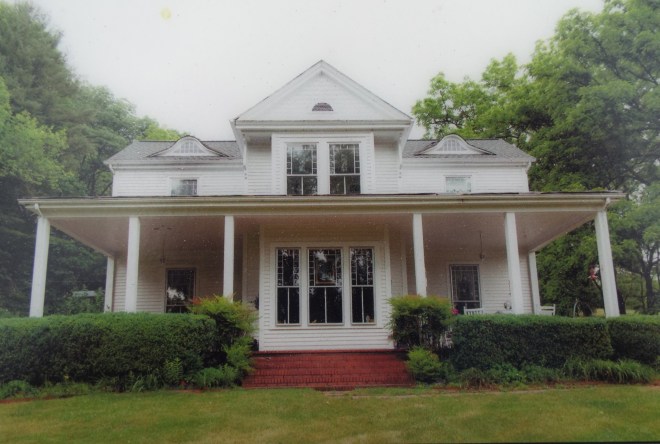
The Webster farmhouse today,  having been lovingly restored by Lacy and Dottie Thornburg

(By the way, I’m happy to say a version of this article has recently been published in the anthology, Bearing Up, a series of essays about overcoming hardships.)


Dear Lula

My grandmother, Lula Smith Coats,  11/25/1894-4/14/1942

(I was recently challenged to issue a dinner invitation to one of my ancestors. I chose my paternal grandmother, who died four years before my birth.)

Dear Lula, (you don’t mind if I call you that, do you?)

Will you please join me for dinner on Saturday evening? There’s so much I want to ask you. You’re the grandmother I never got to meet, having died just after my parents met. As a child, I didn’t know enough to ask about you, and once I had the good sense to get interested, some of the details had begun to fade from the memories of your children.

I want to know what it was like raising seven boys. They talked about some of their mischief, but I’ll bet they left out a few juicy details. I’d love to hear their mom’s perspective. You probably have stories of precious moments with each of them, too. I’d like to hear them. What made you proudest of them? (And did you secretly long for a daughter? Wouldn’t it have been nice to have some female companionship in that household! Did you dote on nieces? Seek feminine refuge with your sisters?)

Would you describe your typical day—if there was such a thing? I know you washed clothes in a pot over an outdoor fire and that between preparing breakfast, dinner, and supper you worked in the fields along with the rest of the family. And that you cleaned, ironed, made everyone’s clothes. What other chores filled your days? Did you ever have a moment to yourself?

What were your favorite activities? Daddy told me you gardened, played the piano, sang, and told stories. Were there more? What did you love to do above all else?

What would you have said and done with the twenty-two grandchildren you never got to know? Could you ever have imagined that after having seven sons, the first five grands would be girls—and that of the first eight grandchildren, seven would be girls? Would you have sewed up some frilly dresses for us? Would you have oohed and cooed over us? What advice would you have given us as we grew up?

And what about your experiences as matron at the Poor House? I never heard much about that. It must have been quite the experience raising those boys while overseeing all the domestic chores of the County Home when its seams were bursting during the Great Depression. Did you ever worry about the boys being exposed to the TB patients? To their being around convicts assigned to work on the farm? To their being around so much sickness and dying? Or did you even have time to think about it while you were overseeing the cooking, housekeeping, laundry, medications, clothing and personal needs, and more? Maybe you were just glad your boys had a roof over their heads during those tough years.

You were twenty-five, mother of four children, and pregnant with your fifth when our country finally recognized that women have an inherent right to vote. Did you take advantage of it? Your husband and father were on opposite political sides, almost rabidly so. Where did you fall? Did you ever share your political leanings with either or both of them or did you keep quiet about the whole thing? What was it like, in general, to be a woman in rural North Carolina in the early twentieth century? Would you have supported my feminist activism in the second half of the century?

I want to know about your strokes and your migraines, too. I used to suffer from migraines, too, so I have an inkling how you must have felt. But by my time, they’d at least discovered some medications that helped a little. It must have been devastating being in such pain and cooped up in a dark room so much of the time while life was swirling outside your door. Is it true that the doctor bled you when your blood pressure spiked? Did he use leeches? They say that after your first stroke, you were bedridden for a year or two and had to learn to walk and talk all over again. Is that right? What got you through those days and nights? Were your sons attentive to your needs? When you were up to it, did they fill you in on their days? Did they confide their fears and dreams?

And the little things—what was your favorite color? Your favorite song? Your favorite radio program? Did you have a favorite food? Book? Movie? Holiday? What were your pet peeves? Most dreaded chore?

Then there’s Granddaddy. The story goes that you were his seventh-grade teacher and that’s when you met. You married as soon as the school year was over. (He was old for a seventh-grader.) Is that the way it all happened? How did your romance evolve? What kind of student was he? Where was the school? I understand you only taught that one year. Did you give up a longed-for career to marry and start a family or was teaching simply the most logical job available to a young, single woman in those days?

You see, I have so many questions! Please come early. I’ll invite all the cousins and we’ll have a good old-fashioned pajama party catching up on each other’s lives all night long. You’d better believe I’ll be recording the whole thing, too. I can’t wait!

With love and anticipation,

Your (4th) granddaughter Carole

Everybody Has a Story

Everybody has a story.

Each of us has a story that’s uniquely ours, though it may have been forgotten in the hubbub of daily life: the blare of alarm clocks, getting everyone up and out of the house on time, job demands and annoyances, financial worries, unexpected emergencies.

Sometimes it’s hard to recall that special moment or event. When we hear others tell their tales, we may tend to think our lives are tediously predictable and tame—though predictable and tame can be blessings, and we should count them.

I’m one of those people who forgot. My life has been blessed with what I used to think was normal: happy, healthy childhood; happy, loving family; food and shelter. Very Donna Reed, Leave It to Beaver, and Father Knows Best all rolled into one (minus the hats and gloves for PTA meetings and errands). I thought it was that way for everyone. Then I learned differently. The TV norm, mirrored in my own family life, was not the norm at all. It was a sad awakening.

In all the normalcy of my life, I completely forgot two most unusual events, one major and one not so much. But both are events that make my story a little different from the stories of other folks in my orbit.

The first was the decision the Gnome and I made to move to a land of strangers hundreds of miles from the known, leaving our jobs and other security blankets behind, to hand-build our own home in the country, just the two of us. It was a remarkable risk and a singularly unlikely step for us to take. Its very significance may be what pushed it to the back of my mind as part of my unique story.

It was a major life decision, but it quickly became the everyday. What brought us here and has guided our decisions and processes is part of our daily life, so it’s become our normal, something it never occurs to me to bring up by way of introducing who I am. Yet it’s the very definition of who I am. I tell that story here. (It’s a nine-part series interspersed with blogs on other subjects—just click your way through for the whole story.)

A totally different aspect of my personal story was a single event, one based purely on luck. At the time, the Gnome owned and managed a small travel and map store. He sold lots of outdoor products and thus was invited to attend the annual Outdoor Retailers’ Market, then held in Salt Lake City. The organizers planned a drawing for free tickets, lodging, and airfare for two to the market. Although he’d never attended one of these markets and assumed he never would, he figured he might as well enter the drawing. He was astonished when he got the call that he’d won. And just like that, we were off to Salt Lake.

The prize package included a few other perks, one of which was a bobsled ride on the Park City Olympic run from Utah’s hosting of the Winter Olympics of a few years previously. I’m not much of an outdoors person and had never taken up any winter outdoor activities the other side of rushing downhill in a plastic sled. But I was ecstatic about that once-in-a-lifetime chance to do something pretty amazing.

The Olympic Park officials are no fools. They provided an experienced driver for us novices. We were given a brief preliminary lesson, and, of course, we had to sign a waiver which reminded us we were doing something pretty darned risky. The waivers dire language did nothing to dissuade us.

We didn’t set any records, but within mere seconds we were hurtling down that run at seventy-eight miles an hour, our brains bashing against our skulls, our skulls smacking  violently against our helmets, and our helmets cracking against helmets in front of and behind us which, in turn, snapped our necks to and fro in full whip-lash fashion.

Meanwhile, we barreled down the earth-shatteringly bumpy run at what felt like faster-than-light speed. Imagine, if you will, plunging down a steep mountainside full of jagged boulders—it might be almost as treacherous as our bobsled ride. In less than fifty-four seconds (a lifetime, let me add) it was all over. I never want to move that fast again!
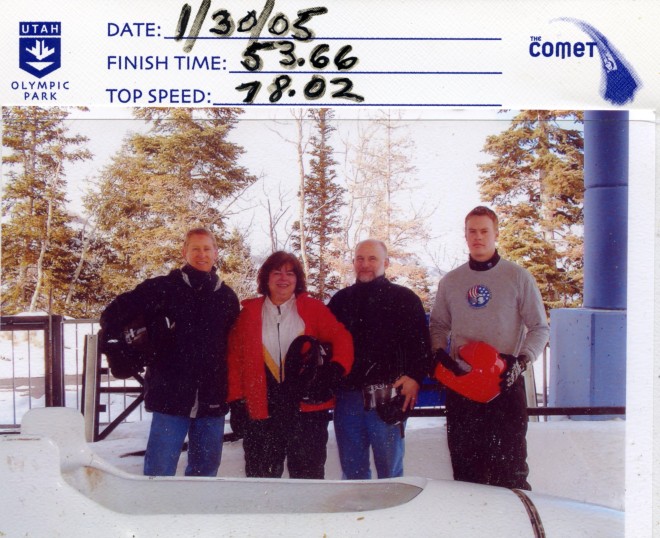
You can tell this is the “before” picture because we’re all smiling. They wouldn’t have dared to take an “after” photo!


By the time we crawled our stomach-churning way out of the sled and onto the welcomingly motionless ground, our brains were so scrambled we suspected permanent damage. To this day, I feel justified blaming any poor decision-making or forgetfulness on that bobsled ride.

As much as we anticipated our Olympic moment, the reality was utterly terrifying. I thought it would never end and for the only time in my life, I wished for an immediate death.

Knowing what I know now, I’d probably opt out of that once-in-a-lifetime “opportunity.” But if I’d chosen not to do it, I know I’d still have regrets for passing it up. What we regret is usually what we didn’t do.

But it will never, ever happen again!

How about you? Big or little, on-going or momentary, funny or serious, good or bad, what would you include in your story?