Joggins and Home

(The end of this reprise of our 2018 trip to Nova Scotia comes to a close with this post. But stay tuned for a couple of extras coming soon. To ‘travel’ virtually with us from the beginning, click here.)

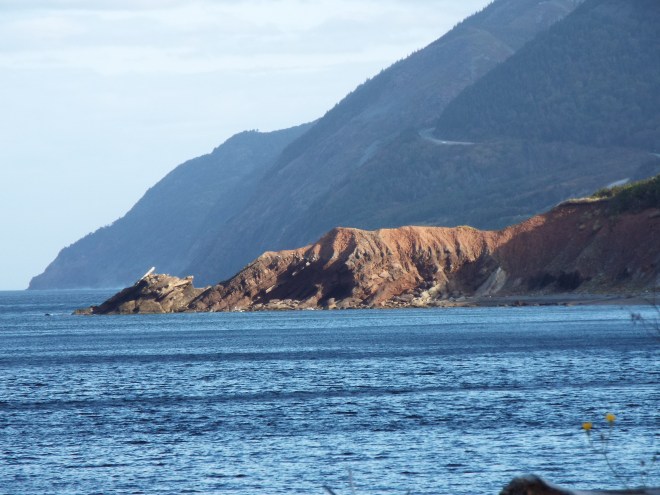
Bittersweet is the best that can be said for what was to be our last day in Nova Scotia. To ensure as much time as possible in Cape Breton, we had planned this to be a long travel day. It would take us practically to the border with New Brunswick, in the tiny rural community of Joggins. So tiny that AAA couldn’t find it to map out this portion of our trip. So tiny even a number of Nova Scotians didn’t recognize the name. Yet Joggins is home to yet another UNESCO World Heritage site. The Joggins Fossil Cliffs contain the most complete fossil record of life during the Coal Age, 300 million years ago. That’s a full hundred million years before the dinosaurs, so these fossils, preserved in the very place they lived, are the dinosaurs’ ancestors. Some of the fossils found here are giant insects. According to the Joggins Fossil Cliffs website, this is the only place on earth where you can view these rare plant and animal fossils in situ. Well, I was impressed! 

The tide is out at Joggins Fossil Cliffs. It will rise by an astounding 43 feet at high tide, cutting off access to the beach area.

See the tiny person in the middle foreground. You must walk down many, many steps from the top of the cliffs to reach the beach, something like 75, as I recall. That’s about six or seven stories! But we did it.

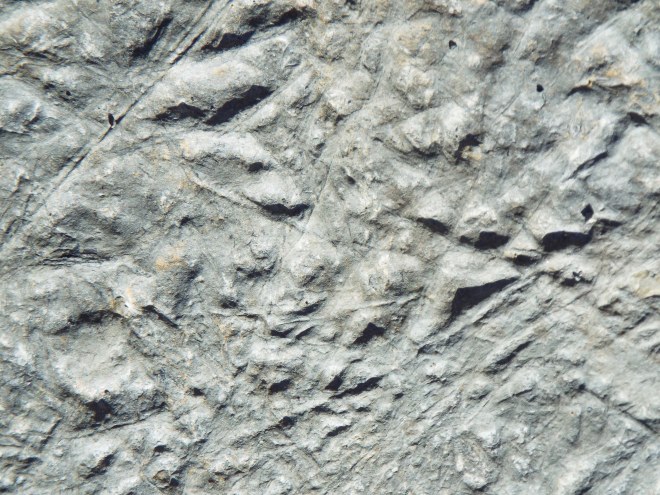
Giant insect?

We stayed the night at a true bed and breakfast inn, though we’d found it through Airbnb. We were joined by a young couple driving from Halifax to be with family for Canada’s Thanksgiving weekend. The four of us enjoyed a visit in the living room where we shared our respective’ backgrounds and learned a bit about cultural similarities and differences while enjoying some of our host’s homemade wine. Not only does Bridget own and run the B&B and make wine, but she’s also begun a business manufacturing buckwheat pillows—and she’s a former international professional singer, besides. (And her breakfast was fabulous!)

Crab Apple Inn, Joggins, Nova Scotia

The next day saw us driving across New Brunswick and into Maine. Though the leaves had only just begun changing color in Nova Scotia, they were really showing off in New Brunswick.

Not be the sharpest photos ever taken, but hey . . .

we were going 110! (in kilometers, of course)

Crossing the border back into the States was harrowing—at least the waiting was. We’d read that we needed to itemize all our purchases and have them and all receipts readily available for inspection, so we’d spent a long couple of evenings getting our documentation and souvenirs organized. Though we’d practically sailed into Canada (no lines and only a single benign question by the border agent), we waited here for close to forty-five minutes. Plenty of time for us to begin feeling guilty for merely imagined offenses. Cameras were watching from every angle. We tried to look innocent and nonchalant. Did that make us look like crooks instead? Our unease only increased when the border patrol unlocked and entered the RV in line in front of us.

Finally, it was our turn. We were asked the nature of our visit, if we’d enjoyed our stay, and whether we’d purchased anything other than souvenirs, personal gifts, and incidentals. That was it. A lot of worry for nothing.

In Maine, we made a little detour to stay in Seal Harbor, right at an entrance to Acadia National Park, a place I’ve always yearned to visit. Was it exhaustion as we were nearing the end of our travels? Was it being surrounded by so many leaf-peekers and their vehicles after so much Nova Scotia tranquility? Whatever the reason, we were underwhelmed. It was the only disappointment of our twenty-five-day journey, but it was about to be made up for in a big way!

We made one last detour before the big push to get home. When we’d come across an Airbnb listing in the small village of Newbury, Vermont, we added a day to our itinerary just so we could take it in. Everything about our host, her home, her village seemed so iconically New England.

And so it turned out to be. The home we stayed in is almost two hundred years old on a street of similarly aged residences, mostly modest clapboard homes with gabled fronts. Most of the village’s structures were built either between 1790 and 1860 or in the ten years following a devastating fire in 1913.

Not every residential neighborhood is on a town’s Main Street, which, in this case, is also Vermont Highway 5. Never was there a quieter thoroughfare. Between the residences is the core of the village, the Village Common, a large green space for public use. The village hall, village school, and Methodist Church sit on one edge of the Common. The entire village, flanked by the Connecticut River, is a historic district.

Simply idyllic. Just our style.

Linda, our host, is a professional photographer. She works in black and white, uses old cameras with actual film, and has her own darkroom. Like the Gnome, she collects cameras. (I told her she should count them before we left–wink, wink.)

She was kind enough to take us on a walking tour of her charming village the next morning. We passed the Village Common, the school, the church, the post office, the village hall, the public library. We stopped for chats with other morning strollers. We talked about the village’s history and Vermont’s fabled town meetings. We took in the village store (the oldest country store in Vermont) for a steaming cup of coffee and yummy homemade cinnamon rolls, then sat on the steps to chow down. We dropped in at the bank to study old black and white pictures of the fire.

The bank is closed on Saturdays, but our host has a key. (It seems that the few villagers who lock their doors share their keys with the neighbors.) Linda loves her hometown and its history, and it shows.

Unfortunately, sometime between our return home and getting to this point in my travel diary, the last two hundred or so photos mysteriously disappeared from our camera. I had to resort to Google to find a couple of photos to share. 

Newbury Village Store. Photo credit: redjar [CC BY-SA 2.0 (https://creativecommons.org/licenses/by-sa/2.0)%5D, via Wikimedia Commons


Tenney Public Library, Newbury Village, VT. Photo credit: Magicpiano [CC BY-SA 3.0 (https://creativecommons.org/licenses/by-sa/3.0)%5D, from Wikimedia Commons
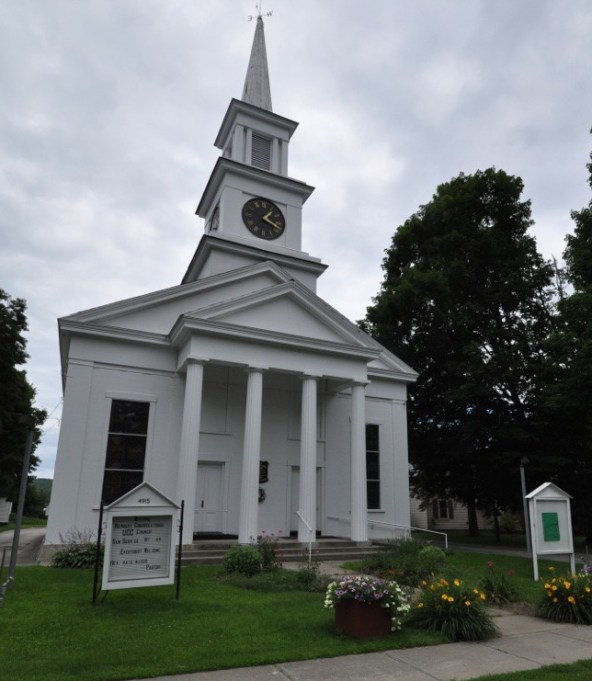
Newbury Village UCC Church. Photo credit: wikimedia.org/wikipedia/commons/5/56/NewburyVT_UCCChurch.jpg

Just because our travels are over, don’t think I’m through writing about Nova Scotia, There are still a couple of reflective posts (and, of course, photos), so I hope you’ll come back to see what they are.

Cabot Trail, Part II

(The Gnome and I recently took a long (and long-awaited) road trip throughout Nova Scotia. To read about—and see—it from the beginning, click here.)

It was almost mid-afternoon on our trek around the Cabot Trail when we stepped into a small museum near Dingwall (on the northern edge of Cape Breton Highlands National Park) for a much-needed bathroom break. A couple of (very) young women from New Zealand had the same idea. (Amazing how you meet people from all over the world on the trail!) They were cycling the trail from the opposite direction. While we were going downhill, they’d been climbing all day, since dawn, in the chilly rain. How I felt for them!

I had to chuckle at the sign on the inside of the bathroom door. It said something to the effect of, “We get it. You really need to go,” and welcomed folks to use the amenities (they are few and far between on the trail), but it also asked for a donation if you planned to skip the museum itself. Fair enough! We decided to take it in, though. It was surprisingly professional and enlightening, especially for such a tiny place. There’s even an area for genealogical research.

We saw lots of informational exhibits like this one at the North Highlands Community Museum which explains why all the island’s small communities are so tightknit. Note how doctors made house calls well into the mid-20th century!


Oh, my! I sat at a desk like these in my rural elementary school.

The pleasant woman staffing the museum told us she thought the part of the trail still ahead of us was its prettiest section. That was hard to believe, given the vistas of our previous two days. Turned out she was right, though the day was so stormy it wasn’t such a good picture-taking day. We decided to come back for more the next day, which was less rainy, but extraordinarily windy and often almost as hazy. Still, we took lots of photos. (You knew we would!) 


We took a few damp hikes, including the bog walk at which, if we’d been there a few hours earlier, we’d have surely seen moose—we sure saw lots of tracks. We also hiked the short trail to this Scottish Highland shieling, a hut to shelter crofters (farmers) and their livestock from the brutal weather on the moutaintops. And we hiked enough of the Skyline Trail to see . . .

this! After 49 years’ worth of trips searching in vain, we were able to prove to ourselves once and for all that moose are not the mythical creatures we’d begun to believe them to be.

From the road far below, you can see folks that made it to the end of the Skyline Trail, at least with binoculars—or a telephoto lens.

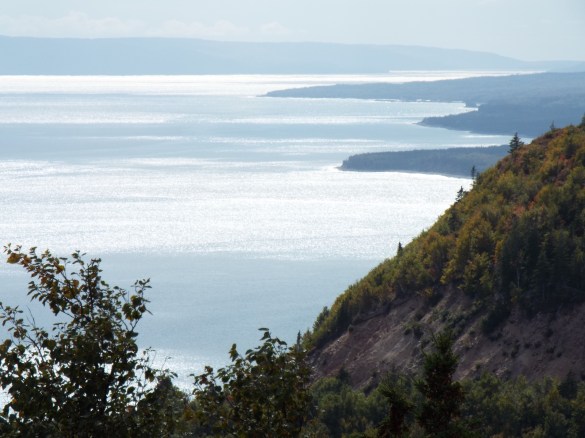
Photos of the curvy, coast-hugging Cabot Trail, where the mountains kiss the sea.

Our destination was Chéticamp. Little did we know that on one of our look-off stops, our camera had captured an image of the home where we’d be spending the next couple of nights.DSCF5596 Our charmed, and charming, hosts had found themselves one of the most perfect places on earth to live. Not only is their home on the edge of the Chéticamp River (which they often kayak, lucky ducks!), but on the opposite side of the river is the majestic park itself. From their huge living room windows, they can also see where the river empties into the Atlantic Ocean. Where else could you get that kind of view? It was a good way to end our trip around the park.
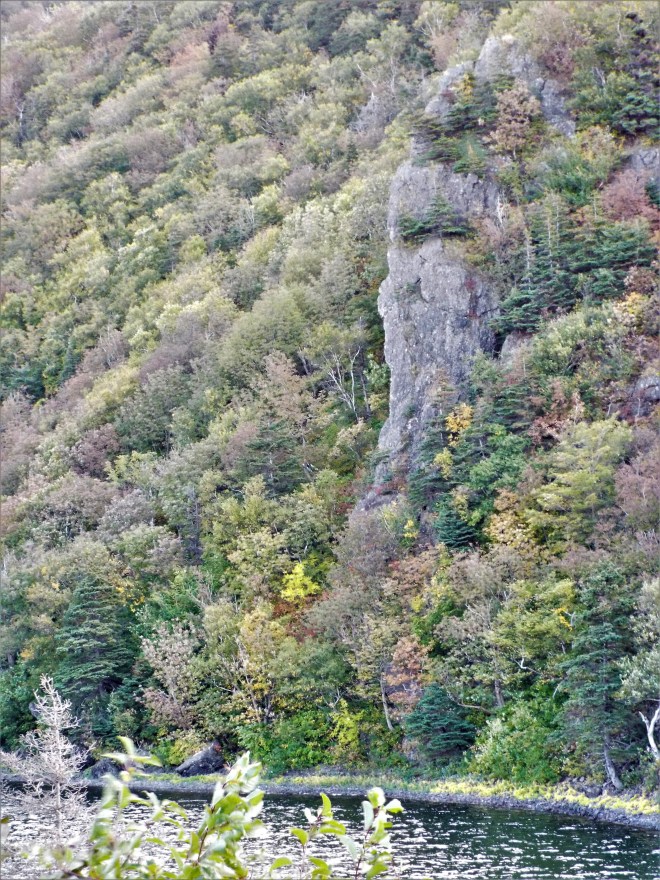
The view from the living room window includes this mountainous cliff, part of Cape Breton Highlands National Park.

This spit of land is all that separates the river from the ocean, also seen from our hosts’ living room window. How cool is that?!


Come back for the last days of our travel adventure and some more reflections, won’t you?


The Cabot Trail, Part I

(To start at the beginning of our recent trip to Nova Scotia, click here.)

When it comes to the Cabot Trail, the winding road that hugs the coastline in Cape Breton, much of it in Cape Breton Highlands National Park, words are a waste. Let’s just look at some pictures!

seal island bridge, sydney river

We crossed the Sydney River by way of the Seal Island Bridge (vantage point: atop Kelly’s Mountain) to reach the Cabot Trail.

Someday I want to go here to see if I can learn Gaelic. Really, I do.

The sky was angry and so was the sea! Can you see a bit of the white house hiding behind that huge spray of water in the lower right photo? (Click on individual photos for larger view.)

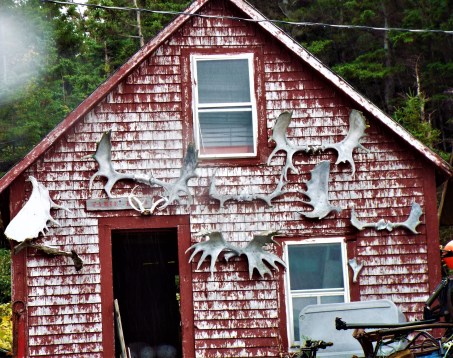
Cabot Trail: Anglican ChurchA stand of birch, an Anglican church, and a workshop adorned with moose antlers

DSCF5295

Scenes from Neil’s Harbour (I believe).

Meat Cove: much prettier than it sounds. You reach this beautiful spot after a very long (30 minutes or so) drive on a rutted dirt road (only to return the same way). Not much more than a campground (see the little cottages in the foreground of the bottom picture?), it’s worth the drive. They say that on a clear day you can see Newfoundland from this northernmost Nova Scotia community. We weren’t there on a clear day.

Check out all those balancing rock cairns on the rocky beach far below us at Meat Cove.

Why, yes, you can find sand on Nova Scotia’s beaches! (A wee bit, anyway.)
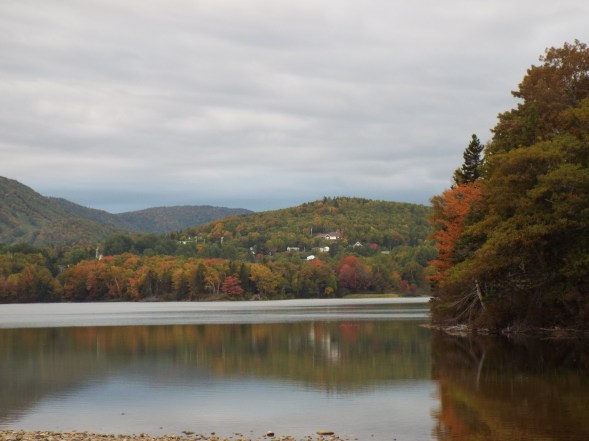
Freshwater Lake, Ingonish Beach
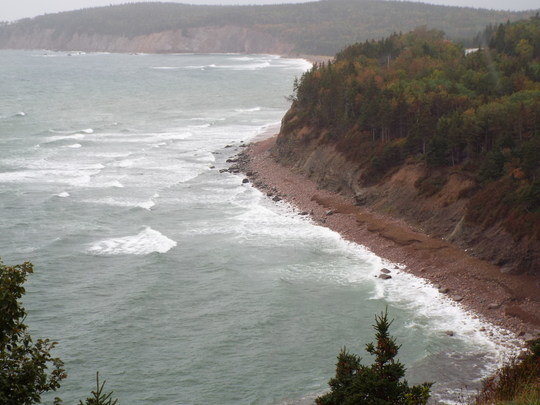
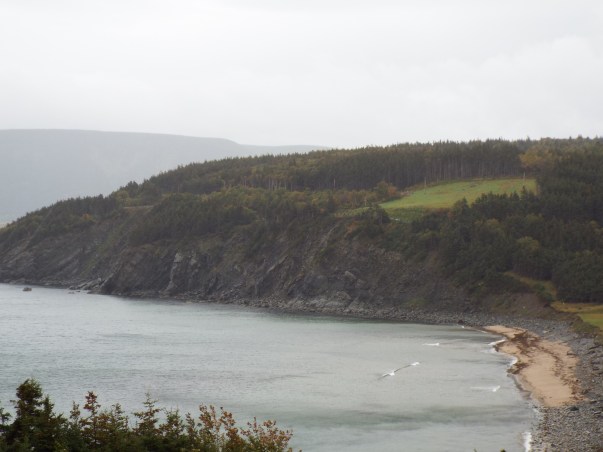
cabot trail shoreJust some pretty Cabot Trail views, even on a rainy, foggy, hazy day
Stay tuned for more on Cape Breton’s Cabot Trail.

Nova Scotia’s Eastern Shore and More

I’m currently in the midst of a series of posts about our recent, long-awaited return to one of my favorite places, Nova Scotia. If you’d like to follow our adventures in words and photos from the beginning, click here.)

From Wolfville, we headed for Cape Breton Island by way of Nova Scotia’s Eastern Shore. The province is divided into seven geographical regions, and this one may be the least well-known. It’s surely the least visited by outsiders and maybe even other Nova Scotians. There are no towns to speak of, only communities—and small ones at that. Places with names like Ecum Secum. According to Wikipedia, the name comes from the M′ikmaq (aka Mi′kmaw) language and means ‘a red house,’ which suggests to me that may be about all that was there at the time. The nearest town of any size is Antigonish on the west coast, 45 miles away, with a population of 4,200.

As usual, we drove as close to the coast as we could get, this time on Trunk 7, also known as Marine Drive. Our Airbnb stop for the night was at Moser River, in what was billed as a former prospector’s cottage. It was an instant hit, and Gail, our Airbnb host, was simply delightful. (More about her in a future post.)

Our Moser River prospector’s cottage Airbnb and area images. (Click on individual photos for larger view.)

We were advised to stop for food or gas in the community of Sheet’s Harbor, about 30 miles away—that’s how unpopulated this place is. People here are mostly connected to either the fishing or gold mining industry.

The Eastern Shore is not a place to go if you depend on theme park style extravaganzas for entertainment (though if you time it right you can join in a sand sculpture competition, a parade, a cakewalk, or a Celtic jam session). But if you want a little solitude away from everyday hassles, it’s perfect. I can imagine hanging out here for a long weekend with a hammock and a good book or hiking boots and a walking stick. It’s the perfect retreat stop—as long as you bring your own meals. Unfortunately, we had only one night at this peaceful place.

And the next day we finally made it to the place that had held onto our hearts for so many decades, Cape Breton Island. We would be here for six days instead of the one of so long ago. It would still be too little.

But first, we made a little detour to the opposite side of the province. We kept having to remind ourselves how short a drive it is from one side to the other. This side trip was to Cape George, near the town of Antigonish. It was well worth the drive.

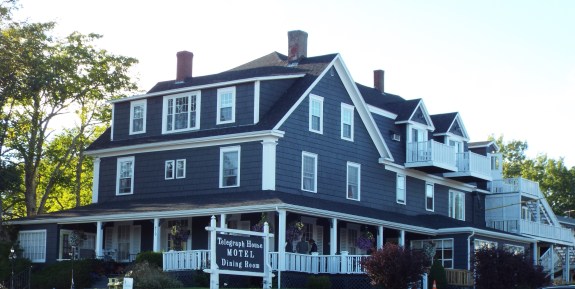
Our first Cape Breton stop was the town of Baddeck (pronounced Buh-DECK). We stayed at the historic Victorian-style Telegraph House, built in 1861, one of the few non-Airbnb places we stayed during our travels. At one time, the Telegraph Inn contained the office of the first Trans-Oceanic Cable Company. Some of the first telegraph messages in North America emanated from here.

Baddeck is famous for two things. It’s home to the Bras d’Or Lake (arm of gold), actually an inland sea. It’s roughly sixty miles long and thirty miles wide. Pretty darned big. And beautiful, surrounded as it is by low mountains. We could never get a photo that came near to doing it justice.

Baddeck is also where Mabel and Alexander Graham Bell lived for the latter half of their lives. It was here that Bell established a research laboratory—the first Bell Labs. He used the lake to test his huge kites, hydrofoil boats, and airplanes, just a few of his varied research projects.

Of course, there’s a museum, and since the Gnome is interested in anything having to do with inventiveness, we had to go.

Married as I am to someone who observes every little thing, I was especially drawn to this quote memorialized in the museum.

I was impressed to learn that Bell was much more interested in his work teaching deaf students (Mabel was deaf), and later with aviation, than with his best-known invention, the telephone. In fact, he was rarely interested in following through with any of his inventions after the initial creation; he was ready to move on to the next thing, leaving the details to others.

The highlight of our time in Baddeck had to be finding a ceilidh (KAY-lee), or kitchen party, where we got to listen to some lively traditional Cape Breton tunes by fiddler Mike Hall. Mike didn’t just play; he talked about the history of the music and how the Scottish Highlanders who were driven from their homelands with no instruments or written music managed to keep their musical tradition alive and true to its roots. It was mesmerizing—and quite different from the bluegrass jams we attend at home.

Cape Breton is where you might hear not only English and French, but also Gaelic and Mi′kmaq, an Algonquin language. It was fascinating to see multi-lingual signs everywhere. Appropriately, top billing usually matched the primary culture and language of a given area, as far as I could tell. Here’s a little Gaelic for you: Fàilte gu Cridhe Gàidhealach Albainn Ùr.  (Don’t bother trying to pronounce it—it sounds nothing like you’d think if English is your primary language.) As best I can determine, it translates to “welcome to the heart of New Highland Scotland.”

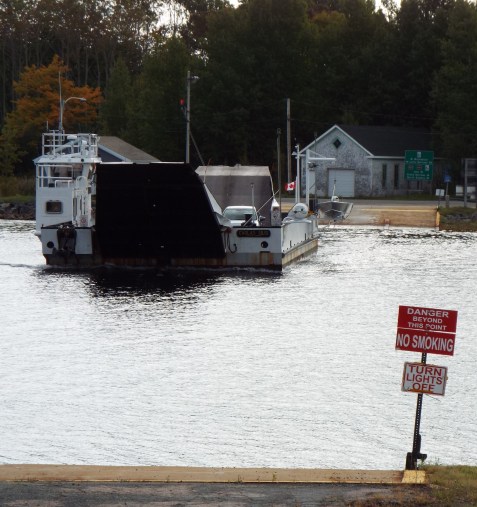
We left Baddeck by way of Iona, traveling ever so briefly on a cable ferry to Grand Narrows, then on to Sydney and the Cabot Trail, the subject of my next blog post.

Here comes the ferry. Short crossing—very short.

(Check back next week for more of our Nova Scotia travels as we head to the famed Cabot Trail and Cape Breton Highlands National Park.)

A Couple of Nova Scotia’s Historical Sites

(This post is part of a series about a recent trip the Gnome and I recently made to Nova Scotia. To travel along with us from the beginning, start here.)

In previous posts about our visit to Nova Scotia, I’ve mentioned a couple of sites that deeply moved me, promising to delve into them later. Today, I’m keeping that promise with memories and photos of our visits to Grand Pre, a UNESCO World Heritage Site, and the Canadian Museum of Immigration.

A little history is called for here. The Canadian encyclopedia entry about the Acadians of Grand Pré begins this way: “Soldiers rounding up terrified civilians, expelling them from their land, burning their homes and crops ‒ it sounds like a 20th century nightmare in one of the world’s trouble spots, but it describes a scene from Canada’s early history, the Deportation of the Acadians.” The story of the expulsion of Acadians from Grand Pré is painfully evocative of our own Trail of Tears history, when the Cherokee were led on a forced march from the east to Oklahoma.

In French, the forced deportation was known as le grand dérangement. Sounds fitting. Since 1604, Acadians had created a thriving, peaceful community in the Bay of Fundy area. During their 150 years here, they developed an impressive dyke system to control the bay’s high tides, a method still in use today; they developed and maintained a rich agriculture; they created a massive and gorgeous landscape

The arduous task of building earthen dykes to hold back the Bay of Fundy’s high tides

A  typical Acadian farmstead

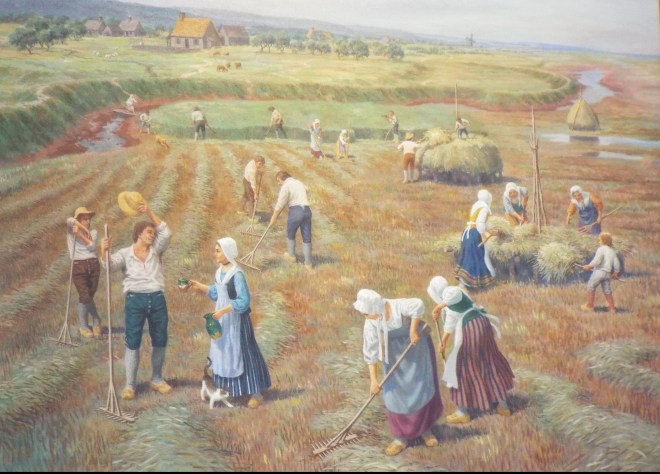
An image of  an Acadian day in the fields

A portion of the 3200-acre landscape of Grand Pre’

Meanwhile, the British and French were engaged in a long tug of war over Nova Scotia. The Acadians had sworn neutrality in any conflict between the two countries, but that wasn’t enough for the British governor. In 1755, he hatched a plan to surround their churches, threatening entire families with bayonets, while breaching the dykes and burning homes and crops. The first 3,000 deportees were sent to Pennsylvania, South Carolina, and Georgia while 7,000 more were shipped to other British colonies, France, and the Caribbean during the next seven years.

Try putting your family in this scene:  panicked flight, trying to stay together, leaving everything–everything–behind forever.

People found themselves left, like Longfellow’s Evangeline, to wander fruitlessly in search of the families they’d been separated from. That, too, sounds all too familiar in today’s troubled times. (Only later did Acadians find their way to Louisiana because of their familiarity with the language. Thus did the Cajun culture become established.)


Detail of the statue of Henry Wadsworth Longfellow’s heroine, Evangeline. It graces the entrance to the memorial church built in the early 20th century which serves as a museum today. It was a church at this approximate location where British soldiers set up headquarters, rounded up the village’s men and boys, and told them their land, livestock, and almost everything they owned were to be forfeited to the Crown, and that their families were to be deported.

By 1764, the British government allowed small groups of Acadians to return, but they didn’t return to their former lands—nothing was left for them there. Instead, those who returned settled on the mainland and in Cape Breton. It was, indeed, as the Acadian Shores restaurant patron we overheard had said, a shameful moment in Nova Scotia’s history.

But Nova Scotia can at least be proud of how it owns up to inglorious historical moments. I was impressed by this trait both here and at the Canadian Museum of Immigration, located in Halifax.

Even before you pay your admission fee to the immigration museum, the Wheel of Conscience almost smacks you in the face with its raw power. A circular steel structure about six feet in diameter, the wheel includes names of the approximately one thousand Jews who were aboard the MS St. Louis in May 1939, the eve of World War II. They were fleeing Nazi Germany, seeking and being refused entry into Canada and other countries, including the United States. With nowhere to go, the ship was forced to return to Germany where a quarter of its passengers ultimately died in concentration camps. 

 The kinetic sculpture also features four rotating, interlocking gears, each one larger than the one before and each emblazoned in red with a single word—from smallest to largest: hatred, racism, xenophobia, anti-Semitism. As visitors study the sculpture, they can’t help but see their own reflected faces looking back at them.

Inside, the exhibits are equally powerful. The museum is located in the very place, Halifax’s Pier 21, where more than a million immigrants came into Canada between 1928 and 1971. It’s logical that the museum would tell what that experience was like.

But the museum is more than that. It also tells the story of 400 years of immigration to Canada, and it takes an even broader approach, looking at refugee life as a whole, documenting through both visual and oral exhibits the horrors that force people to leave their home countries.

What horrific conditions would cause you to make this kind of journey? For how long? To what unknown future?


Imagine living in a tent this size with your entire family and all your very limited possessions, buckets for washing yourselves, your food, your dishes, and more. Imagine living here for up to eighteen years–or more? What would have brought you here?

Some of these painful exhibits come with a warning: “Not suitable for some visitors.” I tend to shy away from such stories, but I think we should force ourselves to face them so we can remember—cannot forget—the realities that send people fleeing all they know in hopes of finding a better life, a safer place, for their families. I did not photograph them.

Among other displays we visited were life-size replicas of a ship’s cabin, a life raft meant for eight that carried as many as thirty refugees, a child’s trunk, a family’s crate carrying everything they could cram in.

You can read notes handwritten on cardboard luggage tags from previous museum visitors who had immigrated, and you can watch videos of immigrants telling their personal stories. As moving as these exhibits are, what touched me most was finding myself in the company of a number of immigration ‘veterans,’ individuals who had landed at the immigration center in Halifax—at this very site when they were mere children. Other visitors were children of immigrants who had come through the port of Halifax. It was truly humbling to hear their stories, to be in their presence.

We didn’t want our visit to Nova Scotia to be touristy; we didn’t intend to spend much time inside museums. Our trip was meant to be about getting a feel for day-to-day life in the province and getting to know real-life Bluenosers while soaking in the phenomenal natural beauty of this place. But I’m really glad we took time out to visit these two sites. They, too, tell a story about the real Nova Scotia. And the rest of the world, in the past and, unfortunately, the present. They remind us about ‘man’s inhumanity to man’ as well as hope and the possibility of redemption.

This moving piece of public art, “The Emigrant,” near the Immigration Museum, pays tribute to those who have said goodbye to their families, hopefully temporarily, in search of a better life for all of them.

(Check back next time for more of our Nova Scotia travels.)

Return to Nova Scotia

Forty-nine years later, the Gnome and I have fuzzy but memorable impressions of our first visit to Canada. They go something like this—Ottawa: old-fashioned officialdom; Toronto: sleekly professional with more traffic lanes than we’d ever seen; Montreal: sophisticated, Euro-cosmopolitan; Quebec City: old-world charm; rural Quebec: rolling green farmland; New Brunswick: waves of amber; Prince Edward Island (PEI): verdant romanticism.

And then there was Nova Scotia, a place I’d seen in my dreams, a place where the mountains meet the sea, a place of blues and greens, a place that inspires the imagination, a place of calm and peacefulness.  I’d always imagined living someplace where I could open my front door to the ocean and my back one to the mountains. I assumed it was a mythical place, attainable only through my fanciful visions.

Yet, here it was, right before my awestruck eyes. But our trip was at its end. We only had a fraction of two days to soak in this magic. Still, Nova Scotia managed to grab a little piece of our hearts.

So, how come it took almost fifty years for us to return to this bewitching land? We’d managed to revisit some of the other provinces and explore them further, making a five-hour, 186-mile train trip to (what we thought was far north) Moosonee, Ontario, on the Polar Bear Express. (Rail is the only way to reach Moosonee by land.) And we camped on Quebec’s Gaspé Peninsula, home of Forillon National Park and the Chic-Choc Mountains, a continuation of the Appalachian chain.

Maybe we stayed away so long out of an unconscious fear that reality couldn’t possibly measure up to our happy memories. Or maybe we instinctively knew the longer we yearned, the more phenomenal it would all be when our dreams finally turned to reality.

And so it was that in mid-September we made our way back for a long-planned and even longer-imagined visit to the place that had held on to our hearts for so long. A twenty-six-day road trip, eighteen of those in Canada’s second smallest and second most densely populated province (coming in after PEI in both cases).

Eighteen days, especially compared to the barely two of our previous visit, should be enough time to get to know a place so small that it’s a mere 360 miles from tip to tip, so small that nowhere in the province is more than 42 miles from the ocean, right? Hardly. That was clear after only a couple of days.

We weren’t so much interested in visiting museums and traditional tourist sites, though we did take in a few. Instead, this time around we wanted to get to know the real Nova Scotia—her people, places, and culture. We didn’t want to just see the place; we wanted to feel it. We thought we could accomplish that by visiting community after community. But each locale has its own unique story and demands more than a quick pass through. Before we knew it, we were busy planning our next trip, one that keeps us in fewer places, but for a longer period of time in each.

Was it all we’d imagined? Oh, yes! In the next few weeks, I’ll be writing about some of the special places we saw, people we met, and things we learned. In the meantime, to tantalize you, here are just a few of the 3500+ pictures we took along our journey.

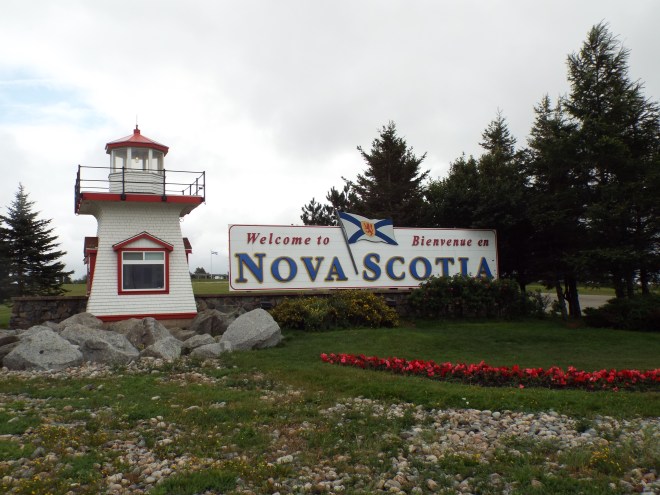
Long-awaited welcome

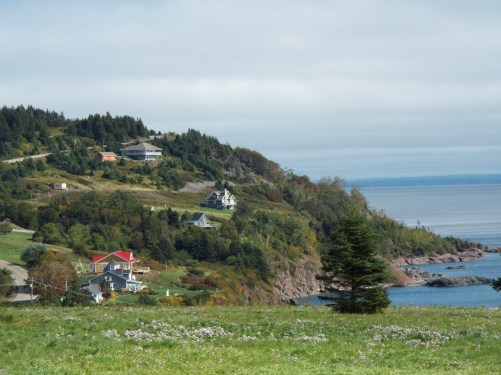
So many colorful houses everywhere–you’re as likely to see red, purple, or orange as you are white.

Early morning in Peggy’s Cove

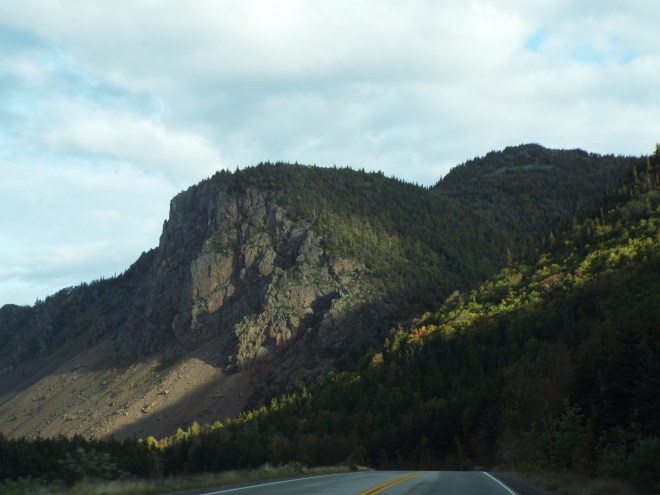
Beautiful Cape Breton

DSCF5984

We even got to see the beginning of Cape Breton’s fall colors.

DSCF3865

Looking out from a sea cave at Ovens Natural Park


DSCF4047

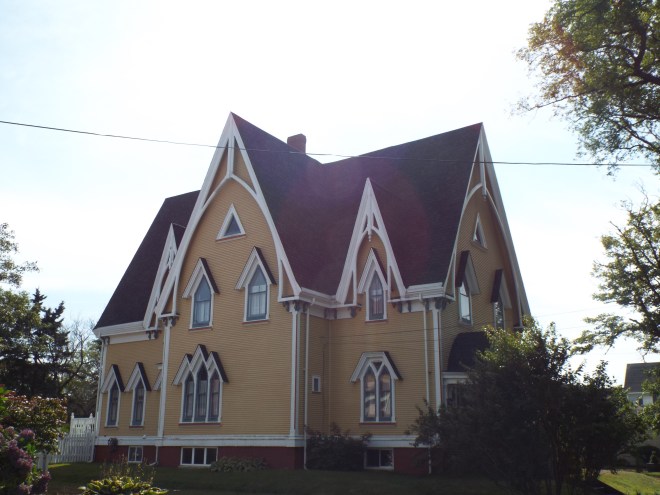
So many striking homes. So much detail.

Annapolis Valley

DSCF4332

Example of an 18th century  Acadian home

Oh, Canada!

The Landscape of Grand Pre, a UNESCO World Heritage Site


And here are a couple of Nova Scotia factoids: The distance from Nova Scotia’s southernmost tip to its northernmost is 360 miles, almost two hundred miles less than the distance across my home state of North Carolina. In land area, it is closest to, though smaller than, West Virginia, which is ranked 41st among our 50 states.

To join me on my journeys stay tuned for more stories and pictures.

Bear Sighting

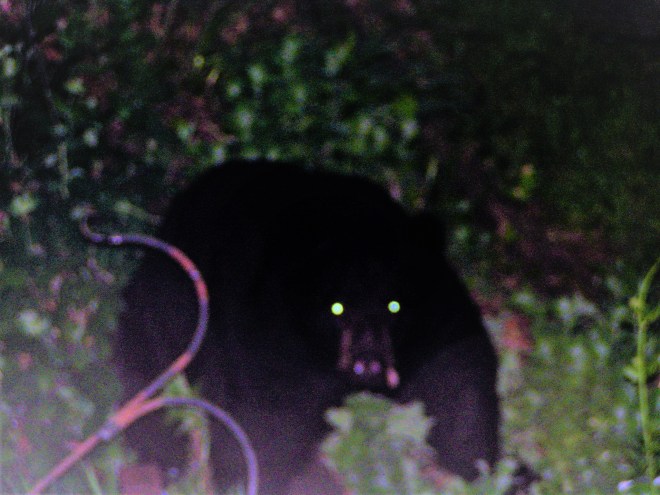
Have I told you about our late night bear visits? That’s right. We’ve had a bear in our front yard, on our wooded hillside, even on our deck. We named her Shadow. I tried to capture the tale in a rhyming story for the grandkids.

Okay, not the greatest shot, but hey, I was staring at a bear!

SHADOW

It was late, late one night—
I woke up to a crash!
A Kapow! And a Bang!
I jumped up in a dash!

I wandered outside
and what did I see?
A great big black bear
staring at me!

That bear was so black,
that bear was so big
with her cinnamon nose,
I just flipped my wig!

But why was she there
in my yard late at night?
She was eating my birdseed—
every single last bite!

What could she think
of seeing me now
peeking out in the dark
and watching her chow?

I thought she might run,
but I found that instead
she sat on her haunches
slowly turning her head

To give me a stare.
So I stared right back
till I suddenly thought
I ought to backtrack

Or she’ll give me a whack
with her giant bear paws,
or carry me off
in her great big bear jaws.

I tiptoed inside
and called Grampa Ron.
“Come here to the window!”
But the big bear was gone.

And so was the birdseed,
and the bird feeder, too!
We found it next day
at the edge of the wood.

Can you picture that bear,
feeder swinging from mouth
like a big picnic basket,
traveling south?

The next night and the next
she did not come back,
but the following night
what a thwack, whack, and crack!

A tree limb she broke.
Another bird feeder gone!
And where do you think
we picked up this one?

Right! Right you are—
at the edge of the woods
just where she left
the first of her goods!

She was so clever,
that great big old bear;
She gobbled her food
with nary a care.

She hasn’t returned.
I do not know why.
Maybe she’s patiently
waiting for pie!

The Tyranny of the Garden

Last week I extolled the virtues of gardening, and here I am saying the garden is a tyrant. I know. I’m a bundle of contradictions.

It always happens about this time of year—when the garden’s productivity turns into excess and demands more time than I have to give it. And I’m not talking about weeding and watering. For the most part, the Gnome takes care of those chores. I’m talking about harvesting the results of all the labor that has gone before. I’m talking about the next steps. This is the time of year I begin to reevaluate my relationship with the garden.

When the Gnome and I purchased our first home, we couldn’t wait to plant a garden. A few years after we moved to the diagonal, we tried gardening again. But we were too busy with child-rearing, house building, and jobs to keep up with it. When we retired, we took up gardening yet again—it was a natural extension of the simple lifestyle we were after. He liked working out of doors, doing something where he could see results, connecting to the earth.

I had my own reasons. Gardening is a huge part of my heritage; it ties me to my ancestors. Besides, I wanted to prove to myself that I could. If we were to find ourselves in the midst of a worldwide food catastrophe, I wanted to know I could still make food happen.

I like the smaller footprint we make by growing and eating our own food. Getting food from thousands of miles away costs the environment and decreases food’s quality and flavor. It doesn’t get much more local than taking a few steps from door to garden.

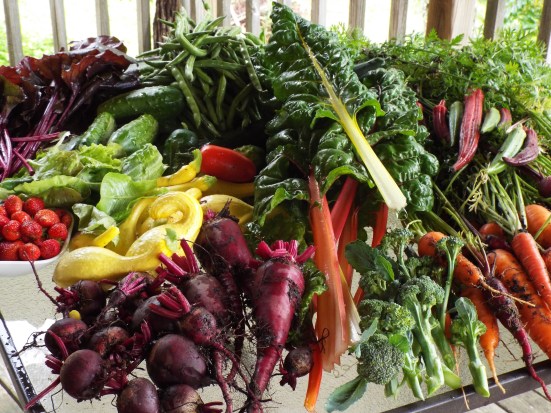
I like knowing exactly what’s going into my body. When I grow my own, I do. And there’s something almost magical about realizing the food I prepare and eat is mine! I made this happen. There’s nothing quite like looking at a plate of lima beans, broccoli, squash with onions, sliced tomatoes and cucumbers, and cornbread cooked with meal ground from our own corn and realizing that everything on the plate is fresh from the garden.

Gardening is primal. It’s healing. It’s hope. But it also takes over my life for about half the year. In the dead of winter, that’s a good thing. I need a break from winter’s tedium. But I have more in my life than gardening. At least I want to.

At this time of year, the garden is a demanding taskmaster. Food that isn’t harvested at the right moment gets tough and seedy. Failure to pick inhibits further growth. (Sometimes I could do with a little growth inhibiting, but it feels almost criminal to let it go.) Or it rots. Heartbreaking.

If it were only the hour or so of picking beans and squash, digging potatoes and garlic, pulling up beets and carrots, it wouldn’t be so bad. But that’s only the beginning. There’s the rinsing and scrubbing, there’s rearranging the fridge to find a few more square inches of space for the day’s gleanings, there’s the meal planning—what needs to be eaten right away and what can wait a day or two or three (when there will be yet another kitchen full of fresh produce filling kitchen counters), there’s the search for recipes to learn how to prepare that weird new veggie I just had to plant and for other recipes to keep yet another meal of green beans or summer squash from becoming boring.

There’s the pickling and root cellaring and dehydrating and freezing and canning so we’ll have food from the garden all year long. Cleaning the kitchen and emptying it of everything nonessential, because processing food takes a LOT of space. Getting out equipment and supplies and cleaning them. Filling huge pots with water and waiting for it to boil. Sweating in a kitchen that was hot even before I turned on the stove. Setting timers, watching pots and gauges, adding ice to already icy water to chill freshly blanched foods. Labeling freezer containers, filling them, and finding space in a freezer already bursting at the seams. Cleaning up. Putting away. There will be no time left today for those other things I hoped—or needed—to get done.

There’s figuring out how to distribute the excess. Harvesting on a day my donation spot will be open and able to take my offering, on a day I can afford to leave the garden and kitchen to make a delivery.

There’s postponing vacations and family visits until after gardening season ends and before it starts up again.

And there’s the refrigerator-full of vegetables crying out to be eaten. Squash and beans and tomatoes last night, eggplant and peppers and carrots tonight, beets and chard and zucchini and cucumbers tomorrow night. Yes, it’s all good, an embarrassment of riches for vegetarians like us.

But every once in a while a person just wants some chips and a ‘Not Dog.’

Soul Food

Since the Gnome and I took up gardening in a serious way, food has sort of taken over my life. It all starts in January when I sit down with the tall stack of seed catalogs that have been filling my box for the last month or so.

The pictures alone make me drool. The exotic new vegetables, the colorful ones, and especially bean seeds capture my imagination. In truth, beans aren’t my favorite dish, but I’m batty over the seeds. So, beans take up a fair amount of the garden landscape.

After the seeds arrive in February or March, I begin diagramming the garden. How much space to allot to this or that veggie, how to rotate the crops, which plants will be good companions are all questions that come into play during the planning process.

Spring means cleaning up the previous year’s garden, weeding, and watching long-term forecasts to determine when I dare to plant the earliest crops. By late spring, I do an almost daily dance with the weather, trying to outguess its long-range plans. Can I push the planting up a week this year or should I err on the side of caution and wait for that ‘last average frost date’?

At whatever date I settle on, planting begins in earnest, along with mulching and more weeding. Seeds need moisture to germinate, so I find myself in the garden with a hose on dry days. Within days, maybe up to a couple of weeks in some cases, tiny green sprouts begin popping up out of the ground. It’s a magical time and my joy is palpable.

When I’m gardening, I’m following in some mighty big footsteps. Feeding the family from the land was the work of all my grandparents and theirs before them. For them, it was honest work that meant survival. Every moment I’m in the garden feeds me ancestrally.

But harvest time is what truly feeds me, both literally and figuratively. I can’t help but smile when I look at a dinner plate filled with only the bounty of our garden: green salad, asparagus, Swiss chard, squash, rutabaga, corn, kale, eggplant. Whatever the dishes of the day, I’m satiated before I take the first bite.

Harvest time also means preserving, another soul-fulfilling activity. The hours and days I invest in food preservation mean we’ll have tasty, healthy eating from our garden all the way through winter and right on up until the next harvest season rolls around.

Typical grocery list during gardening season

Harvesting food and preserving it make me sing. It doesn’t get much better than that.

So Beautiful It Changed My Life

What an amazing concept—something so beautiful it could change a life. Most of us, if we’ve lived long enough, have had at least a couple of life-changing experiences. But by nothing more than beauty? That was the writing challenge I was presented recently: a time when something was so beautiful it changed your life. It took me aback for a moment. But only for a moment. As I scoured my memory, it came to me.

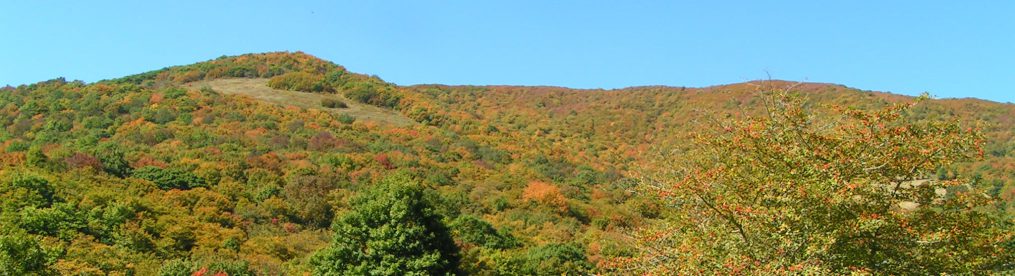
Driving from Kentucky to the mountains of North Carolina in 1979, after the Gnome and I had made the mental decision to move but before we had actually taken action to make it happen (in other words, it would be easy enough to back out), I looked at the mountains on the horizon with new eyes. It was as if they were cloaked in blue-green velvet.

Their apparent softness overwhelmed me. Though I didn’t have words to articulate it, I sensed something magnificent. Those ancient rocks, some of the oldest in the world, had been worn down by eons of rain and wind; in the process, they had been reshaped from the haughty cragginess of youth into the gentle wisdom of age. Their strength lay in their graceful endurance. I didn’t want to back out.

We spent a week searching for a spot to call home Discouraged by all the not-right-for-us places we’d been shown, we were about to head back to Louisville with unfulfilled dreams. At the last minute, our realtor recalled a secluded piece of land tucked away on a mountainside, and our decision was made. In early April, things were still pretty barren; still, we were confident we’d found what we were looking for. We signed some papers and went back to Louisville to prepare for the big move.

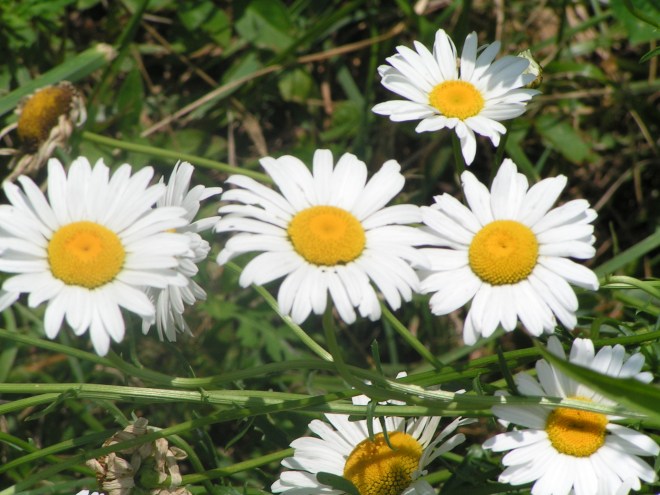
When we returned to our mountain with all our worldly goods not quite three months later, my heart stopped as we drove into a meadow bursting with daisies. (How did the universe know to greet me with this outsize bouquet of my favorite flower?) 

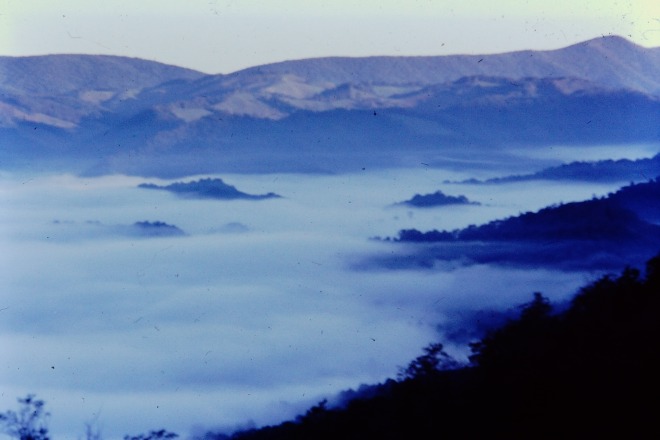
It stopped again the first time I looked over a cloud-filled valley, mountaintops peeking out like islands in a sea of snowy foam.

I knew I’d never leave.

pict0068

(To read more about our adventure of moving and building a home with our bare hands while living in the wild, begin here.)