Needles and Thread, Part I: Workmanship

Needles and Thread, Part I: Workmanship

(Part of my Blowing on Embers series)

My mother is an expert needlewoman. At least, she was until arthritis and eyesight betrayed her. She grew up in an era when nearly all young girls learned to sew and excel at other needlework. When I was a girl, my mother made all my clothes before she taught me to sew, too.

She was a painstaking seamstress who worked on an item of clothing until it met the approval of her extraordinarily critical eye. Ripping out seams didn’t bother her one whit if it meant a better garment. A dart that didn’t end precisely at the right point, a facing that didn’t lie perfectly flat, a seam that puckered the tiniest bit—none of these flaws would do, no matter how slight.

I spent torturous hours standing on a stool where I was required to turn ever so slowly, like a music box ballerina (but not nearly so patiently), while she pinned and repinned a dress hem until it was perfectly straight, a fact she ensured with her trusty yardstick. Wherever needle and thread were concerned, Mother was a perfectionist.

My mother, like hers before her, tatted for years, making doilies, snowflake tree ornaments, and yards of knotted lace edging for collars, sleeves, and hemlines. She spent many an evening working on needlepoint, embroidery, crewel work, and cross-stitch, too. Needlework pieces made by either Mother or Grandmother covered the walls of my parents’ home: a zinnia bouquet, a North Carolina map, birds of America, twin Christmas “Partridge in a Pear Tree” wall hangings, along with humorous or pithy pearls of wisdom. “If Mama ain’t happy, ain’t nobody happy,” and”Nobody sits down until the cook sits down,” and “Use it up, wear it out, make it do, or do without” are three memorable ones.

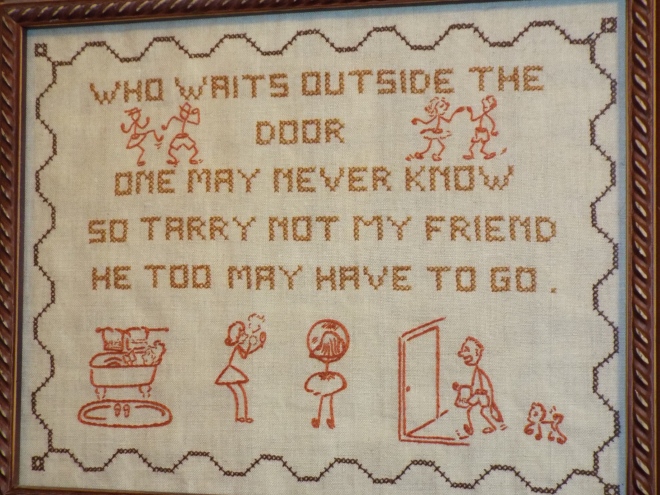
The combination cross-stitch and embroidery piece that long hung just inside Mother’s bathroom door has always been one of my favorites. Surrounded by basic embroidered designs depicting various bathroom scenes (a stick figure powdering her nose, an overflowing tub, someone nervously dancing on the wrong side of the door), are these cross-stitched words:

Who waits outside this door / One may never know / So hurry up, my dear / He, too, may have to go.

One day when I was visiting Mom, I wondered aloud about its provenance. I wasn’t a hundred percent certain, but I was pretty confident I’d seen this piece hanging in my grandparents’ house before it was in hers. Her response was sure and strong. “Mother made it. I’ve always been really proud of my needlework. Mother was never very careful with hers, and there’s a mistake in this picture.”
DSCF8888

Can you find a mistake?

She cheerfully volunteered to show me its fault as proof. She studied that piece, then studied some more trying to find the offending error. After a long few minutes, Mother said, “I can’t find anything wrong with it. I made it, after all!”

A perfectionist—and a cocky one at that.

No Touching

(Part of my Blowing on Embers series)

About this time of year I’m overcome with nostalgia. What brings it on is the flowering of touch-me-nots. My now grown children groan in exasperation whenever they hear me mention these wildflowers—they know what’s coming next.

It’s the story of how these jewel-toned flowers remind me it’s time for the school year to start in these parts. How I fondly remember watching the two of them emerge from a heavy fog as they walked up our newly-graded and graveled road after their first day of school barely more than a month after we moved up here on the diagonal. (Punkin was a fourth-grader, wishing she was back in the Brown School in Louisville. It was Cuddlebug’s very first day of school anywhere.) How their arrival home from late-summer school days was often delayed because they couldn’t resist the urge to stop along the way to do exactly the opposite of the warning implied by the plant’s name and pop the flowers’ seedpods. It’s an addictive pursuit, and it was a fun way to end the school day.

Handling a touch-me-not is a uniquely rewarding and giggle-worthy experience. The seedpods don’t look particularly fragile, but when they’re mature, the slightest movement causes a virtual explosion, with tiny seeds catapulting onto the landscape—no doubt the reason this wildflower is so prevalent in territory friendly to its needs. The steep banks along our country roads are saturated with touch-me-not plants right now.

Predictably, with all those explosive seedpods, touch-me-nots have taken over the roadsides.

Also known as jewelweed, this prolific wildflower may be either yellow or orange, each variety’s flowers freckled with deep reddish-brown spots near and in their deep throats. Their nectar-filled spurs make them attractive to hummingbirds, butterflies, and other pollinators. In appearance, they strike me as a cross between miniature orchids and larkspurs.Touch-me-nots are common throughout all of the U. S. with the exception of a few western states. They’re fascinating plants—beautiful, useful, quirky, and irresistible to kids of all ages. Once you’ve popped a few seedpods, you never outgrow the urge when you come upon a patch of these intriguing plants.

When a seedpod bursts open, either on its own or with a little human help, the hull instantly curls up into tight coils, like small, green springs. It’s all so fast you can’t see it happening. A captivating sight in itself. And even though you know that little explosion is coming and are waiting for it, it will inevitably make you jump in startled surprise.

The leaves are just as intriguing. If you find yourself in a patch of jewelweed on a dewy morning or just after a rain, its leaves will be the only dry thing around, displaying little beads of water on their surface. Dancing in sunlight, the water glistens like diamonds.

Submerge a leaf in water with its underside facing up and it turns silver. Pull it out and it will be dry, with only a few droplets of water here and there.

Touch-me-nots also have medicinal uses. The best-known and most practical use is as a remedy for itching. In fact, they’re often found in conveniently close proximity to itch-inducing poison ivy and stinging nettle. By breaking open the liquid-filled stems and spreading the watery sap on skin that’s been exposed to these plants or to insect bites or stings, you’ll most likely experience immediate relief.

And you can even eat the little seeds. They taste a lot like walnuts–really! Granted, it would take a lot of collecting to get enough to bake into a dish, but it’s a handy thing to know if you happen to find yourself lost and hungry in the midst of these delightful plants.

All this and nostalgia, too.

The sight of touch-me-nots, the start of the school year, the long held vision of our children in their first-day-of-school finery, the hint of autumn in the air, the memory of those first days of house-building—all these things represent the beginning of our life on the diagonal.

Kids, if you didn’t already realize, you might as well get used to it because whenever touch-me-nots are in bloom, I’ll continue to reminisce aloud about this giant tangle of sweet memories.

Polio: From Reign of Terror to Obscurity in One Generation

(Part of my Blowing on Embers series)

Recently, I was recounting a childhood event in my life to my teenage grandchildren. I mentioned polio (paralytic poliomyelitis). “What’s polio?” asked the seventeen-year-old.

Wow—imagine that! To think this (mostly) childhood disease which terrorized U. S. parents for four epidemic-laden decades of the 20th century is unknown to today’s youth is almost unfathomable to someone like me who lived through that era. That there’s no reason for them to know about it is an amazing blessing.

It certainly wasn’t always like that. If you’re in the same boat as my grands, you may want to know there was a time when polio, a disease that’s been around since ancient times, was widespread in this country.

The U. S. experienced annual polio epidemics every summer between 1916 and 1955, with the worst outbreaks occurring in the 40s and 50s—the period of my childhood. Nineteen fifty-two was the peak year for the nation’s epidemic: 60,000 cases were reported. Three thousand victims died; 21,000 more were paralyzed.

Polio was, and is, a highly contagious, virus-caused disease which can be transmitted via contaminated water. That’s why public swimming pools were regularly closed during my childhood whenever a case was reported. Interestingly, most people who contracted polio never even knew it; they had no symptoms. For many others, symptoms were similar to the flu—a few days of high fever, sore throat, headache, abdominal distress. But for others . . .

My worst polio-associated image has always been the iron lung, that body-enveloping steel cylinder to which many polio victims were confined. Because polio attacked muscles, including those required for breathing, this mechanical breathing machine was the only survival hope for many. For some, like actress Mia Farrow, the iron lung was temporary, though it probably didn’t seem like it at the time.—she lived in one for eight months. For others, it was a life sentence. At least one victim was confined to an iron lung for more than forty years, until his death in 2003. 

Food and Drug Administration: iron lung ward, Rancho Los Amigos Hospital, CA.

Public domain photo courtesy of Centers for Disease Control and Prevention‘s Public Health Image Library (PHIL), identification number #6536.

Two of those terrorized mid-20th century parents were mine. When I awoke crying with a high fever in the middle of the night after a day of playing with other three-year-olds in a neighborhood mud puddle, they wasted no time rushing me to the hospital. I still retain the memory of being swooped up and cradled in my dad’s arms, tightly wrapped in a blanket. In my next remembered image, I was lying in a hospital bed, Daddy lying beside me, reading a Cornet magazine. I was terrified when I woke the next morning to find myself alone in that strange place. Mother arrived not long thereafter with a brand new pair of patent leather shoes for me to wear home. The diagnosis was tonsillitis. Their overreaction just shows how real the fear was.

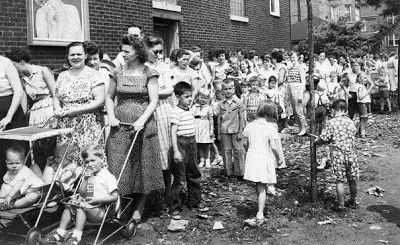
Then came 1955. I was one of millions of reluctant kids dragged by our equally hopeful parents to stand in long, winding lines—in my case in the hot South Carolina summer sun—to get the brand new polio vaccine, developed by Jonas Salk. Hundreds of thousands had worked frantically to develop an effective vaccine, from scientists to test subjects to ordinary citizens raising funds for research and development.

This Pinterest photo was taken in Chicago in 1955. The line I stood in seemed every bit as long as we waited in the hot sun, dreading our fate: the first of a series of three shots. Later came the oral vaccine we took as a booster.

And just like that the epidemic was over. The residual effects, though, were not. Years later, a college classmate of mine wore leg braces and used crutches to get around campus. When I lived in Louisville, KY, in the 70s, three of my work colleagues, two of them wheelchair-bound, had contracted the disease in that city’s 1952 epidemic.

Some famous people who suffered from polio: Franklin Delano Roosevelt; Emmett Till; Jack Nicklaus; actors Alan Alda, Donald Sutherland, Mia Farrow; former Secretary of Defense and World Bank president Robert McNamara; ventriloquist (and voice of Tigger) Paul Winchell; artist Frida Kahlo; singers Neil Young, Joni Mitchell, Judy Collins, Dinah Shore; NYC ballet soloist Tranquil Le Clercq; photographer Dorothea Lange; former Washington Post executive editor Ben Bradlee; saxophonist David Sanborn; Olympic gold medalist (track and field) Wilma Rudolph; Tarzan portrayer and Olympic gold medalist (swimming) Johnny Weismuller; violinist Itzhak Perlman.

Even today, there’s no cure for polio. Survivors often have residual complications and can anticipate post-polio syndrome in later life—a return of weakening muscles and other issues. Our salvation is in prevention. And while polio is now virtually unheard of in the United States and most of the world thanks to global eradication efforts, the disease hasn’t yet been wiped out. Polio still exists in two or three countries in Asia and Africa and has, on occasion, been reintroduced into others. It wouldn’t take much for a resurgence to occur here. As long as it’s out there, I won’t be completely comforted.

And yet, I’m gleeful that my grandchildren, knowledgeable as they are, have no knowledge of polio, that they have no need to know. And ever thankful to the scientists and public servants who were, and are, committed to finding a way to curb this horrific scourge worldwide.


Blowing on Embers: Postscript

As I often do, I asked the Gnome to read and give me his thoughts on the draft of my Blowing on the Embers blog essay before I posted it. I value his insights, and he’s generous in offering me his time. It’s one the many things I love about him.

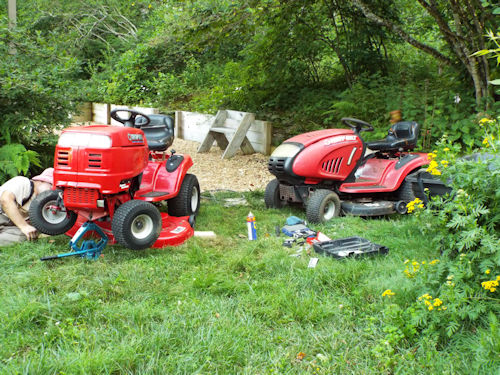
Then he went about one of his self-assigned chores: trying to get at least one of our two broken riding mowers to function. We have several acres of land in desperate need of mowing. If one of those mowers doesn’t get fixed, too many unwanted trees take over. (Black locusts, I’m talking about you.) And that means we have to cut them down, chop them up, and either burn them or pile them up into yet another wildlife habitat—good for the birds, but a little unsightly to us humans, and yet one more unwelcome chore that keeps us from more satisfying activities. But I digress.

The Gnome spends a lot of time around here fixing things that don’t work. He’s not a mechanic or an engineer or an electrician. He thinks his way through these tasks, using brainpower to solve problems he doesn’t innately understand. He believes in the power of being able to do a thing if you just put your mind to it. Another thing I love about him.

But it’s a time-consuming process. And it can be fraught with frustration—all that time and energy going into a chore, the outcome of which is unknown, when he could be doing something much more personally fulfilling. Like painting. Or writing. Or photography. Or building.

After hours of unsuccessful attempts to fix something, a sense of defeatism can set in. That’s what I expected the other day when he was working on the mowers. I’d been paying attention from my writing desk—I heard all the times he turned the key and the engine refused to catch. So, when he came in the house in the middle of the afternoon, I was all ready to offer some sympathy along with his tea and his favorite oatmeal cookies. He had to be discouraged.

Instead, he looked at me with those crinkle-cornered, laughing eyes he’s so famous for (reason # 3 if you’re keeping count) and an enigmatic smile. He told me he’d been remembering all the hours he’d spent as a boy watching his electrician dad work on the family car. He’d conjured up the time he himself had crawled up under the huge hood of our International Harvester Scout to ferret out a problem, even then imagining what his dad would have done, how he might have worked out the issue at hand.

All that time I thought he was just working on the mower, he was also channeling his dad, recalling fond memories. That afternoon, it didn’t matter so much that the mower was still in pieces.

It seems there’s more than one way to blow on the embers of your heritage.

Blowing on Embers

Blowing on Embers

Blowing on Embers: I came across this lovely phrase the other day.

Have you ever sat around an evening campfire? Remember how when it started to die out and you weren’t quite ready to call it a night or maybe you wanted just one more toasted marshmallow, you blew on the embers to keep the fire alive?glowing coalsWell, Johanne from www.sunnysideheanne.com has  put a new spin on that old tradition. After she lost her father, mother, and a special aunt, all within a year, Johanne and her sister wanted to make certain they wouldn’t forget their own story.  They began a new family tradition—trading stories of childhood memories. In other words, they began blowing on embers of the dying fire of their family’s personal history.

Reading Johanne’s story, I immediately identified with the concept. Recalling memories is a favorite pastime around here. It’s why I create and peruse photo albums and scrapbooks. And it’s what I do with much of my writing.

I’ve told children and grandchildren about memories from when I was no more than two years old, one from even earlier in my life. These “memories” are actually no more than snapshots in time, and I’ve come to realize I don’t so much remember them as I remember the remembering of them from stories told and retold. But that’s the point, and it’s why it’s so important to keep recounting them.

Reminiscing is a social activity that gives meaning and coherence to our personal narratives. It keeps family history alive. It triggers nostalgia, and nostalgia gives us an endorphin boost, improving our mood and making us feel better able to tackle whatever challenge we face at the moment.

Memories, especially childhood ones, are fragile. Without jogging them, they fade, ultimately dissolving, like a morning fog, into nothingness. Yet, our early moments are powerful ones, shaping our lives. As we weave the vignettes into a whole, our life stories emerge. We better understand who we have become.

The accumulation of childhood memories, even those enhanced by retelling, also influences our on-going behavior. There’s evidence that when childhood memories are triggered, we behave more kindly and ethically towards others. Our memories, it turns out, serve as a moral compass.

So let’s get to work. I’ll be blowing on my own embers on this blog. Maybe the glowing coals of my stories will spark some of your fondest childhood memories. Share them. It will do you—and the world around you—good. I’d love to hear your stories. Feel free to share them in comments beneath each post.

I Blog For Mother Earth News!


I’m excited to announce that I’ve been accepted as a blogger for Mother Earth News. If you’re a regular reader, you know a little about Mother’s influence on me. There’s this favorite soup recipe for instance.

This opportunity solves a blogging conundrum that’s been bugging me for awhile. My broad interests may sometimes make my Living on the Diagonal blog disjointed and, depending on readers’ interests, sometimes irrelevant.

From now on, Living on the Diagonal will focus on personal essays, miscellaneous musings, daily life up here on the diagonal, and a little poetry and photography. While you may still find a few gardening, food, or modern homesteading posts here, I’ll be posting most articles of this sort to the Mother Earth News site. By all means, come on over and check me out. You’ll need to use this link to my tag page to find me. It’s not easy to remember, so make it easy on yourself and bookmark it: http://www.motherearthnews.com/search?tags=“Carole%20Coates”.

I expect to be posting to Mother Earth News every two weeks or so while maintaining my current schedule of weekly posts to Living on the Diagonal.

Thanks to everyone for your continued interest and support of my blogging.

Our Grand Road Trip, Part VI: The Touristy Things

Oh, goodness! I just realized I never published this last post about our almost-cross-country road trip last fall. If you’ve been following along, you may recall that way back in May and early June, I wrote a five-part series about some pretty magnificent sights we were lucky enough to visit—natural wonders, national parks and monuments, historic sites. We managed to fit in a few typical touristy things, too.

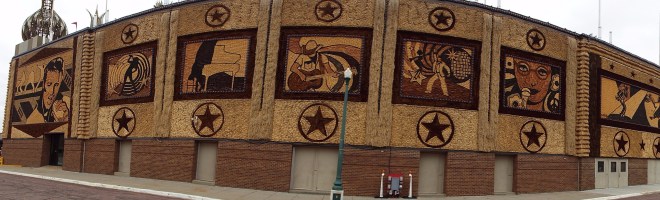
After the Badlands (already covered here), we made a quick side trip to the Corn Palace in Mitchell, South Dakota, another of those things I’d heard about and yearned to see for years. Pretty amazing, especially when you learn that the organizers, all volunteers, put up an entirely new display with a different theme, every year. The 2016 theme was Rock ‘n’ Roll.

Exterior view of the Corn Palace

Exterior of the Mitchell, SD, Corn Palace

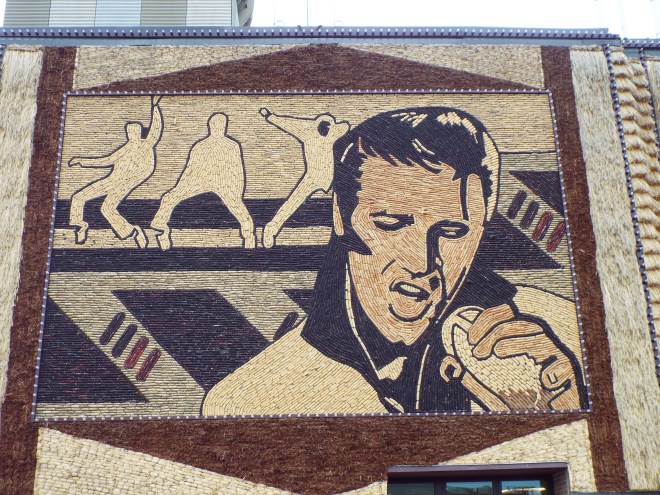
I know you recognize this guy!

This one, too. These murals are made of nothing but corn (over 275,000 ears, 13 different shades, no dyes) with a couple of other grains and native grasses used for the borders. It takes about four months each year to complete the decorating process. See? I told you it was amazing. There are more corn scenes inside—and it’s all free.

We began seeing signs for Wall Drug a full three hundred miles to the east, another of those legendary “must see” places. Is it blasphemy to say we were a little disappointed? I’d expected to see a huge store—after all, that’s what they advertise—but it’s really a jumble of individual shops, many of them selling identical or nearly identical items, and most of them your standard souvenirs. Besides, we’d have had to wait an hour or so even to get one of those famous doughnuts we’d been drooling over for several hours’ worth of roadside ads. Just not worth it with the Black Hills in our near future.

Ah, the Black Hills. Here’s what we learned. It’s a fairly long drive from Keystone, the nearest town, to Custer State Park (which, though the scenery along the way is quite spectacular, is where the fun really begins). Next time, we’ll plan on renting a cabin in the park boundaries—and taking all our food and necessary supplies. That way we won’t waste precious time just getting to and from. In the park, there’s a n eighteen-mile loop you can drive in hopes of close-up encounters with wildlife like bison, donkeys, prairie dogs, and big horned sheep. (You can see some Black Hills pictures here.)

In Rapid City, South Dakota, we spent a couple of hours at the Dahl Arts Center. I was flat out gobsmacked by the 180-foot oil-on-canvas panoramic cyclorama mural depicting 200 years of U. S. economic history, painted by acclaimed muralist Bernard P. Thomas. I sat in the center of the room for more than an hour, my eyes and brain soaking in every single scene. Pictures wouldn’t do it justice. If you’re ever in the area, check it out. It’s a hidden gem. Admission to the Dahl is free.

While we were in Rapid City, we drove out to the  Chapel in the Hills. The chapel itself is an exact reproduction of the famous Borgund Stavkirke of Laerdal, Norway. I felt like this stop was a little extra tribute to my Minnesota cousins, who have Norwegian ancestry. We were first greeted by the “Stabbur,” an authentic grass-roofed storehouse which serves as the Chapel’s visitors’ center. It was built in Norway and assembled on site. The grounds, complete with wooded trail, are lovely. The perfect place for a quiet, reflective afternoon. You can see pictures and learn more about the architecture here. In lieu of an admission fee, goodwill donations are accepted.

In  Lolo,Montana, we visited Traveler’s Rest, the only archaeologically verified campsite of Lewis and Clark’s Corps of Discovery.  Without knowing it, we were stalking Lewis and Clark for much of our trip, so this stop was pretty cool. 

We also spent a little time at the historic St. Mary’s Mission, the first settlement in Stevensville, Montana, “where Montana began.” DSCF2503

DSCF2508

I’ve already written about our too-brief visits to Glacier, The Grand Tetons, and Yellowstone National Parks, all of which qualify as typical tourist attractions and stupendous natural wonders.

Here are a few last miscellaneous looks at our trip.

DSCF1235 - Copy (2)

Until next time.

About that Terrible, Horrible, Very Bad, No Good Day

I recently wrote about a bad day I was having. It seemed pretty horrible at the time. And it wasn’t good. But . . . there are some really terrible, horrible things that happen in this world. I won’t do the litany; you know them. Suffice it to say none of those kinds of things happened to me on my bad day.

That awareness isn’t about making myself feel good that I’ve skirted woes when others haven’t been so lucky. To me, that feels a little like that old saying, “I cried because I had no shoes until I met a man who had no feet.” This kind of sentiment has always struck me as a little perverse—the notion that seeing someone else’s misfortune should somehow make me feel better. As if the Power of All has randomly chosen me for good fortune and just as randomly chosen another for very bad fortune. As if I should feel grateful for such  capriciousness.

I prefer looking at such incidents in another way, as a reminder of what’s genuinely important in this life. To recognize, to understand, to appreciate what really matters. The little things as well as the great big ones. To not be so self-absorbed. Seems to me it’s the best chance we have to make the world a better place—certainly the best chance for contentment and true joy.

Just wanted to get that out there.

My Terrible, Horrible, No Good, Very Bad Day

My Terrible, Horrible, No Good, Very Bad Day

It all started the night before. As my netbook (the computer where I do all my writing) was updating, the screen suddenly went black. Then these words appeared: no bootable device found. No, this wasn’t part of the worldwide ransomware attack. My problem occurred days earlier.

I tried not to panic. But practically everything I’d ever written was on that computer. While most of it had been backed up on a flash drive, I’d forgotten to do that for the last few months. You see, I have this challenge. It applies to all facets of my life. I can be going along just fine, doing everything I’m supposed to. Then something happens to interrupt the pattern—a trip, an ailment, anything that gets me out of my routine. That’s when my brain suffers the same kind of fate my computer did. No bootable device found.

Still, there was nothing to do but attempt a good night’s sleep before taking the netbook to the local computer docs for a thorough internal exam. The fellow at the desk assured me it’s almost always possible to retrieve the data. Stay calm, he cooed. “Stay calm” was the mantra I kept repeating while the Gnome and I ran a couple of errands before going home to await the call from the self-proclaimed computer geeks.

One of those errands was to the local big box home improvement store to pick up some drywall and painting supplies for our latest home rehab project. The clerk said we were in luck. This was the last day of a 10% discount on paint and paint supplies. I moaned to the Gnome. If only we’d known, we could have gotten the couple of gallons of paint we’d need shortly. Paint is expensive! The clerk reminded us we had until 9:00 pm. Not likely—we had work to do and another hour-long round trip to town wasn’t in the cards.

The call came in the early afternoon. Stay calm. Stay calm. It’s almost always possible . . .

Almost. The operative word. “We’ve done all we can do here,” the guy said. Our hard drive had a mechanical failure. The next step was to send it off to intensive care specialists. It would take a couple of weeks and if—if—there was anything salvageable (that didn’t sound optimistic), it would cost another $400-$1,000. Plus the cost of repairing or replacing my computer.

By this time, I couldn’t remember anything that was on my computer. Could any of it be worth $1,000? Especially if I couldn’t remember what that might be? I couldn’t concentrate. Everything began to go wrong. I varnished the wrong side of the treads for the new stairs we were building, for one. Seemed like a good day to chuck it all.

I suggested we go back to town, after all, and pick up a pizza. We could use the trip to see what computers were available locally and maybe we could even get that discounted paint. We searched in vain for a paint chip naming the paint we needed to match, so we grabbed an old paint can with the paint code on the lid.

While the paint guy tried to match the code, we perused paint chips. We were sure we’d recognize ours if we saw the name. But all we found were names like Dust Bunny, Wool Coat, Basket, Spirited, Capricious. Really? Do you have any idea what kinds of colors those are? Then there was La La Love, Someday, Semi-Sweet, and Panacea. I could have used a little semi-sweet panacea about then. The name of our paint had been nothing like these. Besides, we’d gotten that can six years ago—an eon in paint time. All the names had changed.

We had a long time to scour paint chips. The paint guy simply could not make a match. Every gallon he mixed up, and he mixed up plenty, came out wrong. Too pink, too green, too anything but what we had.

We’d been waiting almost two hours when he came up with a color that was pretty close. Good enough on a new wall, perhaps. But not where we needed patches in existing walls. Maybe the remaining paint in our old can would stretch far enough to make those touch-ups. We decided to get the new mix, along with a can of white. Thinking about the 10% discount, we picked up some more paint-related supplies.

That’s when the checkout clerk (followed by a manager) told us the paint discount only applied to business accounts. What?! We could have waited till some other day for the disappointment of not finding a match. Too late now to look at potential computer replacements. Dejected from head to toe, we just grabbed a to-go pizza and headed home.

On the way to the house, we checked our mailbox. Nothing jumped out at us, so we laid the small pile on the counter and ate our pizza as we mulled over possible next computer steps. Then I took a second look at the mail. A letter from our utility company. I figured it was the next month’s bill; instead, it was for a fuel delivery I’d already paid—apparently a few days late, though there was no due date listed on the bill and I’d paid it well within 30 days of its receipt. Turns out that’s not their measure, so I owed a whopping forty-six cents in finance charges.

Forty-six cents. Perfect ending.

Post script: Still haven’t figured out what to do about my lost data. We found a highly-reputable service on line whose maximum charge is less than the minimum quoted to us on that no good day. I vacillate between going for it (it would be nice to get my e-mail address book back, for instance) or just throwing my arms up in surrender and starting all over with a clean slate. Decluttering, even if forced, can be refreshing—my own personal reboot.

At the Car Wash

There was a time in my life (several, actually) when money was really tight. So tight that sometimes the only way to purchase groceries was with a credit card. So tight that the Gnome and I foraged wild cherries and asparagus in the nearby city park and dug day lily tubers from our back yard to sauté for supper.

Then came the day I lost a five dollar bill. I panicked. I cried. I called everywhere I’d been that day. I searched high and low—the depths of my handbag, my pockets, under the floor mats of the car, across the parking lot. That five dollars was a lifeline; the idea of it having disappeared in a poof like a magician’s cheap trick made me physically ill. I’m glad to say I finally found it—tucked in a hard-to-see spot between my car’s front seat and the door post.

So, a drive-through car wash, though it cost less than a dollar in those days, was a rare luxury. As I sat quietly watching the soapy froth dance on the windshield and those big, blue brushes caress the car’s skin, I felt as if I were receiving a massage. Not that I’d ever experienced a professional massage, but it seemed like how a massage might feel. I reveled in it.

I drove through a car wash the other day. No magic this time, just a plain old car wash. But every time I think about those car washes of leaner times, my lips spontaneously curve into a Madonna-like smile and I sense my shoulders relaxing.