Those Lazy-Hazy-Crazy Days of Summer

They call them the dog days of summer, these days of July and August, usually the hottest and most humid of the year (for those of us in the northern hemisphere). But I can already feel fall. The air has grown slightly less moist, hinting at autumn’s dry coolness, even when the thermometer doesn’t agree.

I hear it in the sounds of insects—different from early summer bug buzzes and chirps. And I hear the occasional thump when a premature nut hits the ground.

I see it in the trees. Their leaves grow simultaneously darker and paler, and occasional ones waft to the ground. I see it in the flowers, too, whose colors have changed from bright summery hues to the softer mauves, lavenders, and golds of fall.

Yes, we may still officially be in summer’s dog days, but fall is in the air. There’s something slightly wistful about these times when the old begins to fade and the new is just beyond the horizon. We become nostalgic for something not yet gone. While some of us bemoan the loss of barefoot days, summer picnics, tubing down a river, others are perking up at the prospect of football, fall foliage, apple cider, and hayrides.

By the way, do you know where the term ‘dog days of summer’ comes from? I always thought it had to do with the way lethargic dogs laze on country roads or under porches during our annual heat waves. I guess in a roundabout way that’s not far off. In fact, the ancient Romans called the hottest, most humid days of summer ‘dog days’ because they associated them with the star Sirius, the dog star. Our most sultry days coincide, more or less, with the time each year when Sirius, the brightest star in the night sky, appears to rise just before the sun.

At this time in my life, the change of seasons brings a question to mind. It looms larger with each cycle—what changes lie in store with the next season? But, whatever is in my own future, my head knows that each season brings its own gifts. My challenge is to embrace them while they are here in all their fullness and, when the time comes, to let them go lightly so I can do the same when the next one rolls around.


Summertime

(Well, this is embarrassing. For reasons too complicated to explain here, I’m not sure whether the following piece is mine or if it’s a compilation of some of my fellow writers. Logic dictates it’s mine, yet it doesn’t feel as familiar as it should. But since summer, in all its fullness, is officially just around the bend, I want to share. So, here goes—with sincere apologies if I’ve inadvertently plagiarized.)

Summertime

Summer is the most voluptuous season.

Summer is like

. . . a rainbow, bright and colorful after a dark storm;

. . . . wide open spaces with no boundaries;

. . . imagination with endless possibility.

Summer is like like the blinding light of a camera flash, the scent of singed skin, the music of Beethoven; it’s like life at full maturity—gone is the perky innocence of youth as hints of age peek through its brilliance.

Summer is like lemonade—sunshiny bright, sweet and tangy, liquid in a sweating glass.

Found Poetry, Part IV

(For more Found Poetry, click here, here, and here. I’d love to hear what you think.)

Merlin’s Last Voyage

crystal moon
out of the mist
ancient evening
entering the mystery
of a hidden world

dark falls the night
on the island cathedral


Night Sight

northern lights
swimming
o’er the land, o’er the sea
casting out darkness


Earthdream

sunshine on a meadow
the smile of a breeze
breathing light
between two worlds

The Month of Yellow

April is the month of yellow around these parts.

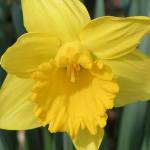
The daffodils finally burst into bloom last week and dandelions along with them. Country roadsides have exploded into an earthly vision of sunshine with forsythia. The shrubs are packed so tightly together, their branches so thick and intertwined, that even the cleverest rabbit would have a hard time navigating them.

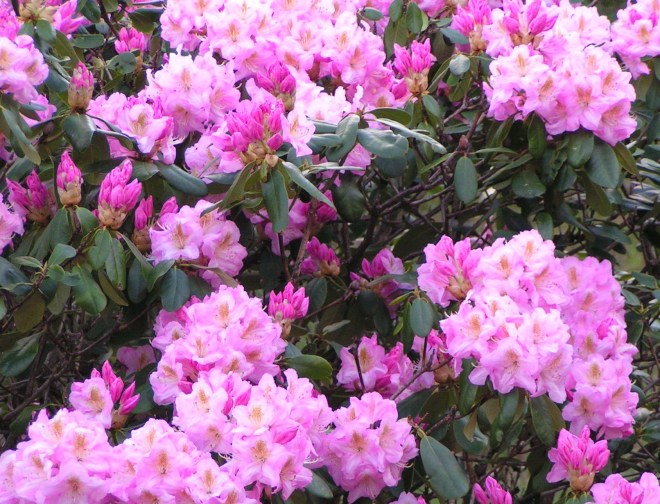
And since yesterday, the goldfinches, those canaries of the wild, have overtaken our bird feeders (at least when they can wrest a few perches from the squirrels). At this very moment, I look outside to see half a dozen of the lemony-yellow birds crowded on the feeder outside the living room window, with more waiting in the wings—flitting in the rhododendron, sitting on branches of the nearby mountain ash, even perching on the windowsill.

Everything about goldfinches is showy—bright yellow feathers glowing next to raven-colored wings, sweet soprano chirps filling the air, bouncing flight patterns giddily announcing, “We’re back!”

Ten days ago, the day heralding April, we watched snow falling outside the very window where the finches now gather. Exactly six months ago, the colors were inverted. At ground level, nature was browning. The color was in the trees-—the rich, muted reds and bronzes of fall. Today, our trees are still bare. To see most of today’s colors requires looking down instead of up, down towards the earth from which they are being birthed.

April yellows are the yellowest yellows. Like spring itself, the yellow of daffodils, dandelions, forsythia, and goldfinches is a symbol of happiness, hope, energy, our very life force.

April is a good time to be alive.

Rhododendron’s Many Faces

The rhododendron buds for next year’s flowers appear almost as soon as petals drop from the bush like an early summer cascade of pink snowflakes.

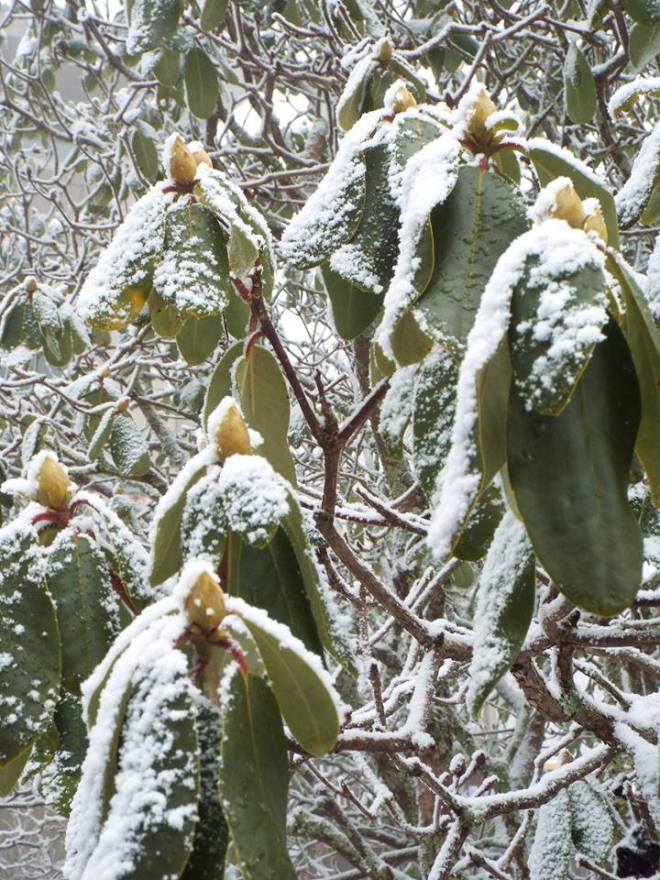
In winter, I can tell how many layers I need to wear by looking out the window at the big rhodie in our yard. On temperate days, the oblong leaves lie almost flat. As colder weather comes our way, they begin to curl inward, as if hugging themselves to keep the chill off. On the coldest days, a toddler’s little finger wouldn’t fit inside a single one of those curls.

As the leaves hang pendulously in winter, the buds above point skyward, reaching for warmth. Individually, they look like homemade hankie days long gone. Clustered together, they remind me of a chorus of angels.

On days like today, the merest dusting of snow clings to the leaves, and I see a different kind of snow angel.

Not long after spring makes its debut, the buds are pregnant with new life almost ready to burst open with color and aroma as killing frosts threaten.

Yet, somehow, they survive.

Again with the Found Poetry!

(Unlike my first two rounds of SXM Found Poetry—here and here—these short pieces are titled. I look forward to hearing your thoughts.)

DSCF4886


Dreamless

kindle a flame
before the last leaf falls
on the shores of time
be at peace


Contemplation

tears in the rain
flowing into formlessness
roll on forever


Scenes of Reflection

rainbow visions
cloudscapes
canopy of stars
between sacred mountains


And Evening Falls

silver cloud shimmer
almost full moon
serenade of the night sky


Winter, Reconsidered

My emotional connection with winter has a long history. It has rocked back and forth sometimes depending on my geographic circumstances. For the last few years our alliance has been strained.

This year, I’ve been trying to redefine my relationship to the season of short days and long nights, relentlessly prolonged and wrapped in gray in my neck of the woods.

During the coldest months, the sun’s rays rarely make an appearance and not just because of the brief period of daylight. Overcast is a generous word for many of our wintry days. Of the first fourteen days of this new year, we had perhaps two sunny days. That was the beginning of a season-long trend.

Even those rare days are frequently unhelpful when it comes to getting a dose of Vitamin D. The frigid temperatures allow for only a couple of small skin slivers—between toboggan and eyebrows and between lower eyelids and muffler. Even eyes may be covered with sunglasses, particularly when sun and snow combine to create blinding brightness. And sometimes the snow—especially if it’s deep, icy, or drifts high and unevenly—makes the outdoors a dangerous proposition, particularly for those of us who are more susceptible to breakage because of age.

Nonetheless, I’m taking measures.

  • I treat all my senses: my most worn sweater that wraps me like a cocoon, thick, soft socks, and a plush comforter make me feel as if I’m burrowing into the neck of a friendly Old English Sheepdog.
  • I surround myself with the soft glow and herbal scent of candles. I play soothing music that lifts my spirit—mostly classical, folk, and Celtic.
  • I try to hold an intentional smile, if only as subtle as the Madonna’s. It brings comfort to those around me, and my spirits unconsciously lift.
  • I sip tea, slowly, and look at the outdoors. Really look at it, noticing all the nuances of winter’s offerings, playing with words to find the most descriptive—and life-affirming—ways to describe the scene before me.

The work is all-encompassing. But so far it has proven worth the effort. Winter will still be around for a while up here on the diagonal, so I’m still working at it.

Our society has a tendency to think of winter as a time of death. Green grass and summer wildflowers have ‘died;’ leaves have fallen and dried making deciduous trees look dead. I’ve challenged myself this year to look at nature differently.

Lawns may no longer be emerald, but they will regrow; the grass is not dead. We have a tendency to overlook the subtle tan shades of tall grasses, but they provide rustling interest on a winter day, even more when they wave gently in a breeze.

Winter isn’t a braggart. Its marvels are less noticeable than the lushness of spring and the vibrancy of summer. In those seasons, winter’s elusive wonders are hidden. But now—now they surround us. Now is the time to revel in them.

When I manage to get out of doors, whether for a walk in the woods or a scenic drive, I look again. I search for positive words, alternatives to bleak, dreary, and overcast. Words like contemplative, silver-tinged skies, reflective, pensive. Winter calls us to introspection. Is that why we resist it?

On one typically cold but unusually bright morning, the roofs of the houses we passed on our way to town were covered with the thinnest veneer of frost. As we rode by, sunlight played on the icy crystals, creating a glittery shimmer, as if the shingles were made of twinkling fairy lights.

The skeletal trees, bare of their green camouflage, fill the landscape with sculptural architecture. Their nakedness allows me to appreciate aspects hidden at other times of the year.

The branches of some reach upward, as if in praise of the sky. Some trees are encircled by draping branches, reminiscent of welcoming arms ready to enfold me and offer comfort. Some trees are so gnarled and craggy it’s easy to imagine they sit on the edge of an enchanted forest.

About now, with trees looking as bereft of life as they have for months, the sap begins rising, an event which will go entirely unnoticed except for syrup makers and those who happen to fell a tree at that crucial time, but pivotal to the reemergence of the verdant leaves we long for.

Subtle color variations and not-so-subtle textural differences in tree bark differentiate one species from another. Touch a sycamore or crape myrtle, with bark as smooth as the proverbial baby’s bottom.
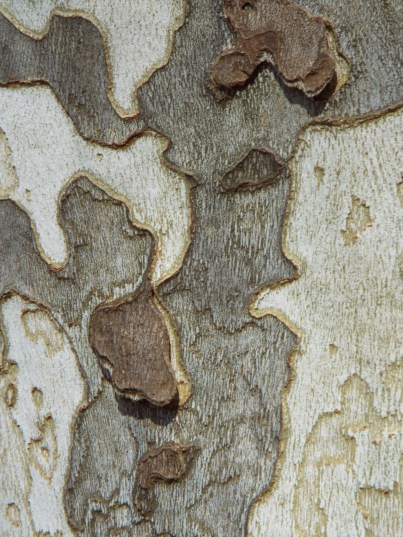
Consider the trees with peeling bark—paper thin birches and rugged shagbark hickories, or the finely ribbed bark of the pin oak and the thick, deeply furrowed bark of the black locust. Bark with overlapping plates, like black birch, make me think of armadillos and scaly dinosaurs.

As I look more closely at trees, I see mosses as dark as midnight and lichens, some the palest green, eerily fluorescent in the dark. In the woods outside my kitchen window sits the tree stump. Over time, moss has begun to creep upwards, slowly covering its sides. Today, I saw for the first time that the entire stump is blanketed in moss as soft as down, hinting at a fairyland.

There are trees with burls and hidey holes. Who goes there?
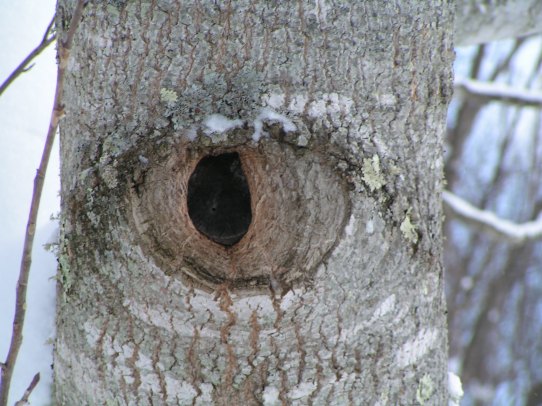
A cyclops tree?

Winter serves a purpose. Plants store up their reserves, ready to explode with new life as warmer weather and more hours of sunlight appear. The flora does what it needs to do during winter. Animals know how to handle winter, too. Some, like plants, go dormant to preserve strength, feeding off stores of fat until nature is ready to provide its bounty.

What if we humans were to welcome winter in all its aspects and live with it, not against it, as the rest of nature seems to do so well? What if we turned off the electronics, indeed perhaps electric lights when the sun goes down. What if we did those quiet chores best done in front of a fire or by candlelight with a cup of hot chocolate or tea at our sides? What if, instead of staring at some screen, we talked to each other, played games together, put together a jigsaw puzzle, corresponded with relatives and other friends, read aloud or silently, wrote, contemplated? What if we used winter to restore ourselves, to create, to maintain?

Would our family and internal lives be richer? I think they might. Would we welcome winter as we welcome spring? Would we be better primed for what life brings in the next season? We might begin to treasure and even look forward to long winter evenings as a time of personal and family enrichment.

We can’t beat winter. Why not join it?
 

“Everything I Need”

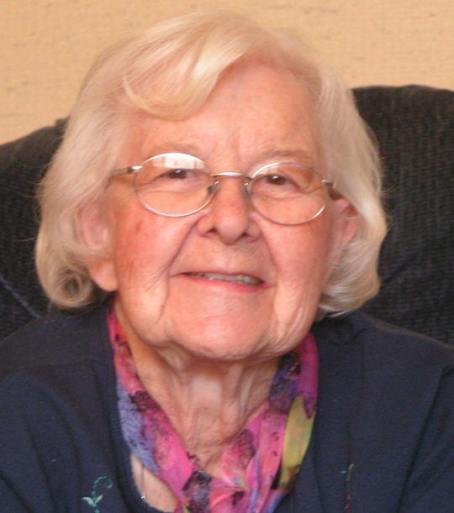
Have I mentioned I have the most amazing mom? Really, I do. This woman, 95 today, has never ceased being my mentor and teacher. And I’ll bet she doesn’t even realize it. She’s no longer trying to mold me; that work is done. Yet, her daily, living example does influence me.

I recently came across a March 19, 2018, New York Times article by Jane E. Brody: “Finding Meaning and Happiness in Old Age.” She references several experts in the field of geriatrics with observations such as these:

  • Even when physical decline and losses restrict one’s options, there remains the capacity to appreciate and approach each day with a sense of purpose. It’s all about how you frame what you have.

  • Positive aging is “a state of mind that is positive, optimistic, courageous, and able to adapt and cope in flexible ways with life’s changes.”

  • older people, knowing they face a limited time in front of them, focus their energies on things that give them pleasure in the moment,” not on a future that may never be.

That sounds a lot like Mom, now classified as among ‘the oldest of the old.’

Five years ago, my mother lived in a six-room house filled with antiques and family heirlooms. She and my dad had already downsized once or twice. Today, widowed after sixty years of marriage, she lives in one room in an assisted living facility. She no longer drives. She shares her small room with all her possessions—a chest, a rocking chair, a couple of bedside tables and lamps, a small bookcase overflowing with books and word puzzles, a television set, and a few pictures and pieces of needlework adorning the walls. Aside from her clothing and a bed furnished by the facility, that’s about it. Talk about downsizing!

Having suffered a broken hip, a fractured pelvis, severe osteoarthritis, and several fractured vertebrae that shortened her height by at least five inches, she moves slowly, painfully, and infrequently—with an aluminum walker as her constant companion.

Some people would look at her circumstances and be overcome with sadness. Not Mom. Sometimes when we’re on the phone, she’ll randomly say something like, “Not many ninety-four-year-olds are as lucky as I am,” citing her long and happy marriage, her children, the mountain view from her room, the resident cats that come for daily visits.

On my most recent visit, I asked if there was anything I could pick up for her. She took a cursory glance around, looked me straight in the eyes with a tranquil smile, and said, “You know, I have everything I need.”

I’d say she’s mastered the art of finding meaning and happiness in old age. Now, if only I can be as good a pupil as she is a teacher.    

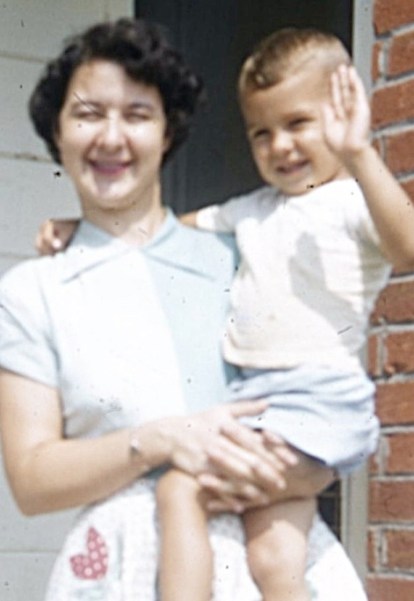
Mom through the years


One Life

What if someone were to curate a museum exhibit of your life? What objects would you want included? What would they say about who you are and what matters to you? How would the accompanying plaque interpret the exhibit?

Here are some vignettes I picture as part of my “One Life” exhibit:

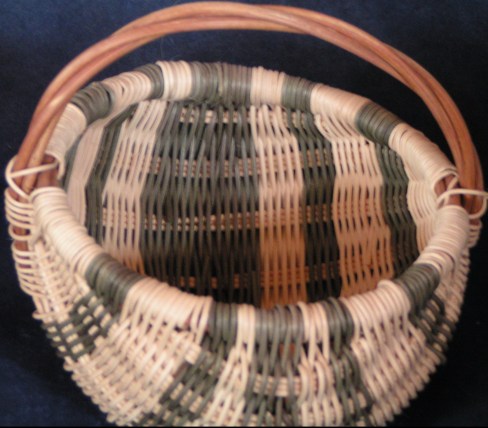
A seed picture, a macramé wall hanging, and a handwoven basket depicting a childhood of craft-learning at my grandmother’s feet which morphed into my would-be-hippie-street-fair-vendor period and morphed again into a more nuanced appreciation of handiwork and an unending need to work with my hands;

A shelf filled with books by the likes of Annie Dillard, Mark Twain, Mary Oliver, Robert Fulghum and more, some of which prompted me to read more while others influenced who I became and still others led me to become a writer myself;

A table holding a pencil, eraser, and notebook symbolizing my love of writing, an urge  that visited me randomly and infrequently until recently, when it became a near obsession;

A collection of LPs and CDs: classical—Mozart, Chopin, Mussorgsky, Beethoven (there was a time when I fantasized about becoming a concert pianist. That time was sandwiched between my Debbie Reynolds period and delusions of being a race car driver); folk—philosophical storysingers the likes of the Kingston Trio, Christine Lavin, John McCutcheon, and Carrie Newcomer who prick our consciences and prod us to action with thought-provoking messages, sometimes with some quirky humor thrown in; the Gaelic melodies of Enya and kin which, through their sheer ethereal beauty, transport my mind to the shores of my heritage;

A hammer, a saw, and a scattering of nails on a 2 x 4 piece of lumber portraying our once-in-a-lifetime homebuilding adventure;

A grouping of family heirlooms—perhaps a chair, a plate, a crocheted doily: items that tell the story of my attachment to family and family history;

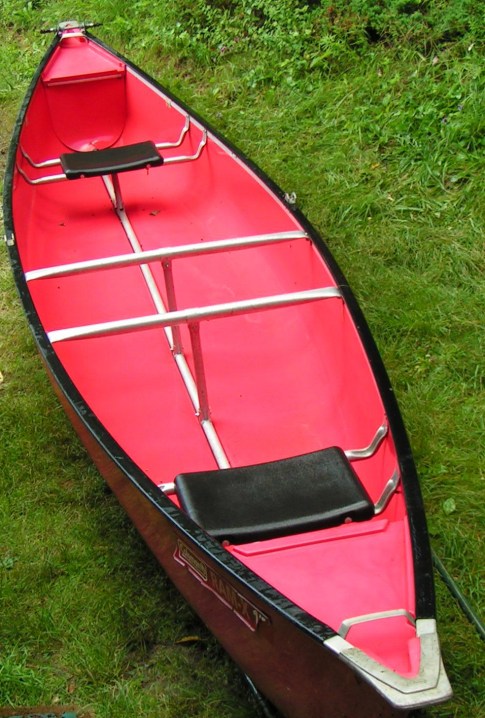
A tent, a canoe, and a campfire all in the midst of a small square of outdoor space, testaments to my love of camping, water, and nature;

A collection of photo albums—more proof of my strong sense of family as well as my love of photography, nature, and wildlife;

A corner filled with bumper stickers, protest posters, sit-in images, and a couple of rabble-rousing speeches representing my passion for human rights, all sorts, and my years as an activist and leader in social change movements;

A few fruit- and vegetable-filled canning jars next to some colorful seed packets resting atop a small mound of well-composted garden soil—evidence of my gardening and food preservation heritage and interest.

All of this would, of course, be displayed against a backdrop of the Blue Ridge mountains while the sounds of bird songs and a waterfall are piped into the exhibit space.

Looked at as a whole, such an exhibit speaks to me of eclecticism (or perhaps the inability to settle on any one thing). I like to think it also speaks of an enthusiasm for life, a certain joie de vivre. But I see what isn’t there, too—in some cases, things I wish I’d had a chance to experience or was passionate about, but in truth am not; in others, things that once mattered and have been cast aside. I see the absence of objects that are critically important to other people but don’t matter a whit to me.

(Conspicuously absent is anything about my family—other than the references to the photo album and family heirloom exhibits. Make no mistake: they are, every single one of them, central to my life. But with this kind of exercise, it’s all too tempting to focus on other people and to turn the whole thing into a cliché, so I resist the urge.)

Chances are, there are also things that have simply skipped my mind in the moment. If I were to write this piece next week or next year, an entirely different collection of objects might appear.

I wonder what my exhibit would say to the casual observer? What about yours?

On Living Well

One of the important writers in my life is Robert Fulghum. In case you don’t recognize the name, the easiest way to identify him, though it’s far too limiting, is to say he’s the author of Everything I Really Need to Know I Learned in Kindergarten. I never fail to be moved by his thinking and his insights. So, today, I’m cheating a little bit.  Instead of posting my own thoughts, I want to pass along something he wrote on his website not long ago because it speaks to me, because it’s important and I want to share it. (He even gave me permission. See?)

* * *

Please Note: This journal contains a wide variety of stuff — complete stories, bits and pieces, commentary, and who-knows-what else. As is always the case these days, the material is protected by copyright. On the other hand, I publish it here to be shared. Feel free to pass it on. Just give me credit. Fair enough?

Pack Creek Ranch, San Juan County, Utah.
The second week of September, 2018
Cooler weather, mix of sun and clouds, with occasional rain showers . . .

BED MAKING

A man I know well makes up his bed every morning.
He wakes up around 6:00, rises, puts on his robe, and – weather permitting – carries his duvet and two pillows outside to hang in the sunny morning air.
Then he turns on some music, makes coffee, takes a shower, and dresses.
The last act of this daily ritual is taking his sun-infused duvet and pillows
back inside to arrange on his bed, ready for his return at night.

Why these morning habits?
Why does he bother making up his bed every day?
Even he wonders sometimes.
Who cares?

After all, he is a single man, living alone – with no next-door neighbors.
His house is twenty five miles away from the nearest town.
He seldom has visitors – and he rarely entertains house guests.
Therefore, nobody is likely to have access to his private environment or witness his early morning rituals.
Nobody is going to know whether he makes his bed or not.
And yet . . . despite his solitary privacy – reliably – day after day, week after week, year in and year out – he makes up his bed.

Well . . . almost always . . .
But there was one exceptional week – three years ago.
When he fell into a deep black hole of existential despair.
And he just let go of the reins of his life.
He thinks of it now as The Week of Living Like a Loser.

The dirty dishes piled up in the kitchen sink for days.
The garbage cans were filled to overflowing.
In the refrigerator, moldy hair began growing on the leftovers.
The laundry accumulated in unwashed heaps.
The bathroom became a grotty mess.
And his bed was left unmade – a stale snarl of gnarly sheets and blankets.

And nobody – nobody – ever witnessed this fall from grace.

“Who cares – who gives a damn about how I live in my cave?” he thought.

And then . . . one morning . . . he finally crawled up out of his dung heap,
and looked around in dismay – a man living a homeless existence in his own home.
He dressed and drove away – fled to spend a day hiking along the river.
And stayed in town in a motel overnight.
The next day he came home to his house and himself – to put them back in order.

Who cared? Well . . . he did.
He could not live like a loser for long.
His daily morning ritual resumed, and has remained in place until this very day.

You might say the man has OCD – Obsessive Compulsive Disorder.
Perhaps. But that’s a speculative negative view.
Besides, if you witnessed the higgledy-piggledy unpredictable way he goes about
most days and weeks you could hardly say he is set in his ways.
One useful morning habit is not the sign of pervasive neurosis.
You might say the man simply learned something about his need for self-respect — in his environment and in his own skin.

The man I know recently saw a video of a commencement address by the Admiral who leads the U.S. Navy SEALS – the toughest, most highly-trained combat unit in any armed forces in the world.
The Admiral said that the first thing required of SEALS is simply to make their beds to a high standard every morning.
He said it was a matter of self-discipline, self-respect, and personal pride in paying reliable attention to a small, ordinary task.
Moreover, he explained, making your bed in the morning meant that no matter how arduous, dirty, or awful a day of training might be – a SEAL would have a personal place to come back to at the end of the day that was rightly welcoming.
The day would at least begin well and end well.

The man I’m writing about hasn’t applied to be a SEAL, but if he did, he could at least meet the first basic requirement – making his bed just right every day.
He, too, understands the pleasure of coming to the end of the day to a bed prepared as if he was an honored guest in his own home.
Part of that pleasure is lying down on sheets and pillows rinsed in the morning sunshine. And then closing his eyes in the deep quiet dark sleep of contentment.

I’ve been writing about a man I know quite well.
The man, of course, is me.
We are on very intimate terms.
I meet him in the bathroom mirror every morning and at the end of every day.
There he is – again and again.

Sometimes I think and write about him in the third person in order to consider his life objectively, and help him stay in touch with his better self.
Because he gets lazy and sloppy at times – in his house and in his mind.
He needs to be reminded that the truth of his character lies in what he thinks and does alone – in solitude, when nobody else is watching.
He needs to be reminded to be a special guest in his house and in his life –
even though that’s not always easy or simple or required.

But if he makes his bed every morning, the day will at least begin and end well.
And he can drift off to sleep knowing he has at least the most basic requirement for becoming a Navy SEAL.

Plato wrote that Socrates said that the unexamined life is not worth living.
Yet the man I know often goes about his life without examining it –
he doesn’t have time to be relentlessly, thoughtfully, reflective all the time.
He’s too busy just living through the tasks and opportunities of a given day.
If it is true that the unexamined life is not worth living, it is also true that the life not lived well is not worth examining.

* * *

If you want more of Fulghum, click here.