My Year in the Yellow House—Revisited

My Year in the Yellow House—Revisited (part of my Blowing on Embers series)

As I wrote “My Year in the Yellow House,” I wondered whether the story would have broad appeal since it didn’t have any overarching theme or message. Just random memories. Nothing much to see there.

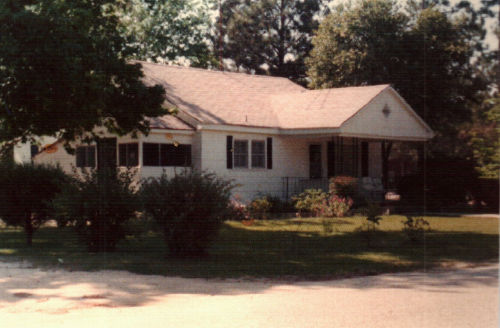
The yellow house many decades later—no longer yellow, but with the addition of front and side porches

I was suddenly taken aback at that notion. My essay was full of big deals. Unstated, but implied, was the fact that my youngest brother was conceived the year we lived in the yellow house, rounding out our family. How would my own life story be changed if that hadn’t happened? Most assuredly, he and his children think it was a pretty big deal.

Questions bubbled up.

For the family who lost their home and all their household belongings right down to their shoes and underwear, the blaze that destroyed their house was monumental. I wonder how it changed their lives. Did they have family nearby to put them up temporarily? Did they have a savings account in the bank to help get them back on their feet? Was their life savings, however large or small, stashed in a mattress that went up in flames? What happened to them, I wonder.

Was Glory’s tumor malignant? That’s what I always thought. If it was, did it go into spontaneous remission? Did her family’s faith cure her? How did she turn out? Or did the tumor kill her? When? How was her family—and their belief system—affected?

What about Carol’s family? Is there a more devastating blow than losing your young child? Did her family survive intact? Many don’t. And what did the world lose with no Carol to grow up in it? What about the family that never was? Would she have changed the world? Questions the answers to which no one will never know.

It was an eventful year on our small block. My own travails were pretty petty compared to what was happening all around me.

And yet, they weren’t. I heard something on the radio recently about how important it is to listen, really listen, to all the insignificant things your young child wants to tell you, no matter how busy you are with more important grown-up issues. The point was that if you don’t listen now, they’re unlikely to tell you the really important stuff later. But it was the next phrase that really struck me: “to them [the children] it’s all important.” Of course it is. It’s all they know.

To five-year-old me, it was all important. It would have been to any five-year-old.

My most potent memory from that year is the one where I was pushed into a tiny but formidable dark space, locked in, and forced to allow my most valuable possession to be desecrated in order to gain my freedom, having no confidence that the bargain would be honored, even then. My doll was my baby; it was an intolerable choice. And all because of someone’s inexplicable need to be cruel.

I don’t know all the ways the doll experience colored my life. Was that the moment the meek, compliant girl I grew into was forged? Was it what made me forever seek to avoid confrontation at almost any cost? Was Glory’s taunting what birthed my empathy for others? Or was it just a terrible moment with no particular future consequences other than a bad memory?

I don’t have the answers to any of these questions.

What about you? What questions still linger from your early years? Were there childhood moments—little or not so little— that changed your life?

My Year in the Yellow House: Childhood Vignettes

My Year in the Yellow House: Childhood Vignettes (part of my Blowing on Embers series)

I was five the year we lived in the yellow house. My brother was two. Our little two-bedroom home in Florence, South Carolina, near Cole’s Crossroads, was part of a modest and sparse subdivision, if you could even call it that. There were no sidewalks, and grass grew erratically in the sandy yards. Roads in the development were nothing more than not-too-packed sand.

alan yellow house

My brother’s favorite place to play was on the sandy road in our neighborhood.

Our house sat on a corner of the neighborhood’s main road. Follow it for a block or so and you’d be on old Hwy 301/52. Directly across the highway was Edwin Turner’s Chicken Basket, a popular family restaurant and the favorite spot for our very occasional meals away from home. As the name suggests, the restaurant’s main fare was fried chicken, along with french fries and hush puppies,* served in brightly colored, paper-lined plastic baskets—the kind you now see in a few casual dining establishments, but a true novelty then. We usually chose a booth in the knotty pine dining room, and Edwin Turner himself would stop by to ensure we were enjoying our meal.

Out front was the sign proclaiming the name of the place. As I recall, atop the sign sat a large rotating replica of one of those famed plastic baskets. My brother could never keep the words for Edwin Turner’s Chicken Basket straight. He always called it Chicken Edwin’s Turning Basket. When you think about it, his literal rendering made perfectly good sense—as children’s name mash-ups often do.CHICKEN BASKET
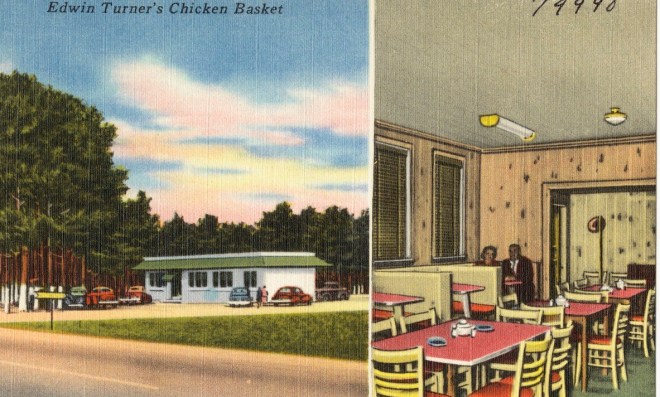
From the Tichnor Brothers Collection, Boston Public Library, http://ark.digitalcommonwealth.org/ark:/50959/mg74r003g

We loved the Chicken Basket—for its tasty food, its novelty, the attention of its owner, its prominent role in our lives. In addition to special dinners out, Edwin Turner’s was a true landmark in the community. For us, it was the easiest way to direct friends and out-of-town family to our house.

But the restaurant is only one of many memories I have of that year. They are a mixture of good and bad. It was while we lived in the yellow house that my first real childhood friendships developed. It was also where I experienced my first significant encounters with sickness, trauma, and grief.

My childhood preceded the era of many vaccines in use today, and I was in bed with a severe case of mumps for what seemed like forever. The lumps on either side of my neck felt humongous, and the pain of swallowing was so intense that I demanded something to spit into so I wouldn’t have to swallow. Of course, it didn’t work, but I gave it my best, spitting several times a minute all day every day into the blue and white speckled enamel pan Mother placed next to my bed. To this day, I have an aversion to enamel cookware.

Glory (not her real name), with her white-blonde hair, lived across the street from us. She had a tumor on her lower back, just above her buttocks. Her parents’ religious beliefs prevented them from seeking medical attention for Glory, but the tumor must have been extraordinarily painful because Glory, who only wore dresses, didn’t wear underpants—the pressure would have hurt too much.

Neither Glory’s illness nor her family’s deeply held religious beliefs kept her from being a bully, though. One day when we were playing in my bedroom, Glory locked me in the toy cabinet and refused to let me out until I gave her permission to tear my doll’s hair off her head. I was terrified in the pitch black cabinet, and I was devastated at the thought of what was happening to my precious doll. Mother was in the kitchen just a room away, but the cabinet doors and the wall between us must have muffled my piteous crying.

My very best friend, Teddy, lived on the third corner of our intersection. We played together much more often than I played with was tortured by Glory. One of Teddy’s and my favorite places to play was in the abandoned excavated lot on the fourth corner of our intersection. We loved it down there where our imaginations could run wild.

Then Teddy had a birthday—his sixth. When I got the invitation to his party, I was inconsolable. Six was when children started school; it stood to reason that Teddy would start first grade without me. It took both my parents and his ages to convince me that I, too, would be six before school started. Teddy and I would still enter school together, they assured me. (It turned out to be a moot point, anyway, since our family moved to another state before the school year began.)

Celebrating Teddy’s sixth birthday—no longer afraid he’d start school without me

Another playmate—another Carol—lived on the far corner of our street. She rounded out our little circle of playmates. Carol and I shared more than a name. We were exactly the same age, born the same day. We were also both dark-eyed, dark-haired, olive-skinned little girls. We could have passed for twins. I can still see the heavy bangs that framed her round face.

One day Carol was hit by a car. She was hospitalized for a few days before dying from her injuries. We didn’t have a telephone and Mother didn’t drive, so she had no way of delivering the terrible news to Daddy. When he came home from work that day, he found Mother crying in the kitchen. She blurted through her tears, “Carol died today.” It was Daddy’s shattered look that made her realize he thought she meant me.

You might expect Carol’s death to be my big trauma from those days. But the truth is, I remembered nothing about it until my mother recently reminded me of it. I was either too young to understand what was going on or I was, in fact, so traumatized that my mind blocked the whole experience.

From time to time a few other random memories of our year across from “Chicken Edwin’s Turning Basket” flutter through my mind. Late one night, we were awakened by sirens and flashing lights. The whole neighborhood stood and watched as a nearby house burned to the ground, its occupants standing alongside us in their pajamas, watching helplessly as their house went up in flames.

The image of them, pajamas now the only clothing they owned, was indelibly seared into my brain. Ever since that night I’ve thought losing my home and its treasured contents to fire would be one of life’s worst tragedies. All these years later, when coming home from an out-of-town trip, I reach the bend our house is just around only to realize I’ve been holding my breath for the last little bit, waiting to be sure our home is still there, still intact.

My brother and I shared a bedroom in the yellow house. Our parents were awfully concerned about his incessant thumb-sucking. Afraid his habit would cause future dental problems, they tried every remedy they could think of. I remember his thumbs being heavily wrapped in adhesive tape. That didn’t work. Neither did the last desperate measure our parents employed: swabbing his thumbs with the latest advance in thumb-sucking cures. My little brother was unswayed. He stubbornly sucked away, bawling all the while because his mouth was on fire with hot cayenne pepper, the “cure’s” main ingredient. More than sixty years later, Mother still feels guilty about trying that remedy.

We moved back to Florence a year or two later with another brother in tow. In one of those interesting twists of fate, he later became fast friends with Edwin Turner’s son, also an Edwin. Over the years, they shared quite a few adventures of their own. Misadventures, too. But that’s a whole other story—and his to tell. Or not.

*For the hush puppy recipe from Edwin Turner’s Chicken Basket, check outhttp://www.familycookbookproject.com/recipe/3394125/edwin-turners-chicken-basket-hush-puppies.html.
Summer’s Slow Slide into Fall

Summer’s Slow Slide into Fall (written in mid-August)

First day of summer: words that conjure up notions of vacations, suntans, freedom from homework. Thoughts of fun in the sun with summer reads, picnics, hikes, swimming, tennis, softball and baseball, bike rides, day trips. All those traditional outdoor activities mean summer’s here.

In truth, when the first official day of summer rolls around, fall is already lurking in the shadows. The first sign, of course, is day length. Summer means longer days, right? But summer officially begins with the summer solstice—the year’s longest day. The very next day—officially the first full day of summer—will be a little shorter, as will the day after that, and the next, and the next. Every day for the next six months.

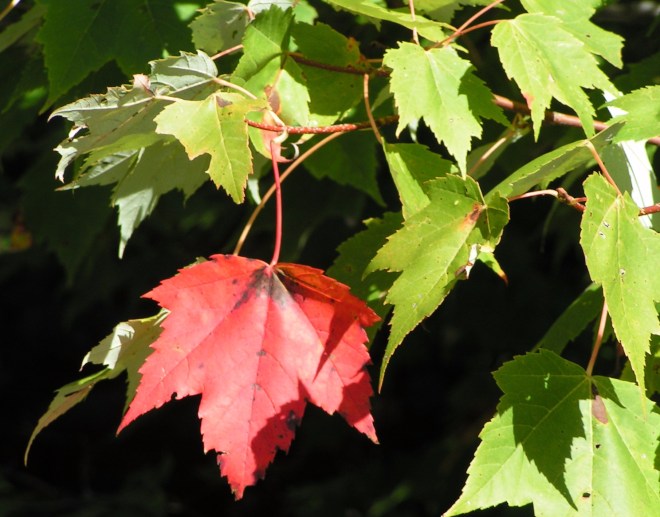
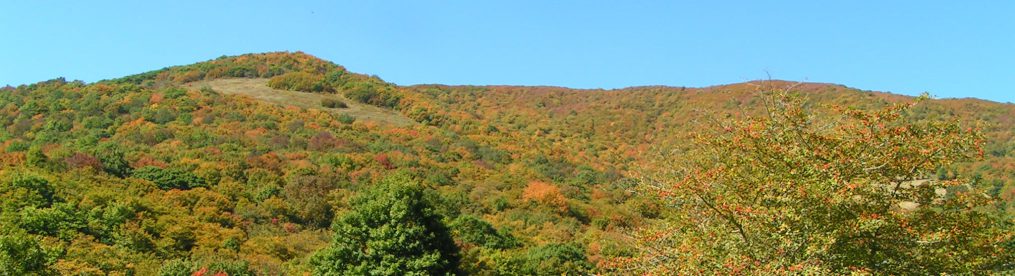
It’s about the time of the summer solstice that I inevitably spot a tree with that one red or yellow leaf. I’m a big fan of autumn, but I also prefer to live one day at a time, and that leaf sits there taunting me, reminding me that fall is inching its way into my life. To the astute observer, other signs of autumn’s sure return are all around. Those lime-green spring leaflets that sprouted on trees (wasn’t that just yesterday?) have been growing both larger and darker. Before they put on their showy fall display, they will continue to darken until, in the distance, they’re such a deep green they look almost black.

As spring wildflowers transform into summer ones, so summer’s blooms have now, almost imperceptibly, given way to those of fall. Daisies are replaced by Queen Anne’s lace; black-eyed Susans seem to morph into yellow coneflowers, Jerusalem artichokes, and sunflowers. Floral hues become both more muted and more rich. The buttery yellows of summer’s evening primrose make way for the more mellow tones of fall’s goldenrod. There’s the rusty shade of spotted touch-me-nots in lieu of daylilies’ brighter tints. In the wild, pinks virtually disappear as summer subsides, and lavenders transmute into the subtler mauves of milkweed and Joe-pye weed and the rich purple of ironweed. In front yards, gardeners discard summer’s petunia palette in favor of the earth tones of chrysanthemums. Berries appear. Fruits ripen.


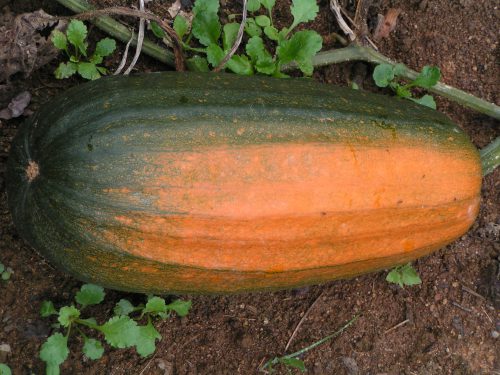
Birds’ feathers become a little less brilliant. Grasses develop gracefully drooping seed heads. Little by little, vegetable gardens show signs of wear as growth slows, pumpkins turn from green to orange, and early veggie plants dry up or go to seed.

dscf9200.jpg

The sun itself gets in on the action. Ever since summer’s solstice, its arc becomes a little more southerly, a little lower as it moves across the sky.

As I write this piece at the beginning of the third week of August, my calendar tells me we are just past summer’s midpoint. To be precise, sixty percent of our summer days have passed. Sitting outside in the afternoon, I hear a distinctive sound unique to this time of year—the thump of acorns and hickory nuts as they hit the ground in the woods. It’s not a safe time to be standing under a nut tree!

Then comes an evening’s after-supper walk when I unexpectedly sense another change. The days may still be warm and humid, but I feel the barest hint of chill in the night air. Sometimes, I even catch a slight change in nighttime scents—a little less floral, a little more spice. My ears notice the ever-increasing cacophony of crickets and katydids doing their late-summer thing. Their sounds also pierce the otherwise country quiet during the day, but at night the music is almost deafening, yet soothing in its own way and one more sign that fall is closing in.

Fall has always been my favorite season, so I welcome its coming. Still, it’s a little curious that just as we’re getting into the full swing of summer, autumn has already begun its birthing process. I guess that’s the way of things. The peak signals certain ending, but an ending accompanied by new beginnings—caterpillar to chrysalis to butterfly, seed to tree and back to seed again, adolescence to adulthood, retirement to a new life chapter,  the whole of life itself.


On Their Own—Sort of

The other morning, the Gnome and I were breakfasting at our favorite 24-hour restaurant chain. It’s the perfect place to pick up stories. It’s also a popular spot with the college crowd, partly because of its proximity to off-campus housing and its quick and reasonably priced fare.

On this particular morning we found ourselves in a booth just behind a group of college-age young men, five of them crammed around a table. We couldn’t help but eavesdrop on their spirited conversation. Nearly every sentence began with something like, “One time my dad . . . ,” or “When my dad and I . . . ,” or “My dad told me . . . ,” and so on. I didn’t hear these comments as some sort of my-dad’s-stronger-than-your-dad schoolyard oneupmanship, but more of a this-is-my-experience kind of sharing among peers.

After breakfast, we ran an errand at the nearby big box store, another popular hangout with the college crowd. Walking to the store from the parking lot, we overheard another pair of student types. This time it was, “My mom . . .”.

I was utterly fascinated. Not so much by the stories themselves as by their underlying significance. Here are all these kids, off on their own for probably the first time. Semi-independent. Feeling their oats. Maybe sowing a few wild ones, too. But what’s the nexus of their conversations? Their parents. They are still tethered. Their denials may be vociferous, especially to said parents, but the bond remains strong. I’m betting the young folks we overheard didn’t realize how parent-centered their conversations were.

Meanwhile, I imagine, the parents may have been mourning the loss of their fledglings. Or maybe they were feeling their own oats for the first time after a couple of decades of child-rearing. I’m almost certain, though, that they had no idea their children were putting them front and center in their relationships with their peers. In the parents’ wildest dreams, they probably never pictured their kids spending their early days of freedom sharing a piece of maternal advice or reminiscing with their friends about a fishing trip with Dad. Talking about watching maple syrup production with their folks.Retelling Mom’s stories of her own college years. Whatever.To moms and dads everywhere, know that your influence is strong. If you’re the parent of a newly-minted adult, don’t imagine for a minute that you’re not still an almost constant traveler in your son’s or daughter’s mind. Your kids may forget to call, but they are thinking of you. They are talking about you (hopefully in a good way). They are remembering your lessons. You’re still important to them, central to their lives.
And if you’re a grown child of parents who are still living, maybe you’d like to call and give them a verbal hug right about now. It’ll mean a lot. More than you can imagine—at least until you become the parent of a grown child yourself.


Needles and Thread, Part III: Grandmother’s Quilts

Needles and Thread, Part III: Grandmother’s Quilts (part of my Blowing on Embers series)

My maternal grandmother, like most rural mountain women of her generation, was a prolific quilter. Her quilting frame was hung from the dining room ceiling where it could be raised and lowered by pulleys. It made her home the perfect place for a quilt-making gathering, but she would have been worried to pieces having outsiders in the way, so quilting bees were limited to family members.

When I was about nine years old, I was the recipient of one of those quilts. It featured the Little Dutch Girl pattern: a little girl in profile with her flared dress, a big sunbonnet hiding her face from view, and equally big shoes—wooden clogs, no doubt. In each square, the girl’s outfit was multi-hued, each square’s color combination different from the ones around it.

The colorful quilt served as my bedspread for several years, on the same antique cherry bed that had been my mother’s. She had restored it when she was a teen as part of a 4-H Room Improvement project which earned her a blue ribbon at the North Carolina State Fair. That same bed was used by my daughter when she was a girl and then by her own daughter.

Unfortunately, the quilt was not quite so long-lived as the bed, now more than 150 years old. While not exactly ephemera, quilts were made to be used. My Little Dutch Girl quilt was well-used, first by me and later by my daughter. It wore out.

By the time I learned to appreciate my quilt for both its personal and cultural heritage, it was too threadbare, stained, and torn to save it. But I couldn’t toss it. A few years ago, I cut the quilt into its squares and framed the few that weren’t too stained or frayed. One I gave to my mother, one I kept for myself; others I stashed away for children and grandchildren.

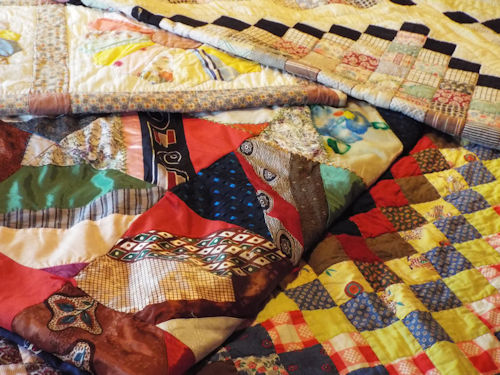
Now I’ve inherited a few more of Grandmother’s quilts. Unlike my girlhood quilt, I treat these with great respect. I don’t tuck them away where they can’t be appreciated, but I’ve learned not to expose them to daily use and abuse atop beds, either. These quilts hang side by side over a bedroom railing. Like MaMa’s Civil War bedspread, they are always on view and always available to provide extra cover on chilly nights—when they warm both body and soul.

I love these old quilts made by my grandmother, and I’m fascinated by the study of them. Her stitches were exquisite and her squares, large or tiny, were precise. But Grandmother didn’t exercise the same kind of care in other aspects of her quilt making. (Mother was right.)

Precision was not what you’d expect to find within Grandmother’s squares. One little Dutch girl’s profile, for instance, might vary from those around it. One’s shoes may be a little larger or smaller, while another’s might drop off the square entirely. Grandmother carelessly arranged colors. With Grandmother’s quilts, it’s not unusual to spot an aqua square somewhere in a row of royal blue ones. Or, you may find a wool or satin piece of fabric mixed in a row of cotton squares.

This quilt contains 148 border squares. 146 of them are black. The other two look like this.

Notice the random color placement of the “petals” in this quilt square. Can you spot the petal that was pieced together?

Whether it was plain old sloppiness, a preference for form over function, poor planning, or the “Use it up, wear it out, make it do, do without” philosophy stated on one of her many cross-stitched pieces, these little details simply didn’t seem to matter to Grandmother. And one thing’s for sure—her quilts are unique; they’ll never be mistaken for anyone else’s.

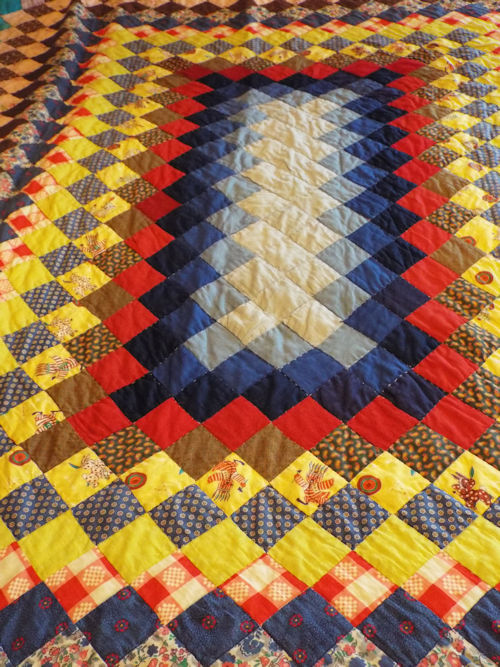
Among other fabrics, Grandmother used a red-checkered tablecloth, printed flour sacks, and old children’s pajamas to make this quilt.

Grandmother was a giggler and she kept me in stitches. Even now, looking at her quilts makes me chuckle. I think she’d have wanted it that way.

Needles and Thread, Part II: MaMa’s Treasure

(Part of my Blowing on Embers series)

I never knew my paternal grandmother. She died in 1942, about two and a half years before my parents married. After still another year, Grampa married Carolyn Usher Johnson, the woman I always knew as MaMa.

When Grampa and MaMa married, she moved into his three-bedroom home. As I was growing up, I thought the house was hopelessly old-fashioned with its mahogany furniture, Oriental rugs, ornate cuckoo clock, and velvet upholstered sofa and chairs adorned with crocheted antimacassars. An old wind-up Victrola, complete with its puzzled-dog-staring-into-the-horn icon and wax cylinders, always a fascination to us grandchildren, stood in the hall.

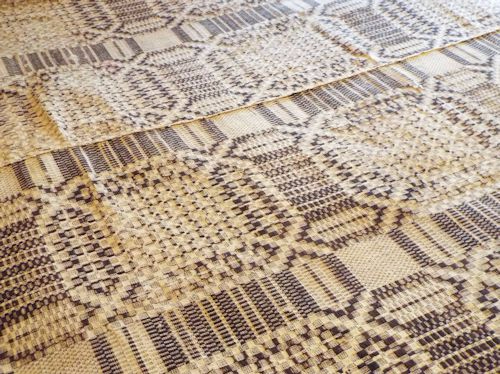
Once the last of the nine sons and stepsons was out of the house, two of the three bedrooms were reserved for company. When our family visited, we usually stayed in the front bedroom, which featured a porcelain pitcher and bowl on the antique washstand and a brightly colored, velvet crazy quilt on the bed. The bedspread in the second bedroom was much more sedate: a thin woven cotton spread in muted shades of brown.

After I was married with children of my own, I was happy when our young family moved to North Carolina because it meant being nearer both my husband’s and my extended families. I was especially eager for our children to get to know their only living set of great-grandparents.

When we went to see Grampa and MaMa in the summer of 1981, the term Alzheimers’ had only recently entered the popular lexicon to describe the most common form of dementia. MaMa had been diagnosed with this horrid disease not long before our visit. Her diagnosis came after she was found walking along the highway near their home in the middle of night, wearing nothing but a nightgown, unsure where she was or how she got there. But when we visited, she was perfectly lucid, even joking about that nighttime misadventure. She seemed quite competent.

We stood in the front yard saying our always stretched-out goodbyes when MaMa asked us to wait a few minutes more and disappeared into the house. She returned a few minutes later, carrying the brown bedspread I remembered from my childhood. As she presented it to me, she explained that her grandmother had woven the spread during the Civil War.

I was touched, but I demurred. Surely, she should give it to one of her sons’ children. It was their birthright. She was quick to say, “Oh, they’d just pack it away in a cedar chest. I know you’ll use it the way it was meant to be used.” Grampa, standing beside and ever so slightly behind her, silently gestured that we shouldn’t belabor the point. MaMa knew what she wanted and would be unduly upset if we declined. We accepted the spread.

It was the last time we saw her. MaMa died before we were able to make another visit to eastern North Carolina. We were even more honored,and now sobered, to be in possession of the spread with its rich heritage. But how were we to honor it?

It had been in regular use for over a hundred years and simply wouldn’t stand up to much more wear, especially in a house filled with cats, dogs, and active children. Yet, we knew we couldn’t let the spread spend the remainder of its days in the dark recesses of a cedar chest, no matter how much longer it could be preserved.

We had to find some other way to care for the special piece of history entrusted to us. Today, the treasured spread is folded over the loft rail overlooking our bedroom, a compromise that keeps it in sight but protects it from the risks of everyday use. We’re careful to keep it out of direct sunlight, to fold it loosely, and to rearrange its folds every so often to keep the fabric from weakening at fold points.

We honor it. We tell its story. I hope that’s good enough.

Move-In Day

Move-In Day

(Written on Saturday, August 19, 2017)

move in 5 better

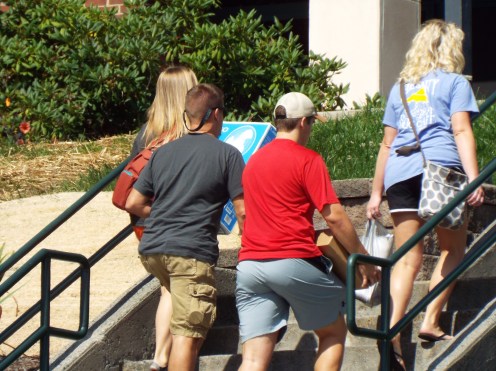
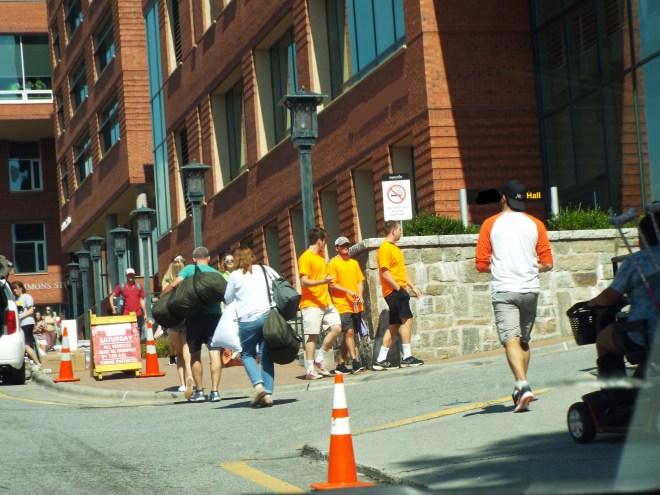
It’s Move-In Day at the local college. Traffic has been a mess all week as students who live off campus, as well as student advisors and others with pre-move-in responsibilities, clog the roads for miles around. Roadside signs directing parents and new students to this or that area of campus begin several miles beyond town.

The campus itself is dotted with temporary identification and directional signage. Campus security personnel and ROTC students direct on-campus traffic while other staff, including my nearest neighbor, are on hand to help carry suitcases, boxes, and carts full of bedding and other necessities to dorm rooms—this being their fourteenth straight day on the job. They’ve been hectically sprucing up those same rooms and making sure all maintenance issues have been resolved in preparation for this weekend for weeks. 

Dorm parking lots are full of loaded pick-up trucks and rental trailers as parents help their fledglings move in. I’ve seen license tags from places as far away as New Hampshire, Texas, and Colorado. We’re used to out-of-staters. After all, we’re a tourist town as well as a college town, but the prevalence of far flung tags has been greater for the last few days. DSCF9247_LI

Students fill the campus and downtown sidewalks in groups of twos, threes, and fives. It’s an exhilarating time. Freshmen are getting acquainted with their roommates and other newbies. Their shared excitement, nervousness, and uncertainty creates an instant and strong bond. Upperclassmen are eager for reunions with friends. Some are all aflutter at the prospect of being back together with sweethearts after months apart. For a few, the start of the new year is bittersweet, having said sad good-byes to their steadies back home, but eager to greet friends and decorate their rooms.

Parking lots and dorm rooms are scenes for a fair share of teary-eyed goodbyes, but for the most part the damp cheeks belong to parents. More students than not are virtually shoving their families out the door. They want Mom and Dad to stop with the bed-making and drawer-filling and advice-giving. They want to get on with it. This is their time.

It’s a weekend unlike any other. No classes, no assignments. It’s get-acquainted time. Settle-in time. A few hours of relaxation with no academic stresses. Still, minds are a little muddled for many freshmen, who have more-than-ever moments of feeling like little kids on the inside while trying with all their might to be all grown up on the outside. Their innermost feelings and fears will not be spoken aloud.

Today is all about hope. It’s the beginning of a fresh start. Freshmen, especially, have a chance to make themselves anew, if they choose. No baggage follows them here. No one knows their academic, family, or personal backgrounds. They can scout out other like-minded folks; there are clubs and organizations aplenty for exploring new ideas and finding expression for their deepest interests. (In fact, some of these kids will be unrecognizable on their first weekend home—with radical hair colors and styles, tats in unlikely places, piercings on improbable body parts, and strange new ideas. They may sport heretofore unknown wardrobes to announce their current status.)

Meanwhile, vendors conglomerate just beyond the school’s boundaries to hawk mini-fridges, carpet remnants, and college-themed products for student rooms. Restaurants, retail stores, and churches display signs that say things like “Welcome Back” or “Welcome, Students.” One was different. It simply said, “Welcome Home.” In a microsecond I was transported to my own college days, and I realized this was the sign that got it right.

Even as a butterflies-in-the-stomach freshman, it was only a matter of days until I understood I’d found my home at my now alma mater. As I returned from semester and summer breaks for my next three years, I knew for certain I was coming home—home to roommates, classmates, hall parties (held for any reason or no reason at all). Home to favorite professors and classes for which I had a passion. Home to love interests, ball games, dances, bonfires, and concerts. Home to learning and my still unknown future. Of course, I still referred to that place from which I hailed as home, too, but it was my parents’ home. This was mine. All mine.

Welcome home, students! 


Needles and Thread, Part I: Workmanship

Needles and Thread, Part I: Workmanship

(Part of my Blowing on Embers series)

My mother is an expert needlewoman. At least, she was until arthritis and eyesight betrayed her. She grew up in an era when nearly all young girls learned to sew and excel at other needlework. When I was a girl, my mother made all my clothes before she taught me to sew, too.

She was a painstaking seamstress who worked on an item of clothing until it met the approval of her extraordinarily critical eye. Ripping out seams didn’t bother her one whit if it meant a better garment. A dart that didn’t end precisely at the right point, a facing that didn’t lie perfectly flat, a seam that puckered the tiniest bit—none of these flaws would do, no matter how slight.

I spent torturous hours standing on a stool where I was required to turn ever so slowly, like a music box ballerina (but not nearly so patiently), while she pinned and repinned a dress hem until it was perfectly straight, a fact she ensured with her trusty yardstick. Wherever needle and thread were concerned, Mother was a perfectionist.

My mother, like hers before her, tatted for years, making doilies, snowflake tree ornaments, and yards of knotted lace edging for collars, sleeves, and hemlines. She spent many an evening working on needlepoint, embroidery, crewel work, and cross-stitch, too. Needlework pieces made by either Mother or Grandmother covered the walls of my parents’ home: a zinnia bouquet, a North Carolina map, birds of America, twin Christmas “Partridge in a Pear Tree” wall hangings, along with humorous or pithy pearls of wisdom. “If Mama ain’t happy, ain’t nobody happy,” and”Nobody sits down until the cook sits down,” and “Use it up, wear it out, make it do, or do without” are three memorable ones.
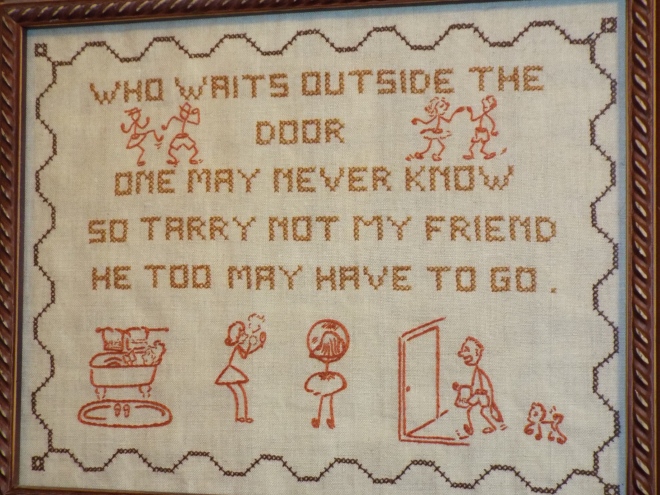
The combination cross-stitch and embroidery piece that long hung just inside Mother’s bathroom door has always been one of my favorites. Surrounded by basic embroidered designs depicting various bathroom scenes (a stick figure powdering her nose, an overflowing tub, someone nervously dancing on the wrong side of the door), are these cross-stitched words:

Who waits outside this door / One may never know / So hurry up, my dear / He, too, may have to go.

One day when I was visiting Mom, I wondered aloud about its provenance. I wasn’t a hundred percent certain, but I was pretty confident I’d seen this piece hanging in my grandparents’ house before it was in hers. Her response was sure and strong. “Mother made it. I’ve always been really proud of my needlework. Mother was never very careful with hers, and there’s a mistake in this picture.”

DSCF8888

Can you find a mistake?

She cheerfully volunteered to show me its fault as proof. She studied that piece, then studied some more trying to find the offending error. After a long few minutes, Mother said, “I can’t find anything wrong with it. I made it, after all!”

A perfectionist—and a cocky one at that.

No Touching

(Part of my Blowing on Embers series)

About this time of year I’m overcome with nostalgia. What brings it on is the flowering of touch-me-nots. My now grown children groan in exasperation whenever they hear me mention these wildflowers—they know what’s coming next.

It’s the story of how these jewel-toned flowers remind me it’s time for the school year to start in these parts. How I fondly remember watching the two of them emerge from a heavy fog as they walked up our newly-graded and graveled road after their first day of school barely more than a month after we moved up here on the diagonal. (Punkin was a fourth-grader, wishing she was back in the Brown School in Louisville. It was Cuddlebug’s very first day of school anywhere.) How their arrival home from late-summer school days was often delayed because they couldn’t resist the urge to stop along the way to do exactly the opposite of the warning implied by the plant’s name and pop the flowers’ seedpods. It’s an addictive pursuit, and it was a fun way to end the school day.

Handling a touch-me-not is a uniquely rewarding and giggle-worthy experience. The seedpods don’t look particularly fragile, but when they’re mature, the slightest movement causes a virtual explosion, with tiny seeds catapulting onto the landscape—no doubt the reason this wildflower is so prevalent in territory friendly to its needs. The steep banks along our country roads are saturated with touch-me-not plants right now.

Predictably, with all those explosive seedpods, touch-me-nots have taken over the roadsides.

Also known as jewelweed, this prolific wildflower may be either yellow or orange, each variety’s flowers freckled with deep reddish-brown spots near and in their deep throats. Their nectar-filled spurs make them attractive to hummingbirds, butterflies, and other pollinators. In appearance, they strike me as a cross between miniature orchids and larkspurs.Touch-me-nots are common throughout all of the U. S. with the exception of a few western states. They’re fascinating plants—beautiful, useful, quirky, and irresistible to kids of all ages. Once you’ve popped a few seedpods, you never outgrow the urge when you come upon a patch of these intriguing plants.

When a seedpod bursts open, either on its own or with a little human help, the hull instantly curls up into tight coils, like small, green springs. It’s all so fast you can’t see it happening. A captivating sight in itself. And even though you know that little explosion is coming and are waiting for it, it will inevitably make you jump in startled surprise.

The leaves are just as intriguing. If you find yourself in a patch of jewelweed on a dewy morning or just after a rain, its leaves will be the only dry thing around, displaying little beads of water on their surface. Dancing in sunlight, the water glistens like diamonds.

Submerge a leaf in water with its underside facing up and it turns silver. Pull it out and it will be dry, with only a few droplets of water here and there.

Touch-me-nots also have medicinal uses. The best-known and most practical use is as a remedy for itching. In fact, they’re often found in conveniently close proximity to itch-inducing poison ivy and stinging nettle. By breaking open the liquid-filled stems and spreading the watery sap on skin that’s been exposed to these plants or to insect bites or stings, you’ll most likely experience immediate relief.

And you can even eat the little seeds. They taste a lot like walnuts–really! Granted, it would take a lot of collecting to get enough to bake into a dish, but it’s a handy thing to know if you happen to find yourself lost and hungry in the midst of these delightful plants.

All this and nostalgia, too.

The sight of touch-me-nots, the start of the school year, the long held vision of our children in their first-day-of-school finery, the hint of autumn in the air, the memory of those first days of house-building—all these things represent the beginning of our life on the diagonal.

Kids, if you didn’t already realize, you might as well get used to it because whenever touch-me-nots are in bloom, I’ll continue to reminisce aloud about this giant tangle of sweet memories.

Polio: From Reign of Terror to Obscurity in One Generation

(Part of my Blowing on Embers series)

Recently, I was recounting a childhood event in my life to my teenage grandchildren. I mentioned polio (paralytic poliomyelitis). “What’s polio?” asked the seventeen-year-old.

Wow—imagine that! To think this (mostly) childhood disease which terrorized U. S. parents for four epidemic-laden decades of the 20th century is unknown to today’s youth is almost unfathomable to someone like me who lived through that era. That there’s no reason for them to know about it is an amazing blessing.

It certainly wasn’t always like that. If you’re in the same boat as my grands, you may want to know there was a time when polio, a disease that’s been around since ancient times, was widespread in this country.

The U. S. experienced annual polio epidemics every summer between 1916 and 1955, with the worst outbreaks occurring in the 40s and 50s—the period of my childhood. Nineteen fifty-two was the peak year for the nation’s epidemic: 60,000 cases were reported. Three thousand victims died; 21,000 more were paralyzed.

Polio was, and is, a highly contagious, virus-caused disease which can be transmitted via contaminated water. That’s why public swimming pools were regularly closed during my childhood whenever a case was reported. Interestingly, most people who contracted polio never even knew it; they had no symptoms. For many others, symptoms were similar to the flu—a few days of high fever, sore throat, headache, abdominal distress. But for others . . .

My worst polio-associated image has always been the iron lung, that body-enveloping steel cylinder to which many polio victims were confined. Because polio attacked muscles, including those required for breathing, this mechanical breathing machine was the only survival hope for many. For some, like actress Mia Farrow, the iron lung was temporary, though it probably didn’t seem like it at the time.—she lived in one for eight months. For others, it was a life sentence. At least one victim was confined to an iron lung for more than forty years, until his death in 2003. 

Food and Drug Administration: iron lung ward, Rancho Los Amigos Hospital, CA.

Public domain photo courtesy of Centers for Disease Control and Prevention‘s Public Health Image Library (PHIL), identification number #6536.

Two of those terrorized mid-20th century parents were mine. When I awoke crying with a high fever in the middle of the night after a day of playing with other three-year-olds in a neighborhood mud puddle, they wasted no time rushing me to the hospital. I still retain the memory of being swooped up and cradled in my dad’s arms, tightly wrapped in a blanket. In my next remembered image, I was lying in a hospital bed, Daddy lying beside me, reading a Cornet magazine. I was terrified when I woke the next morning to find myself alone in that strange place. Mother arrived not long thereafter with a brand new pair of patent leather shoes for me to wear home. The diagnosis was tonsillitis. Their overreaction just shows how real the fear was.

Then came 1955. I was one of millions of reluctant kids dragged by our equally hopeful parents to stand in long, winding lines—in my case in the hot South Carolina summer sun—to get the brand new polio vaccine, developed by Jonas Salk. Hundreds of thousands had worked frantically to develop an effective vaccine, from scientists to test subjects to ordinary citizens raising funds for research and development.

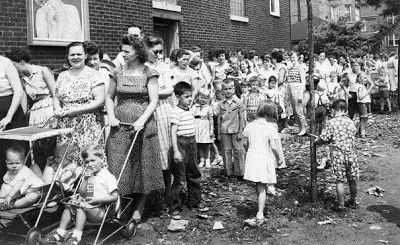
This Pinterest photo was taken in Chicago in 1955. The line I stood in seemed every bit as long as we waited in the hot sun, dreading our fate: the first of a series of three shots. Later came the oral vaccine we took as a booster.

And just like that the epidemic was over. The residual effects, though, were not. Years later, a college classmate of mine wore leg braces and used crutches to get around campus. When I lived in Louisville, KY, in the 70s, three of my work colleagues, two of them wheelchair-bound, had contracted the disease in that city’s 1952 epidemic.

Some famous people who suffered from polio: Franklin Delano Roosevelt; Emmett Till; Jack Nicklaus; actors Alan Alda, Donald Sutherland, Mia Farrow; former Secretary of Defense and World Bank president Robert McNamara; ventriloquist (and voice of Tigger) Paul Winchell; artist Frida Kahlo; singers Neil Young, Joni Mitchell, Judy Collins, Dinah Shore; NYC ballet soloist Tranquil Le Clercq; photographer Dorothea Lange; former Washington Post executive editor Ben Bradlee; saxophonist David Sanborn; Olympic gold medalist (track and field) Wilma Rudolph; Tarzan portrayer and Olympic gold medalist (swimming) Johnny Weismuller; violinist Itzhak Perlman.

Even today, there’s no cure for polio. Survivors often have residual complications and can anticipate post-polio syndrome in later life—a return of weakening muscles and other issues. Our salvation is in prevention. And while polio is now virtually unheard of in the United States and most of the world thanks to global eradication efforts, the disease hasn’t yet been wiped out. Polio still exists in two or three countries in Asia and Africa and has, on occasion, been reintroduced into others. It wouldn’t take much for a resurgence to occur here. As long as it’s out there, I won’t be completely comforted.

And yet, I’m gleeful that my grandchildren, knowledgeable as they are, have no knowledge of polio, that they have no need to know. And ever thankful to the scientists and public servants who were, and are, committed to finding a way to curb this horrific scourge worldwide.