The Queen of Her Destiny

Queen of Her DestinyDenmark_crown

This meme popped up on my computer the other day: “One day she finally grasped that unexpected things were always going to happen in life. And with that, she realized the only control she had was how she chose to handle them. So, she made the decision to survive using courage, humor, and grace. She was the Queen of her own life and the choice was hers.”

It brought to mind a news feature I’d heard not long before: a discussion with a principal in a school full of students who have faced the kinds of challenges that might do most of us in. Unsurprisingly, some of those students are troubled. This wise principal takes those students in hand and tells them how sorry she is that they’ve had to deal with such horrible life circumstances.

Then she says, “I can’t do anything about that,” and goes on to challenge them to shift their focus from what has happened to them in the past—what they, too, can do nothing about. She tells them she’s there to help them figure out what they’re going to do about things now. And to stand alongside them to help them get where they want to go.

I think that’s so wise. I’ve seen far too many “Woe is me” people. Their obsession with the bad things that have come their way has paralyzed them to the point that they’re unable to make a single decision, to take one positive step forward.

I know it’s hard. I’m not here to suggest anything to the contrary. But what that principal says is true. What the meme says is true. Paying these words heed is the only way to crawl out of despair and into the future.

Seek the light and grab hold. Be the queen—or king—of your destiny.

Photo attribution: By Ikiwaner (Own work) [GFDL (http://www.gnu.org/copyleft/fdl.html) or CC-BY-SA-3.0 (http://creativecommons.org/licenses/by-sa/3.0/)%5D, via Wikimedia Commons

Coming ‘Round the Mountain

Coming ‘Round the Mountain

Coming ‘Round the Mountain (part of my Blowing on Embers series)

Public domain photos retrieved from Wikimedia Commons titled Winning horse and buggy with driver at the Wynnum Show, Brisbane

Is there anything quite like the sweet scent of a dew-kissed early morning—especially in our green southern mountains? Every time—every single time—I catch a whiff of it, I’m transported back to those too-rare childhood trips to visit my maternal grandparents.

It was an excruciatingly long drive from the South Carolina flatlands to North Carolina’s southwestern mountains, even longer for the three children relegated to the back seat.

We claimed our territory before the first hand ever touched a door handle. No one wanted to be stuck in the middle, surrounded by sibling arms, legs, and torsos. We knew we’d have to take turns, but hope sprang eternal.

The window-seat sitters were intolerant, and arguments began almost immediately: your feet are on my side . . . I don’t have anywhere to put them . . . keep ’em on the hump . . . Mama, he’s touching me. And so on.

Our trips usually began late on a Friday afternoon so Daddy could get in most of a day’s work and we’d still have all day Saturday for visiting—and resting up before we had to make our return trip on Sunday afternoon. In the days before interstate highways, the drive lasted more than six hours—an eternity to us children. A couple hours in and we were miserably fidgety. That’s when the questions began. When will we get there? How much longer? Are we there yet?

Mother tried diverting our attention with car games. We looked for license plates from other states; we searched for words on billboards that started with the next letter of the alphabet; we tried to be first to spot whatever animal or object one of our parents called out to us.

Once our brown, two-tone Ford Fairlane began climbing and winding, we knew we were getting close, which only made us more restless. That’s when Mother began leading us in all the verses of She’ll Be Coming ‘Round the Mountain, with its ever longer refrain. In my mind’s eye we were singing about Mother in an earlier era. I imagined her in a bonnet riding on the front seat of our song’s buggy, maybe even wearing scratchy red pajamas.

For Dad, navigating those ever steeper, narrow, curvy roads in the dark after an already long day at the office was harrowing enough without being distracted by the fussing and whining emanating from the back seat. No wonder Mother was so desperate to keep us occupied.

Everyone knew what was coming when we inevitably got on Dad’s last nerve, and we didn’t want to hear it any more than he wanted to say it: “Ask me that one more time, and I’ll turn this car around right here.” Not likely. Returning home would have made for an even longer trip, and no one wanted that. Occasionally, the threat was, “One more argument and I’ll stop this car and give everyone a spanking.” We rarely got spanked and never on a car trip, so why pull out that old chestnut? Sheer exhaustion, most likely.

Somehow, we always reached our destination in one piece and not too awfully frazzled. A few hugs, kisses, and a midnight snack later, we were hustled off to bed and bundled under the covers.

And then it was morning. This was the moment I’d been looking forward to since we first got in the car. I woke under a pile of Grandmother’s homemade quilts, fog drifting through the windows I’d opened the night before so I could feel the kiss of the deliciously crisp mountain air on my face.

Before anyone else stirred, even my early-rising grandfather, I stole outside to walk barefoot in the cool, damp grass. I breathed in the clean scent of a world washed in dew, nibbled on a green apple that had fallen from its tree, and slipped under the graceful, draping branches of the giant weeping willow on the edge of the yard—my sacred hideaway. It was the perfect spot for a little girl to daydream, think private thoughts, and grow.

And worth every minute I was stuck in the middle.


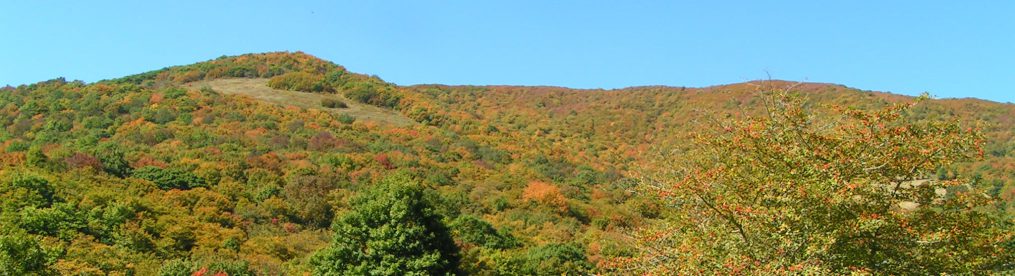
Any hour of the day, any season of the year, every time I see sights like these I know the mountains are my meant-to-be home.


School Field Trips

School Field Trips (part of my Blowing on Embers series)

When we moved up here on the diagonal, our children attended a school far out in the county. Field trip time rolled around, and I was surprised to overhear some of the students saying they were planning to “lay out” that day. A field trip to town not only held no interest for them; they were a little overwhelmed by it. For some, visits to downtown were rare and intimidating, it seemed.

Not for me. Back in my school days in Florence, South Carolina, everyone I knew shared my enthusiasm for our annual field trip. It took place in the spring and was the highlight of the school year. I think we may have seen it as a sort of rite of passage. We’d made it through (almost) another year in the classroom.

My first field trips occurred when I was a student at Briggs Elementary. Some school board shuffling meant I spent the fourth, fifth, and sixth grades at Tans Bay, so much further out in the county that I’d never heard of it. Field trips were a staple at both schools. When the big day came, the air was electric with anticipation.

Below are pictures taken of my third, fourth, and fifth grade field trips.

Notice anything?

3rd Grade field trip

Can you spot  me–or Teddy?

4th Grade field trip

5th grade field trip

That’s right! Every single field trip was exactly the same. Year in and year out.

It went like this:

  1. Put home-packed lunch (mine was always my mom’s terrific egg salad sandwich and a small bag of potato chips) in the large cooler filled with dry ice. Do not touch the ice!
  2. Tour Coble Dairy; select a half-pint carton of white or chocolate milk; return to bus.
  3. Tour Merita Bakery; pick up a cinnamon roll two-pack and a Pepsi; pose for official field trip photo on steps of bakery; return to bus.
  4. Hop off bus at Timrod Park; retrieve lunch from cooler, watching in fascination as the dry ice forms fog when it transforms from solid to gaseous state (remember not to touch!); eat lunch and play on playground; return to bus.
  5. Disembark charter bus back at school and board yellow school buses for home.
DSCF0320

The schoolhouse where 19th century poet Henry Timrod taught is a showpiece of Timrod Park.

For some reason I cannot fathom, we were always accompanied by a police officer—he was the same year after year, too. Our county was small and peaceful. We students were certainly not rabble rousers. Nonetheless, we had police protection. Not that we minded. We girls thought he was the cat’s pajamas. Tall, uniformed, dark wavy hair. He scared us a little, but we couldn’t help but flirt in our grade-school way. (You can see him sitting in the lower left of the middle picture with holster hanging from his hip, and standing, upper right, in third picture.)

Florence must not have been much of a happening place in the middle of the last century. But it sure seems like the school system could have come up with a little field trip variety.


Big Changes

Big Changes (part of my Blowing on Embers series)

My year in the yellow house was pretty eventful, but so was the next place we lived: Thrift Road in Charlotte, North Carolina. It was where my youngest brother was born, where I started school and learned to read—a lifetime passion.

The night before my first grade school picture was to be taken, I took a pair of scissors to my hair.

It was where our family listened to the 1952 presidential election results. “Who are we for, Mommy?” It was where I got my first pet, a blonde cocker spaniel-spitz mix we named Boots and where she died from injuries received when she was hit by a car a few months later.

It was where I went from measles to chickenpox in one fell swoop, missing an entire three weeks of school. (Remember, this was before today’s age of vaccines.) I was so sick! And it was where my across-the-road neighbor, Mary Ann, told me she was adopted and had me convinced I was, too, a conviction so powerful that it had me searching for proof among my parents’ papers for five years.

Charlotte was where I was terrorized by the hundreds—hundreds—of snakes that slithered out of a weedy field and across our driveway after a heavy summer rain with me in their midst. I’d never seen a snake, but I’d picked up from somewhere (certainly not from my wildlife-loving parents and not from TV—we didn’t have one of those) that snakes were to be feared more than death itself. I leapt onto the bottom rail of the chain link fence that enclosed our back yard, my tiny hands clutching the links for dear life, and screamed bloody murder till my parents came out to save me. My snakes turned out to be nothing more than slugs!

Thrift Road must have extended further then than it does now because I was able to walk to Thomasboro School, just a few blocks away. According to current maps, it’s much too far a distance for a first grader to walk. Today’s roads in that neighborhood (like Freedom Road and I-85) are also far too busy for children to walk them safely.

We had a school-wide assembly on my very first day where the principal, Mr. Curlee, announced that he had locked up all bicycles that had been improperly parked (whatever that meant). I thought that was so mean! Mr. Curlee terrified me.

I’d swear that my teacher, Mrs. Howie, was older than these mountains I live among today. For reasons I won’t go into, I thought she was mean, too. But she must have been an effective teacher. I started school at a distinct disadvantage: all my classmates had a year of kindergarten under their belts, but I’d just moved from South Carolina where there was no public kindergarten. As a result, everyone else in my first grade class was well ahead of me both academically and socially in the beginning. It must not have taken long for me to catch up, though, because my report card (yes, of course I still have it) was stellar in every way, even when I missed a full 30% of a grading period because of those childhood diseases.

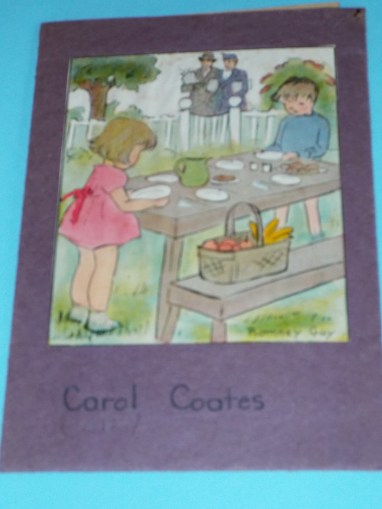
My report card cover. How very Dick and Jane.

We lived in Charlotte a mere sixteen or seventeen months before returning to Florence. I’d been in second grade for just days when we made the move. When I walked into Briggs Elementary School, a few days into the South Carolina school year, as well, whose do you think was the first face I saw? Teddy’s! We were reunited! It was more than I’d ever dared hope for. I had long since resigned myself to the certainty that our paths would never again cross.

In my elation at this happy surprise, I told my newfound girlfriends that Teddy and I already knew each other, that he was, in fact, my long lost boyfriend. When they didn’t seem to believe me, I did what may have been—to this day—the boldest and most uncharacteristic thing of my entire life. I told them I’d prove it by kissing Teddy one hundred times! I had to chase him down at recess, but I did it.

We never spoke again.

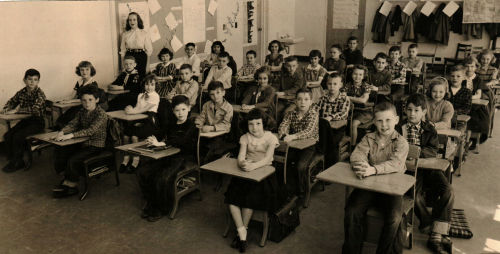
My third grade class. For some reason, I don’t have a second grade picture, but with the exception of the teacher, the cast is the same. (That’s me way back there in the last seat of the row next to the wall.)  Miss Milliken was our second grade teacher. Our exotic, red-headed third grade teacher was Miss Whitlock. I adored them both.

My Year in the Yellow House—Revisited

My Year in the Yellow House—Revisited (part of my Blowing on Embers series)

As I wrote “My Year in the Yellow House,” I wondered whether the story would have broad appeal since it didn’t have any overarching theme or message. Just random memories. Nothing much to see there.

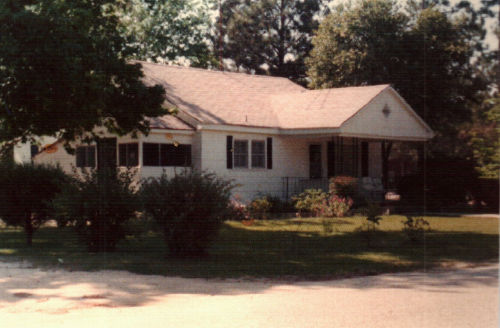
The yellow house many decades later—no longer yellow, but with the addition of front and side porches

I was suddenly taken aback at that notion. My essay was full of big deals. Unstated, but implied, was the fact that my youngest brother was conceived the year we lived in the yellow house, rounding out our family. How would my own life story be changed if that hadn’t happened? Most assuredly, he and his children think it was a pretty big deal.

Questions bubbled up.

For the family who lost their home and all their household belongings right down to their shoes and underwear, the blaze that destroyed their house was monumental. I wonder how it changed their lives. Did they have family nearby to put them up temporarily? Did they have a savings account in the bank to help get them back on their feet? Was their life savings, however large or small, stashed in a mattress that went up in flames? What happened to them, I wonder.

Was Glory’s tumor malignant? That’s what I always thought. If it was, did it go into spontaneous remission? Did her family’s faith cure her? How did she turn out? Or did the tumor kill her? When? How was her family—and their belief system—affected?

What about Carol’s family? Is there a more devastating blow than losing your young child? Did her family survive intact? Many don’t. And what did the world lose with no Carol to grow up in it? What about the family that never was? Would she have changed the world? Questions the answers to which no one will never know.

It was an eventful year on our small block. My own travails were pretty petty compared to what was happening all around me.

And yet, they weren’t. I heard something on the radio recently about how important it is to listen, really listen, to all the insignificant things your young child wants to tell you, no matter how busy you are with more important grown-up issues. The point was that if you don’t listen now, they’re unlikely to tell you the really important stuff later. But it was the next phrase that really struck me: “to them [the children] it’s all important.” Of course it is. It’s all they know.

To five-year-old me, it was all important. It would have been to any five-year-old.

My most potent memory from that year is the one where I was pushed into a tiny but formidable dark space, locked in, and forced to allow my most valuable possession to be desecrated in order to gain my freedom, having no confidence that the bargain would be honored, even then. My doll was my baby; it was an intolerable choice. And all because of someone’s inexplicable need to be cruel.

I don’t know all the ways the doll experience colored my life. Was that the moment the meek, compliant girl I grew into was forged? Was it what made me forever seek to avoid confrontation at almost any cost? Was Glory’s taunting what birthed my empathy for others? Or was it just a terrible moment with no particular future consequences other than a bad memory?

I don’t have the answers to any of these questions.

What about you? What questions still linger from your early years? Were there childhood moments—little or not so little— that changed your life?

My Year in the Yellow House: Childhood Vignettes

My Year in the Yellow House: Childhood Vignettes (part of my Blowing on Embers series)

I was five the year we lived in the yellow house. My brother was two. Our little two-bedroom home in Florence, South Carolina, near Cole’s Crossroads, was part of a modest and sparse subdivision, if you could even call it that. There were no sidewalks, and grass grew erratically in the sandy yards. Roads in the development were nothing more than not-too-packed sand.

alan yellow house

My brother’s favorite place to play was on the sandy road in our neighborhood.

Our house sat on a corner of the neighborhood’s main road. Follow it for a block or so and you’d be on old Hwy 301/52. Directly across the highway was Edwin Turner’s Chicken Basket, a popular family restaurant and the favorite spot for our very occasional meals away from home. As the name suggests, the restaurant’s main fare was fried chicken, along with french fries and hush puppies,* served in brightly colored, paper-lined plastic baskets—the kind you now see in a few casual dining establishments, but a true novelty then. We usually chose a booth in the knotty pine dining room, and Edwin Turner himself would stop by to ensure we were enjoying our meal.

Out front was the sign proclaiming the name of the place. As I recall, atop the sign sat a large rotating replica of one of those famed plastic baskets. My brother could never keep the words for Edwin Turner’s Chicken Basket straight. He always called it Chicken Edwin’s Turning Basket. When you think about it, his literal rendering made perfectly good sense—as children’s name mash-ups often do.CHICKEN BASKET
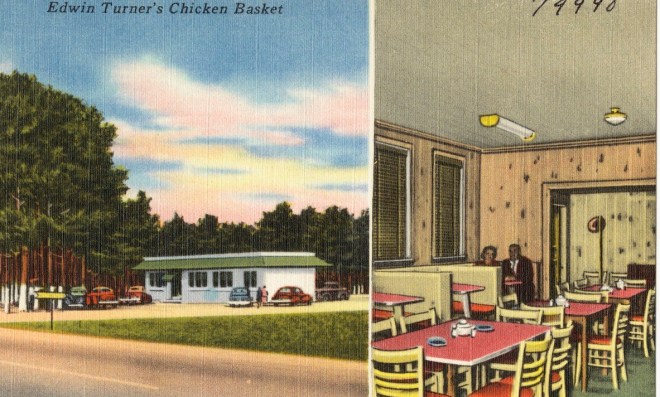
From the Tichnor Brothers Collection, Boston Public Library, http://ark.digitalcommonwealth.org/ark:/50959/mg74r003g

We loved the Chicken Basket—for its tasty food, its novelty, the attention of its owner, its prominent role in our lives. In addition to special dinners out, Edwin Turner’s was a true landmark in the community. For us, it was the easiest way to direct friends and out-of-town family to our house.

But the restaurant is only one of many memories I have of that year. They are a mixture of good and bad. It was while we lived in the yellow house that my first real childhood friendships developed. It was also where I experienced my first significant encounters with sickness, trauma, and grief.

My childhood preceded the era of many vaccines in use today, and I was in bed with a severe case of mumps for what seemed like forever. The lumps on either side of my neck felt humongous, and the pain of swallowing was so intense that I demanded something to spit into so I wouldn’t have to swallow. Of course, it didn’t work, but I gave it my best, spitting several times a minute all day every day into the blue and white speckled enamel pan Mother placed next to my bed. To this day, I have an aversion to enamel cookware.

Glory (not her real name), with her white-blonde hair, lived across the street from us. She had a tumor on her lower back, just above her buttocks. Her parents’ religious beliefs prevented them from seeking medical attention for Glory, but the tumor must have been extraordinarily painful because Glory, who only wore dresses, didn’t wear underpants—the pressure would have hurt too much.

Neither Glory’s illness nor her family’s deeply held religious beliefs kept her from being a bully, though. One day when we were playing in my bedroom, Glory locked me in the toy cabinet and refused to let me out until I gave her permission to tear my doll’s hair off her head. I was terrified in the pitch black cabinet, and I was devastated at the thought of what was happening to my precious doll. Mother was in the kitchen just a room away, but the cabinet doors and the wall between us must have muffled my piteous crying.

My very best friend, Teddy, lived on the third corner of our intersection. We played together much more often than I played with was tortured by Glory. One of Teddy’s and my favorite places to play was in the abandoned excavated lot on the fourth corner of our intersection. We loved it down there where our imaginations could run wild.

Then Teddy had a birthday—his sixth. When I got the invitation to his party, I was inconsolable. Six was when children started school; it stood to reason that Teddy would start first grade without me. It took both my parents and his ages to convince me that I, too, would be six before school started. Teddy and I would still enter school together, they assured me. (It turned out to be a moot point, anyway, since our family moved to another state before the school year began.)

Celebrating Teddy’s sixth birthday—no longer afraid he’d start school without me

Another playmate—another Carol—lived on the far corner of our street. She rounded out our little circle of playmates. Carol and I shared more than a name. We were exactly the same age, born the same day. We were also both dark-eyed, dark-haired, olive-skinned little girls. We could have passed for twins. I can still see the heavy bangs that framed her round face.

One day Carol was hit by a car. She was hospitalized for a few days before dying from her injuries. We didn’t have a telephone and Mother didn’t drive, so she had no way of delivering the terrible news to Daddy. When he came home from work that day, he found Mother crying in the kitchen. She blurted through her tears, “Carol died today.” It was Daddy’s shattered look that made her realize he thought she meant me.

You might expect Carol’s death to be my big trauma from those days. But the truth is, I remembered nothing about it until my mother recently reminded me of it. I was either too young to understand what was going on or I was, in fact, so traumatized that my mind blocked the whole experience.

From time to time a few other random memories of our year across from “Chicken Edwin’s Turning Basket” flutter through my mind. Late one night, we were awakened by sirens and flashing lights. The whole neighborhood stood and watched as a nearby house burned to the ground, its occupants standing alongside us in their pajamas, watching helplessly as their house went up in flames.

The image of them, pajamas now the only clothing they owned, was indelibly seared into my brain. Ever since that night I’ve thought losing my home and its treasured contents to fire would be one of life’s worst tragedies. All these years later, when coming home from an out-of-town trip, I reach the bend our house is just around only to realize I’ve been holding my breath for the last little bit, waiting to be sure our home is still there, still intact.

My brother and I shared a bedroom in the yellow house. Our parents were awfully concerned about his incessant thumb-sucking. Afraid his habit would cause future dental problems, they tried every remedy they could think of. I remember his thumbs being heavily wrapped in adhesive tape. That didn’t work. Neither did the last desperate measure our parents employed: swabbing his thumbs with the latest advance in thumb-sucking cures. My little brother was unswayed. He stubbornly sucked away, bawling all the while because his mouth was on fire with hot cayenne pepper, the “cure’s” main ingredient. More than sixty years later, Mother still feels guilty about trying that remedy.

We moved back to Florence a year or two later with another brother in tow. In one of those interesting twists of fate, he later became fast friends with Edwin Turner’s son, also an Edwin. Over the years, they shared quite a few adventures of their own. Misadventures, too. But that’s a whole other story—and his to tell. Or not.

*For the hush puppy recipe from Edwin Turner’s Chicken Basket, check outhttp://www.familycookbookproject.com/recipe/3394125/edwin-turners-chicken-basket-hush-puppies.html.

Needles and Thread, Part III: Grandmother’s Quilts

Needles and Thread, Part III: Grandmother’s Quilts (part of my Blowing on Embers series)

My maternal grandmother, like most rural mountain women of her generation, was a prolific quilter. Her quilting frame was hung from the dining room ceiling where it could be raised and lowered by pulleys. It made her home the perfect place for a quilt-making gathering, but she would have been worried to pieces having outsiders in the way, so quilting bees were limited to family members.

When I was about nine years old, I was the recipient of one of those quilts. It featured the Little Dutch Girl pattern: a little girl in profile with her flared dress, a big sunbonnet hiding her face from view, and equally big shoes—wooden clogs, no doubt. In each square, the girl’s outfit was multi-hued, each square’s color combination different from the ones around it.

The colorful quilt served as my bedspread for several years, on the same antique cherry bed that had been my mother’s. She had restored it when she was a teen as part of a 4-H Room Improvement project which earned her a blue ribbon at the North Carolina State Fair. That same bed was used by my daughter when she was a girl and then by her own daughter.

Unfortunately, the quilt was not quite so long-lived as the bed, now more than 150 years old. While not exactly ephemera, quilts were made to be used. My Little Dutch Girl quilt was well-used, first by me and later by my daughter. It wore out.

By the time I learned to appreciate my quilt for both its personal and cultural heritage, it was too threadbare, stained, and torn to save it. But I couldn’t toss it. A few years ago, I cut the quilt into its squares and framed the few that weren’t too stained or frayed. One I gave to my mother, one I kept for myself; others I stashed away for children and grandchildren.

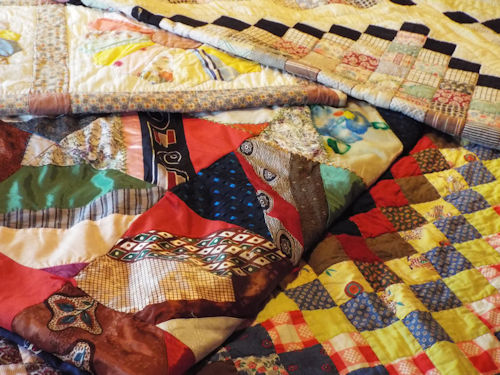
Now I’ve inherited a few more of Grandmother’s quilts. Unlike my girlhood quilt, I treat these with great respect. I don’t tuck them away where they can’t be appreciated, but I’ve learned not to expose them to daily use and abuse atop beds, either. These quilts hang side by side over a bedroom railing. Like MaMa’s Civil War bedspread, they are always on view and always available to provide extra cover on chilly nights—when they warm both body and soul.

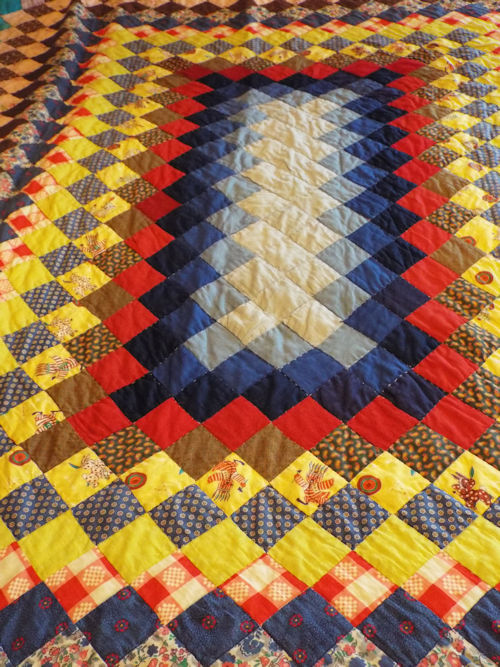
I love these old quilts made by my grandmother, and I’m fascinated by the study of them. Her stitches were exquisite and her squares, large or tiny, were precise. But Grandmother didn’t exercise the same kind of care in other aspects of her quilt making. (Mother was right.)

Precision was not what you’d expect to find within Grandmother’s squares. One little Dutch girl’s profile, for instance, might vary from those around it. One’s shoes may be a little larger or smaller, while another’s might drop off the square entirely. Grandmother carelessly arranged colors. With Grandmother’s quilts, it’s not unusual to spot an aqua square somewhere in a row of royal blue ones. Or, you may find a wool or satin piece of fabric mixed in a row of cotton squares.

This quilt contains 148 border squares. 146 of them are black. The other two look like this.

Notice the random color placement of the “petals” in this quilt square. Can you spot the petal that was pieced together?

Whether it was plain old sloppiness, a preference for form over function, poor planning, or the “Use it up, wear it out, make it do, do without” philosophy stated on one of her many cross-stitched pieces, these little details simply didn’t seem to matter to Grandmother. And one thing’s for sure—her quilts are unique; they’ll never be mistaken for anyone else’s.

Among other fabrics, Grandmother used a red-checkered tablecloth, printed flour sacks, and old children’s pajamas to make this quilt.

Grandmother was a giggler and she kept me in stitches. Even now, looking at her quilts makes me chuckle. I think she’d have wanted it that way.

Move-In Day

Move-In Day

(Written on Saturday, August 19, 2017)

move in 5 better

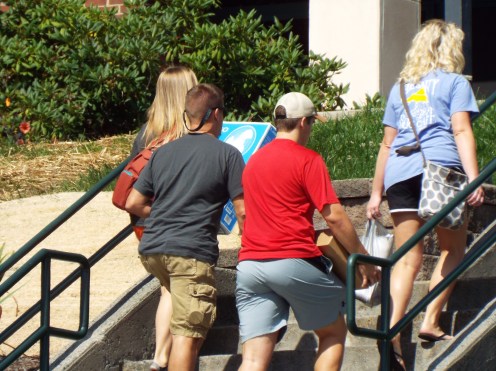
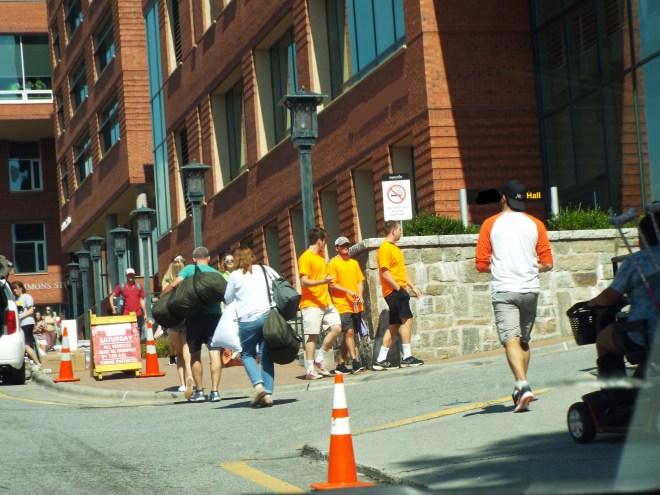
It’s Move-In Day at the local college. Traffic has been a mess all week as students who live off campus, as well as student advisors and others with pre-move-in responsibilities, clog the roads for miles around. Roadside signs directing parents and new students to this or that area of campus begin several miles beyond town.

The campus itself is dotted with temporary identification and directional signage. Campus security personnel and ROTC students direct on-campus traffic while other staff, including my nearest neighbor, are on hand to help carry suitcases, boxes, and carts full of bedding and other necessities to dorm rooms—this being their fourteenth straight day on the job. They’ve been hectically sprucing up those same rooms and making sure all maintenance issues have been resolved in preparation for this weekend for weeks. 

Dorm parking lots are full of loaded pick-up trucks and rental trailers as parents help their fledglings move in. I’ve seen license tags from places as far away as New Hampshire, Texas, and Colorado. We’re used to out-of-staters. After all, we’re a tourist town as well as a college town, but the prevalence of far flung tags has been greater for the last few days. DSCF9247_LI

Students fill the campus and downtown sidewalks in groups of twos, threes, and fives. It’s an exhilarating time. Freshmen are getting acquainted with their roommates and other newbies. Their shared excitement, nervousness, and uncertainty creates an instant and strong bond. Upperclassmen are eager for reunions with friends. Some are all aflutter at the prospect of being back together with sweethearts after months apart. For a few, the start of the new year is bittersweet, having said sad good-byes to their steadies back home, but eager to greet friends and decorate their rooms.

Parking lots and dorm rooms are scenes for a fair share of teary-eyed goodbyes, but for the most part the damp cheeks belong to parents. More students than not are virtually shoving their families out the door. They want Mom and Dad to stop with the bed-making and drawer-filling and advice-giving. They want to get on with it. This is their time.

It’s a weekend unlike any other. No classes, no assignments. It’s get-acquainted time. Settle-in time. A few hours of relaxation with no academic stresses. Still, minds are a little muddled for many freshmen, who have more-than-ever moments of feeling like little kids on the inside while trying with all their might to be all grown up on the outside. Their innermost feelings and fears will not be spoken aloud.

Today is all about hope. It’s the beginning of a fresh start. Freshmen, especially, have a chance to make themselves anew, if they choose. No baggage follows them here. No one knows their academic, family, or personal backgrounds. They can scout out other like-minded folks; there are clubs and organizations aplenty for exploring new ideas and finding expression for their deepest interests. (In fact, some of these kids will be unrecognizable on their first weekend home—with radical hair colors and styles, tats in unlikely places, piercings on improbable body parts, and strange new ideas. They may sport heretofore unknown wardrobes to announce their current status.)

Meanwhile, vendors conglomerate just beyond the school’s boundaries to hawk mini-fridges, carpet remnants, and college-themed products for student rooms. Restaurants, retail stores, and churches display signs that say things like “Welcome Back” or “Welcome, Students.” One was different. It simply said, “Welcome Home.” In a microsecond I was transported to my own college days, and I realized this was the sign that got it right.

Even as a butterflies-in-the-stomach freshman, it was only a matter of days until I understood I’d found my home at my now alma mater. As I returned from semester and summer breaks for my next three years, I knew for certain I was coming home—home to roommates, classmates, hall parties (held for any reason or no reason at all). Home to favorite professors and classes for which I had a passion. Home to love interests, ball games, dances, bonfires, and concerts. Home to learning and my still unknown future. Of course, I still referred to that place from which I hailed as home, too, but it was my parents’ home. This was mine. All mine.

Welcome home, students! 


No Touching

(Part of my Blowing on Embers series)

About this time of year I’m overcome with nostalgia. What brings it on is the flowering of touch-me-nots. My now grown children groan in exasperation whenever they hear me mention these wildflowers—they know what’s coming next.

It’s the story of how these jewel-toned flowers remind me it’s time for the school year to start in these parts. How I fondly remember watching the two of them emerge from a heavy fog as they walked up our newly-graded and graveled road after their first day of school barely more than a month after we moved up here on the diagonal. (Punkin was a fourth-grader, wishing she was back in the Brown School in Louisville. It was Cuddlebug’s very first day of school anywhere.) How their arrival home from late-summer school days was often delayed because they couldn’t resist the urge to stop along the way to do exactly the opposite of the warning implied by the plant’s name and pop the flowers’ seedpods. It’s an addictive pursuit, and it was a fun way to end the school day.

Handling a touch-me-not is a uniquely rewarding and giggle-worthy experience. The seedpods don’t look particularly fragile, but when they’re mature, the slightest movement causes a virtual explosion, with tiny seeds catapulting onto the landscape—no doubt the reason this wildflower is so prevalent in territory friendly to its needs. The steep banks along our country roads are saturated with touch-me-not plants right now.

Predictably, with all those explosive seedpods, touch-me-nots have taken over the roadsides.

Also known as jewelweed, this prolific wildflower may be either yellow or orange, each variety’s flowers freckled with deep reddish-brown spots near and in their deep throats. Their nectar-filled spurs make them attractive to hummingbirds, butterflies, and other pollinators. In appearance, they strike me as a cross between miniature orchids and larkspurs.Touch-me-nots are common throughout all of the U. S. with the exception of a few western states. They’re fascinating plants—beautiful, useful, quirky, and irresistible to kids of all ages. Once you’ve popped a few seedpods, you never outgrow the urge when you come upon a patch of these intriguing plants.

When a seedpod bursts open, either on its own or with a little human help, the hull instantly curls up into tight coils, like small, green springs. It’s all so fast you can’t see it happening. A captivating sight in itself. And even though you know that little explosion is coming and are waiting for it, it will inevitably make you jump in startled surprise.

The leaves are just as intriguing. If you find yourself in a patch of jewelweed on a dewy morning or just after a rain, its leaves will be the only dry thing around, displaying little beads of water on their surface. Dancing in sunlight, the water glistens like diamonds.

Submerge a leaf in water with its underside facing up and it turns silver. Pull it out and it will be dry, with only a few droplets of water here and there.

Touch-me-nots also have medicinal uses. The best-known and most practical use is as a remedy for itching. In fact, they’re often found in conveniently close proximity to itch-inducing poison ivy and stinging nettle. By breaking open the liquid-filled stems and spreading the watery sap on skin that’s been exposed to these plants or to insect bites or stings, you’ll most likely experience immediate relief.

And you can even eat the little seeds. They taste a lot like walnuts–really! Granted, it would take a lot of collecting to get enough to bake into a dish, but it’s a handy thing to know if you happen to find yourself lost and hungry in the midst of these delightful plants.

All this and nostalgia, too.

The sight of touch-me-nots, the start of the school year, the long held vision of our children in their first-day-of-school finery, the hint of autumn in the air, the memory of those first days of house-building—all these things represent the beginning of our life on the diagonal.

Kids, if you didn’t already realize, you might as well get used to it because whenever touch-me-nots are in bloom, I’ll continue to reminisce aloud about this giant tangle of sweet memories.

Blowing on Embers: Postscript

As I often do, I asked the Gnome to read and give me his thoughts on the draft of my Blowing on the Embers blog essay before I posted it. I value his insights, and he’s generous in offering me his time. It’s one the many things I love about him.

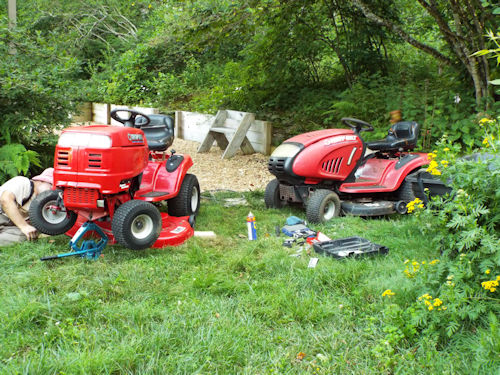
Then he went about one of his self-assigned chores: trying to get at least one of our two broken riding mowers to function. We have several acres of land in desperate need of mowing. If one of those mowers doesn’t get fixed, too many unwanted trees take over. (Black locusts, I’m talking about you.) And that means we have to cut them down, chop them up, and either burn them or pile them up into yet another wildlife habitat—good for the birds, but a little unsightly to us humans, and yet one more unwelcome chore that keeps us from more satisfying activities. But I digress.

The Gnome spends a lot of time around here fixing things that don’t work. He’s not a mechanic or an engineer or an electrician. He thinks his way through these tasks, using brainpower to solve problems he doesn’t innately understand. He believes in the power of being able to do a thing if you just put your mind to it. Another thing I love about him.

But it’s a time-consuming process. And it can be fraught with frustration—all that time and energy going into a chore, the outcome of which is unknown, when he could be doing something much more personally fulfilling. Like painting. Or writing. Or photography. Or building.

After hours of unsuccessful attempts to fix something, a sense of defeatism can set in. That’s what I expected the other day when he was working on the mowers. I’d been paying attention from my writing desk—I heard all the times he turned the key and the engine refused to catch. So, when he came in the house in the middle of the afternoon, I was all ready to offer some sympathy along with his tea and his favorite oatmeal cookies. He had to be discouraged.

Instead, he looked at me with those crinkle-cornered, laughing eyes he’s so famous for (reason # 3 if you’re keeping count) and an enigmatic smile. He told me he’d been remembering all the hours he’d spent as a boy watching his electrician dad work on the family car. He’d conjured up the time he himself had crawled up under the huge hood of our International Harvester Scout to ferret out a problem, even then imagining what his dad would have done, how he might have worked out the issue at hand.

All that time I thought he was just working on the mower, he was also channeling his dad, recalling fond memories. That afternoon, it didn’t matter so much that the mower was still in pieces.

It seems there’s more than one way to blow on the embers of your heritage.