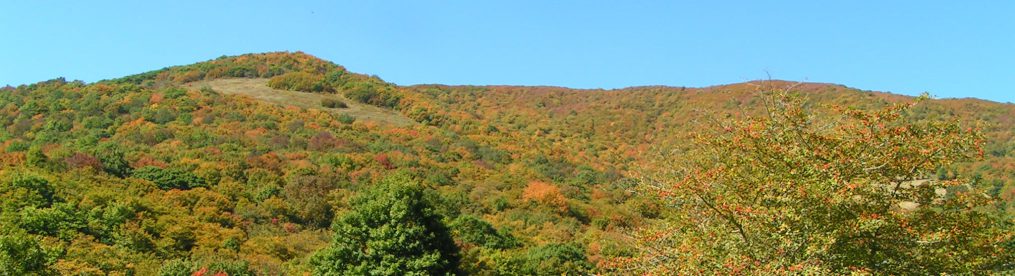
(I’m reposting a travel series from a couple of years ago. If you’re like me, you are patiently (or maybe not so patiently) waiting for a safe return to the road. If so, how about traveling along with me on a virtual road trip. To read about our Nova Scotia travels from the beginning, start here.)
Nova Scotia redux began for us in Halifax, a fitting first stop. The province’s capital and by far its largest city, Halifax is vibrant and cosmopolitan, but with a cozy feel. It never felt overcrowded—at least as the first stop on our provincial travels. After a couple of weeks touring the coastline and running into people in only twos and threes, even a city as welcoming as Halifax might have seemed jarring.
We were surprised at how easy it is to navigate Halifax. Though we were staying in an Airbnb condo in a residential area, a short one-block walk took us to a large grocery store (liquor store, too); we found numerous local restaurants in easy walking distance; and we were never more than a five-minute drive from anywhere we wanted to visit.
Our days in Halifax were by far the most ‘touristy’ part of our Nova Scotia visit. Our first stop was the Halifax Citadel National Historic Site, a star-shaped fortress first constructed in 1749 to protect the harbor. The Citadel was never engaged in battle. It didn’t need to be; its mere presence was deterrent enough to would-be invaders. We watched the hourly sentry change, as well as cannon and rifle-firing demonstrations, all performed in full military regalia of the era. With the national parks passes we purchased prior to our travels, this was a freebie.


As avid gardeners, we could hardly pass up the sixteen-acre, Victorian-era Public Gardens, occupying a large city block in the heart of downtown. We took our time exploring its fountains, bridges, statues, pond, and its massive floral displays including exhibits like these


and carpet beds like these.


They even have tropical plants on display. How do they do that?
Not every public library is a tourist destination, but Halifax’s new Central Library certainly is, with its five-story, 112,000 square foot award-winning architecture. It even boasts a green roof, a cafe where patrons can buy coffee or a meal, and a rooftop garden for enjoying their purchases. The library is even LEED-certified, a high-performance green building designation.
-

- Fifth-floor adult reading room
-

- Green roof beyond glass letter-filled walls
-

- Plenty of art works here
Among its many sustainable features are a green roof sustained by rainwater, electric vehicle charging stations, rainwater harvesting for flush features, solar heating, and use of recycled, local, and low-emission building materials. All that and stunning, too. So stunning that in 2014, CNN named it one of ten ‘eye-popping’ new buildings of the year. I wonder why.

Photo attribution: Citobun [CC BY-SA 4.0 (https://creativecommons.org/licenses/by-sa/4.0)%5D, from Wikimedia Commons

(Speaks for itself)
She doesn’t know it, but a primary reason Halifax was one of our destination points was folk artist Shelagh Duffett, whose brightly colored, playful prints (mostly of cats) adorn our walls. The weekend we were there, she was selling at the Maritime Makers’ Market. We were excited to meet her in person and to purchase even more of her smile-producing fanciful artwork.
Typical of Nova Scotians, Shelagh was genial and generous, giving us tips on vegetarian restaurants and an important site to visit, one we weren’t familiar with. We went straightaway to the historic Hydrostone District, a lovely neighborhood with a tragic history. (I’ll be writing more about that in a later blog, too.)

The tree-lined boulevards in Halifax’s historic Hydrostone District feature wide, grassy strips for community use.
But the best part of our stay in Halifax was strolling, whether through parks, neighborhoods filled with lovely Victorian homes, shopping districts, or the boardwalk at the harbor, a place we found ourselves every day of our visit, sometimes more than once. Day or night, it was safe, relaxing, and yet spirited, filled with people, public art, and a few surprises—like the hammocks just waiting to be used by anyone. What a delightful way to pass the time: swinging in a hammock while reading, watching seagulls, or gazing at sailboats on sparkling water.
-

- ‘Got Drunk, Fell Down’ lamp post sculpture on the boardwalk
-

- ‘The Bicycle Thief’
-

- ‘The Emigrant’
-

- Fisherman’s Cove
-

- Halifax provides Adirondack chairs for boardwalk strollers to sit and relax. . .
-

- and these heavy duty hammocks for more serious relaxation. How cool is that?!
Yes, Halifax was a good place to start our journey. Stay tuned for more about our Nova Scotia travels.















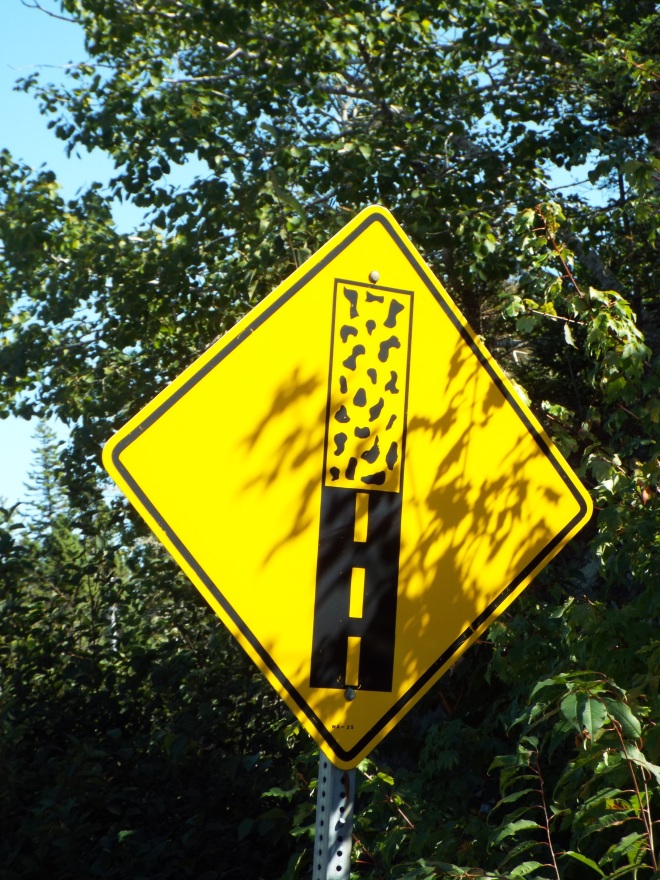 You may have seen this on a previous post, but it fits here, too. It took us a while to figure it out. It looks like cuts of meat or something on top of two capital H’s. Soon enough we learned it means the pavement is about to end in favor of gravel–or worse.






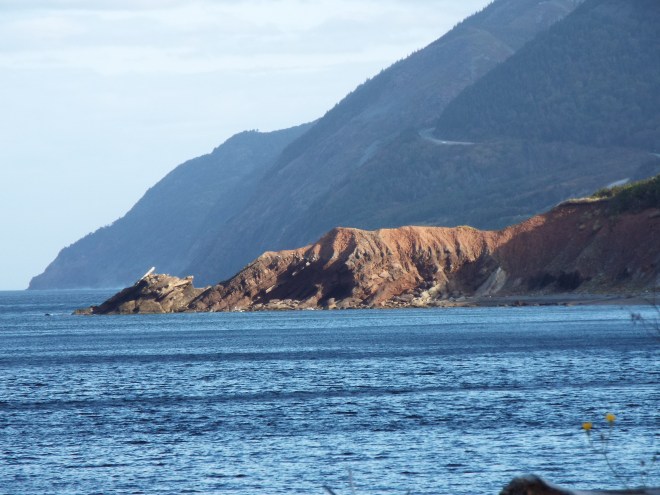

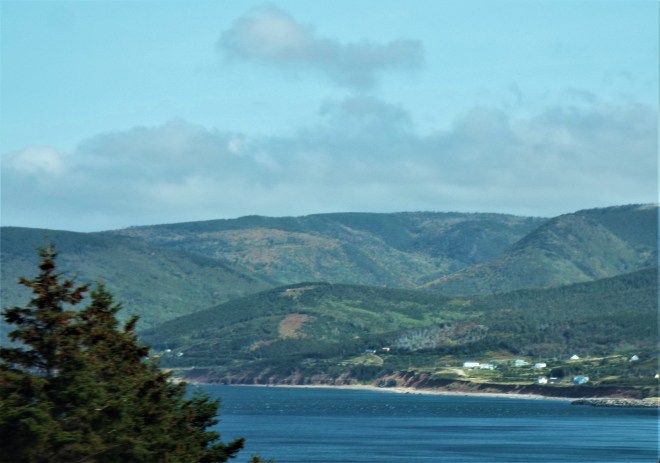


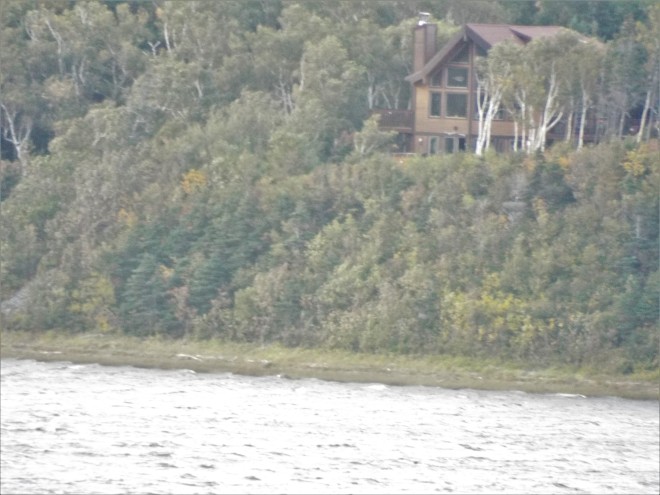 Our charmed, and charming, hosts had found themselves one of the most perfect places on earth to live. Not only is their home on the edge of the Chéticamp River (which they often kayak, lucky ducks!), but on the opposite side of the river is the majestic park itself. From their huge living room windows, they can also see where the river empties into the Atlantic Ocean. Where else could you get that kind of view? It was a good way to end our trip around the park.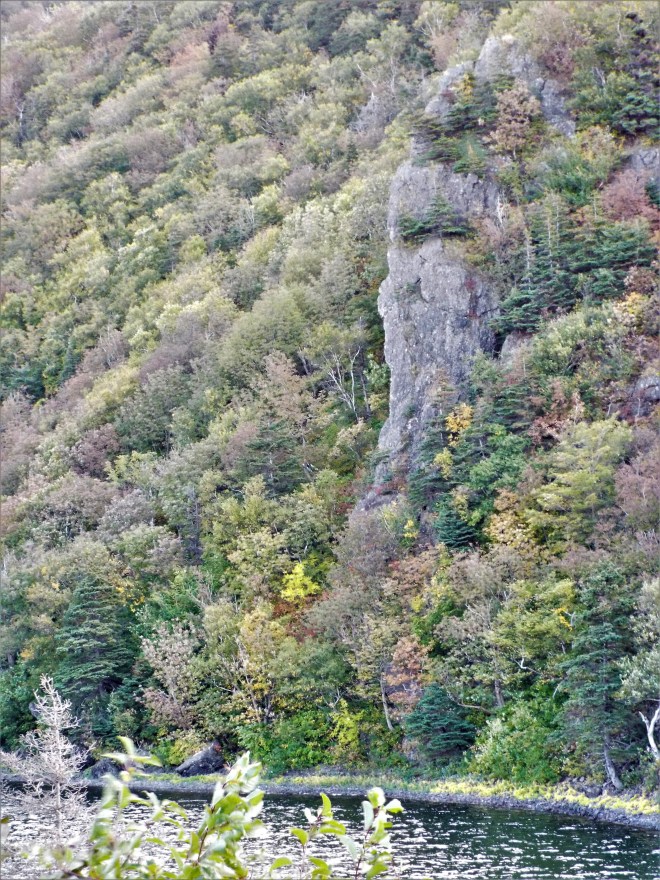
 This spit of land is all that separates the river from the ocean, also seen from our hosts’ living room window. How cool is that?!




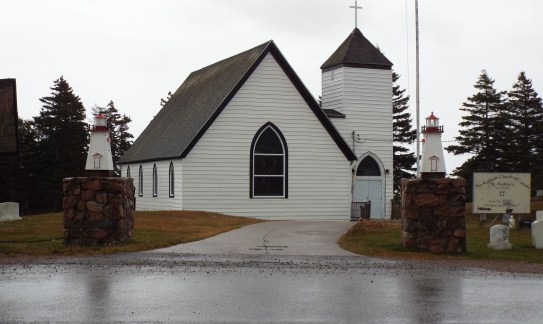
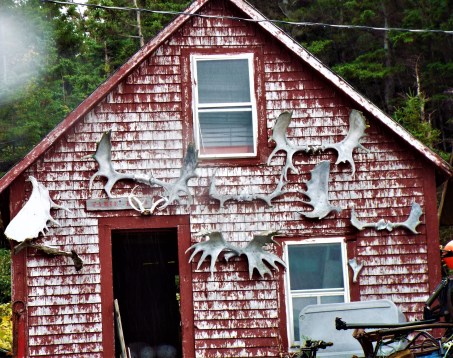 A stand of birch, an Anglican church, and a workshop adorned with moose antlers
 Scenes from Neil’s Harbour (I believe).


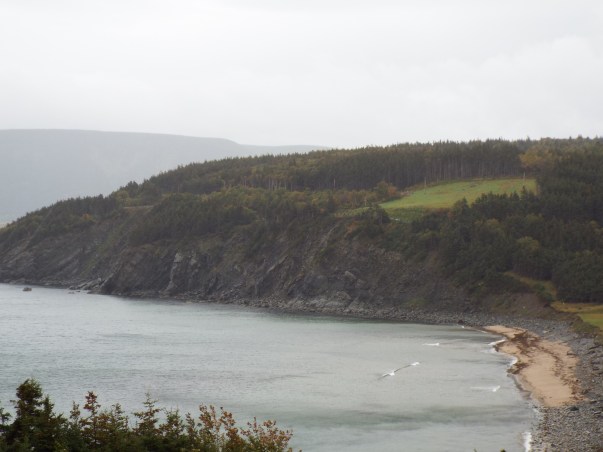
 Meat Cove: much prettier than it sounds. You reach this beautiful spot after a very long (30 minutes or so) drive on a rutted dirt road (only to return the same way). Not much more than a campground (see the little cottages in the foreground of the bottom picture?), it’s worth the drive. They say that on a clear day you can see Newfoundland from this northernmost Nova Scotia community. We weren’t there on a clear day.
 Check out all those balancing rock cairns on the rocky beach far below us at Meat Cove.
 Why, yes, you can find sand on Nova Scotia’s beaches! (A wee bit, anyway.)
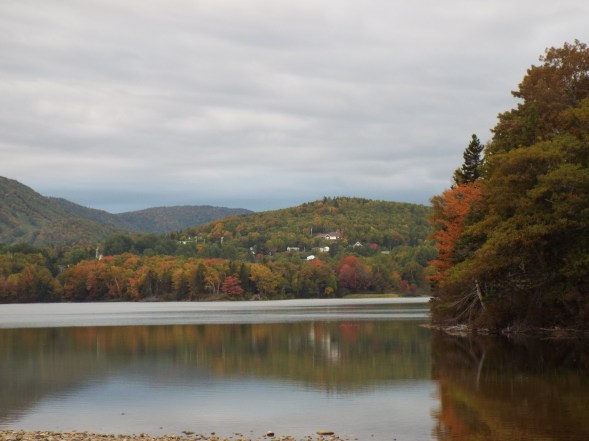 Freshwater Lake, Ingonish Beach
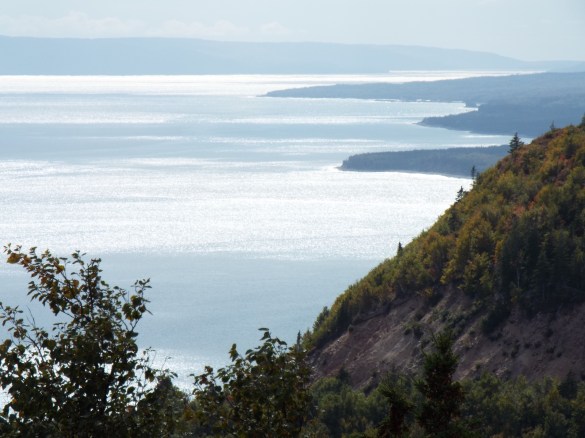


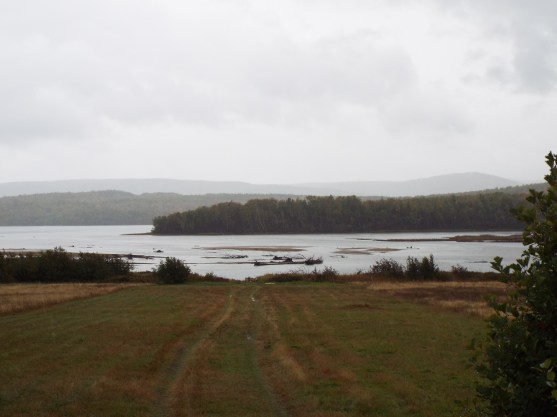

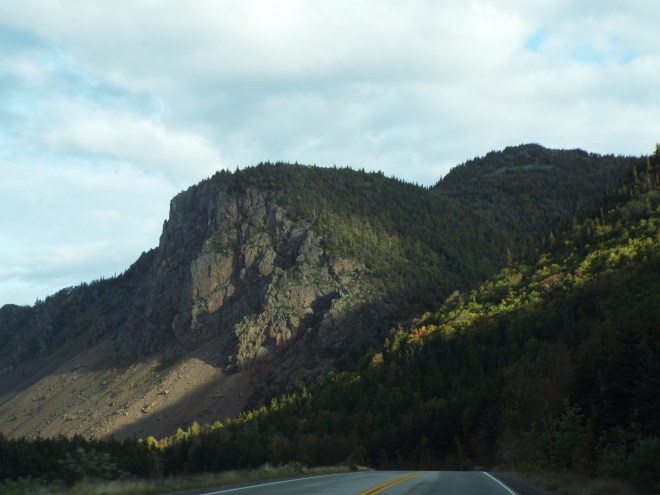
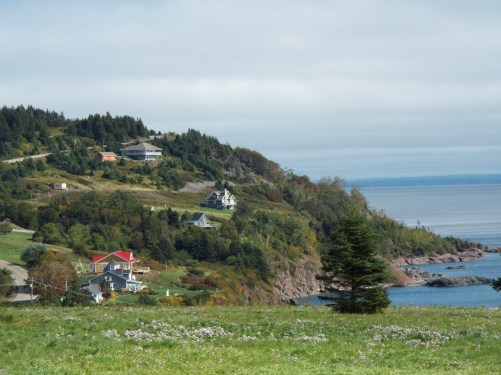
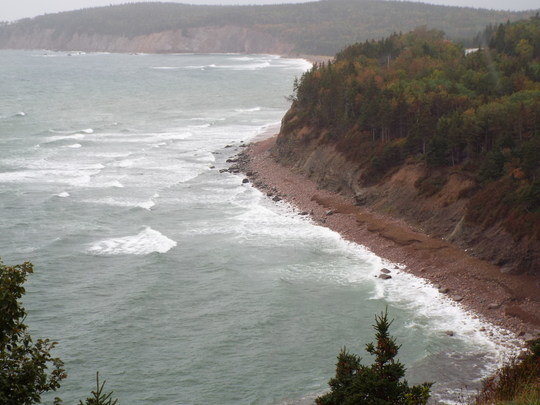 Just some pretty Cabot Trail views, even on a rainy, foggy, hazy day





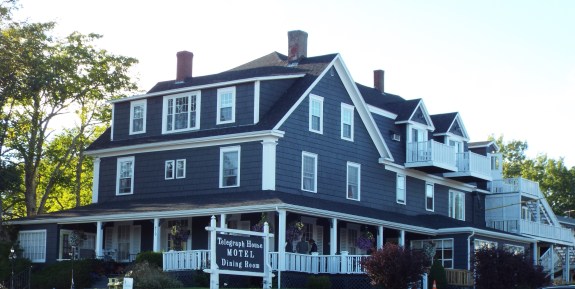


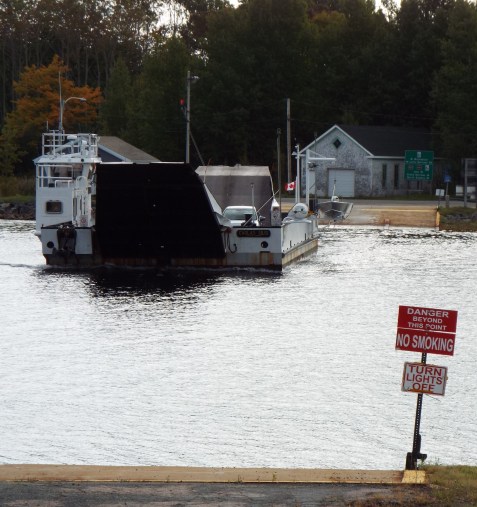 Here comes the ferry. Short crossing—very short.




 Living on the Diagonal