Nothin’ But a Hound Dog (Or a Hundred or So)

The Gnome and I took a day off last weekend. In theory, we can do that every day of the year now that we are repurposed. Reality is a bit different. We’re each working on major projects, and we push ourselves as if the world will end if we don’t finish sooner rather than later. Actually, that’s the truth—we have way more days behind us than we could ever hope to have in front of us. One day our time will run out and chances are we’ll still have more than a few unfinished projects lying about.

I think that’s the way I prefer it. Much better to be in the middle of something I care about, anticipating the results, than twiddling my thumbs feeling that there’s nothing left to do.

But back to our day off. We decided to visit a small, picturesque waterfall in the small county that borders ours. I’d never seen it, never in our almost forty years here even heard about it until a few months ago. In his work, the Gnome had driven past but, zipping by in a car, he hadn’t had a chance to stop and enjoy it, either.

Falls and a swallowtail at Newland’s Waterfalls Park (Photos by Ron Wynn)

After soaking in the beauty of the place for half an hour or so, we decided to continue on the same rural road to a popular general store, dipping and climbing on curvy mountain roads. Our route took us through the unincorporated community of Cranberry, population 500 or so. (Even before it was settled in 1850, Cranberry was known for having one of the largest veins of iron ore in the United States.)

We passed the grounds of the former high school, which is now being used for occasional community events. The place was crammed with cars and trucks, mostly trucks. A metal yard sign next to the road read, “Heritage Day.”

That sounded like fun. We whipped the car around and headed back. As we drove onto the property, our ears were assaulted with barking, howling, yelping,  baying. We found ourselves surrounded by dogs, dogs, and more dogs. More than a hundred, we were sure. Dogs with their wiggly noses sticking out of car windows, crated dogs in pickup truck beds, dogs pulling people on leashes, dogs tied to fence posts on the shaded lawn. They were not, not a one of them, sleepy yard dogs. These dogs were on the alert. They were, in the truest sense, rarin’ to go.

Hound dogs.

Have you ever heard a hundred hounds baying simultaneously? Well, let me tell you, it’s deafening, each dog with a distinctive and  urgent voice. We couldn’t help but smile.

This was a very particular breed of hound, a scent dog known as the Plott Hound. If you’re not a North Carolinian, maybe just a Western North Carolinian, you may not be familiar with this breed. The dogs were brought to North Carolina by Johannes Plott when he emigrated from Germany in the 1700s. In the early part of the next century, his son Henry moved with his family to the mountain range that bears the family name: the Plott Balsams in Jackson and Haywood Counties in the southwestern corner of the state. Henry continued to breed the dogs, mostly for bear and wild boar hunting. The Plott Hound was named the state dog of North Carolina in 1988.

As it turns out, my mother was born and raised in the shadow of the Plott Balsams, and I’m interested in anything related to that heritage.

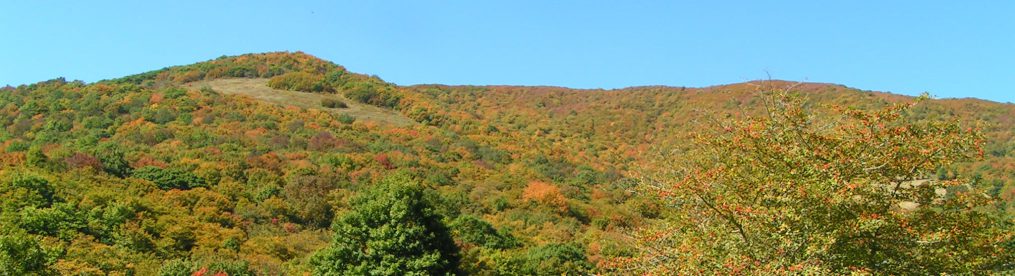
plott balsams wikimedia commons

View of the Plott Balsams (courtesy of Wikipedia Commons (wikimedia.org/wikipedia/commons/7/70/Plott-balsams-pb-ll-nc1.jpg)

Somehow, we had landed in the middle of a Plott Hound barking competition. (Never heard of that before.) What a stroke of luck! We followed the dogs.

In the far corner of a temporarily fenced-in section of the school grounds stood a cage, ever so slightly camouflaged. Inside the cage was a bear. Not a real one, thank goodness. But it moved. And it growled. I’m willing to bet bear scent had been sprayed around the cage, too.

In the near corner, dog handlers were hanging on to the leashes of their dogs. From the looks of it, that was some kind of hard work. When the whistle blew, three dogs at a time were turned loose and inevitably flew straight to the cage where they positioned themselves, barked, repositioned, and barked some more, stopping only when the timer blew his whistle and the keepers releashed their dogs, leaving the arena for the next trio to advance.

We didn’t fully understand how the process worked and we left before trophies were awarded. But from what we observed and overheard, we gathered this much. The event is timed. There are three judges. The judges are looking for degree of aggression, number of barks, and focus.

We looked, but if there was anything to Heritage Day other than the dog competition, it was well hidden. Never mind. Listening to the baying of a hundred eager hounds left us buoyant.

We almost always manage to come across some bit of serendipity—chance magic—when we’re out and about. Maybe a four-leaf clover, a funky art gallery, or longhorn cows in a meadow of buttercups. What a treat to happen upon a Plott Hound barking competition.

Have you encountered a bit of serendipity this week?

(Take a listen to the Plott Hounds.)


Found Poetry, Part IV

(For more Found Poetry, click here, here, and here. I’d love to hear what you think.)

Merlin’s Last Voyage

crystal moon
out of the mist
ancient evening
entering the mystery
of a hidden world

dark falls the night
on the island cathedral


Night Sight

northern lights
swimming
o’er the land, o’er the sea
casting out darkness


Earthdream

sunshine on a meadow
the smile of a breeze
breathing light
between two worlds

The Month of Yellow

April is the month of yellow around these parts.

The daffodils finally burst into bloom last week and dandelions along with them. Country roadsides have exploded into an earthly vision of sunshine with forsythia. The shrubs are packed so tightly together, their branches so thick and intertwined, that even the cleverest rabbit would have a hard time navigating them.

And since yesterday, the goldfinches, those canaries of the wild, have overtaken our bird feeders (at least when they can wrest a few perches from the squirrels). At this very moment, I look outside to see half a dozen of the lemony-yellow birds crowded on the feeder outside the living room window, with more waiting in the wings—flitting in the rhododendron, sitting on branches of the nearby mountain ash, even perching on the windowsill.

Everything about goldfinches is showy—bright yellow feathers glowing next to raven-colored wings, sweet soprano chirps filling the air, bouncing flight patterns giddily announcing, “We’re back!”

Ten days ago, the day heralding April, we watched snow falling outside the very window where the finches now gather. Exactly six months ago, the colors were inverted. At ground level, nature was browning. The color was in the trees-—the rich, muted reds and bronzes of fall. Today, our trees are still bare. To see most of today’s colors requires looking down instead of up, down towards the earth from which they are being birthed.

April yellows are the yellowest yellows. Like spring itself, the yellow of daffodils, dandelions, forsythia, and goldfinches is a symbol of happiness, hope, energy, our very life force.

April is a good time to be alive.

Rhododendron’s Many Faces

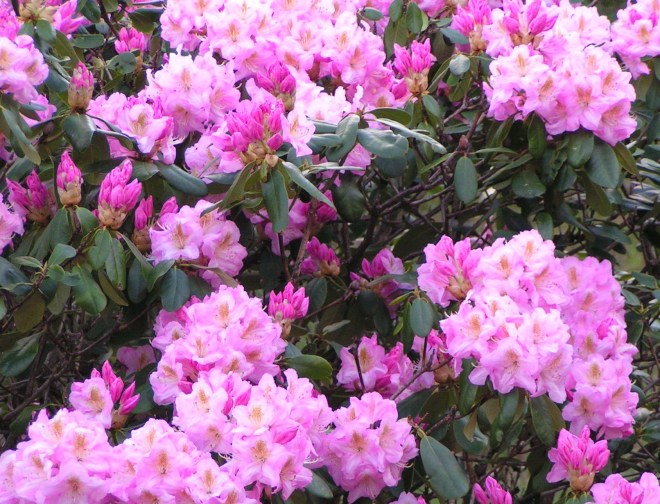
The rhododendron buds for next year’s flowers appear almost as soon as petals drop from the bush like an early summer cascade of pink snowflakes.

In winter, I can tell how many layers I need to wear by looking out the window at the big rhodie in our yard. On temperate days, the oblong leaves lie almost flat. As colder weather comes our way, they begin to curl inward, as if hugging themselves to keep the chill off. On the coldest days, a toddler’s little finger wouldn’t fit inside a single one of those curls.

As the leaves hang pendulously in winter, the buds above point skyward, reaching for warmth. Individually, they look like homemade hankie days long gone. Clustered together, they remind me of a chorus of angels.

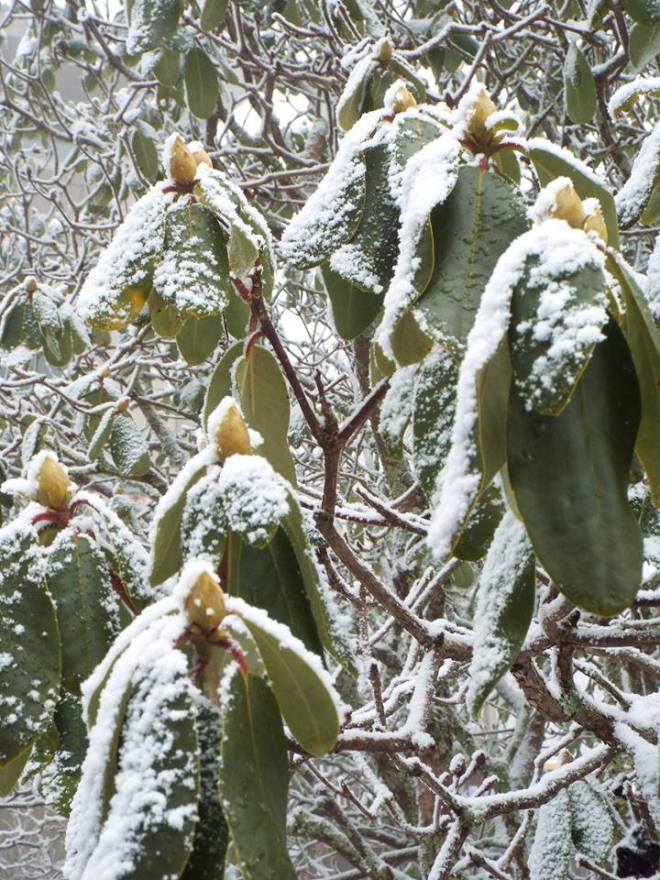
On days like today, the merest dusting of snow clings to the leaves, and I see a different kind of snow angel.

Not long after spring makes its debut, the buds are pregnant with new life almost ready to burst open with color and aroma as killing frosts threaten.

Yet, somehow, they survive.

Again with the Found Poetry!

(Unlike my first two rounds of SXM Found Poetry—here and here—these short pieces are titled. I look forward to hearing your thoughts.)

DSCF4886


Dreamless

kindle a flame
before the last leaf falls
on the shores of time
be at peace


Contemplation

tears in the rain
flowing into formlessness
roll on forever


Scenes of Reflection

rainbow visions
cloudscapes
canopy of stars
between sacred mountains


And Evening Falls

silver cloud shimmer
almost full moon
serenade of the night sky


More SXM Found Poetry

(For more about my latest foray with Found Poetry, click here. And leave a comment if you find a favorite, please.)


I.
waters of time
cast out the darkness
of a thousand teardrops
in the rhythm of the night


II.
through the blue
rainshadow sky
the river dances
drifting toward a dream
of canyon sounds
in a western wind


III.
out of the mist
promises
memories of comfort


IV.
first snow
ocean peace
bamboo forest
in the deep distance
I kiss the quiet


V.
breath of sky
sunshine on a stony path
frost on an empty field
summer’s end


VI.
the light in your eyes
lifts me on a weightless
incandescent voyage
you are my home

Winter, Reconsidered

My emotional connection with winter has a long history. It has rocked back and forth sometimes depending on my geographic circumstances. For the last few years our alliance has been strained.

This year, I’ve been trying to redefine my relationship to the season of short days and long nights, relentlessly prolonged and wrapped in gray in my neck of the woods.

During the coldest months, the sun’s rays rarely make an appearance and not just because of the brief period of daylight. Overcast is a generous word for many of our wintry days. Of the first fourteen days of this new year, we had perhaps two sunny days. That was the beginning of a season-long trend.

Even those rare days are frequently unhelpful when it comes to getting a dose of Vitamin D. The frigid temperatures allow for only a couple of small skin slivers—between toboggan and eyebrows and between lower eyelids and muffler. Even eyes may be covered with sunglasses, particularly when sun and snow combine to create blinding brightness. And sometimes the snow—especially if it’s deep, icy, or drifts high and unevenly—makes the outdoors a dangerous proposition, particularly for those of us who are more susceptible to breakage because of age.

Nonetheless, I’m taking measures.

  • I treat all my senses: my most worn sweater that wraps me like a cocoon, thick, soft socks, and a plush comforter make me feel as if I’m burrowing into the neck of a friendly Old English Sheepdog.
  • I surround myself with the soft glow and herbal scent of candles. I play soothing music that lifts my spirit—mostly classical, folk, and Celtic.
  • I try to hold an intentional smile, if only as subtle as the Madonna’s. It brings comfort to those around me, and my spirits unconsciously lift.
  • I sip tea, slowly, and look at the outdoors. Really look at it, noticing all the nuances of winter’s offerings, playing with words to find the most descriptive—and life-affirming—ways to describe the scene before me.

The work is all-encompassing. But so far it has proven worth the effort. Winter will still be around for a while up here on the diagonal, so I’m still working at it.

Our society has a tendency to think of winter as a time of death. Green grass and summer wildflowers have ‘died;’ leaves have fallen and dried making deciduous trees look dead. I’ve challenged myself this year to look at nature differently.

Lawns may no longer be emerald, but they will regrow; the grass is not dead. We have a tendency to overlook the subtle tan shades of tall grasses, but they provide rustling interest on a winter day, even more when they wave gently in a breeze.

Winter isn’t a braggart. Its marvels are less noticeable than the lushness of spring and the vibrancy of summer. In those seasons, winter’s elusive wonders are hidden. But now—now they surround us. Now is the time to revel in them.

When I manage to get out of doors, whether for a walk in the woods or a scenic drive, I look again. I search for positive words, alternatives to bleak, dreary, and overcast. Words like contemplative, silver-tinged skies, reflective, pensive. Winter calls us to introspection. Is that why we resist it?

On one typically cold but unusually bright morning, the roofs of the houses we passed on our way to town were covered with the thinnest veneer of frost. As we rode by, sunlight played on the icy crystals, creating a glittery shimmer, as if the shingles were made of twinkling fairy lights.

The skeletal trees, bare of their green camouflage, fill the landscape with sculptural architecture. Their nakedness allows me to appreciate aspects hidden at other times of the year.

The branches of some reach upward, as if in praise of the sky. Some trees are encircled by draping branches, reminiscent of welcoming arms ready to enfold me and offer comfort. Some trees are so gnarled and craggy it’s easy to imagine they sit on the edge of an enchanted forest.

About now, with trees looking as bereft of life as they have for months, the sap begins rising, an event which will go entirely unnoticed except for syrup makers and those who happen to fell a tree at that crucial time, but pivotal to the reemergence of the verdant leaves we long for.

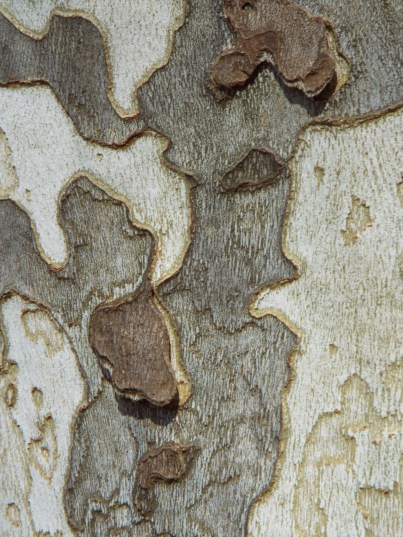
Subtle color variations and not-so-subtle textural differences in tree bark differentiate one species from another. Touch a sycamore or crape myrtle, with bark as smooth as the proverbial baby’s bottom.

Consider the trees with peeling bark—paper thin birches and rugged shagbark hickories, or the finely ribbed bark of the pin oak and the thick, deeply furrowed bark of the black locust. Bark with overlapping plates, like black birch, make me think of armadillos and scaly dinosaurs.

As I look more closely at trees, I see mosses as dark as midnight and lichens, some the palest green, eerily fluorescent in the dark. In the woods outside my kitchen window sits the tree stump. Over time, moss has begun to creep upwards, slowly covering its sides. Today, I saw for the first time that the entire stump is blanketed in moss as soft as down, hinting at a fairyland.

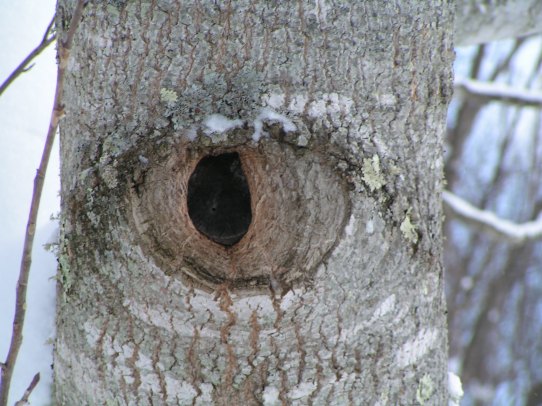
There are trees with burls and hidey holes. Who goes there?

A cyclops tree?

Winter serves a purpose. Plants store up their reserves, ready to explode with new life as warmer weather and more hours of sunlight appear. The flora does what it needs to do during winter. Animals know how to handle winter, too. Some, like plants, go dormant to preserve strength, feeding off stores of fat until nature is ready to provide its bounty.

What if we humans were to welcome winter in all its aspects and live with it, not against it, as the rest of nature seems to do so well? What if we turned off the electronics, indeed perhaps electric lights when the sun goes down. What if we did those quiet chores best done in front of a fire or by candlelight with a cup of hot chocolate or tea at our sides? What if, instead of staring at some screen, we talked to each other, played games together, put together a jigsaw puzzle, corresponded with relatives and other friends, read aloud or silently, wrote, contemplated? What if we used winter to restore ourselves, to create, to maintain?

Would our family and internal lives be richer? I think they might. Would we welcome winter as we welcome spring? Would we be better primed for what life brings in the next season? We might begin to treasure and even look forward to long winter evenings as a time of personal and family enrichment.

We can’t beat winter. Why not join it?


The Other Side of Snow

In eastern South Carolina where I grew up, about an hour’s drive from Myrtle Beach, a snowfall was a unexpected and exciting gift from Mother Nature. I remember one particularly bountiful snow—enough to build a snowman! That was a true rarity. My brothers and I went all out, rolling three balls of snow, each larger than the one before. We rolled and we rolled. How proud we were to be able to make a huge snow statement.

We rolled the huge bottom section where we wanted to build our snowperson. We rolled the next one over, but when we tried to lift it into place, it didn’t budge. That’s how little we knew about snow. Finally, Dad’s strength and ingenuity solved our conundrum.

Now I live in a place that gets snow most every winter, some years more than others. I enjoy the variation of the seasons, so I welcome snow. Sometimes.

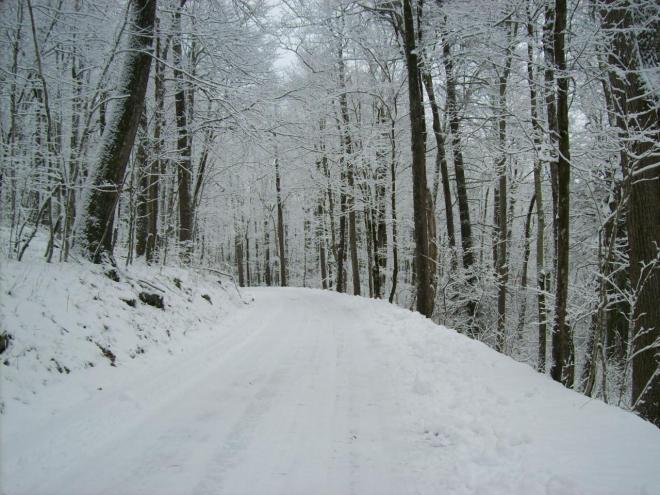
In the right conditions, a snowfall can be breathtakingly beautiful. If the temperature hovers near the freezing mark, the snow is usually heavy and wet, turning every outdoor thing into a pearlescent sculptural wonder.


Snow paw and snow antlers


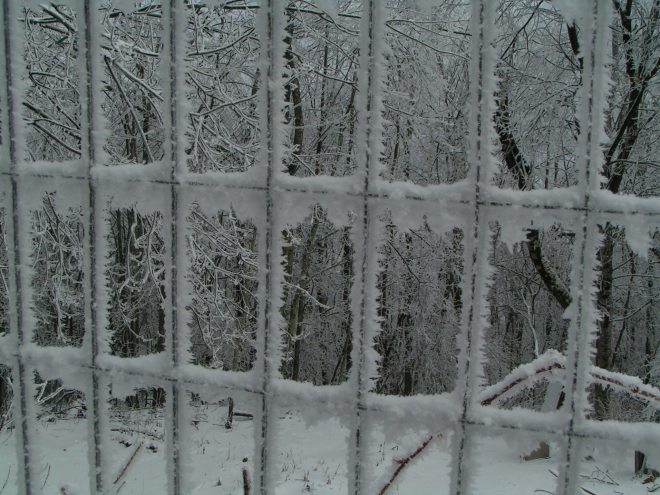
Snow fences

Stopping by woods on a snowy evening

The tiny, dry flakes created by brisker winter temperatures sparkle when the sun comes out as if billions of diamonds fell from the sky.

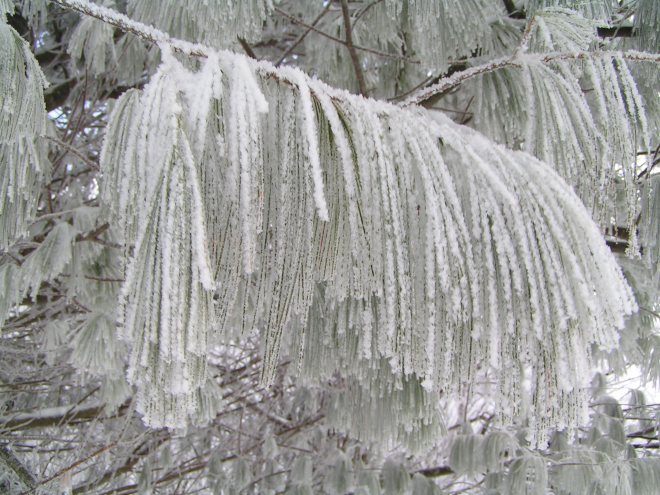
If the snow is preceded by hoar frost, feathery ice crystals that attach themselves to every outdoor surface, the whole world becomes white—every branch of every tree, every pine needle, every fence post and metal structure, everything. It almost makes my heart ache.

Clothespins on clothesline

Tree with hoar frost against blue sky

Abandoned bed springs

Garden fence


Pine branch


Even cobwebs are appealing when covered in hoar frost.


But snow has another side. The excitement grows old when winter comes early and refuses to leave center stage so colorful spring can make a long-awaited debut. And that’s not all.

When even a modest snow is accompanied by strong winds, as is so often the case on our mountainside, the snow piles into unplowable drifts. We’ve been known to pack snowshoes, a shovel in case we get stuck, and a plastic sled in our car and park at the bottom of our nearly half-mile gravel drive in anticipation of such an event. On more than a few occasions, we’ve slogged up that mountain road pulling a sled full of groceries, bags of pet food and birdseed, book bags, and more.

Sometimes we’ve been caught off guard. Without snowshoes or the shovel that spends most of the winter in the car, walking in can be a real trial, especially in a deep snow where each step means lifting one’s knees waist high or higher with every step. And climbing uphill, at that. Conversely, we’ve been completely snowed in for four or five days at a time. An adventure at first, but gnawing anxieties grow with each day as we begin considering the possibilities of being trapped in the event of an emergency.

And then there’s that dreaded word, ice. At just the right—or wrong—temperature, snow is preceded by rain which freezes on roads. Sometimes the reverse happens and rain or sleet falls after the snow. Walking and driving in either condition is treacherous. Add steep, curvy, and sometimes narrow mountain roads for a bigger thrill than any theme park ride.


Icicles can be fascinating, though, especially when the wind blows.

In normal times, we may only have one ‘good’ snow a year, and it doesn’t usually hang around long. A day or two later, the sun’s rays melt most of it away. We’ve had a few exceptional years, though. Real doozies.

In 1993, snow totaled more than three feet in just over two days. We were under curfew for forty-eight hours straight. Locals fondly remember it as the Blizzard of ’93 (and yes, it was an actual blizzard). At the time, it was called ‘the storm of the century.’ The National Weather Service named it a superstorm.

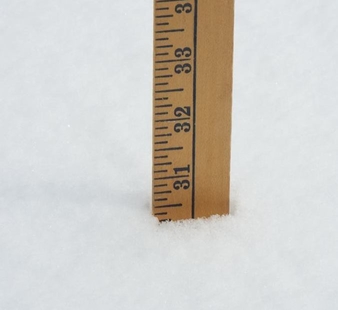
The 2009-10 winter brought us more than nine feet of snow—and since temps remained below freezing for the duration, none of it had a chance to melt. For more than three months, the only outdoor colors we saw were white and gray.

Once we could drive around our mountain road,  2010

Snow field

Fifty years earlier, way back in 1960 (well before we lived here), it only snowed seven feet, all of it falling in a just over a month. Every other day it snowed. Temperatures never rose. The winds were fierce. What snowplows cleared one day, howling winds turned into another drift the next. Children missed a month of school; helicopters dropped food, medicine, and cattle feed to isolated rural households.

Now, I know our snow totals are nothing compared to the country’s northernmost areas and tallest peaks. But, hey, I’m in the south. Most folks don’t typically associate such snow totals in the land they think of as all sunshine and beaches.

But don’t feel sorry for us. We mountaineers take a kind of perverse pleasure in our extreme weather. It’s like a badge of honor and we wear it (read: talk about it) all the time, as if we somehow deserve credit for weather’s natural occurrences. We proudly claim our snow.

MINOLTA DIGITAL CAMERA

Among the trees

MINOLTA DIGITAL CAMERA

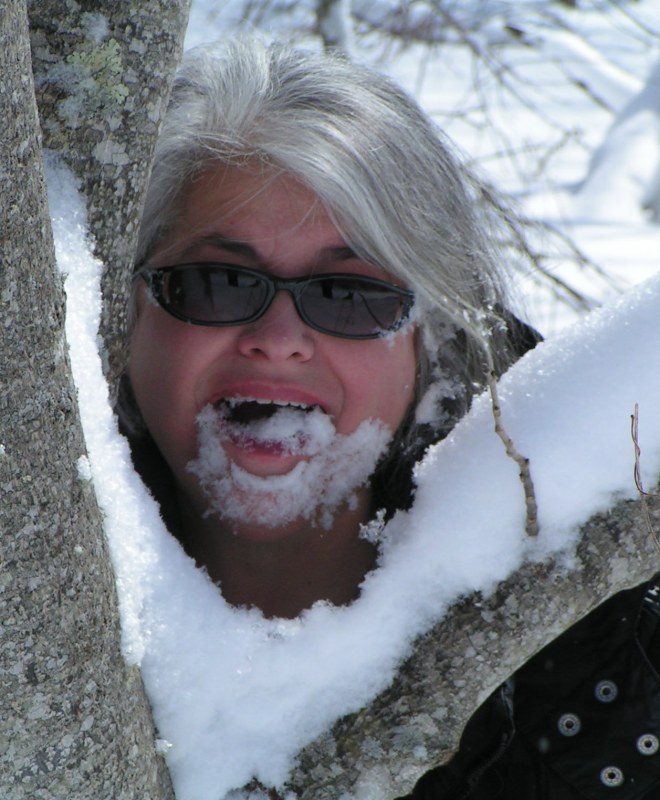
Taking a bite out of snow

Bragging rights

Back in my high school days, when every snowflake sent us running to the windows in gobsmacked awe, we were naively oblivious to snow’s downsides. All we knew was that even a relatively deep snowfall would disappear within hours, the reason we wasted no time getting outside.

During spring break of my senior year, our high school chorus went on tour. We were headed to New York. We spent a night in New York City, the first time most of us had ever seen a skyscraper. Then we traveled upstate to perform. We were excited to see snow on the ground. But what were those humongous ugly mountains of grayish-black, sludgy-looking stuff at nearly every corner? Yeck! Why, I wondered, didn’t these northerners care enough to keep their snow clean and pristine? How could they let it sit around and get so dirty, so totally ruinous to the landscape of purest white?

Now I know.


Recent snow scene

A New Find

I’ve occasionally played around with found poetry, that genre that refashions existing texts to present them as poems.  Poets.org describes found poetry as a literary collage and notes that it usually comes from newspaper articles, speeches, letters, etc.

But I recently discovered another rich source for found poetry: musical titles from the SXM station I most often listen to while in the car. In turning these titles into short poems, I’ve almost always left the titles just as they are, making only the rarest addition of a pronoun or preposition and even more rarely omitting a word from the original.

To offer the greatest possible freedom of interpretation, my SXM found poems are short, generally untitled, and mostly lacking punctuation, choices that seem to offer the best opportunities for individual interpretation. Just the way I like it.

Here are a few. I’ll drop in more in future posts. Because each one is so short but distinct from the others, I think they’re best experienced in small doses. If something particularly strikes you, one way or the other, I hope you’ll comment. I’d like to hear what you think as I keep working on this intriguing poetry style.

I.

all dreams
are made within
looking through
voices of the past


II.

the wind
whispers visions
stretching my wings
as the story unfolds


III.

desert afternoon
bright sky
dark dreams
in a long lonely light


IV.

Swimming with stones
in a dark and silent space
as a clearness of light
beams out of the silence;
now I let it go.


V.

miles from nowhere
wind whispers
on a lazy afternoon
I could live here
at one with you


Traveling with Airbnb

(Part of a series from a recent trip the Gnome and I took to Nova Scotia.  To read from the beginning, start here.)

How do two naturally reticent travelers get to know the people of their host country? It occurred to us that staying in real homes where we’d get to meet honest-to-goodness Nova Scotians on a more than fleeting basis might be a good way to do it, so we decided to take a chance on Airbnb rentals. (Disclaimer: I have no relationship with Airbnb except as a customer.)

Ultimately, we were looking for safe, clean, convenient places to lay our heads, perhaps cook a couple of meals, and occasionally run a load of laundry. And we wanted a reasonable amount of privacy. But we also wanted to get to know our hosts, where possible.

With those goals in mind, we began scouring Airbnb sites at each of the locations we anticipated spending a night. We splurged a time or two because we were so taken with a particular listing, but overall, we booked on the cheap. With service fees, taxes, and in some cases cleaning fees, our nightly rentals ranged from a mere $47 (for a whole house!) to $103 (for a bedroom and private bath, but the location—and our hosts—made it worth the price.)

We stayed in a couple of garage apartments attached to the host families’ homes but as private as we wanted. In one, our laps were kept warm by Mustache, the hosts’ loving cat.


We stayed in the upstairs loft of a former nautical museum. How’s that for quaint? And our host, Ginger, wowed us with her homemade whole wheat rolls.


We stayed in a former B&B honeymoon suite complete with waterfall Jacuzzi, right on the banks of the Annapolis Royal River.


The gracious Cheticamp hosts where we rented a bed/bath suite, are former teachers who once lived in Nunavut, Canada’s newest, largest, and most northwestern province. Their home, shared with a cat and seven former sled dogs, is filled with Inuit art. Each morning we were greeted with a full breakfast, not at all the norm with Airbnb. We hugged our goodbyes while the dogs sang for us.


Private home so no pics, but here are a couple of views of the river just outside and of one of our hosts’ seven dogs.

A couple of sites we picked from Airbnb listings were more traditional B&Bs, though small ones with just two or three rooms each. Both featured shared baths along the lines of boarding houses of the past. That worked out just fine; we never had to compete for bathroom time. Salty Rose’s and Periwinkle Cafe, run by a pair of sisters, was above a combo bakery and craft shop. We got a complimentary breakfast and left with a few locally made souvenirs. At the Crab Apple Inn, we were treated to a full breakfast (as well as complimentary homemade wine the night before). These places were almost as cozy and familial as single-family Airbnb spots.


dscf5955.jpg

A couple of places we stayed were touted as 200-year-old homes. That really appealed to us. And there were two places where the host wasn’t on site and we were completely on our own. In Halifax, we stayed in a modern apartment in a residential neighborhood in easy walking distance of eateries and no more than a five-minute drive from every site on our long list of places to visit. So convenient! A colorful, fully decorated home greeted us in Cape Breton’s Sydney, where we had a good view of the Sydney River from the living room window.


Each of these places had its own charms. And with each, the Gnome and I took a little informal survey. What did we especially like or dislike? It was a way to hone our preferences for future searches. And let me tell you, sometimes we had to scratch our heads to find a ‘dislike.’ We never had trouble coming up with a wow factor, though.

Two places really stood out for us. One was billed as a ‘former prospector’s cottage.’ We had the whole rustic place to ourselves on a quiet country road in rural eastern Nova Scotia. It reminded us of our long-ago dream of finding and loving an old farmhouse in the country. We really loved this place. We fell in love with our host, Gail, too. Maybe it was because we’re the same age. Maybe it’s because we saw the ‘old hippie’ in each other.

Or maybe it was her keen insight. She sensed how much we loved this maritime province. As we were chatting, she looked deep into our eyes with her witchy ones, an enigmatic smile forming on her face, and out popped these words: “You’re going to move here!” Of course, she didn’t know how bound by love we are to our own home, but neither did she know that we once seriously considered moving to Nova Scotia nor the hold it’s had on us all these years. Gail brought us warm eggs from her henhouse for our breakfast. Yum!


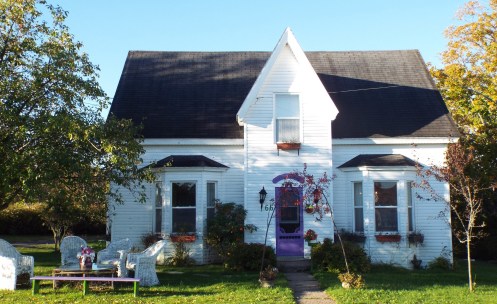
Gail calls this a heritage home. We call it perfect.

The other stop that filled our hearts wasn’t in Canada but Vermont, in the charming village of Newbury. When we read the description of this 200-year-old home and its location in an honest-to-goodness New England village, with a village commons, town hall meetings, and all. (Newhart, anyone?), we added a day to our trip so we could make this detour. In theory, we prefer to nix places where we have only a bedroom in a private home; we can’t help feeling that we’re imposing—never mind that the hosts have chosen this path and we’re paying for the space. Irrational, I know, but we feel like we have to tiptoe and whisper.

This time it was different. In essence, we had the whole downstairs to ourselves. But it was more than that, and more than the charm of an old home in a quintessential New England village that dates to the revolutionary period. It was also our host, Linda. You can read more about her and our stay in her home here.

No pics of Linda’s private home, but I snagged this one of the village store from Creative Commons.

In a head-to-head competition between traditional lodgings and this entrepreneurial one, Airbnb wins hands down in my book, at least for this kind of trip. Our experience was so enriched by these homey, sometimes quirky, stays—and ever so much more by the hosts who extended us such hospitality and friendship. Thanks to every one of you!