Grandparents’ Camp, Part I

The Gnome and I sponsored our annual grandparents’ camp a few weeks ago. Lots of folks do these days, but I’d never heard of such a thing when we opened our first camp seventeen years ago.

A lot has changed in that time. Back then, we had only one camper. Easy peasy. As the years passed, the number of campers has, at times, quadrupled; the camp directors’ ages increased dramatically, along with the number of cranky joints. The age gap between campers grew, too. We’ve had as many as four campers simultaneously, their ages ranging from two to eighteen. That makes planning a little more complex than back in the early days of our camp.

Our pioneer camper is clearly aging out, no doubt soon to be followed by the next eldest—too soon. But they will always be welcome in our home, camp or no camp.

I still look forward to camp and, unsurprisingly, still feel a bit of a letdown when the last camper says goodbye and heads for home. Kind of like that feeling I get as a wonderful vacation is nearing its end or the way I felt as a child as the holiday season wound down.

The first few camp years, I began planning weeks in advance. Now, with nearly two decades of experience, I’ve pared the process down a bit. I keep a notebook with all essential information (menus, recipes, activities), adding new ideas along the way. But planning still begins about three weeks in advance—I just don’t spend so long on it in a given day or week.

For campers of a certain age, I send camp invitations and registration forms, SASE included. I insert a goofy questionnaire asking, for instance, if the camper has ever been bitten by a tsetse fly or suffers from conditions like whinitis or pre-teen angst. I send a checklist of potential activities, including a few goofy options, such as eating worms or picking up rocks. I include a list of common-sense items to bring with them, and I request that they leave some items at home, absurd things like pet crocodiles.

About the same time, I put together a menu and shopping list. It’s fairly standardized because I can count on the same special requests from year to year: fondue, cookout, s’mores, sweet potato casserole, and a baked spaghetti dish.

I break buying trips into two parts. Perishables are purchased only a day or two before the start of camp. But to save myself from too much sticker shock, I buy non-perishables a week or two in advance.

I check the status of our regular supplies: canvases, paper, and acrylics for painting along with glue, food coloring, and liquid starch for that all-time favorite, slime. I collect materials for new projects I’ve discovered over the year.

I make sure bedding is in place, pull out equipment that’s been stored for the last twelve months, and do a last minute clean-up. I don’t know why I do this—it will take about five minutes for the house to explode in suitcase innards, toys, crayons, and more. Still, my illusion (delusion?) is that starting the week organized helps keep things under control.

In addition to the ever-popular painting and slime-making, we blow bubbles, watch fireflies, stargaze, make homemade ice cream—with a different fruit each year, add an item or two to one grandchild’s wooded fairyland, go for walks. I try to stay away from rigid schedules as much as possible. At the risk of hearing those dreaded words, “I’m bored,” I still prefer the freedom from routine that comes with grandparents’ camp.

The best part of making ice cream is getting every last drop from the can and dasher.

Learning to arm knit
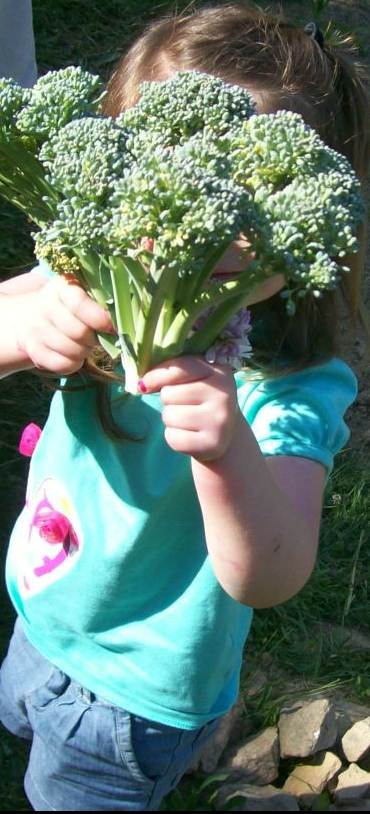
Harvesting supper from the garden is great fun.

We include a few field trips. They break up the routine, but too many and the week starts to feel overscheduled. Field trips have included a trip to our favorite local park for picnicking, playground fun, bicycling or strolling, kite flying, and splashing in the icy mountain river that bounds the park. We’ve visited local tourist attractions, we’ve gone gem mining, we’ve toured a cavern. Lately, we’ve included a shopping trip to boutiques for the older kids while the youngest one visits a playground or library story hour. (Shopping bonus: I get surefire gift ideas.) We’ve gone on downtown scavenger hunts, visited a working alpaca farm, attended a street festival, spent long evenings at fireworks displays.

One of our all-time favorite activities was the “spaghetti pool.” It involves playing naked in a kiddie pool full of oily spaghetti sprinkled with food coloring, so it’s only suitable for the youngest campers. But since it’s one of the first camp experiences the grandkids have, they’re sure to anticipate future camps as a wildly fun adventure. (A long, warm, bubbly soak in the tub inevitably follows this activity.)

We’re seventeen years older than we were when we held our first grandparents’ camp. We’re a little slower now, but I love our special week with grandkids every bit as much now as then. It’s a rare opportunity for them to spend time with each other; it’s a different pace than their norm with different freedoms—and different rules; they get to know us one-on-one. Invariably, the kids initiate conversations on subjects that don’t usually come up when the house is filled with mostly adults, so we get to know them better, too. Their conversations are open and free, and they treat us like one of their own.

John McCutcheon, one of my favorite folk artists, sings the song, “Water from Another Time. It tells of childhood summers spent with grandparents, getting water from a rusty pump “primed with water from another time.” The point of the song is that we all need a little from the past to feed our souls—old melding with new to help us make our way in this world.

I hadn’t really thought about it before I heard those words, but that’s what the Gnome and I are trying to give our grandchildren with these precious summer moments. My fervent hope is that one day my grandchildren will utter the words I so often do: “I want to be kind of grandmother my grandmother was.”

Water from another time.

Dressing Gramma’s childhood doll in clothing made by Great-gramma—water from another time.


A Mountain of Wildflowers


The early July day we drove onto our property for keeps is a day I’ll never forget. The four-acre meadow was white, covered with native oxeye daisies—my favorite. There were enough black-eyed Susans thrown in for variety, but not enough to take away the impression of snowy summer field.

At that time, we had no idea how many different wildflowers would grace us each year. We had to live through a full year to see it all. More, actually—a few, like jack-in-the-pulpit, can be hard for the novice to spot in a wooded landscape.

We didn’t know the following May and June would bring rhododendron blossoms throughout these mountains or that June-blooming flame azaleas dotted our property with mountain laurel following close behind. We’d never heard of fire pinks, which are actually blazing red. Red bee balm and both yellow and orange-spotted touch-me-nots are summer-to-fall natives.

Milkweed, Joe-pye weed, and ironweed (none of which should have the word weed attached to them) add varying hues of purple to the landscape. Open fields turn yellow when wild mustard, common ragwort, and evening primroses bloom.

The list goes on from March’s trillium to October’s purple asters—not to mention the many varieties of ferns, mushrooms, mosses, and lichens that share this land with us. But we all know pictures tell a story much more eloquently than words. Enjoy the two slideshows below.


This slideshow requires JavaScript.


This slideshow requires JavaScript.

Our Garden in June

Our Garden in June

For the most part, I write about gardening and modern homesteading over at Mother Earth News these days. I hope you’ll check it out. But sometimes my enthusiasm is just too big for one blog.

This is an exciting time of year for avid gardeners. Tiny leaves erupt from the ground and unfurl where seeds were buried yesterday. Early crops such as salad greens and lettuces are in full production mode, strawberries are juicy red, and summer crops like squash are beginning to produce. At this time of year, it’s not so busy that a gardener-food preservationist feels overwhelmed, yet each day brings evidence of progress and growth. It’s a time full of hope, exuberance, and plenty.

I adore this time in the gardening calendar. Mornings and evenings are cool enough to enjoy garden work without breaking a sweat, whether weeding or gathering part of the evening’s meal. Hardly ever do I leave the garden without taking a few minutes (which often stretch into bigger chunks of time) to sit on our garden bench and survey the success of our efforts.

A couple of weeks ago, our grandchildren were here for “camp” ( a story for another time). The nine-year-old asked if she could go down to the garden—a question sure to garner a hearty “Yes.” A cousin spotted her from the deck and wondered who she was talking to. Sure enough, her mouth was busy as she wandered from plant to plant, her hands reaching out to release the aromas of various herbs.

When she returned to the house, I asked her if she’d been talking to the plants. “Huh? How do you talk to plants?” she asked in astonishment. So, I had to ’fess up. Yes, I regularly talk to our plants, as an older grandchild who’s accompanied me on many a trip to the garden can attest. I didn’t even realize I was doing it until she turned to me and said, “I like how you talk to them. It’s like they’re human.”

Indeed! I encourage them, I apologize when the weather is uncooperative and urge them to hang in there, I thank them. They bring me great pleasure and I can’t help but give that pleasure some expression.

Here’s what’s going on the garden these days.  (To see captions, click on each photo group, then place cursor over individual photo. You’ll have to click a second time to see captions in their entirety.)


Thanks for stopping by and stay tuned. More to come as the garden matures.

Spring Has Sprung!

In this yet another crazy weather year, the entire month of February was one cruel joke: such sunny, springlike weather that some of the wildflowers began to bloom. It gave us a too-early taste of the beauty and hope of spring. And then, winter returned—with a vengeance. It must have decided it liked it here because it stayed and stayed. Those heavy winter coats we wanted to put away back in February were called into frequent action all through April.

I wondered if spring would ever come. Seriously, I began to have my doubts. Back in April, my Facebook memories taunted me. There I was with a healthy handful of asparagus in early April a few years ago. This year, though, not the tiniest hint of an asparagus spear more than a full month later. Next, a three-year-old memory popped up showing our big rhododendron bursting with beautiful clusters of pink. That was a few weeks ago. Meanwhile, our rhodie remained bereft of color.

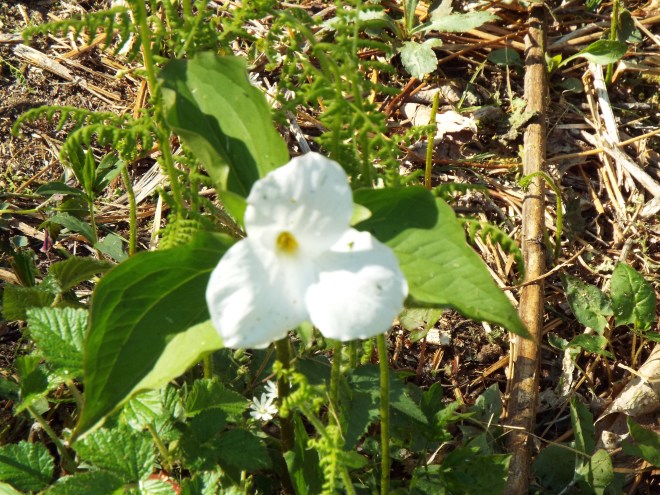
Finally, of course, spring did decide to emerge, and when it did it came on like a house afire. Pretty, white trillium flowers began dotting our forest landscape. One day the ground broke in a couple of spots in our asparagus bed. The next, we were deluged with asparagus. (I am not complaining.) We hadn’t been able to get our early crops planted as early as usual this year. It was either too cold or too wet. When we did have a decent break in the weather, our schedules demanded something else of our time.

Now we’re making up for it. We took to the garden on the first clear day of May. We may have gotten a little ahead of ourselves—our last average frost date is May 25th, but the long-range forecasts look so hopeful we’re taking a chance. We’ve forced ourselves to hold off on the things that demand more heat, but we couldn’t wait to get most everything else in the ground, even those seeds that say not to plant until there’s no more danger of frost. At this point, I’m okay with replanting if some of our seedlings get zapped by a late frost. It just felt too good to get out there and get dirt under my fingernails.

So far, we’ve planted onions, spinach, radishes, carrots, parsnips, rutabaga, kohlrabi, cucamelon, shelling and snow peas, runner beans, potatoes (purple and yellow), yellow squash, zucchini, lots of herbs, cabbage, broccoli, eggplant, beets, and more, as well as new raspberries, blueberries, and blackberries. Still to come: Christmas limas, scarlet runners, tomatoes, green beans, okra, and cukes.

Here are a few photos of long-awaited growing things—both wild and from the garden.

We’re eating asparagus everything these days!

DSCF1898

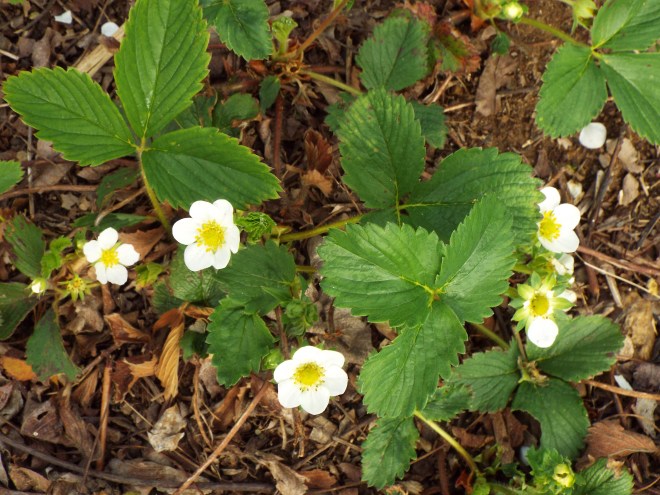
Lots of strawberry blossoms—yum!

DSCF1911

The peas are up.

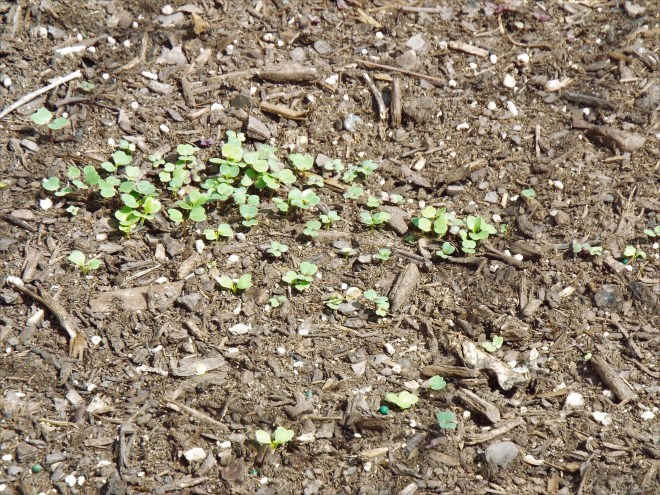
So are our salad greens—already they need thinning. Fine by me.

We’re giving Jerusalem artichokes a try this year, safe and secure in their own little bed so they don’t take over the whole garden.

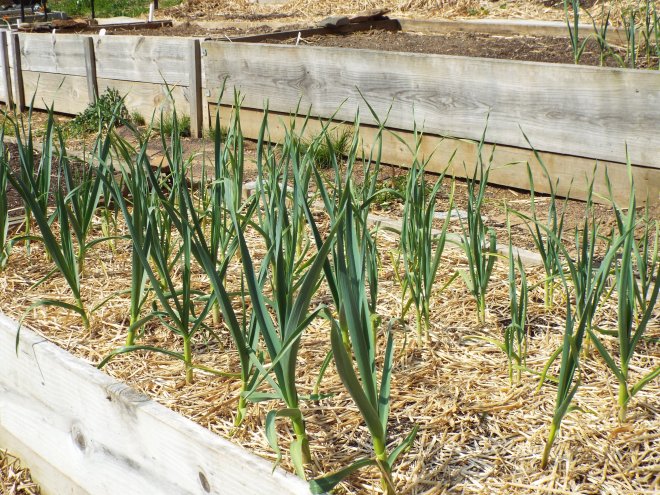
Garlic is so special—plant it in the fall and forget it. It’s the first thing to appear in spring.

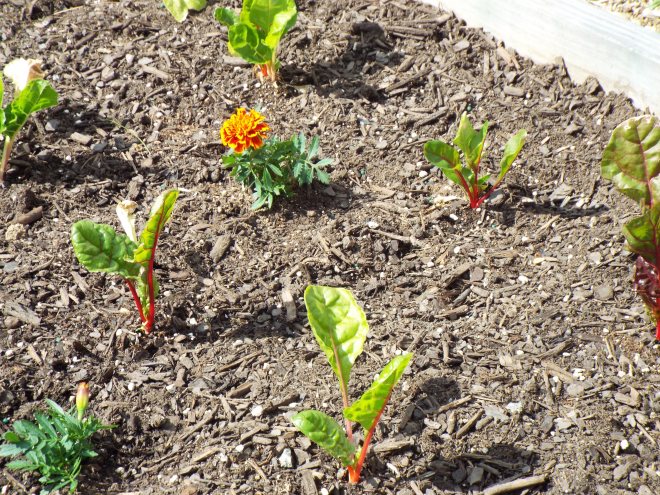
Bright Lights chard with stems in beautiful rainbow hues, interplanted with marigolds for even more color

Edible wildflowers–what a gift! Violets (sugared, for jelly, or in salads); wild mustard flowers and leaves add color and tang to salads; star chickweed is another salad option; mayflowers grow a sort of apple-like fruit that can be used in pies—assuming you can get to them before the deer. We never have.


Trillium—they have three of everything, it seems. And they’re all over the place right now.


Showy columbine


Best Laid Plans

(This year marks the 250th anniversary of Daniel Boone’s first trip to Kentucky from North Carolina. The trip was filled with adversity. It reminded me of our own journey—especially since our path was similar to Boone’s except in reverse.)

Two hundred and twelve years after Daniel Boone left western North Carolina for his first foray into Kentucky, our family of two adults and two young children made its way from Kentucky to a new life in western North Carolina. Our adventures weren’t nearly such a hardship as the Boone band’s, but plenty hard, nonetheless.

Our plan was simple: camp out on our newly purchased land while we hand built—all by ourselves—our forever home. Reality was a little more complicated. For one thing, we had no jobs. For another, we had almost no money. Our budget was shoestring for sure.

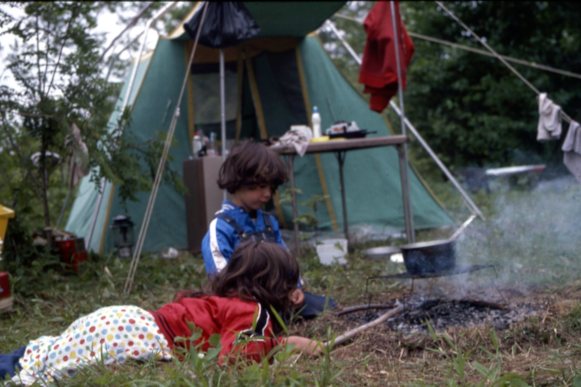
For the younger campers, the best part of our earliest days of adventure revolved around the campfire.


The excitement of tent-camping in the wild far outweighed the inconvenience of having neither water nor electricity. We cooked over a campfire. A rhododendron thicket was the perfect spot for a pit toilet. We drove to a roadside spring to collect water. We hiked to a creek in the woods when we were desperate for an all-over, if frigid, bath. The return hike uphill sweated off our clean.

Daily thunderstorms sent us to the relative safety of our steamy car. Soppy sleeping bags regularly sent us to a laundromat in town. The effort of camping precluded any progress on building. We had to make alternative plans.

Instead of building our house, we built a very temporary shelter. It was all of 8′x12′, barely large enough to hold two cots and a double sleeping bag. The plywood floor kept us off the ground. We wrapped the lumber framework with inexpensive clear plastic for make-do walls and roof. Instead of a door, we had an opening covered with a tarp.

Our “kitchen” is outside on left end of shed. The doorway is also on the left end. Look carefully and you can see a suitcase and canned goods lined up along our front “wall.”

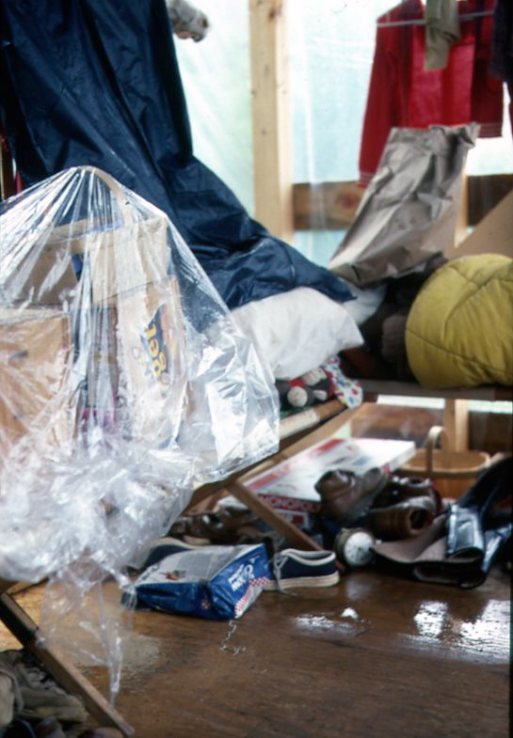
During the day our shed, as we called our new quarters, was a stifling greenhouse. Mountain nights were a different matter. We wrapped ourselves in sweaters under our blankets. Then the rains came, and the winds, in the form of an inland hurricane. Our  “walls” were decimated. The black plastic “roof” caved in. We were forced to invest in slightly sturdier materials.

It was a mess!

Finally, we could complete our building plans, which meant we could have a temporary power pole installed. Electricity made it ever so much easier to build, though the only power tools we had were a drill and a couple of circular saws. Nonetheless, progress was slow with two novices working on our first significant building project, learning as we went.

As the nights turned colder, we used a space heater to keep relatively warm, but with no door, much of the heat escaped. December’s bitter cold found us huddled over the heater more often than pounding nails.

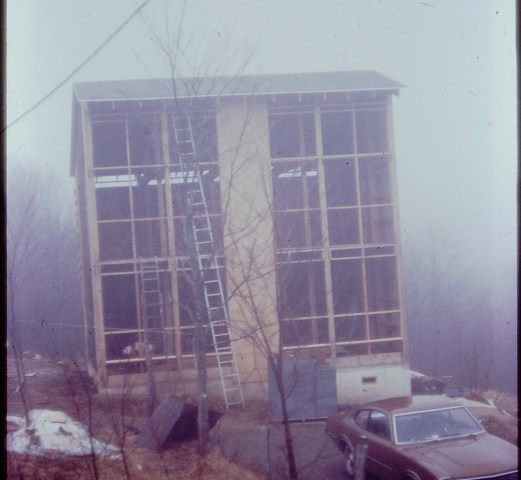
Finally, it became too much. At 1:00 pm on December 20th, when the temperature dipped to five degrees and was heading lower and our water containers and canned goods were frozen solid, we faced the inevitable and moved into a one-bedroom apartment in town until warmer weather descended.

The state of things when the weather got the better of us.

In spite of the cold, we managed to get some work done on the house throughout the winter. Four months later when we returned to our mountain place, we moved into our home, a structure that barely qualified as a shell. Loose plywood covered the floor joists. Blackboard sheathing was the extent of our walls—no siding, no insulation, no drywall. Our plan called for lots of south-facing windows, but we had no windows. Once again, we used plastic to protect us from critters and the elements. A construction site heater warmed us during our morning bathing and dressing routines. We still had no running water and what little electricity we had access to still came from the temporary pole. Of course, we didn’t have a phone.

Except for the plastic we installed over the window openings, this is how the house looked when we moved in.

It would be another year before we got those modern conveniences and many more until our house was what most folks would consider properly finished. But we persevered.

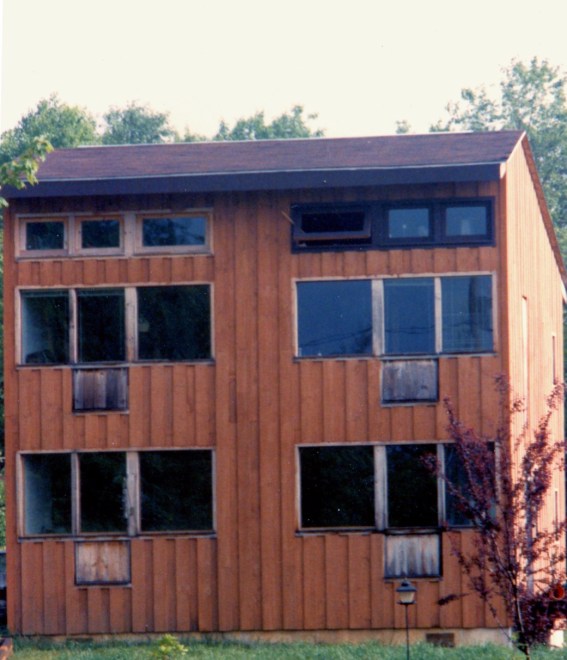
Other than a coat of paint on the window trim (see where we’d started, upper right) and vent openings below windows, this was as finished as our house got until thirty or so years later when it got a total facelift–standard windows, horizontal siding, awnings, and more.

Almost forty years later, our daughter says our years of living in the wild brought our family closer together and notes that her somewhat unusual childhood always makes for a good conversation starter. Our son, wanting his own children to experience the kind of life he had as a kid, has begun a homebuilding venture of his own. The Gnome and I are still here, still working on our dream home. We are here to stay.It was an undertaking of our own choosing, born of youthful enthusiasm and sheer ignorance. Had we known what we were getting into, we might still be in Kentucky today. But we’d have missed out on the adventure of a lifetime.

(To read more about our homebuilding adventure, check out the nine-part series beginning here. Unrelated posts are interspersed, but you can scroll past those if you choose.)

Yes, It Snows In North Carolina

Yes, It Snows in North Carolina   

(On the occasion of the twenty-fifth anniversary of the Blizzard of ’93)

When the Michigander I’d just met learned that our family lives in North Carolina, he said, “Well then, you don’t have to worry about snow.” It’s a comment I frequently hear from people who “aren’t from around here,” as if they think all Tar Heels live at the beach. Little do they know. In a state that stretches 600 miles inland, my home is on the same longitudinal plane as Cleveland, Ohio. The meridian actually skims Michigan’s mitten thumb and lines up with eastern Ontario. Pretty far inland.

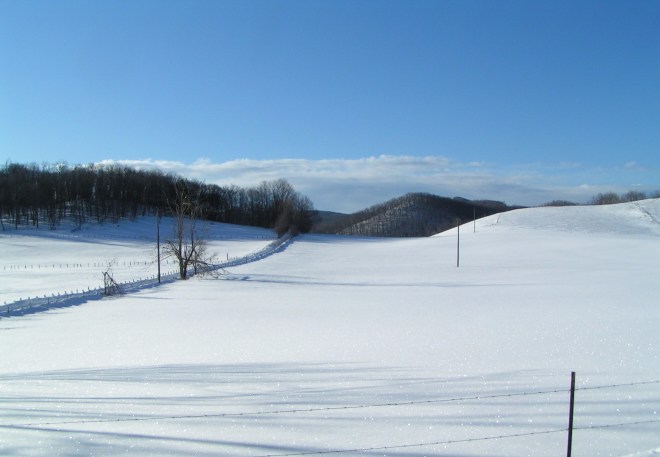
At more than 4,000 feet in elevation, we’re also a bit higher than coastal areas. So, yes, we have some weather, and it’s not usually fit for swimsuits. Our thermometer has read as low as -32º. Our most wintry weather has a tendency to come after many folks have long since said goodbye to winter. During our first year here, we were surprised by several inches of snow on Memorial Day. Just a few years later, four-foot drifts covered our gravel road in the middle of April.

Snowfall near our house, 2010: everything is covered.

Then, there was that other time . . .

In mid-March, 1993, I had a business meeting a couple hours from here. I decided to add a quick overnight visit with my parents, who lived nearby. Snow was again in the forecast, but it wasn’t expected to begin falling until sometime the following day. I’d surely return home ahead of any significant precipitation.

Even so, I parked my little Geo Metro at the bottom of the mountain road that led to their home. Just in case. If the snow came earlier and/or heavier than expected, it would have been treacherous trying to drive out from my parents’ mountainside perch.

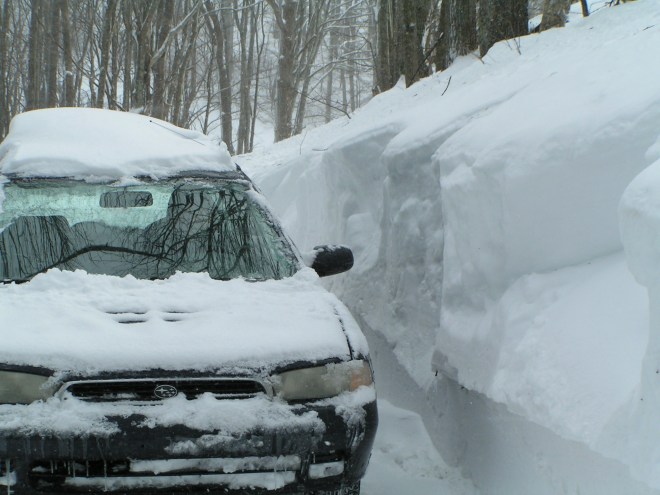
The next morning, we woke to a world of white outside and darkness indoors. The snow was deep and heavy. Power lines had snapped for miles around. Snow poured down for three days. Hundred-mile-an- hour winds created monstrous drifts. The governor issued a two-day long, twenty-four-hour curfew. Even wwhen the curfew was lifted, it was clear I wasn’t going anywhere.

Not only could I not retrieve my little car from the snowbank created by a snow plow—I couldn’t even see it under its huge snow mountain. My seventy-something-year-old father, who had suffered a massive heart attack several months prior, was in no shape to shovel snow. And I wasn’t willing to risk the same fate myself.

Back at home, the Gnome and our college-aged son who was getting ready to return to school after spring break were confronted by drifts up to four feet deep once the snow finally stopped falling. They were trapped, too. We usually hire someone to plow out our gravel road when it’s impassable, but no one could get up there. With school beckoning, they felt compelled to begin the daunting task of digging themselves out by hand.

Worried about not one but two potential heart attacks, I insisted on sworn promises that they’d take breaks a minimum of every two hours and call me on the nose at each break. I couldn’t get to them, but if I didn’t hear from them on time, I’d be calling 911 stat!

There was nothing more I could do except wait it out. My parents and I got by with a roaring fire in the fireplace and a lot of canned soups heated on a camp stove. We entertained ourselves with conversation and reading.

Enjoying my snow exile in a hammock

My mother had recently acquired a book published by the genealogical society of her home county. Residents had been invited to send in family stories and histories. Some were straightforward with lots of begats. Some people heaped praises on themselves—in the third person, clearly not realizing their own name would appear as author of their submission. Some were pious, some irreverent, some lavishly embellished.

Other entries were laugh-out-loud funny. Like the one about the grandpa who never cut his toenails and walked around his log cabin barefoot, his nails clicking loudly on the wood floor with each step. Or the one about the family whose children decided to outfit their mother with a football helmet and hang her upside down in a homemade traction device to cure her aching back. Or the story about the man who kept a skull in his closet. Then again, maybe we were just punch drunk. It was good medicine to read and share those stories while we were cooped up.

The book presented another opportunity, one to learn about my own family history. When I’d previously asked Mother how long her family had lived in her home county, she couldn’t tell me. She knew nothing about her family beyond her grandparents. Even then, the information was sometimes scanty.

Each article, it seemed, provided a clue about yet another previously unknown branch in my family tree, which in turn led me to still another and another. My paternal grandfather died years before my grandparents met. Mother knew hardly anything about him. With the help of the heritage book, I discovered that he had been in the Civil War, that my great-grandmother was thirty years his junior and was his second wife. I learned that my grandfather’s ancestors were some of the first European settlers in the area. My grandmother had deep local roots, too. I discovered that while most of my ancestors hailed from the British Isles, some came from Germany. It was fascinating stuff, even if not quite all of it was verifiable.

I was stuck in place for almost a week, much of it with my nose buried in the heritage book. By the time I finally left for home, I had a sheaf of papers summarizing family stories and diagramming potential genealogical connections for further research.

That week was the beginning of an enduring passion for family history, one that’s even led to a couple of books. All because of the Blizzard of ’93, otherwise known all along the East Coast as the Storm of the Century. On this occasion of the storm’s twenty-fifth anniversary, we’re in the midst of another great snowstorm. It’s not expected to be as big an event as the Blizzard of ’93, but then that one caught us off guard, too. 

Taking a bite out of snow

For a recap of the Blizzard of 1993, click here:   https://www.wataugademocrat.com/watauga/the-blizzard-of/article_13899f70-3c38-5153-8e92-10c2da17e884.html

A Thing of Beauty Is a Joy Forever

For Valentine’s Day

John Keats wrote it as the opening line in his poem, Endymion. If you’re like me, you read Keats, along with his fellow second-generation British poets, Shelley and Byron, in your senior high school English class. How I loved them.

At sixteen, I was primed for their romanticism—the imagery, the sensuousness, the idealism, the pensiveness. I remember spending rainy days under one of our massive pecan trees (in the midst of thunderstorms, no less) mulling over their poetry. Their young deaths (Byron at thirty-six, Shelley at twenty-nine, and Keats at the tragically youthful age of twenty-five) added an extra touch of melancholy to my teen moods.

Endymion’s opening lines go like this:

A thing of beauty is a joy for ever:
Its loveliness increases; it will never
Pass into nothingness; but still will keep
A bower quiet for us, and a sleep
Full of sweet dreams, and health, and quiet breathing.

This verse conjures up something uniquely mine, but I’ll bet it invokes something uniquely yours, too. What follows came to me one day when, as usual, I was first to wake. As I lay in the quiet of early morning, I took a long look at the Gnome‘s face, oblivious and peaceful in sleep.

* * *

At twenty, the only “wrinkles” on his face were the crinkly corners of his always smiling eyes. At twenty, he had a full head of dark blond hair. At twenty, his body was taut and tanned.

The skin is looser now, and the golden hair that covered the top of his head is gone, replaced by a full beard of gray on his face. The wrinkles have spread both upward and downward.

I try to see him dispassionately, as a stranger might. But I cannot. When I contemplate his sleeping form, I only see the whole of him across all the years of knowing him. What I see is the kindness, the love, the mischievous curve of his lips.

The crinkles are still there, too, framing the ever-present dancing smile that lives in his eyes.

And suddenly he is twenty again, but with the added dimensions of experience, of a  shared life together, of wisdom. A thing of beauty. A joy forever.


Summer’s Slow Slide into Fall

Summer’s Slow Slide into Fall (written in mid-August)

First day of summer: words that conjure up notions of vacations, suntans, freedom from homework. Thoughts of fun in the sun with summer reads, picnics, hikes, swimming, tennis, softball and baseball, bike rides, day trips. All those traditional outdoor activities mean summer’s here.

In truth, when the first official day of summer rolls around, fall is already lurking in the shadows. The first sign, of course, is day length. Summer means longer days, right? But summer officially begins with the summer solstice—the year’s longest day. The very next day—officially the first full day of summer—will be a little shorter, as will the day after that, and the next, and the next. Every day for the next six months.

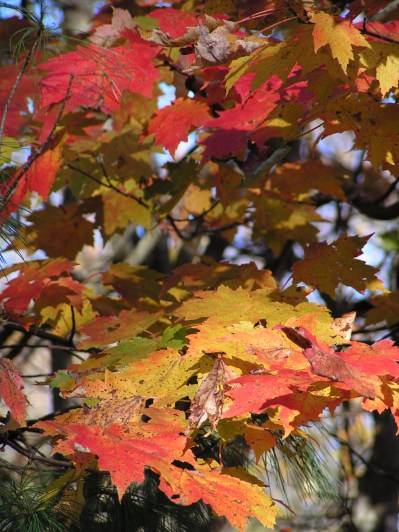
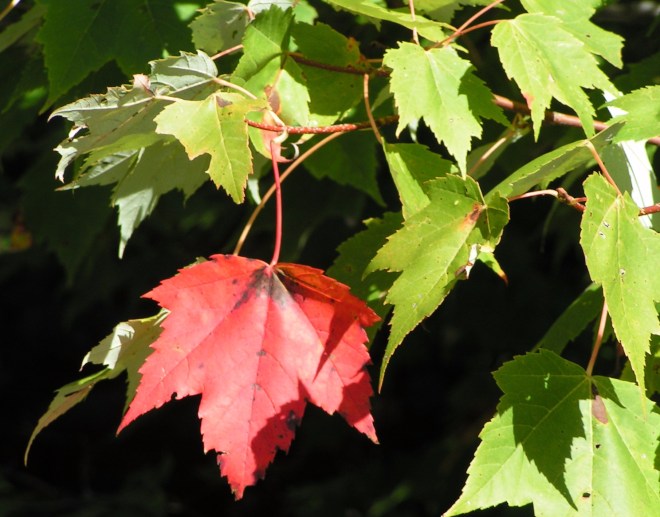
It’s about the time of the summer solstice that I inevitably spot a tree with that one red or yellow leaf. I’m a big fan of autumn, but I also prefer to live one day at a time, and that leaf sits there taunting me, reminding me that fall is inching its way into my life. To the astute observer, other signs of autumn’s sure return are all around. Those lime-green spring leaflets that sprouted on trees (wasn’t that just yesterday?) have been growing both larger and darker. Before they put on their showy fall display, they will continue to darken until, in the distance, they’re such a deep green they look almost black.

As spring wildflowers transform into summer ones, so summer’s blooms have now, almost imperceptibly, given way to those of fall. Daisies are replaced by Queen Anne’s lace; black-eyed Susans seem to morph into yellow coneflowers, Jerusalem artichokes, and sunflowers. Floral hues become both more muted and more rich. The buttery yellows of summer’s evening primrose make way for the more mellow tones of fall’s goldenrod. There’s the rusty shade of spotted touch-me-nots in lieu of daylilies’ brighter tints. In the wild, pinks virtually disappear as summer subsides, and lavenders transmute into the subtler mauves of milkweed and Joe-pye weed and the rich purple of ironweed. In front yards, gardeners discard summer’s petunia palette in favor of the earth tones of chrysanthemums. Berries appear. Fruits ripen.


Birds’ feathers become a little less brilliant. Grasses develop gracefully drooping seed heads. Little by little, vegetable gardens show signs of wear as growth slows, pumpkins turn from green to orange, and early veggie plants dry up or go to seed.

dscf9200.jpg

The sun itself gets in on the action. Ever since summer’s solstice, its arc becomes a little more southerly, a little lower as it moves across the sky.

As I write this piece at the beginning of the third week of August, my calendar tells me we are just past summer’s midpoint. To be precise, sixty percent of our summer days have passed. Sitting outside in the afternoon, I hear a distinctive sound unique to this time of year—the thump of acorns and hickory nuts as they hit the ground in the woods. It’s not a safe time to be standing under a nut tree!

Then comes an evening’s after-supper walk when I unexpectedly sense another change. The days may still be warm and humid, but I feel the barest hint of chill in the night air. Sometimes, I even catch a slight change in nighttime scents—a little less floral, a little more spice. My ears notice the ever-increasing cacophony of crickets and katydids doing their late-summer thing. Their sounds also pierce the otherwise country quiet during the day, but at night the music is almost deafening, yet soothing in its own way and one more sign that fall is closing in.

Fall has always been my favorite season, so I welcome its coming. Still, it’s a little curious that just as we’re getting into the full swing of summer, autumn has already begun its birthing process. I guess that’s the way of things. The peak signals certain ending, but an ending accompanied by new beginnings—caterpillar to chrysalis to butterfly, seed to tree and back to seed again, adolescence to adulthood, retirement to a new life chapter,  the whole of life itself.


Becoming a Home–and a Construction Zone: Early Days on the Diagonal, Part 8

Becoming a Home–and a Construction Zone: Early Days on the Diagonal, Part 8

(If you’re just tuning in the Early Days on the Diagonal series, you may want to start here and work your way forward.)

Not surprisingly, December just keeps getting colder. As far as temperatures go, life in our shed isn’t much different from sleeping on the ground. Not much construction work gets done—we spend most of our time trying to keep warm. Finally, on December 20th, when at 1:00 pm the thermometer reads 5°, all our water and canned foods are frozen solid, and the temperature keeps dropping, we know we can’t keep this up.

pict00631.jpg

Within two hours we find a furnished one-bedroom apartment in town. Temporarily, we leave behind a lonely-looking but imposing 2 1/2 story structure—shingled and, for the most part, enclosed.

We also face the reality of a drastically low bank account. If we want to finish the house, we have to find paying work. Consequently, we have barely any time to work on the house. Vicious cycle.

Nonetheless, we continue our building efforts on weekends, and by mid-April, after nearly four months in town, we move back to our land, this time directly into the shell of our house. It, too, is only covered with blackboard—for the moment—but we do have doors. No glass in our twenty-three window openings, so we’re still very exposed to the elements.

Once again we turn to plastic, but this time with a protective layer of landscape shade cloth and rows of strapping to protect the plastic from the rain and whipping winds. This combo does nothing to abate either the cold or noise, though. We wince every time the fierce wind blows and beats noisily against the plastic.

Naturally, a cold front moves in the same time day we do and temperatures drop to the twenties. Our little space heater can’t compete. At least we’re warm when we snuggle under the electric blankets the Gnome’s parents have provided.

img003_edited

Looking into kitchen area. Horizontal girts make perfect narrow shelves.

In May our phone is installed. Now we have access to the outside world. With no stairs yet, our access to the second floor is a ladder. Neither do we yet have running water; we’re still pretty much camping.

By the end of June, all the studs for our few interior walls are in place. We’re also beginning to put up exterior siding. With the height of the house and no scaffolding, this means even more ladder-climbing. It’s a slow process.

img006_edited

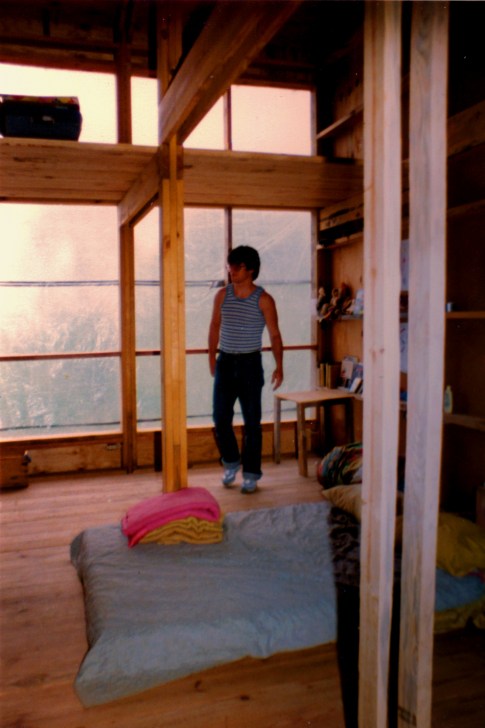
Upstairs with loft above. Look carefully and you can see some of the horizontal plastic strapping protecting our plastic-covered window openings.

The glass for our windows arrives in August. After installing them, we finish most of the exterior siding. We wait for lumber prices to drop before buying the rest. We also install our tub, toilet, and bathroom and kitchen sinks, but it will be a full year after we’ve moved back up here before we complete all the plumbing work and get running water. Since we’re dependent on an electric pump, getting water is also dependent on having electricity. The Gnome’s electrician dad does a walkthrough to assure us we’re doing it right. April 24th, 1981, the day we’ve completed our wiring and water is finally running to all our indoor fixtures, is a red-letter day for sure!

Our home’s far from finished—for instance, we’ve only now finished nailing down the subflooring that’s been sitting on joists for a year—but we finally bring all our belongings home from the storage unit where they’ve been sitting for eighteen months. It gives the place a homey feel.

Punkin and Cuddlebug’s extracurricular activities keep us so busy that work on the house slows to barely a crawl. Living in an unfinished house means working around people, furniture, and stacks of unpacked boxes, slowing things down even more.

img005_edited

Lumber gets stored inside to protect it from the weather.

It will be another five years before we have a kitchen counter and cabinets, and still another before we get around to painting our interior walls, build a closet, and finish the exterior siding.

img002_edited

Before we had a closet

In truth, we will never get finished. When we once again have time—and money—to finish the job, the house will be begging for some serious rehab and remodeling. But that’s another story for another time. Meanwhile, stay tuned for a bonus segment of Early Days on the Diagonal.

finished-house

Except for painting the window trim (we’d started, upper right) and vent openings below windows, this is as finished as it gets until thirty years or so hence. But we did it all by ourselves, y’all!