Here’s to What We Don’t Know

Another quick assignment in my Wednesday writing group—you’ll find the prompt in the last nine words of this post. (Unh-uh! No skipping to the end!)

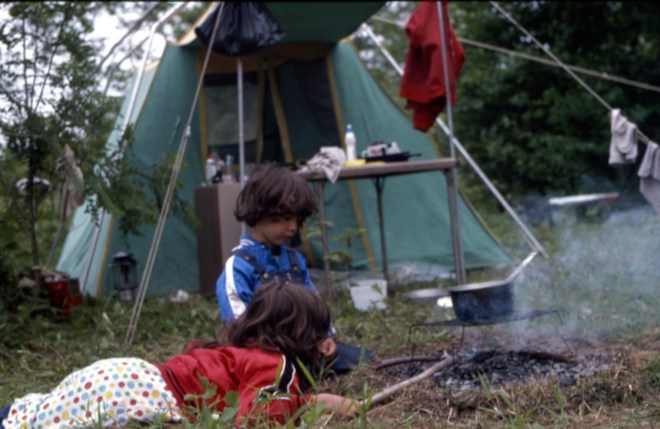
Living in a tent on ten acres of land in a strange place with no water, no electricity, no phone access, no knowledge of local weather conditions—like that severe thunderstorms could and would pop up daily with no warning, no jobs, and no money but with two elementary-aged children, two neurotic cats, and a notion we could live this way for as long as it took to design our own house, get planning approval, and build the entire thing with nothing more than our own four hands and a few hand tools . . . well, it seemed like a good idea at the time.

Grandparents’ Camp, Part II: Lessons Learned

If you read last week’s blog post, you know we sponsor Grandparents’ Camp every year for our grandchildren. Some have told us the name is topsy-turvy—sounds like someone’s sending the Gnome and me to old people’s camp. Hey, maybe when they get older, the grandchildren will actually host a camp for us. That would be totally awesome!

A friend of mine hosted her own grandparents’ camp the same week as ours. She’s a natural born planner with a strong theatrical bent—each year her camp has a different theme. She even engages her grands in planning and preparation. That must be fun. Our camps are more a hodgepodge: a few new activities scattered among a host of old favorites. That works, too, though it can be a challenge finding activities that suit a toddler, a soon-to-be ’tween, and a couple of teenagers all at the same time.

(Hover over picture for caption. Click a second time to see captions in their entirety.)

Here’s a little compilation of things I’ve learned from hosting Grandparents’ Camp. Some I learned long ago; now, with a little one added to the mix, I’m learning a few new things, as well as relearning a few old tricks.

1. Children thrive when they get to explore outdoors, sometimes completely on their own. Children thrive when given the opportunity to be creative. Children thrive when they discover it’s perfectly fine to get dirty. Children thrive when they know it’s okay to use their ‘outside’ voices.

2. Almost-three-year-olds ask a lot of questions, especially ‘why’ questions, often about life’s great unanswerables: why do you have (insert any visible object)? Why do you wear clothes? Why do you have stairs? Why are birds here? Why are we eating (insert any visible food item)? Why is it still light?

3. Almost-three-year-olds also talk about their parents a LOT! Mommy this, Daddy that. It’s only natural—an almost-three-year-old’s world is small and those in it loom large. Our almost-three-year-old has set his parents on such high pedestals they’re in danger of breaking something when they inevitably crash to the floor with the rest of us mere mortals. (They are mighty special—and lucky to have his adoration.)

4. Little girls idolize their older cousins, looking at them with wondrous eyes, mimicking everything they see. The older ones are a little stunned by the awesome responsibility that just dropped in their laps once they notice a younger cousin adopting their hairstyles and clothing tricks.

5. There’s nothing quite so good for one’s self-esteem as having an almost-three-year-old scoot next to you for a cuddle with these words: “I love you. You’re my best friend.” Hundreds of times a day. Literally. Hundreds. (Smiling gramma!)

6. There are a few things you should check out with the parents before they say their goodbyes. If certain routines that have become sacred traditions, you need to know about them, word for word. You need to know the bedtime sequence of events.

7. Planning activities for vastly different ages in a camp-like atmosphere is best done with more than one adult on hand. Occasionally, one set of campers needs a break from the other age group and separate activities are called for. A shopping trip for the older ones, a visit to a playground for the younger ones gives everyone the breather they need to be happy to spend their remaining hours together.

8. Just like at home, campers need to be given some responsibilities, such as helping with the dishes, putting things away when an activity is over. Not too many—they’re not at Basic Training—but enough to build their confidence as able human beings and enough to be reminded we’re all in this thing together.

9. It’s important to refrain from the temptation to overly rely on the older ones. They shouldn’t be made to feel like babysitters or ‘junior counselors.’ Camp is for them, too. Sometimes the balancing act is delicate.

10. When older campers notice that the camp directors have hit a wall and offer their services unbidden, you love them more than you thought possible. (Clearly, they’ve  been raised right.)

Bonus: This year, I also discovered that the almost-three-year-old and his camp director, seventy years his elder, now use the same cautious technique to climb stairs! Oh, my!

Grandparents’ Camp, Part I

The Gnome and I sponsored our annual grandparents’ camp a few weeks ago. Lots of folks do these days, but I’d never heard of such a thing when we opened our first camp seventeen years ago.

A lot has changed in that time. Back then, we had only one camper. Easy peasy. As the years passed, the number of campers has, at times, quadrupled; the camp directors’ ages increased dramatically, along with the number of cranky joints. The age gap between campers grew, too. We’ve had as many as four campers simultaneously, their ages ranging from two to eighteen. That makes planning a little more complex than back in the early days of our camp.

Our pioneer camper is clearly aging out, no doubt soon to be followed by the next eldest—too soon. But they will always be welcome in our home, camp or no camp.

I still look forward to camp and, unsurprisingly, still feel a bit of a letdown when the last camper says goodbye and heads for home. Kind of like that feeling I get as a wonderful vacation is nearing its end or the way I felt as a child as the holiday season wound down.

The first few camp years, I began planning weeks in advance. Now, with nearly two decades of experience, I’ve pared the process down a bit. I keep a notebook with all essential information (menus, recipes, activities), adding new ideas along the way. But planning still begins about three weeks in advance—I just don’t spend so long on it in a given day or week.

For campers of a certain age, I send camp invitations and registration forms, SASE included. I insert a goofy questionnaire asking, for instance, if the camper has ever been bitten by a tsetse fly or suffers from conditions like whinitis or pre-teen angst. I send a checklist of potential activities, including a few goofy options, such as eating worms or picking up rocks. I include a list of common-sense items to bring with them, and I request that they leave some items at home, absurd things like pet crocodiles.

About the same time, I put together a menu and shopping list. It’s fairly standardized because I can count on the same special requests from year to year: fondue, cookout, s’mores, sweet potato casserole, and a baked spaghetti dish.

I break buying trips into two parts. Perishables are purchased only a day or two before the start of camp. But to save myself from too much sticker shock, I buy non-perishables a week or two in advance.

I check the status of our regular supplies: canvases, paper, and acrylics for painting along with glue, food coloring, and liquid starch for that all-time favorite, slime. I collect materials for new projects I’ve discovered over the year.

I make sure bedding is in place, pull out equipment that’s been stored for the last twelve months, and do a last minute clean-up. I don’t know why I do this—it will take about five minutes for the house to explode in suitcase innards, toys, crayons, and more. Still, my illusion (delusion?) is that starting the week organized helps keep things under control.

In addition to the ever-popular painting and slime-making, we blow bubbles, watch fireflies, stargaze, make homemade ice cream—with a different fruit each year, add an item or two to one grandchild’s wooded fairyland, go for walks. I try to stay away from rigid schedules as much as possible. At the risk of hearing those dreaded words, “I’m bored,” I still prefer the freedom from routine that comes with grandparents’ camp.

The best part of making ice cream is getting every last drop from the can and dasher.

Learning to arm knit
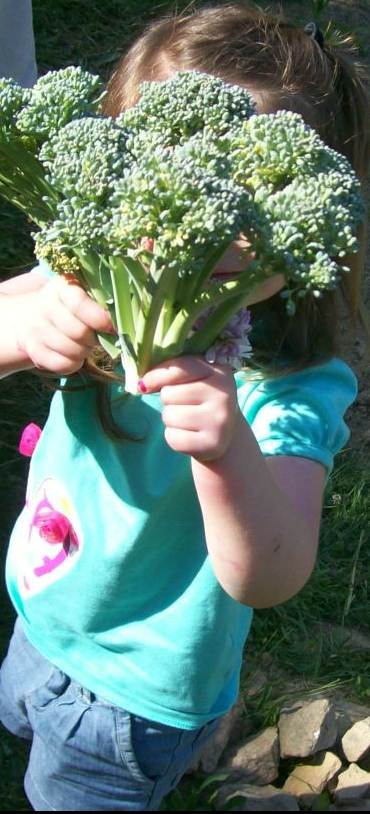
Harvesting supper from the garden is great fun.

We include a few field trips. They break up the routine, but too many and the week starts to feel overscheduled. Field trips have included a trip to our favorite local park for picnicking, playground fun, bicycling or strolling, kite flying, and splashing in the icy mountain river that bounds the park. We’ve visited local tourist attractions, we’ve gone gem mining, we’ve toured a cavern. Lately, we’ve included a shopping trip to boutiques for the older kids while the youngest one visits a playground or library story hour. (Shopping bonus: I get surefire gift ideas.) We’ve gone on downtown scavenger hunts, visited a working alpaca farm, attended a street festival, spent long evenings at fireworks displays.

One of our all-time favorite activities was the “spaghetti pool.” It involves playing naked in a kiddie pool full of oily spaghetti sprinkled with food coloring, so it’s only suitable for the youngest campers. But since it’s one of the first camp experiences the grandkids have, they’re sure to anticipate future camps as a wildly fun adventure. (A long, warm, bubbly soak in the tub inevitably follows this activity.)

We’re seventeen years older than we were when we held our first grandparents’ camp. We’re a little slower now, but I love our special week with grandkids every bit as much now as then. It’s a rare opportunity for them to spend time with each other; it’s a different pace than their norm with different freedoms—and different rules; they get to know us one-on-one. Invariably, the kids initiate conversations on subjects that don’t usually come up when the house is filled with mostly adults, so we get to know them better, too. Their conversations are open and free, and they treat us like one of their own.

John McCutcheon, one of my favorite folk artists, sings the song, “Water from Another Time. It tells of childhood summers spent with grandparents, getting water from a rusty pump “primed with water from another time.” The point of the song is that we all need a little from the past to feed our souls—old melding with new to help us make our way in this world.

I hadn’t really thought about it before I heard those words, but that’s what the Gnome and I are trying to give our grandchildren with these precious summer moments. My fervent hope is that one day my grandchildren will utter the words I so often do: “I want to be kind of grandmother my grandmother was.”

Water from another time.

Dressing Gramma’s childhood doll in clothing made by Great-gramma—water from another time.


A Mountain of Wildflowers


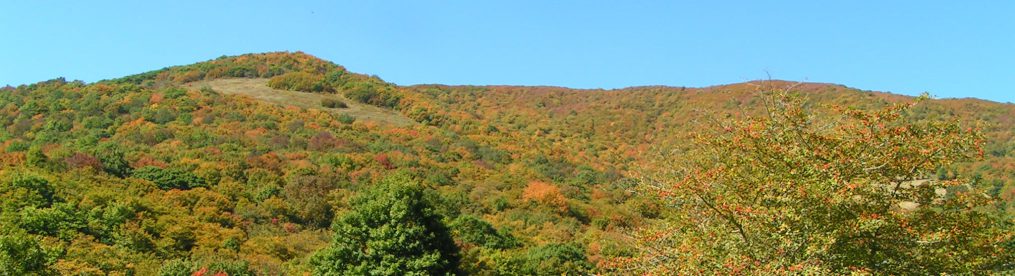
The early July day we drove onto our property for keeps is a day I’ll never forget. The four-acre meadow was white, covered with native oxeye daisies—my favorite. There were enough black-eyed Susans thrown in for variety, but not enough to take away the impression of snowy summer field.

At that time, we had no idea how many different wildflowers would grace us each year. We had to live through a full year to see it all. More, actually—a few, like jack-in-the-pulpit, can be hard for the novice to spot in a wooded landscape.

We didn’t know the following May and June would bring rhododendron blossoms throughout these mountains or that June-blooming flame azaleas dotted our property with mountain laurel following close behind. We’d never heard of fire pinks, which are actually blazing red. Red bee balm and both yellow and orange-spotted touch-me-nots are summer-to-fall natives.

Milkweed, Joe-pye weed, and ironweed (none of which should have the word weed attached to them) add varying hues of purple to the landscape. Open fields turn yellow when wild mustard, common ragwort, and evening primroses bloom.

The list goes on from March’s trillium to October’s purple asters—not to mention the many varieties of ferns, mushrooms, mosses, and lichens that share this land with us. But we all know pictures tell a story much more eloquently than words. Enjoy the two slideshows below.


This slideshow requires JavaScript.


This slideshow requires JavaScript.

The Ones Who Show Up

The Ones Who Show Up

As a society we’re often drawn to bigness. Philanthropy is equated to charitable giving in the millions. Grand gestures get attention. But what would we do without the small gestures? All that magnanimity we hail from people who can easily afford it would be meaningless without the little deeds of daily kindness, sacrifice, and responsibility from just plain folks. I refer to:

* the neighbor who brings groceries to the shut-in

* the gardener who grows a little extra to donate to homeless shelters

* the young woman who weekly organizes her mother-in-law’s medications

* the busy teacher who takes a few sacred moments to send a note of encouragement to a former student

* the friend who brings cookies and laughter to her terminally ill neighbor

* the co-worker who offers a much-needed compliment to a beleaguered colleague

* the harried nurse who still finds time to bring a bookmark to a patient who reads

* the child who writes chatty letters to her lonely grandparents

* the boys who shovel the snow-covered walk of someone recuperating from surgery

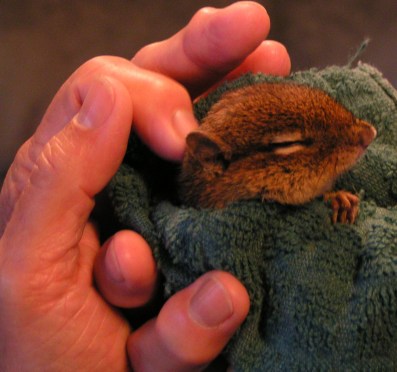
*the passerby who comes to the rescue of a drowning chipmunk

* the writer who sends nostalgic essays to aging relatives

* the man who cares for an acquaintance’s pets when she’s injured and hospitalized

* the many who give to a stranger’s health-related social media campaign, even when their own resources are scant

* the shopper who hands a dollar to the one in front whose bill was a bit bigger than his pocketbook

* the one who smiles at a stranger

* the young one, tired from a long day of grueling manual labor, who nevertheless offers his seat to the older one

* the teens who bring homemade goody boxes to residents of the nearby nursing home

* the foreign visitor who chases you down to return a dropped scarf in the parking lot

* the kid who carries an injured classmate’s books

* the retailer who takes precious time off from work to visit a stranger in prison

* the club members who de-litter a section of highway

* the customer who holds the door for a daughter and her wheelchair-bound father

* the stranger who catches a runaway shopping cart

* and the building custodians and sanitation workers, the electric line workers and snowplow drivers, the bedpan emptiers and street sweepers who do the dirty work at all hours of the day and night to make getting through each day easier for the rest of us.

Oh, that we would glorify these, the ones who show up, the ones who make a profound difference by changing not the world but what is three feet around them.

Our Garden in June

Our Garden in June

For the most part, I write about gardening and modern homesteading over at Mother Earth News these days. I hope you’ll check it out. But sometimes my enthusiasm is just too big for one blog.

This is an exciting time of year for avid gardeners. Tiny leaves erupt from the ground and unfurl where seeds were buried yesterday. Early crops such as salad greens and lettuces are in full production mode, strawberries are juicy red, and summer crops like squash are beginning to produce. At this time of year, it’s not so busy that a gardener-food preservationist feels overwhelmed, yet each day brings evidence of progress and growth. It’s a time full of hope, exuberance, and plenty.

I adore this time in the gardening calendar. Mornings and evenings are cool enough to enjoy garden work without breaking a sweat, whether weeding or gathering part of the evening’s meal. Hardly ever do I leave the garden without taking a few minutes (which often stretch into bigger chunks of time) to sit on our garden bench and survey the success of our efforts.

A couple of weeks ago, our grandchildren were here for “camp” ( a story for another time). The nine-year-old asked if she could go down to the garden—a question sure to garner a hearty “Yes.” A cousin spotted her from the deck and wondered who she was talking to. Sure enough, her mouth was busy as she wandered from plant to plant, her hands reaching out to release the aromas of various herbs.

When she returned to the house, I asked her if she’d been talking to the plants. “Huh? How do you talk to plants?” she asked in astonishment. So, I had to ’fess up. Yes, I regularly talk to our plants, as an older grandchild who’s accompanied me on many a trip to the garden can attest. I didn’t even realize I was doing it until she turned to me and said, “I like how you talk to them. It’s like they’re human.”

Indeed! I encourage them, I apologize when the weather is uncooperative and urge them to hang in there, I thank them. They bring me great pleasure and I can’t help but give that pleasure some expression.

Here’s what’s going on the garden these days.  (To see captions, click on each photo group, then place cursor over individual photo. You’ll have to click a second time to see captions in their entirety.)


Thanks for stopping by and stay tuned. More to come as the garden matures.

Little Things Mean A Lot

Little Things Mean A Lot

Have you ever looked around your home and thought about which things are especially meaningful to you? If you’re like me, it won’t be the big-ticket items, whatever they are. Instead, it will be the little things, sometimes things you’ve held onto for no apparent reason, things to which no one else would attach any importance.

I took a virtual house tour recently and came up with a few special items.

1. The one I’ve had the longest is a Little Golden Book, Busy Timmy. I have a few others, too, but this one captures my imagination for a variety of reasons. Stereotypical as these books were when I was an impressionable tyke, they were my ticket to the wonderful world of words. Timmy could do anything, it seemed. I was just as proud when I could do something on my own—that was the whole idea, after all. I loved the illustrations. And I learned to read. I’ve had this book for close to seventy years. (How is that even possible?!) It never gets old, and it tickles me no end to share it with my grands.

These books are well worn!

2. You’ve surely been asked the question, “If your house was on fire and you could save just one thing, what would it be?” Though I’m sure the true answer lies only in the experience of the moment, my answer to the hypothetical has always been “my photographs.” I’m addicted to picture-taking. I get even more joy from perusing old photos—snapshots of friends and family, vacation scenes, nature photography. I love it all. Of course, I’d never succeed in my photo-saving quest—my albums fill close to ten linear feet of my bookshelf real estate. And that’s not counting the boxes full of loose snapshots or the photos on external drives and SD cards. But I’d do my best. They’re memories of the richest sort. Visual links to time and place that only exist in memory. Treasured keepsakes to share with next generations whose only tie to their past lies in pictures and words.

3. A large, two-tone brown mixing bowl was a fixture in Mom’s kitchen for as long as I can remember—the kind you might find in an antique consignment shop these days. Everything from meatloaf to cake got mixed in that bowl. It’s long had a hair crack down one side, but I still use it almost daily. It wasn’t just part of my childhood; it was part of my learning to cook, an essential item in my 4-H foods project. I mixed up my prize-winning cornbread in it, and I still do today.

4. Growing up, I never cared all that much for framed crewel, embroidery, or cross-stitched pieces. They were too old-fashioned for my taste. But when my mother was breaking up housekeeping, I grabbed a few for old times’ sake. Today, they hang on my walls in places of honor. Each one has a story. This one’s my favorite.

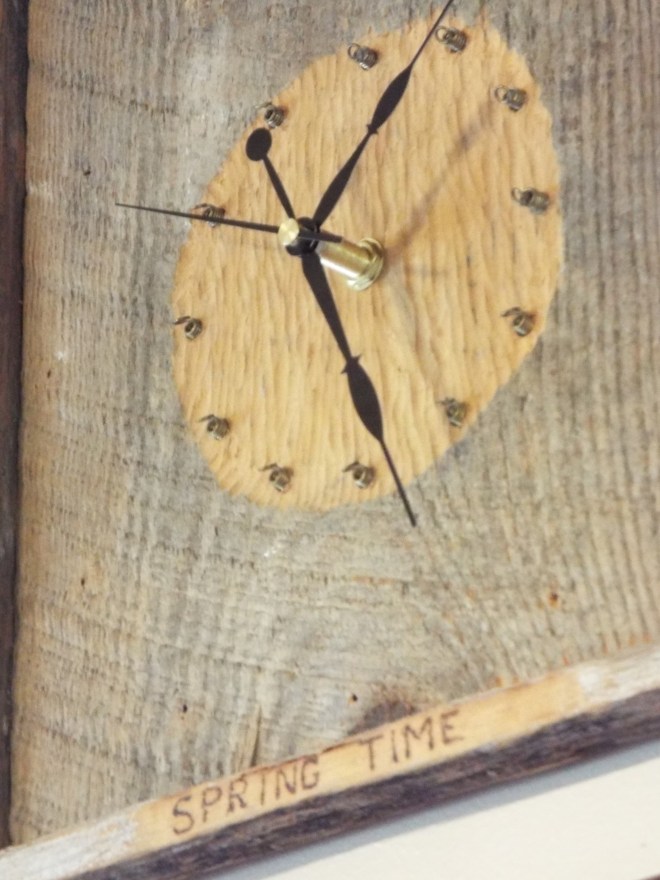
5. My dad took up woodworking in retirement, following in the footsteps of a couple of his brothers. He carved walking sticks, made wooden chimes, turned earrings from exotic woods. I especially liked the clocks he made of aged barn wood. He enjoyed coming up with corny themes for them. (Corn was one of his specialties.) On the frame of mine, he etched, “Spring Time.” Each numeral is represented by a small metal spring. It makes me chuckle. It’s just so Dad.  

6. After decades of filling up precious bookshelf space with my old college textbooks (not to mention hauling them move after move), I finally admitted I no longer had a use for them. Gosh, the psychology texts were embarrassingly outdated. But there’s just something about those old books: their look, their heft, their scent. The slick pages alone send me into paroxysms of nostalgic joy. No doubt part of the allure is the childhood memory of my dad’s sole surviving college text. When I was eight years old, I tortured my younger brother with “school,” while I, as teacher, busily underlined sentences full of words I didn’t understand in that chicken husbandry book.

Still, I knew it was time. Wistfully and semi-regretfully, I began packing my old books in a donation box. Then I came upon my treasured Milton text. I temporarily set it to the side. Not for its content—I tried rereading a few lines. Crikey! No, it was for what it represents: a small seminar class where I was fully present. I loved the challenge of it. I dared to speak out. I got listened to, I belonged, I thrived.

I kept the book.

I could go on and on, but you get my drift. Sentimental trinkets, whose meaning often lies in what they represent rather than the objects themselves—these are the things I value. One of my favorite Top 40 hits during my teens was the song, “Little Things Mean A Lot,” sung by Joni James. “Blow me a kiss from across the room/Say I look nice when I’m not/Touch my hair as you pass my chair/Little things mean a lot . . . Don’t have to buy me diamonds and pearls/champagne, sables, and such/I never cared much for diamonds and pearls/’cause honestly honey they just cost money.” In spite of some fingernails-on-the-blackboard grammar, the song’s theme aligned with my ethos then and now.

I guess it shows.

What about you? Have you taken inventory of your most precious things? Where do they rank on the scale of monetary value? Do you love them for what they are or for what they signify? Or is it just me? Feel free to share in a comment.


Remembering the Forgotten

I’ve been participating in a social media challenge called 52 ancestors in 52 weeks. It’s an effort to encourage learning about and sharing our various family histories in small, doable chunks. Participants are given a weekly prompt to start them on their way. Earlier in the year, one of the prompts was “census.” This is what I wrote.

(Disclaimer: I am not descended from Hardy Watkins. In fact, it’s unlikely he had any descendants. That’s why I want to tell his story. When Granddaddy became the superintendent of the Johnston County, NC, County Home (aka poorhouse) in 1930, Hardy was already there.)

If Hardy was like most folks who were relegated to the poorhouse, no one ever came to see him. Maybe he had no family at all. But neither the absence of visitors from the outside world nor his developmental disability did anything to dampen his enthusiasm for life. He was a good-natured, cheerful sort—until he was pushed too far. Then he’d curse a blue streak. He never missed a service at the nearby church—always sat in the front row. He couldn’t carry a tune in the proverbial bucket, but he sang his heart out on every hymn, always with hymnal in hand, even though he couldn’t read the words.

I grew up hearing tales about Hardy from my dad and his brothers, who lived in the poorhouse during Granddaddy’s tenure there. Whenever our family gathered for reunions, Hardy’s name inevitably came up. He was discussed with animated affection.

This is the tale they shared most frequently. On the rare occasion the boys could scrape a few coins together, they thought it was a hoot to offer Hardy a choice between a penny and a dime. He always chose the penny because it was bigger. At least that’s what they thought. They were grown before they figured out what he surely had understood all along: if he’d ever taken the dime, they’d have stopped playing the game. Instead, he maintained a growing collection of their pennies. It took a while, but with that realization, the brothers finally got their comeuppance.

I got curious about Hardy. I asked my genealogy-savvy husband to check the poorhouse census records. All these years I had thought Hardy was a kid near my dad’s age. But we discovered that when my then nine-year-old dad showed up at the County Home with the rest of his family, Hardy was forty-seven. He was born in 1883. Why, Hardy was even older than Granddaddy! We also learned that Hardy had arrived at the poorhouse long ago—sometime between 1900 and 1910. So, he had been there at least twenty years, perhaps closer to thirty, when Daddy’s family moved in.

According to newspaper reports, poor nutrition marked poorhouse fare in the early years of the twentieth century. Before Granddaddy took over management of Johnston County’s poorhouse, fruits, eggs, milk, and other dairy products were a rarity for the residents. Surely, such a diet would have a negative effect on one’s longevity. I already knew that for the average person born in the late 1800s, like Hardy, the average life expectancy was only forty-two or forty-three years. That got me to wondering what happened to Hardy.

Census records from 1940, the most recent available, showed Hardy was still living at the County Home. He would have been fifty-seven at that time. He had already defied the odds. Further exploration led to the discovery that, in spite of all the cards stacked against him, Hardy lived to the ripe old age of eighty-nine.

At the time of his death, Hardy was still in an institution. The poorhouse was no more. But the building was still there, having transitioned to a privately-operated care home for the aged and infirm in the mid-1950s. So, though the operation of the facility changed hands, it’s quite possible that Hardy stayed put. My bet is he lived all his days since arriving at the poorhouse in the same place, maybe even the same room. (Well, not quite. A new building had been constructed in the early 1920s so he would have moved at least once, though only a few hundred feet.)

Over time, poorhouse records seem to have disappeared. Only the rare newspaper article and a few official reports remain to provide any poorhouse history at all. Hardly anyone is left to tell the stories of the people who lived there.

If he’d had a chance, I wonder what Hardy might have told me about his life at the poorhouse, about his family, about his relationship with my dad and his brothers. About how he defied the odds. What was the rest of his story? Just like the rest of us, Hardy—and everyone else who lived at the poorhouse—had stories to tell. We’ll never know what they were. But they deserve to be honored.

The former County Home in Johnston County, NC, is currently an assisted living facility. You can learn more about Hardy, other poorhouse residents, and the County Home itself in my book, Boyhood Daze and Other Stories: Growing Up Happy During the Great Depression.


Confederacy

(May 10 is the anniversary of the death of Confederate army general ‘Stonewall’ Jackson (1863) and the capture of Jefferson Davis (1865). It is no longer a state holiday in my state, but there are still some local observances of “Confederate Memorial Day” on this date.) 

CONFEDERACY

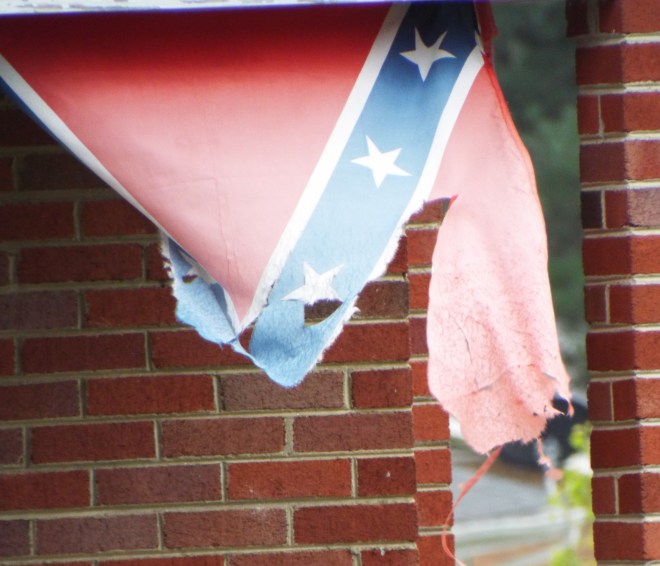
Saw a confederate flag
on display today
hanging on someone’s porch banister—
sinister.

That’s how they always seem to me:
menacing, taunting, ominous;
synonymous
with hate and fear,

jeering at me.
Obtrusive, abusive.
But something was different here—
torn, worn, shredded, frayed.

A charade, I thought.
A symbol perhaps unintended,
decreeing in its degenerate state
that it’s time to stop.

Swap your misplaced anger.
Anchor your feelings in love instead.
Spread the word: its time is over.
Done.

Spring Has Sprung!

In this yet another crazy weather year, the entire month of February was one cruel joke: such sunny, springlike weather that some of the wildflowers began to bloom. It gave us a too-early taste of the beauty and hope of spring. And then, winter returned—with a vengeance. It must have decided it liked it here because it stayed and stayed. Those heavy winter coats we wanted to put away back in February were called into frequent action all through April.

I wondered if spring would ever come. Seriously, I began to have my doubts. Back in April, my Facebook memories taunted me. There I was with a healthy handful of asparagus in early April a few years ago. This year, though, not the tiniest hint of an asparagus spear more than a full month later. Next, a three-year-old memory popped up showing our big rhododendron bursting with beautiful clusters of pink. That was a few weeks ago. Meanwhile, our rhodie remained bereft of color.

Finally, of course, spring did decide to emerge, and when it did it came on like a house afire. Pretty, white trillium flowers began dotting our forest landscape. One day the ground broke in a couple of spots in our asparagus bed. The next, we were deluged with asparagus. (I am not complaining.) We hadn’t been able to get our early crops planted as early as usual this year. It was either too cold or too wet. When we did have a decent break in the weather, our schedules demanded something else of our time.

Now we’re making up for it. We took to the garden on the first clear day of May. We may have gotten a little ahead of ourselves—our last average frost date is May 25th, but the long-range forecasts look so hopeful we’re taking a chance. We’ve forced ourselves to hold off on the things that demand more heat, but we couldn’t wait to get most everything else in the ground, even those seeds that say not to plant until there’s no more danger of frost. At this point, I’m okay with replanting if some of our seedlings get zapped by a late frost. It just felt too good to get out there and get dirt under my fingernails.

So far, we’ve planted onions, spinach, radishes, carrots, parsnips, rutabaga, kohlrabi, cucamelon, shelling and snow peas, runner beans, potatoes (purple and yellow), yellow squash, zucchini, lots of herbs, cabbage, broccoli, eggplant, beets, and more, as well as new raspberries, blueberries, and blackberries. Still to come: Christmas limas, scarlet runners, tomatoes, green beans, okra, and cukes.

Here are a few photos of long-awaited growing things—both wild and from the garden.

We’re eating asparagus everything these days!

DSCF1898

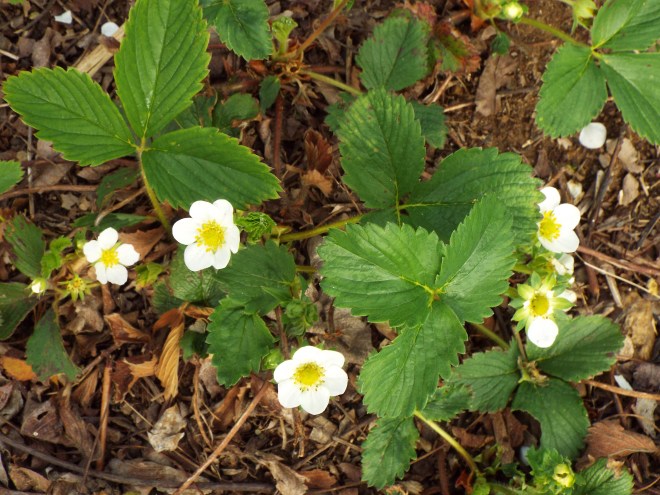
Lots of strawberry blossoms—yum!

DSCF1911

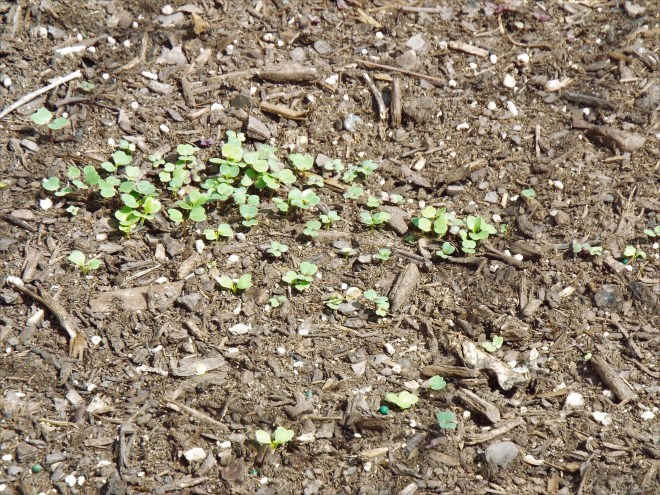
The peas are up.

So are our salad greens—already they need thinning. Fine by me.

We’re giving Jerusalem artichokes a try this year, safe and secure in their own little bed so they don’t take over the whole garden.

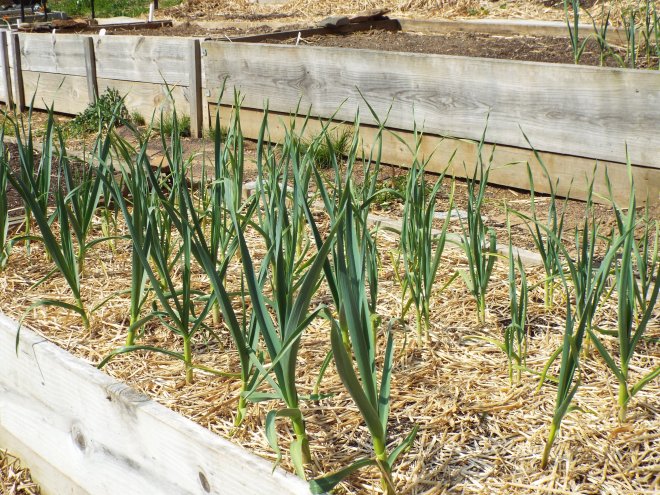
Garlic is so special—plant it in the fall and forget it. It’s the first thing to appear in spring.

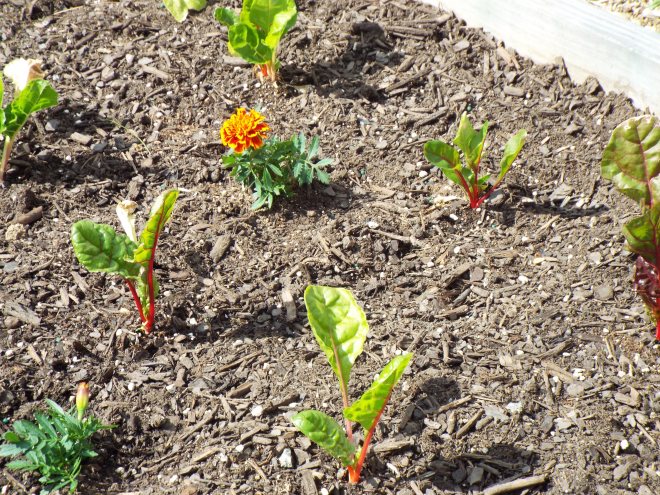
Bright Lights chard with stems in beautiful rainbow hues, interplanted with marigolds for even more color

Edible wildflowers–what a gift! Violets (sugared, for jelly, or in salads); wild mustard flowers and leaves add color and tang to salads; star chickweed is another salad option; mayflowers grow a sort of apple-like fruit that can be used in pies—assuming you can get to them before the deer. We never have.


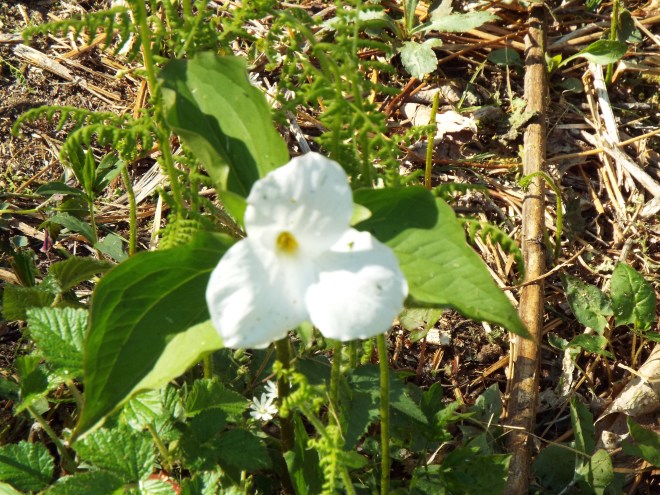
Trillium—they have three of everything, it seems. And they’re all over the place right now.


Showy columbine