This Wild and Precious Life

My Wednesday Writing Group is now meeting via email since we are sheltering in place. Our fearless leader’s recent prompt forced me into some deep soul searching. I didn’t know where this piece was going when I picked up my pen, but it turned into something meaningful for me, so meaningful that I’m opening myself up to you now.

Tell me, what is it you plan to do with your one wild and precious life?

Naturalized daffodils in the woods

I remember when our children were young and complained about not having enough time to do the things that really mattered. My go-to response was to remind them that however they spent their time was a demonstration of what truly mattered the most to them (which was often watching TV). Sometimes the response was tears, sometimes an eye roll or two, but it never seemed to change behavior. Maybe that’s because I was better at preaching than practicing. I was chiding myself every bit as much as I was chiding them.

I live in constant awe and envy of many women whose orbit I circle: women who travel to far off places to do good, putting themselves in who-knows-how-much of harm’s way, risking their health and safety. They give their time, their creativity, and their financial resources to help others. They think of others before themselves.

Like theirs, my heart aches for the plight of so many in this world, but that is often as much as I allow. I’m filled with compassion more than passion. I am not moved to activism. A lifetime ago it was different, but I burned my candle down to a nub. I got burned and burned out, and the flame has never reignited.

Still, I find myself looking around me and wondering how I can help, how I can make a difference. I looked close to home—it’s not an easy place to find an answer. I’m surrounded by an enclave of family—theirs, not mine. Much of what they do, all four generations of them, they do together: farming, canning, eating, errands, playing. They are self-contained; they take care of each other. They do not seem to need others, even in times of need.

“Where am I needed? What can I do?”

That was the question I asked myself when one of the older generation among these neighbors received a devastating cancer diagnosis. They certainly didn’t need me to bring food or offer trips to the doctor. I had just recently retired from my far more than  full-time job when it came to me—the one thing I now had that family members did not.

Time. I could visit. While their children and grandchildren and great-grandchildren are off at work and school, I could give my time.

I had my answer.

At this stage in my own life, it seems the things I have to offer are the small things. A smile, a word of encouragement, a thank you or a compliment. They are indeed small things, but as I look around, they are things the world seems much in need of right now. These things I can do, and I have learned to be on the alert. Not always, not enough, but so much more than when I was so overworked and overwhelmed that I seemed only to live inside myself.

These days I actively watch for opportunities to smile, to make a small gesture. “Is there something I can get for you from that top shelf?” to the older gentleman in his electric shopping cart. “May I help with that?” to the woman struggling to get her arm into the coat sleeve.

I step out of my comfort zone to say something pleasant to a person who seems vulnerable. It’s an indirect way of saying, “You’re not alone. Here is a safe place.” Sometimes I just watch. How is this clerk from Pakistan being treated by her customers? How are those Latino customers being treated by that cashier? I’m ready to step in, though I have no idea how.

I’ve also learned that things I think and say and write can occasionally make a difference. It’s the main reason I continue to write—in hopes that I will sometimes find some combination of words that will touch someone.

In these ever more uncertain times, I believe it is more important than it ever has been—in my lifetime, at least—to look for the small ways I can help improve someone else’s day. Maybe it’s an extra large tip when my server is having a tough time. Maybe it’s a conversation with the overworked cashier at the big box store. Maybe it’s popping a check in the mail to make up for the appointments I’ll miss with my hairdresser for the current stage of the coronavirus shutdown—with a little something extra added in. Maybe it’s looking for a sliver of silver lining someone’s clouds.

What do I plan to do with my one wild and precious life? I plan to plant a little ray of sunshine wherever I can. Carrie Newcomer sings, “Between here now and forever is so precious little time.” With my precious little time I will seek out tiny acts of kindness to perform, following Mother Teresa’s counsel to do small things with great love.

The Summer Day

Who made the world?
Who made the swan, and the black bear?
Who made the grasshopper?
This grasshopper, I mean-
the one who has flung herself out of the grass,
the one who is eating sugar out of my hand,
who is moving her jaws back and forth instead of up and down-
who is gazing around with her enormous and complicated eyes.
Now she lifts her pale forearms and thoroughly washes her face.
Now she snaps her wings open, and floats away.
I don’t know exactly what a prayer is.
I do know how to pay attention, how to fall down
into the grass, how to kneel down in the grass,
how to be idle and blessed, how to stroll through the fields,
which is what I have been doing all day.
Tell me, what else should I have done?
Doesn’t everything die at last, and too soon?
Tell me, what is it you plan to do
with your one wild and precious life?

–Mary Oliver from New and Selected Poems, 1992
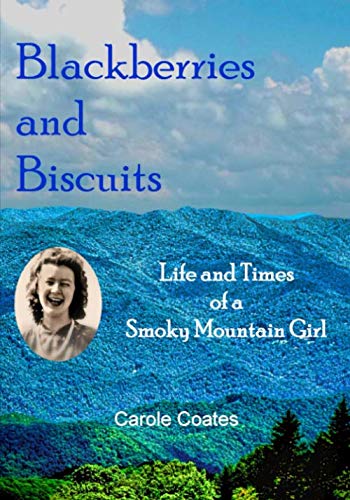


Blackberries and Biscuits: A Review

OK, I’m all puffed up with pride and just can’t help it.

I recently received a lovely, validating  note in the mail from someone who had just finished reading Blackberries and Biscuits. She enclosed a review because, as she said, “I truly believe it deserves literary attention and acclaim.” Wow!

Mind you, we are friends and writing colleagues, but her note and review were completely unsolicited, so I accept that her words are totally from the heart. They made my heart sing, and I’ve just gotta share them with you!

By the way, if you’ve read Blackberries and Biscuits, maybe you’d like to leave a review on Amazon–I’d sure appreciate it. Reviews are important in helping customers make buying decisions.

Review: Blackberries and Biscuits: Life and Times of a Smoky Mountain Girl 

This is a love story that spans multiple generations. By love I mean love of a family through deep kindred roots as well as love between a man and woman that intertwines those kindred roots into a captivating story that stands the test of time. Carole Coates has woven a work of words into a personal, up-close exploration of her own family tree. The family tree branches she shares with her readers surpass common features such as names, birth places and tidbits of local color. Coates’ words dig much deeper than that into the grit, hardship, hunger and belief in faith that make a person stronger. Makes them more resilient and committed to the tasks they set out to achieve. Not the least of these strengths is a true appreciation of humor. Oh yes … humor that makes you smile, giggle and grin.

Taking place on the fringes of Tennessee in the Great Smoky Mountains of North Carolina, the life story of Pansy (Pam) Dillard Coates unfolds through an historical sketch of a Daddy, granddaddies, great granddaddies; Mother, grandmothers, great grandmothers; sisters, brothers, cousins and friends. Photos skillfully arranged throughout this novel strengthen the visual image of this family while also providing a micro-cosmic portrayal of a life growing up in the Appalachian mountains – a life, though often hard, that was also rewarding and beautiful.

Kudos to Coates for taking extensive time to research many aspects of this story. She artfully piques the reader’s interest in a time span of history that so few may have encountered or envisioned. She thoughtfully accomplishes what it appears she has set out to do. To engage the reader in reminiscing about family, close ties, anecdotal happenings and the precious sense of timeless love. Truly, Coates has achieved her goal of writing a beautiful, everlasting love story.

Amy C. Millette
Vilas, NC
January 31, 2020

Thanks, Amy! And, in case that isn’t enough shameless self-promotion for one day, if Amy’s review inspires you to read my book, you can find it here.


Playing with Words

On several occasions, I have had the delightful fortune of participating in a weekend writing workshop led by a treasure of a writer, teacher, and human being. It is a gift to be in Katerina’s presence, though some of her writing assignments do manage to elicit groans.

In Katerina’s workshop, you can be sure to find one particular exercise. On a flip chart, she provides a list of fifteen or so words with the guidance to write a piece including as many of them as possible. Some of the words are challenging in their own right; to attempt putting them together in any sort of coherent structure is daunting, especially with a brief time limit. The exercise is always good for a laugh.

These were the words we were assigned to incorporate into our writing in the most recent workshop I attended. (Don’t be embarrassed if you have to look up one or two—most of the writers did, as well.)

conjecture     contusion     kleptocrat     polyglot    polymath     cogitate    divulge         strangulate     imminent     eminent     vicissitudes
salubrious     sallow      phlegmatic     congenial      syncope

I decided to have a little fun with this one. Never mind that it will never win any awards—I was happy enough to get in all the words in our limited time. Here’s the result.

* * * * *

A polymath, polyglot, and kleptomaniac walked into a bar [drumroll, please], one vaping; another striking a match to light a bent pipe, a habit she claimed was salubrious; while the third was flicking a lighter for no apparent reason.

The phlegmatic barkeep was congenial but dubious as he cogitated on this odd threesome. One too smart for her own britches, one able to speak every language except street talk, the third a crook of the lowest order. What were they up to?

The imminent arrival of the eminent polygamist physician made the mixologist nervous as he conjectured what might happen once his sallow pyromaniac assistant, who was suspicious of the doc and despised elitists of all stripes, returned from the storeroom.

His anxiety was not unfounded, though the brawl that ensued was not the outcome he had feared. The arrival of the MD, however, turned out to be opportune.

It was later divulged that the polymath’s contusion resulted from a fall precipitated by her syncope rather than by the strangulation prompted by her smart mouth.

Such are the vicissitudes of life.


(Image attribution: “dictionary” by stockcatalog is licensed under CC BY 2.0 )

Finding Moments of Joy

Last spring, I heard a writer friend mention the happiness journal—365 days of happiness. I was taken with the concept, but it didn’t quite fit for me. I landed on something similar, but in some ways dramatically different when I began recording one single event each day that I could claim as a personal Moment of Joy (MoJ). I mentioned my Moment of Joy journal here.

I wasn’t looking for things that simply gave me satisfaction or created an exhale of relief. Instead, I wanted to make note of those unexpected moments that take my breath away, that make me want to say to anyone who can hear, “Hey, look at that!” I vowed to exempt personal relationships and everyday happinesses when I recorded a Moment of Joy. Writing that I was happy to wake up next to the GNOME, for instance, could become a cop out and a crutch. Too easy. I’m always happy to wake up next to him. I wanted to become more aware of the little things that are too easy to miss.

I admit I’ve ended a few days scratching my head as I prepared to document an MoJ. Some days are like that. But I’m happy to report that for the most part, I have trouble narrowing down my MoJ experiences to just one or two to record. I’ve been surprised how easy it is to find them. The Gnome’s gotten in on the act, too. We see a rainbow and he says, “That could be your moment of joy today.”

A few months ago, I thought I’d stop keeping an MoJ list. I was practically stumbling over all the moments of joy around me (not a bad thing); maybe I didn’t need a list. But as fall slowly morphed into winter, I changed my mind. I’ve written before about the emotional challenge that the often overcast, always-short-day season can be for me. Of all times to be on intentional alert for moments of joy, this is it.

I’m glad I kept at it. Being attuned to joyful moments after day upon day of gray fog is so good for the soul. As I write this, I glance up every few moments to watch snowflakes lazily drift through the air. Yesterday, all it took was a look outside to notice the heart-stoppingly beautiful scenery with snow on the ground and hoar frost adding its own touch of brilliance to the mountaintops and the tips of branches. The male cardinal wears an especially bright coat of scarlet on days like that.

Last week, we spotted the brightest, biggest, most distinctly colored rainbow I think I’ve ever seen. And when we looked more closely, we could spot an ever-so-faint second rainbow above it. What a WOW moment!

When the world is as naked as it is in winter, I look for subtleties: the patterns and hues of lichen on trees, the grain of tree bark. Winter is the time for noticing the delicate shades of dried grasses in fields and meadows, ranging from sand to bronze to deep burgundy.

My Moments of Joy have ranged from getting an unexpected phone call to listening to wind gusts, from spotting a dandelion puff in winter to discovering a tidbit of information to make an otherwise mundane essay sing, from a stranger’s kindness to seeing five deer standing just outside the window or catching the scent of winter-blooming narcissus.

Being on the lookout for each day’s Moment of Joy quickly became a habit, an almost unconscious one. And that’s the way it should be—being so in the moment and so intuitively aware of the world around me that I never have to be reminded of the many things to be thankful for, of the beauty and potential for joy that surrounds me. Besides, the very best Moments of Joy are those that come unbidden, catching me off guard, sweeping off my feet.

“Hey, look at that!”


Resolutions, Habits, and Intention

I can’t remember the last time I made a New Year’s resolution. Certainly not after young adulthood.

Before that, making a long list of things I would change about myself as each new year rolled in was an act I never questioned. But then it came to me. Resolutions rarely accomplish anything—unless it’s to make you feel bad about yourself. If you were like me, you tended to think of resolutions in terms of negatives, things you’d been doing wrong or at least were not doing right.

I made resolutions the wrong way, too: broad generalizations which couldn’t be quantified and which, even if they could, were usually impossible to live up to. New Year’s resolutions were downright disheartening. They emanated from guilt and were generally doomed to create even more.

So, no New Year’s resolutions for me.

But as we rang in 2020, I realized that 2019 had taught me something immensely important. Not about resolutions, but habits. Resolutions are so often built around breaking bad ones. Hard to do. What about building good habits instead? Practically by accident, I developed several new habits—all good—in 2019. Along the way, I discovered good habits are as easy to form as bad ones.

I feel like a genius!

A couple of my habits have taken the form of lists. I began 2019 by listing EACH BOOK I COMPLETED, mostly out of curiosity. How much was I actually reading?. Before I knew it, recording my reading became second nature. Keeping a log of one’s reading material may be kind of neutral as habits go, but I count this list-keeping as a positive, if only because I stuck to it. But there is more to it. My list gives me information to feed on. It helps me remember what I’ve read and reminds me what I want to follow up on. It helps me clarify what I like and why I like it so I can make more informed reading choices in the future. It’s a reference point for issues to develop in my writing, philosophy, and more.

About midway through the year, I began a Moment of Joy (MOJ) journal. I’ll write more about that in a future post. For now, suffice it to say that what began as a whim became a habit, almost overnight—to someone who with a lifelong ineptitude when it comes to keeping any sort of diary or journal. My MOJ journal became something bigger. Unintentionally, it became a practice in intention.

I formed another intentional habit quite unintentionally when I read Mary Pipher’s Women Rowing North. She wrote about a spiritual retreat where participants were instructed to chew each bite of food, even their breakfast porridge, thirty times. Was that even possible? I had to give it a try.

It felt a little silly at first, counting every time my teeth met. But as I learned it was possible to chew one type of food thirty times, I wanted to test another. And again, without realizing it, I had developed a new habit. I began to catch myself, just below my consciousness, counting. My mind was at work building an intention, slowly ticking off the chews: twenty-seven . . . twenty-eight . . . twenty-nine . . . thirty. And sometimes up to forty or more. I was no longer chewing for the counting. Counting became a means—a pleasant way to be more intentional about the process of eating.

Not only can thirty chews per bite be done (usually); it has tremendous emotional and physical benefits. I stopped choking on food, something that happens far too often, usually because I’m in a hurry or talking or trying to multitask as I eat. Other digestive problems began to lessen or disappear altogether. I found myself more tranquil, more aware of my surroundings. It turns out that chewing each bite thirty or so times is intensely calming and refreshing. What I took on as a one-time challenge became another intention, one with far-reaching results.

Well, the new year is here and I’ve begun yet another project. This gal never before succeeded in developing a journaling habit just gave herself a five-year, line-a-day journal. It’s really more like four or five lines a day. Three hundred and sixty-seven pages, each with space for five years’ worth of notes for every date on the calendar. I’m hopeful that the constraints of this journal will help me stay on track, especially since I’m incorporating my MOJs into each day’s notekeeping. In 2025 I can, at a mere glance, look back on five years’ worth of entries for any given date for the last half decade. I think the comparison will be fascinating.

Now that I think about it, it’s a huge statement of optimism for a septuagenarian to purchase a blank book in anticipation of adding to it for 1800 days. That’s a pretty hopeful intention itself.

I’ve even started a weather diary–another five-year project.

What I learned during the past year has changed me. I’m learning to think more intentionally about lots of things—to BE more intentional. That will surely lead to more good habits, easy to keep.

Who needs resolutions?

Looking for Gift Ideas?

Have you heard about my newest book, Blackberries and Biscuits? It’s all about my mom’s life and times growing up in the Smokies of western North Carolina during the years of the Great Depression–and afterwards, too.  Here’s the opening scene:

Not again!” she snapped. Until this moment, it had been a perfect morning. But when she turned on the tap to fill the coffee pot, nothing. Dadgum it! Preparing a hearty breakfast before seeing Braxton off to work was one of the many ways she strove to be the best wife she could possibly be. This thing with the water was getting to be a nuisance. All she asked of the Harwell boy was that he wait a measly half-hour to divert the water supply from the house to the cattle trough so Brack could get a pre-workday shower and she could fix his breakfast.

Today was one time too many. In a flash of huff, she trounced across the kitchen, slammed the screen door behind her, stomped across the sandy back yard in her pink and blue flowered pajamas, climbed over the barbed wire fence into the neighbors’ pasture, and turned off the cattle trough faucet with a sharp wrist twist.

She marched triumphantly back to the kitchen, still mad, but smug. Today there would be coffee.

Who is this woman?

Her name is Pansy (Pam) Dillard Coates, and I know this true-life episode because the four-year-old version of me was in the kitchen when it happened. Surely, the only reason this long-ago moment stands so clearly in my memory is that such a display of temper was so unlike the quiet, gentle woman I knew as my mother.

That woman would never snap, never slam, and never, ever leave the house in her pajamas.

At the time, our young family of four was living in Mars Bluff, South Carolina, about eight miles east of Florence where Daddy worked. My parents rented an old farmhouse from the Harwells who lived next door in “one of the finest examples of Greek Revival antebellum architecture in South Carolina.”

Built in 1857, the plantation house had been in the possession of Mrs. Harwell’s mother since 1902 and remains in the family today. Even I knew it was pretty impressive, encircled as it was with twenty-two Doric columns. Not that I knew to call them that.

By contrast, our small, wood frame house stood atop brick pillars, the open space under the house intended to keep things cooler in hot southern summers. A wide screened porch ran all the way across the front. In my recollection, a hall sliced the house’s length from front door to back with a living room, bedroom, tiny den (most of which was filled with an oil heater), and a kitchen on the left side and a couple of bedrooms and a bathroom along the right. The cavernous bathroom had a floor of hardwood, dark and shiny. Surely it was originally another bedroom, repurposed when indoor plumbing came along.

Perhaps the nearby presence of The Columns, as the Harwell home was known, made our house look shabby to the lady who came calling one day to welcome us to Florence’s First Baptist Church. Mother did not like the overwhelming sense that this matron “felt sorry for us,” maybe even looked down on us. It was a slight she found hard to forget, though they worked side by side at church functions for decades.

But our home wasn’t nearly as pathetic as the unpainted two-room shanty occupied by a sharecropping couple. On occasion, I walked across the farm fields to visit them. It was a tiny space, even by a four-year-old’s standards. To enter, I walked into a small area designated as the kitchen. There was room for a rough-sawn countertop on one side of the ill-fitting door and a wood-fired cookstove and old-fashioned icebox—I’d never seen one of those before—on the other. An open doorway led into their combination living-bedroom. The place was dismally spare. I wouldn’t be surprised if it had once been slave quarters.

At least our house had electricity. And running water—sometimes.

There are plenty of old photos in Blackberries and Biscuits–more than 100! This one shows Mom with me and my brother Alan on Easter Sunday when our family lived in Mars Bluff.

It’s not too late to order a copy of Blackberries and Biscuits for someone on your holiday gift list–or even as a treat for yourself. You can find it here. (Tip: If you’re local, I’ve got a deal for you—just give me a buzz or pm me on FB.)

Thanks Giving

“What is the best moment of your day?” she asked.

That turned out to be a question I couldn’t answer directly. Let me put it this way.

The best moment of my day is . . .

when a sun’s ray beams onto my face, wakes me, and bird songs welcome the day;

when I eat a breakfast of eggs from the happy chickens who live just down the road;

when the cacophonous chatter of crows having their morning “coffee klatch” interrupts the still of my morning;

when I sip a cup of honeyed herbal tea as my mind loosely organizes my day;

when I check on the latest thing to pop up in the vegetable garden on a sunny summer morning—or later in the season, when I harvest what I’ll eat that day and preserve more for chilly winter nights;

when the comfort of a snuggle under the covers overtakes me upon waking in the morning and again as I fall asleep each night;

when a few hours of dedicated writing time come my way;

The best part of my day is . . .

when the all-day antics of squirrels and chipmunks capture my attention as they battle each other’s wits over food intended for birds;

when I take a twilight summer stroll listening to the quiet, watching the synchronicity of fireflies light up our woods, and catching whiffs of honeysuckle;

when I gaze at the star-studded sky on a clear, crisp wintry night and maybe catch a meteor streaking through the atmosphere;

when I spy mountaintops peeking through a sea of clouds;

when the nighttime call of an owl seeps into my consciousness;

when the early springtime sounds of wood frogs and peepers shatter the otherwise quiet of my bedroom—all night long;

when I’m graced with the giggles and confidences of grandchildren;

when the season’s first wild daisy shows itself in our meadow.

The best—and sweetest—moment of my day is a spontaneous embrace anywhere, anytime as my sweetheart and I sway ever so slightly—the way young lovers move to a slow dance at the prom—for no particular reason and for minutes on end.

With all these best moments, I’m reminded of these words from an old hymn: “How can I keep from singing?”

And I give thanks.


Blackberries and Biscuits

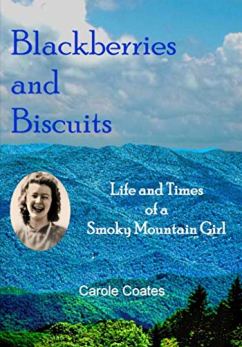
I couldn’t be more excited to share with you that my latest book has been published and is now available for purchase on Amazon. (You can find the reason for the title in Chapter Five.)

Isn’t the cover gorgeous?! The Gnome is responsible for that.

Here’s the Amazon description for Blackberries and Biscuits: Life and Times of a Smoky Mountain Girl (also known as my one-minute ‘elevator speech.’)

In this love story to her mom and the mountains she called home, Carole Coates gives the reader a glimpse into early twentieth century life in rural southwestern North Carolina where her mother was born and raised. The life journey of Pam Dillard Coates takes us through the Great Depression, the New Deal era, the Secret City of World War II, and on into the twenty-first century. The story follows her adventures as a farm girl, wife, war worker, mother, librarian, entrepreneur, and more. Part memoir, part genealogy, part history, Blackberries and Biscuits is a tale of childhood escapades, wartime secrecy, family life, and personal loss, but mostly love. The narrative weaves a tapestry of people, time, and place too rapidly disappearing from our cultural landscape.

Writing this story was a huge, multi-year project requiring lots of research, travel, and informational tooth-pulling. I loved (almost) every minute of it. I learned so many new things along the way, especially about my mother, but also about such disparate things as the Oleo Wars, the history of birth control in the US, half-dimes, and Civil War widows’ pensions. 

But I also felt a tremendous time pressure. Since this is a story about my mother and for my  mother, I really wanted her to be able to see it. And I’ve been promising it to her for so long she probably decided the whole thing was a hoax. Mother just celebrated her ninety-sixth birthday—so you can understand that there have been times I was frantic that I wouldn’t be able to make good on my promise.

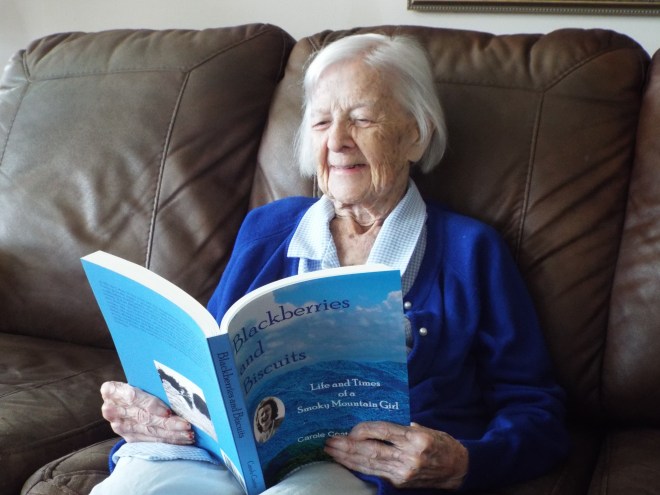
We surprise-delivered Mom’s copy to her last week—just as soon as the big box of beautiful books showed up on our doorstep. To say she was thrilled would be an understatement. Her first words on seeing the book? “Okay, y’all can go home now. I have reading to do.”

Mom’s first look at ‘her’ book.

I am one very happy camper.

I would be thrilled if you choose to read it. While my purpose was to present a very personal gift to Mother and to preserve her story for our family members, it became much more than that, encompassing important historical periods in our nation’s history from a personal standpoint.

The Gnome has spent a couple of very dedicated weeks working on an e-book version, which, because of all the photographs (it’s chock full of pictures) and other formatting issues, took a whole lot longer than we’d imagined. But it, too, is finally available on Amazon. I strongly recommend the print version precisely because of the photos—they’re a big part of the story and the electronic layout just don’t quite do justice to them. But for those with vision problems or who are really into e-reading or who prefer saving a few bucks (hey, I totally get that), by all means go for the e-book. (By the way, the two versions aren’t yet linked on Amazon, so they don’t show up together, but if you do a search for the title, you should see one below the other in a list.)

Now, time for me to take a really deep, long breath. Except for blogging and a small genealogy writing project I’ve also been working on for a while, I plan to take a little writing break. I’ve got a couple of years’ worth of dusting to catch up on!

File:Celebration of Light Brazil 2012 20.JPG - Wikimedia Commons

Family History as a Civics Lesson

Once upon a time, I thought it was decidedly macabre for people to wander around cemeteries randomly looking for names on tombstones. Then I turned into one of them—long before I qualified as the kind of person (OLD) who seemed most fascinated by this hobby. 

The Gnome and I found ourselves immersed in genealogy in our earliest forties. At first, it was nothing more than wanting to find the names and origins of our ancestors, but it quickly became so much more. I wanted to know about these people who came before me. And the more I learned, the more I wanted to know: who they were, what they did, how they ended up where they were, what their world looked like. I wanted to round out their stories.

That’s when I realized that, at least for the intellectually curious, one’s family history is really a massive civics and history lesson.

Do you know how roads in the United States were maintained in the early days? If not for genealogy, I wouldn’t. Each locality required all ‘able-bodied’ men to spend a designated number of days on road work. Imagine that today. Fines—maybe worse—were imposed on shirkers. I suspect most of us are happier paying a fuel tax than putting aside our normal work to build roads on demand with pickaxes and shovels in hand. I understand the quality of those roads was somewhat (!) unreliable. It was a serendipitous lesson to discover that history because it helped me understand the nature and evolution of mutual responsibility for public works.

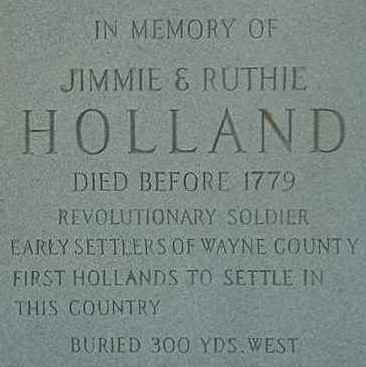
As for my own story, I lucked out when I came upon the account of a pair of ancestors, Jimmie and Jerutha Holland, written by Nellie Holland Russell for her pre-teen nephews. The somewhat fictionalized version of these early Scots-Irish settlers nonetheless told me how desperate things were in the ‘old country,’ how dangerous it was for two teenagers to cross the Atlantic on a rickety boat (‘ship’ is much too generous a word), how their vessel turned out to be run by pirates, how their naiveté in a strange land made them easy marks. In short, it told me I’m darned lucky to be here today.

This historical marker in Wayne County, NC, celebrates my fourth-great-grandparents. Who knew?

Surely it was much the same for millions more immigrants whenever and however they made their own journeys. It’s a piece of our collective history we would all do well to understand.

As the Gnome and I became more involved in learning about our family histories, we found ourselves engrossed in their times. I have precious few details about a great-grandfather and another great-great grandfather who fought in the Civil War. When I came across a book of letters from Confederate soldiers to their families back home, I wildly hoped I’d luck across one signed by one of my ancestors.


My great-great-grandfather, John Holden, and my great-grandfather William Holland Thomas Dillard were soldiers in the US Civil War.

Of course, I didn’t, but that didn’t make the stories any less compelling—stories of boredom mingled with bloody horror, near starvation, worry about a son or other family member in another unit, prison conditions, anxiety about the women and children back home. In that moment, it didn’t matter whose signature was on a letter or which side of the conflict he was on. I suspect the story was much the same for every soldier.

I read about soldiers returning home to western North Carolina from the prison in Petersburg, Virginia, after the war had ended. I pictured what it would have been like to be in their shoes. Or their bare feet, for some were without shoes. My grandpas weren’t part of that group, but reading about the odyssey told me a lot about how it must feel to return home after war, defeated, carrying the wounded, hungry, walking most of the several hundred miles to reach home, not knowing what one will find upon arriving. Seeing the desolation along the way. No parades, no hordes cheering from the roadsides.

It’s a story that’s been repeated through the ages and still is today in too many corners of the world. Looking through this lens, without the judgment of who’s right or wrong, but simply seeing the human heart, gives a person new perspective.

When I traveled to the heritage center in my dad’s hometown, I was hoping to learn more about my grandparents. What was education all about then? Why did Granddaddy only go to school through the seventh grade? He was eighteen when he finished, and within days he married his teacher, only a few months older than he. What a treat when the center’s director pulled out an old survey which included my great-grandparents’ farm. A little square on the edge of their property designated a school. They donated that bit of land to the county. It’s where Granddaddy went to school and most likely where he met my grandmother. With that tidbit of new knowledge. I felt closer to them.

I learned that school wasn’t compulsory, that children who did attend often started at age eight.

In those days, a three-person committee ran each school independently. In some cases, when they needed money to build a new school house, rather than raising taxes as the committee had the authority to do, they chose instead to close the school for a year and divert the teacher’s salary to purchase building materials. Hmm—no wonder a person didn’t finish seventh grade at age twelve.

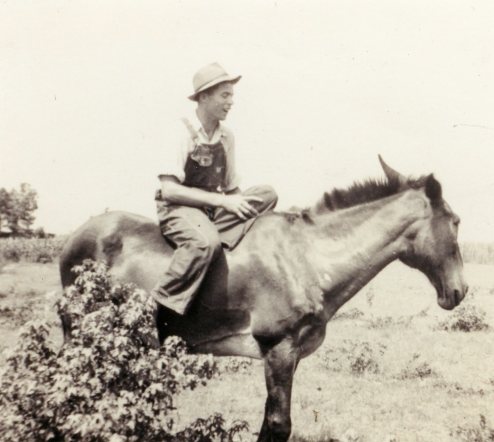
I was in my small, local public library browsing some North Carolina history books when I came upon a small volume about tobacco-growing in the state. My dad’s father was a tobacco farmer. Working in tobacco—and cotton—was how Daddy and his brothers grew up. Maybe I’d find something useful in the pages of my book discovery. I did, but not what I was expecting. There was something about mules—how important they were to farm life in earlier days—so important they were considered part of the family. I asked my Uncle Edwin about that. “Noooo! They were never part of the family. I’d chop cotton [one of the most dreaded farm chores] before I’d plow a mule!” Now, that told me something about my dad’s life growing up. And I never would have known it if the only place I’d searched was the genealogy shelf. 

Daddy’s relationships with the family mules were as varied as their personalities. Rhodie was one of his favorites.

Random gleanings from random places. And each one a jewel that deepens my understanding. Our human story is so much more than the bare bones of begats. It’s a broader story, a deeply-textured one. Everyone’s story is different. Whatever yours is, if you let your curiosity guide you, it will teach you civics and history which will inform your knowledge about the world around you, give you an appreciation for where we are now as a society and what our forebears lived through to get us here. You might even discover a new passion.

Because there is a story to tell. You just have to find it.

Failures and Fiascos

“No true fiasco ever began as a quest for mere adequacy.”  —Drew Baylor, Elizabethtown

I fell in love with this quote the second I heard it. It really resonated with everything going on in my life at the time. Fictional Drew Baylor became my hero.

Drew also said, “Failure is simply the non-presence of success. But a fiasco is a disaster of mythic proportions.”

Thomas Edison put it a different way. “I have not failed. I’ve just found 10,000 ways that won’t work.”

Bob Ross, the afro’d artist of PBS fame, was known to say that when it comes to painting, “We don’t make mistakes; we just have happy accidents.”

The varied nuances in these quotes take me down somewhat different mental paths. I have had failures, and I have experienced fiascoes. For the most part, I point to my years working in the public sector for both. Usually, debacles led me towards alternative paths that worked out just as well and occasionally better, even if it was after a good bit of fretting, fuming, bawling, and varying degrees of depression. I just had to keep an open mind, look for more workable solutions, and refuse to give up.

Failure can indeed open doors, at least for a person who is imaginative and alert to possibilities.

But it’s true there’s a difference between failure and fiasco. Failure doesn’t necessarily imply significance. You can fail to set the alarm clock. You can fail at making the perfect piece of toast. The world will not end.

I’ve definitely experienced a fiasco or two, especially in my career. The world didn’t end then, either, though there were times I thought it would. Mine, anyway. Inevitably, those fiascoes resulted from experiments to break molds, push boundaries, explore the unexplored, be better. Such paths aren’t always popular in the cautious, slow-moving, don’t-rock-the-boat, if-it-ain’t-broke-don’t-fix-it world of the public sector.

Sometimes I was too eager to try the next big thing, assuming others would jump on my bandwagon. I failed to understand that a thing that was only my dream was destined for doom. I didn’t look for unintended consequences.

I didn’t imagine that they couldn’t imagine, or that they simply didn’t want to do the hard work. In my eagerness, I didn’t do my own hard work of laying groundwork, getting investment.

Sometimes, my ideas were just plain dumb! People were right not to dive in with me.

And on occasion, I made the very bad mistake of assuming people I thought of as mentors would stand behind me—or at least guide me. It was a painful lesson to learn otherwise.

As I look in my life’s rear view mirror, my career growing infinitely smaller behind me, I understand that it was always lofty goals which led to my efforts which in turn led to fiascoes. I’m proud of that. And painful as those moments may have been at the time, visible as some scars remain, I’m content in the knowledge that I wanted to make things better, that I knew how to dream.

Like Drew Baylor, I’d rather dream big and fail big than stumble along in mere adequacy.

Tip: watch this 2005 feel-good road trip movie (featuring Orlando Bloom, Kirsten Dunst, Susan Sarandon, Alec Baldwin, and Paula Deen). You’ll be glad you did.