Gender Bender (for Danielle)

What if humans . . .
were synchronous hermaphrodites
like earthworms
who, when two mate,
both become impregnated?

Now, that’s equality!

Or the banana slug,
able to mate with itself alone?
Uniparental reproduction
is what it’s called.

As much fun as with a partner?
More?
Simpler, for sure—
certain of being in the mood.

What if humans . . .
were parthenogenic
like the rock lizard?
Some turkeys do it, too—
going it alone
reproducing without fertilization,
making maleness irrelevant
for species survival,
making maleness obsolete?

If men were extraneous,
would we still
keep them around
just for the fun of it?

What if humans . . .
were like the blanket octopus,
she a hundred times his size
and he, wanting to mate,
breaks off his penis
and gives it to her
for keeps?

The ultimate romantic gesture?

What if humans . . .
were like seahorses
where the male
is the one
who gives birth?

Would we have any reproductive laws?

What if humans . . .
were like anemonefish
practicing dominance hierarchy?
Where the largest female rules
and upon her death
the favored male
gendermorphs to take her place,

where all develop
first as male; then mature
to female.

How would social conventions change?

What if humans . . .
were bidirectional
like hawkfish
able to change gender
at will
and back again
and again?

What would we learn
when we’ve lived both sides?
Where would we hang
our biases?

What if?

(First published in Branches Literary Journal in a slightly different form, 2017)

Hindsight

Hindsight

wrinkly skin thin as tissue paper
her shrunken skeleton icicle brittle
betraying
all her eighty-one years

yet between her thinning surface
and rickety bones
with all her hopes and imaginings
she is still eighteen

her blood flows just as warm
nerve fibers crackle
with the same electricity
as all those years ago

her brain just as alive
her soul just as eager
for adventure,
for love

in the mirror even her age reverses
whether on a slip of paper
or by visions reflected
from her cataract peepers

though now the dreams from long ago—
some realized, some not—
are the stuff of nostalgia
and sometimes bittersweet

for now she knows
some of those dreams
have lost their chance
to become real

and some
might better have been
unrealized
after all

what we wanted at eighteen
isn’t always what we’ll wish we’d had
when the years have vanished
before our rheumy eyes.


Some of Her Dreams

SOME OF HER DREAMS   


At eight
her sibs dubbed her the pet—
she got
most everything she wanted.

At sixteen
she was valedictorian
voted
most likely to succeed.

At twenty-one
a wife;
at twenty-three a mother,
succeeding at what she wanted most.

At thirty-two
she learned to drive
in a ’47 black Mercury.
It never came easy.

At forty-six
she wiggled under
Jamaica’s limbo stick
to wild native applause.

At fifty
with children gone
she retired as
first-to-rise breakfast chef.

At sixty
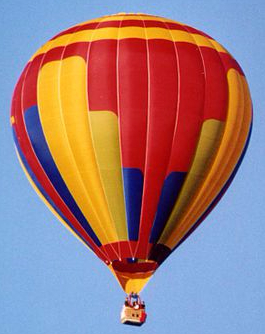
she floated
with the clouds
in a beautiful balloon.

At seventy-three
she rafted the Colorado,
her guide shouting all the way,
“We’re all gonna die!”

At eighty-one
after sixty happy marriage years
and a passel of children, grands, and greats,
she found herself a widowwoman.

At ninety
she’d fractured a hip
lost her license
and downsized

to a single room.
That’s when she said,
“Some of my dreams
will never come true.”

Carole Coates

Photo courtesy of Wikimedia Commons (No machine-readable source available)


The Gift that Wouldn’t Die

The Gift that Wouldn’t Die

What do hair curlers, a canary funeral, and a burn pile have in common? They’re all connected to a childhood Christmas present.

My grandmother—my amazing, funny, creative, exuberant grandmother—sent a replica of an oak sugar bucket for Christmas when I was eight years old.

It was the same year a black cocker spaniel puppy quietly sat in a basket under the tree, waiting to be discovered and fussed over. But Blackie wasn’t the first thing I spotted. The sugar bucket was—a small wood-stave bucket, slightly smaller at the top than the bottom, held in place by two circular wooden bands, one near the bottom and one near the top. It had a wooden lid and a curved handle for carrying. To make it uniquely hers, Grandmother had added decorative touches with crayon.

As was typical, her designs didn’t match. On the lid, in all the primary colors, was a depiction of a female Mexican hat dancer, while red apples and green leaves ringed the bucket’s bands. A strange combination.

That was sixty-three years ago. As unlikely a gift as a wooden bucket is for an eight-year-old, I still have it. It’s traveled with me through childhood, adolescence, and adulthood in all its stages. It’s traveled from South Carolina to Kentucky to North Carolina. It’s been with me through teen angst, first love, first heartbreak, college, marriage, motherhood, and empty nest. It has seen me through girly girlhood to feminist maturity. It’ was part of my greatest life adventure—moving to a strange place and hand-building our home.

My bucket played a role in the funeral of our canary, Gene, who died unexpectedly not long after that Christmas. I’d had no experience with human death at that time, but Gene’s was the second pet death in my life; it was hard on me. I gathered my brothers and neighbors in our backyard where we dug a small hole. I placed Gene in an aluminum-foil-lined shoe box, and we lowered him into the ground with a eulogy, a hymn, and tears. But I didn’t have a monument. So, to memorialize Gene’s life and death, I wrote the details—name, dates, and how beloved he was—on the underside of my bucket’s lid.

For the most part, my bucket was where I stored my hair curlers, curlers that changed over the years as hairstyles and curling techniques evolved. First, there were small-diameter metal rods with attached clips, rubberized on the closure end. Those were followed by spongy, pink, foam curlers with matching attached plastic clips. At some point, self-gripping velcro curlers filled my bucket, as did snap-ons.

When bouffant hairstyles became all the rage, my old curlers were replaced with large, brown, mesh cylinders, supported by wire spirals and held in place with bobby pins, which were in turn succeeded by similar mesh curlers that surrounded hard, stiff bristles to lock the hair in place. Plastic “pins” were stuck through the curlers to hold them in place. Those curlers were painful to sleep in, and if you didn’t curl and uncurl just right, those curlers grabbed your hair and wouldn’t let go. Even more painful.

The way we were–a typical late night dorm party


Probably the last curlers to make my bucket their home were the so-called magnetic curlers. They were made of hard plastic punched with holes for air circulation and came in various pastel shades and multiple sizes from half-inch to two or three inches in diameter. Those were the days of serious hair teasing, gels, and sprays. Again, bobby pins held the curlers to my head.

Primping for the prom


Then, electricity entered the world of home hair care. Heated hard plastic electric hair rollers with nubs to catch hair, steam curlers using a combination of hot water and salt to create some kind of molecular curling magic, and ultimately curling and flat irons took the place of loose curlers. A mish-mash of curlers sat unused in my bucket—just in case they needed to be called into service.

When a more natural look came into style, curlers of any sort were irrelevant to my life. My bucket no longer served a practical purpose. But it was a gift of love from a person dear to my heart, so I kept it, as I do so many things. It became part of our eclectic “decor,” if you will, wherever we lived.

A few years ago, the Gnome and I were on yet another of our simplifying kicks. (They come upon us every now and again, only to be replaced by some other collecting kick.) I decided the time had finally come to say goodbye to my sugar bucket. The rim of the lid was broken and the lid wouldn’t stay in place. The bucket’s bands kept slipping off, turning the whole thing into little more than a pile of sticks. I’d gotten tired of piecing it back together every time something bumped into it.

But it was a conflicted moment. I had to thrash out my mixed emotions with my husband, hoping he’d weigh in and give me justification for either keeping or throwing. He wisely left the decision entirely in my hands. I threw the bucket on our burn pile. Sixty years seemed plenty long enough to hold onto a childhood gift, regardless of its source.

Some time later, suffering from tosser’s remorse, I couldn’t take it anymore. Wracked with guilt, I had to check on my bucket. Even though it had sat through weeks of sun, rain, and snow, the bucket was somehow still intact, not much the worse for wear. I retrieved it.

The lid was too far gone for reincarnation so I bid a final farewell to Gene’s memorial. But the bucket is safely back inside, where it sits as a fine memorial of its own—a lidless monument to perseverance, to my ultimate inability to simplify, and to my inimitable grandmother.
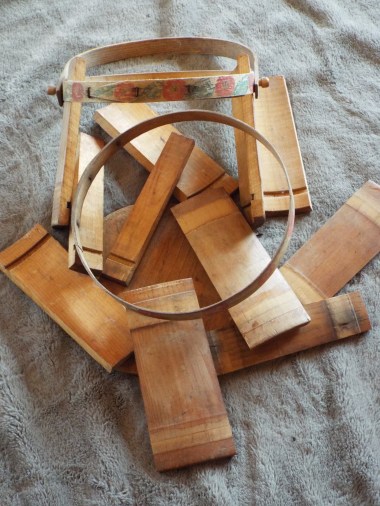
The sugar bucket in tatters
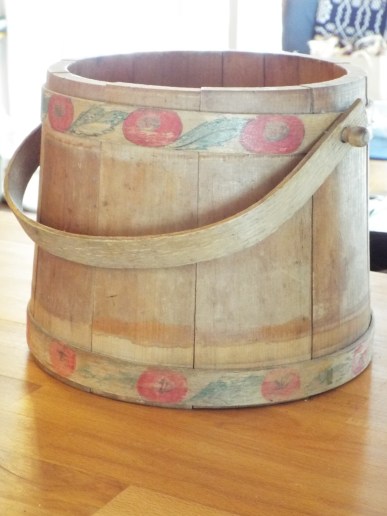
Reclaimed sugar bucket
 

Breakfast Traditions

BREAKFAST TRADITIONS (another in my Blowing on Embers series)

Breakfast: the most important meal of the day, they say.

Always the first one up in the mornings, Mother made sure we had a good breakfast to start our school days off right. In those days before frozen waffles, toaster pop-ups, or smoothies, breakfast was a pretty big deal. And we never rushed out of the house without it.

Our breakfasts were varied. There was that old standard: bacon, eggs, and toast or similar combinations of protein and carbohydrates. Sometimes we had oatmeal and cinnamon toast; other mornings it might be Cream of Wheat; occasionally pancakes or waffles were on the menu, though most likely on the weekends. And sometimes we went into the kitchen to nothing more than dry cereal and milk. I was never much fond of cereal days—those were the days when my stomach started growling by mid-morning.

By my calculation, while we children were living at home, Mother prepared nothing short of 10,000 breakfasts. When my youngest brother left the nest for good, Mother made an announcement to our father: she was retiring from breakfast duty. From that day forward, before he left for work, Daddy made his own breakfasts (willingly, I might add) before Mother gave a thought to getting out of bed. If not for the cat pawing at her face on the pillow every morning, Mother might have remained in bed for a sinfully, but well-deserved, long time.

But back to breakfast. In addition to all that typical morning fare, there were two dishes in our breakfast repertoire that were, I believe, unique.

One was reserved for one day and one day only each year—Christmas. No one was allowed in the living room where the tree and presents were until we’d all eaten breakfast, and that breakfast was always the same: strawberry shortcake. I loved strawberry shortcake as a dessert and thought it was even more special as Christmas breakfast. As I look back on it, I think there were two reasons we were served this delicacy on Christmas morning. The first, and maybe most important, was that it was quick and easy. For one day a year, Mother didn’t have to get up extra early to have breakfast on the table.

The second reason was perhaps a little more wily. What kid wouldn’t be thrilled to have dessert for breakfast? If we were just as eager (or almost) for breakfast as for presents, and if breakfast was just as much a part of our holiday tradition as the rest of that big day, then there wouldn’t be any peeking under the tree before the parents were ready. There wouldn’t be any whining (well, not much, anyway) for everyone to hurry up so we could finally open the door to the living room. Whatever the reason, that strawberry shortcake breakfast was always a success.

The other unusual breakfast we had on occasion had a regional basis. Mother grew up in the Great Smoky Mountains of southwestern North Carolina, a place where blackberries grow profusely on the mountainsides. Along with her mother and three sisters, she spent many afternoons picking blackberries, so many that they were able to can plenty of jars for use in the winter. And one of the ways blackberries were served in her home was stewed with a little sugar and poured over homemade buttered biscuits. It was a breakfast treat summer or winter.

Mother kept this breakfast tradition alive in our South Carolina home. We didn’t have access to fresh blackberries and frozen blackberries weren’t to be found in the freezer aisles in grocery stores, but stores did carry canned blackberries. Not the blackberries in gooey thick syrup for pies, but just plain old blackberries packed in water. All Mother had to do was put them in a pot on the stove, add a bit of sugar and a little more water, and heat them until the berries were warm and the sugar dissolved. In my opinion, there’s just nothing better than a plateful of biscuits, halved and buttered, smothered in blackberries, and swimming in that purple liquid. Mm-mmm good!

Needless to say, we’ve maintained both of these breakfast traditions in our home. And nothing has tickled me more than to discover that our now grown children have done the same in theirs. No doubt, one day some child in generations hence will look up to a parent and ask, “Why do we eat blackberries on biscuits?” or, “Why do we eat strawberry shortcake on Christmas morning?” and the parent will have no better answer than, “I don’t know. We just always have. It’s tradition.”

And that’s just fine with me.

A Holiday Gift for You: Winter Rain Surprise

Winter Rain Surprise

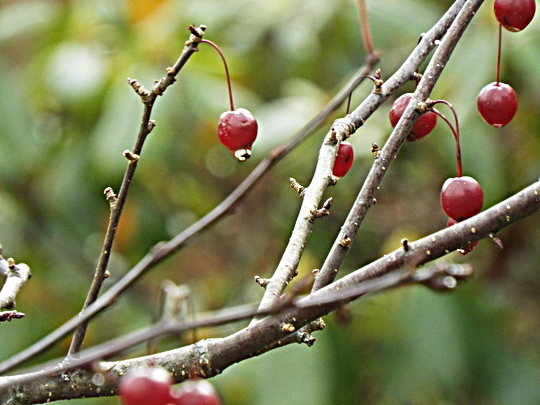
Morning rain
left droplets by the scores
hanging from branches
across today’s countryside.

The sun
peeks through cloudy skies
transforming water
into iridescent fairy lights
and tiny glass ornaments
to decorate all outdoors
for the holidays.

The List, Part III: The Bra and I

The List, Part III: The Bra and I

(If you’re just tuning in, you’ll want to catch up on Parts I and II of The List. You can find them here and here.)

Actually, I had written a hundred and one items on my hundred-things-I-want-to-do-when-I-retire list. One, though, was something I simply didn’t feel comfortable broadcasting to professional colleagues. Yet, if my list had been in priority order, this one item would have been at the very top. The number one thing I wanted to do when I retired was to take off my bra.

It was the number one thing I did, too. For a while. Then I remembered something Maya Angelou once said about her aging experience: “My breasts are in a race to see which one gets to my bellybutton first.” I’d seen that effect first hand at Asheville’s Go Topless Day, and I really didn’t want to speed things up for myself.

Funny thing about bras. Back in the sixth grade, we girls could barely wait to get our first bras, whether we needed them or not. (We didn’t.) We huddled together during recess whispering about them—who had one, who needed one, how embarrassing it would be wearing one to school for the first time. My two best friends and I coordinated our bra-buying plans so we’d arrive at school wearing our first bra on the same day. We reasoned we wouldn’t feel quite so conspicuous that way. Proud and conspiratorial, maybe, but inconspicuous.

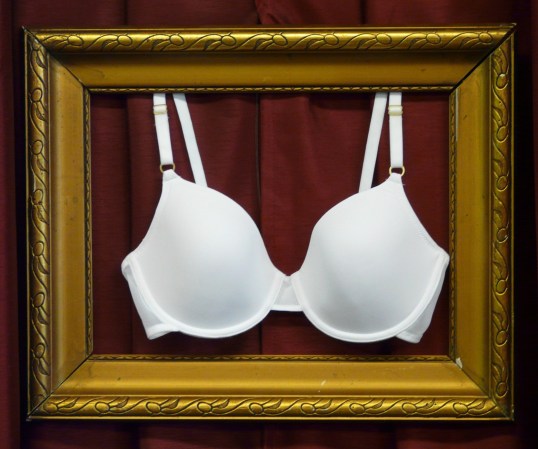
Pretty sure my first bra was this very style! (But smaller—much, much smaller) 


At a church youth retreat a few years later, my friend George said to a bunch of us girls that he couldn’t comprehend how we could bear to be so confined. He thought wearing a bra would feel incredibly constricting, like being in a straitjacket. We were a tad scandalized by his brazen discussion of such an intimate subject, but we tried not to show it. We assured him it wasn’t like that at all, that bras were perfectly comfortable. Frankly, we couldn’t imagine life without a bra.

It’s been a long time since I’ve been excited about a bra. The more I’ve needed one, the less comfortable I’ve been wearing one. George had it right, after all. Constricting is exactly the right word.

In the end, my bra and I came to a compromise. That is to say, I compromised. Pretty soon I started wearing my bra again. Still do. These days, I free my breasts from their bra prison a little earlier in the evenings, though, hoping my body doesn’t notice I’m cheating.

Bras—there’s the Double Support, the Sexy Plunge, the Elegant Lift, the Magic Lift, the Convertible, the Vacationer, the Glamorise, the Wonderwire. Seamed, seamless, lined, unlined, foam lined. Sheer, padded, molded. Strapless, t-strap, gel strap. Wirefree or underwire. Front closure, back closure, pullover. Leisure, sports, nursing, active lifestyle. Extra lift, minimizer, slimming, back smoothing. Push-up, shelf, bandeau, bustier, demi-cup, long line. Cotton, nylon, silk, microfiber, jersey knit, lace, satin.

The most common theme in bra advertising is comfort: original comfort, smooth comfort, pure comfort, moving comfort, 18-hour comfort, super cool comfort, comfort flex, comfort revolution, passion for comfort. HA!

I have a passion for comfort. It’s why I wanted to dispense with my bra in the first place. But gravity is a law. And I’m a law abider, so I’m sticking with my bra.

(Photo images in this post are public domain photos via Creative Commons.)

The List, Part II: Priorities

THE LIST, Part II: Priorities

(If you’re just tuning in, you’ll want to catch up. You can find Part I here.)

Right up near the top of my “One Hundred Things I Want to Do When I Retire” list was to make baskets. I had first learned how as a child from my maternal grandmother.

My grandmother: high school graduation photo

My grandparents, W. G. and Georgia Stillwell Dillard, on their fiftieth anniversary

Grandmother always had craft activities ready and waiting whenever we went for a visit, and she and I made baskets on more than one occasion. Basket making with Grandmother is one of my fondest memories.

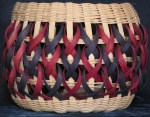
An early basket weaving exercise under Grandmother’s tutelage

But I’d long since forgotten that skill. When I saw an ad for a basket-making class as part of Appalachian State University’s Craft Enrichment Program about three years before I retired, I jumped at it.

In those days I regularly worked until seven or eight o’clock at night and too often as late as ten or eleven. I took work home on the weekends. I dreamed about work. I woke up in a 3:00 a.m. work-related panic almost nightly. My job involved overnight travel, too, sometimes a couple of trips a week. I hadn’t had time for just-for-me activities for years. But I wasn’t about to let anything interfere with my basket-making sessions. In three years of classes, I missed only one because of work.

Making baskets was good for my spirit; it relaxed me; it gave my overworked mind a break from all the work-related issues that were swirling around in it. I really loved making those baskets, and I was eager to delve into my newfound hobby in a big way once I retired. In anticipation of that day, I bought my own basket-making supplies and four big boxes of reed and other materials.

Just a few of the many baskets I made in my basket-making workshops

A few things happened to change all that. No studio space for making baskets magically appeared. Nor did our small house with its open design lend itself to leaving materials all over the place between sessions. Just pulling out all those boxes and supplies, then putting them all away and sweeping up the debris after a basket-making session was time-consuming, so much so that it was only worth doing if I was going to make a day of it. But a full day of hand weaving, of pushing and pulling, of holding ornery pieces in place with one hand while forcing a reed through a too-small space with the other is hard on fingers, especially arthritic ones.

And I was running out of ways to use those baskets. Our house was overrun with them, and I’d given away more than people really wanted to receive. My skill hadn’t developed enough to sell my baskets and I wasn’t really interested in marketing them, anyway—too much like work.

Most of all, I began to realize that baskets had been my very important respite from the daily grind of my work life but now things were different. My needs had changed. Basket-making, it turned out, had served its purpose.

Besides, other interests had begun to take on more importance, like gardening and food preservation. Both of these activities had been on my list, too. At the time, my goal was simply to re-learn those skills from my childhood. I wanted to be competent at them, enough so that if, say, climate change challenged our food distribution system (as it has now begun to do), I’d be able to take care of my own food needs. In other words, I wanted to move towards more self-reliance.

But even I had no idea how these two activities would begin to take over my life. I didn’t expect to get so passionate about them. Why, last year the Gnome and I grew more than twelve hundred pounds of vegetables in our garden, far more than enough for the annual food needs of two people.

One day’s harvest from our garden

I looked back at my list recently and discovered I’d made a pretty good dent in it. What I hadn’t expected though, was to discover a few more items that had lost their importance as new interests—gardening and food preservation, for instance—emerged to take their place. Interests that sometimes have taken me by complete surprise. Like writing. Writing didn’t earn a single mention on my list. Yet, here I am with two books to my name (and hopefully more on the way), a couple of blogs, daily dedicated writing time, and participation in various writers’ groups. Who saw that coming? Not I! That’s the way it is with plans. Priorities change.

It’s one of my favorite things about retirement. I can be flexible. And I don’t need to make any more lists. Which was, as it happens, item 100 on my list.

(Won’t you come back next week for Part III of The List?)

Big Changes

Big Changes (part of my Blowing on Embers series)

My year in the yellow house was pretty eventful, but so was the next place we lived: Thrift Road in Charlotte, North Carolina. It was where my youngest brother was born, where I started school and learned to read—a lifetime passion.

The night before my first grade school picture was to be taken, I took a pair of scissors to my hair.

It was where our family listened to the 1952 presidential election results. “Who are we for, Mommy?” It was where I got my first pet, a blonde cocker spaniel-spitz mix we named Boots and where she died from injuries received when she was hit by a car a few months later.

It was where I went from measles to chickenpox in one fell swoop, missing an entire three weeks of school. (Remember, this was before today’s age of vaccines.) I was so sick! And it was where my across-the-road neighbor, Mary Ann, told me she was adopted and had me convinced I was, too, a conviction so powerful that it had me searching for proof among my parents’ papers for five years.

Charlotte was where I was terrorized by the hundreds—hundreds—of snakes that slithered out of a weedy field and across our driveway after a heavy summer rain with me in their midst. I’d never seen a snake, but I’d picked up from somewhere (certainly not from my wildlife-loving parents and not from TV—we didn’t have one of those) that snakes were to be feared more than death itself. I leapt onto the bottom rail of the chain link fence that enclosed our back yard, my tiny hands clutching the links for dear life, and screamed bloody murder till my parents came out to save me. My snakes turned out to be nothing more than slugs!

Thrift Road must have extended further then than it does now because I was able to walk to Thomasboro School, just a few blocks away. According to current maps, it’s much too far a distance for a first grader to walk. Today’s roads in that neighborhood (like Freedom Road and I-85) are also far too busy for children to walk them safely.

We had a school-wide assembly on my very first day where the principal, Mr. Curlee, announced that he had locked up all bicycles that had been improperly parked (whatever that meant). I thought that was so mean! Mr. Curlee terrified me.

I’d swear that my teacher, Mrs. Howie, was older than these mountains I live among today. For reasons I won’t go into, I thought she was mean, too. But she must have been an effective teacher. I started school at a distinct disadvantage: all my classmates had a year of kindergarten under their belts, but I’d just moved from South Carolina where there was no public kindergarten. As a result, everyone else in my first grade class was well ahead of me both academically and socially in the beginning. It must not have taken long for me to catch up, though, because my report card (yes, of course I still have it) was stellar in every way, even when I missed a full 30% of a grading period because of those childhood diseases.

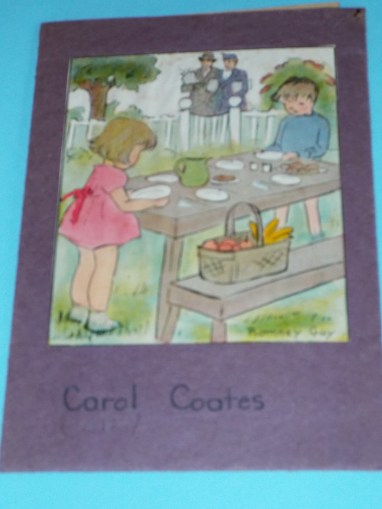
My report card cover. How very Dick and Jane.

We lived in Charlotte a mere sixteen or seventeen months before returning to Florence. I’d been in second grade for just days when we made the move. When I walked into Briggs Elementary School, a few days into the South Carolina school year, as well, whose do you think was the first face I saw? Teddy’s! We were reunited! It was more than I’d ever dared hope for. I had long since resigned myself to the certainty that our paths would never again cross.

In my elation at this happy surprise, I told my newfound girlfriends that Teddy and I already knew each other, that he was, in fact, my long lost boyfriend. When they didn’t seem to believe me, I did what may have been—to this day—the boldest and most uncharacteristic thing of my entire life. I told them I’d prove it by kissing Teddy one hundred times! I had to chase him down at recess, but I did it.

We never spoke again.

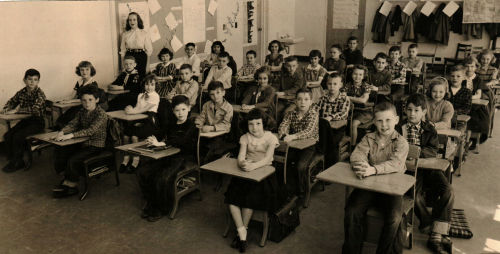
My third grade class. For some reason, I don’t have a second grade picture, but with the exception of the teacher, the cast is the same. (That’s me way back there in the last seat of the row next to the wall.)  Miss Milliken was our second grade teacher. Our exotic, red-headed third grade teacher was Miss Whitlock. I adored them both.

Summer’s Slow Slide into Fall

Summer’s Slow Slide into Fall (written in mid-August)

First day of summer: words that conjure up notions of vacations, suntans, freedom from homework. Thoughts of fun in the sun with summer reads, picnics, hikes, swimming, tennis, softball and baseball, bike rides, day trips. All those traditional outdoor activities mean summer’s here.

In truth, when the first official day of summer rolls around, fall is already lurking in the shadows. The first sign, of course, is day length. Summer means longer days, right? But summer officially begins with the summer solstice—the year’s longest day. The very next day—officially the first full day of summer—will be a little shorter, as will the day after that, and the next, and the next. Every day for the next six months.

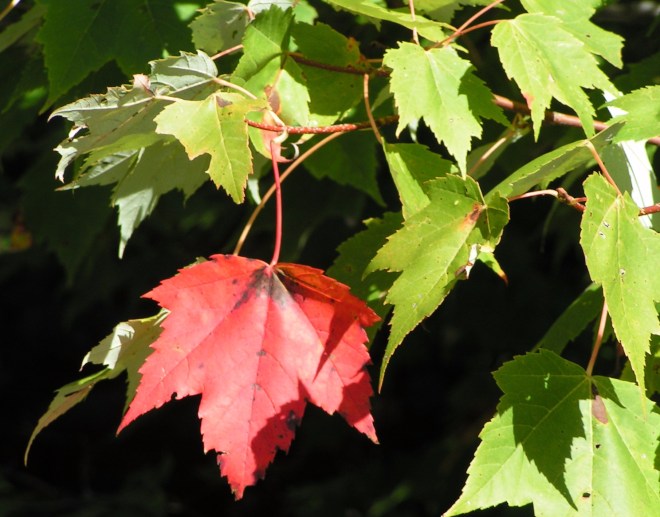
It’s about the time of the summer solstice that I inevitably spot a tree with that one red or yellow leaf. I’m a big fan of autumn, but I also prefer to live one day at a time, and that leaf sits there taunting me, reminding me that fall is inching its way into my life. To the astute observer, other signs of autumn’s sure return are all around. Those lime-green spring leaflets that sprouted on trees (wasn’t that just yesterday?) have been growing both larger and darker. Before they put on their showy fall display, they will continue to darken until, in the distance, they’re such a deep green they look almost black.

As spring wildflowers transform into summer ones, so summer’s blooms have now, almost imperceptibly, given way to those of fall. Daisies are replaced by Queen Anne’s lace; black-eyed Susans seem to morph into yellow coneflowers, Jerusalem artichokes, and sunflowers. Floral hues become both more muted and more rich. The buttery yellows of summer’s evening primrose make way for the more mellow tones of fall’s goldenrod. There’s the rusty shade of spotted touch-me-nots in lieu of daylilies’ brighter tints. In the wild, pinks virtually disappear as summer subsides, and lavenders transmute into the subtler mauves of milkweed and Joe-pye weed and the rich purple of ironweed. In front yards, gardeners discard summer’s petunia palette in favor of the earth tones of chrysanthemums. Berries appear. Fruits ripen.


Birds’ feathers become a little less brilliant. Grasses develop gracefully drooping seed heads. Little by little, vegetable gardens show signs of wear as growth slows, pumpkins turn from green to orange, and early veggie plants dry up or go to seed.

dscf9200.jpg

The sun itself gets in on the action. Ever since summer’s solstice, its arc becomes a little more southerly, a little lower as it moves across the sky.

As I write this piece at the beginning of the third week of August, my calendar tells me we are just past summer’s midpoint. To be precise, sixty percent of our summer days have passed. Sitting outside in the afternoon, I hear a distinctive sound unique to this time of year—the thump of acorns and hickory nuts as they hit the ground in the woods. It’s not a safe time to be standing under a nut tree!

Then comes an evening’s after-supper walk when I unexpectedly sense another change. The days may still be warm and humid, but I feel the barest hint of chill in the night air. Sometimes, I even catch a slight change in nighttime scents—a little less floral, a little more spice. My ears notice the ever-increasing cacophony of crickets and katydids doing their late-summer thing. Their sounds also pierce the otherwise country quiet during the day, but at night the music is almost deafening, yet soothing in its own way and one more sign that fall is closing in.

Fall has always been my favorite season, so I welcome its coming. Still, it’s a little curious that just as we’re getting into the full swing of summer, autumn has already begun its birthing process. I guess that’s the way of things. The peak signals certain ending, but an ending accompanied by new beginnings—caterpillar to chrysalis to butterfly, seed to tree and back to seed again, adolescence to adulthood, retirement to a new life chapter,  the whole of life itself.