The Ones Who Show Up

The Ones Who Show Up

As a society we’re often drawn to bigness. Philanthropy is equated to charitable giving in the millions. Grand gestures get attention. But what would we do without the small gestures? All that magnanimity we hail from people who can easily afford it would be meaningless without the little deeds of daily kindness, sacrifice, and responsibility from just plain folks. I refer to:

* the neighbor who brings groceries to the shut-in

* the gardener who grows a little extra to donate to homeless shelters

* the young woman who weekly organizes her mother-in-law’s medications

* the busy teacher who takes a few sacred moments to send a note of encouragement to a former student

* the friend who brings cookies and laughter to her terminally ill neighbor

* the co-worker who offers a much-needed compliment to a beleaguered colleague

* the harried nurse who still finds time to bring a bookmark to a patient who reads

* the child who writes chatty letters to her lonely grandparents

* the boys who shovel the snow-covered walk of someone recuperating from surgery

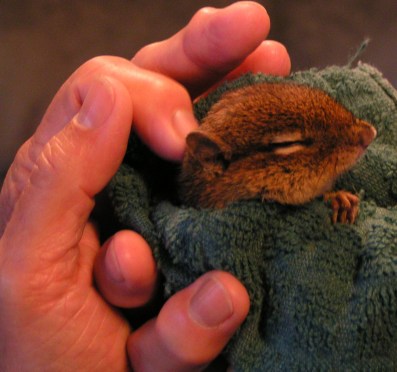
*the passerby who comes to the rescue of a drowning chipmunk

* the writer who sends nostalgic essays to aging relatives

* the man who cares for an acquaintance’s pets when she’s injured and hospitalized

* the many who give to a stranger’s health-related social media campaign, even when their own resources are scant

* the shopper who hands a dollar to the one in front whose bill was a bit bigger than his pocketbook

* the one who smiles at a stranger

* the young one, tired from a long day of grueling manual labor, who nevertheless offers his seat to the older one

* the teens who bring homemade goody boxes to residents of the nearby nursing home

* the foreign visitor who chases you down to return a dropped scarf in the parking lot

* the kid who carries an injured classmate’s books

* the retailer who takes precious time off from work to visit a stranger in prison

* the club members who de-litter a section of highway

* the customer who holds the door for a daughter and her wheelchair-bound father

* the stranger who catches a runaway shopping cart

* and the building custodians and sanitation workers, the electric line workers and snowplow drivers, the bedpan emptiers and street sweepers who do the dirty work at all hours of the day and night to make getting through each day easier for the rest of us.

Oh, that we would glorify these, the ones who show up, the ones who make a profound difference by changing not the world but what is three feet around them.

Our Garden in June

Our Garden in June

For the most part, I write about gardening and modern homesteading over at Mother Earth News these days. I hope you’ll check it out. But sometimes my enthusiasm is just too big for one blog.

This is an exciting time of year for avid gardeners. Tiny leaves erupt from the ground and unfurl where seeds were buried yesterday. Early crops such as salad greens and lettuces are in full production mode, strawberries are juicy red, and summer crops like squash are beginning to produce. At this time of year, it’s not so busy that a gardener-food preservationist feels overwhelmed, yet each day brings evidence of progress and growth. It’s a time full of hope, exuberance, and plenty.

I adore this time in the gardening calendar. Mornings and evenings are cool enough to enjoy garden work without breaking a sweat, whether weeding or gathering part of the evening’s meal. Hardly ever do I leave the garden without taking a few minutes (which often stretch into bigger chunks of time) to sit on our garden bench and survey the success of our efforts.

A couple of weeks ago, our grandchildren were here for “camp” ( a story for another time). The nine-year-old asked if she could go down to the garden—a question sure to garner a hearty “Yes.” A cousin spotted her from the deck and wondered who she was talking to. Sure enough, her mouth was busy as she wandered from plant to plant, her hands reaching out to release the aromas of various herbs.

When she returned to the house, I asked her if she’d been talking to the plants. “Huh? How do you talk to plants?” she asked in astonishment. So, I had to ’fess up. Yes, I regularly talk to our plants, as an older grandchild who’s accompanied me on many a trip to the garden can attest. I didn’t even realize I was doing it until she turned to me and said, “I like how you talk to them. It’s like they’re human.”

Indeed! I encourage them, I apologize when the weather is uncooperative and urge them to hang in there, I thank them. They bring me great pleasure and I can’t help but give that pleasure some expression.

Here’s what’s going on the garden these days.  (To see captions, click on each photo group, then place cursor over individual photo. You’ll have to click a second time to see captions in their entirety.)


Thanks for stopping by and stay tuned. More to come as the garden matures.

Little Things Mean A Lot

Little Things Mean A Lot

Have you ever looked around your home and thought about which things are especially meaningful to you? If you’re like me, it won’t be the big-ticket items, whatever they are. Instead, it will be the little things, sometimes things you’ve held onto for no apparent reason, things to which no one else would attach any importance.

I took a virtual house tour recently and came up with a few special items.

1. The one I’ve had the longest is a Little Golden Book, Busy Timmy. I have a few others, too, but this one captures my imagination for a variety of reasons. Stereotypical as these books were when I was an impressionable tyke, they were my ticket to the wonderful world of words. Timmy could do anything, it seemed. I was just as proud when I could do something on my own—that was the whole idea, after all. I loved the illustrations. And I learned to read. I’ve had this book for close to seventy years. (How is that even possible?!) It never gets old, and it tickles me no end to share it with my grands.

These books are well worn!

2. You’ve surely been asked the question, “If your house was on fire and you could save just one thing, what would it be?” Though I’m sure the true answer lies only in the experience of the moment, my answer to the hypothetical has always been “my photographs.” I’m addicted to picture-taking. I get even more joy from perusing old photos—snapshots of friends and family, vacation scenes, nature photography. I love it all. Of course, I’d never succeed in my photo-saving quest—my albums fill close to ten linear feet of my bookshelf real estate. And that’s not counting the boxes full of loose snapshots or the photos on external drives and SD cards. But I’d do my best. They’re memories of the richest sort. Visual links to time and place that only exist in memory. Treasured keepsakes to share with next generations whose only tie to their past lies in pictures and words.

3. A large, two-tone brown mixing bowl was a fixture in Mom’s kitchen for as long as I can remember—the kind you might find in an antique consignment shop these days. Everything from meatloaf to cake got mixed in that bowl. It’s long had a hair crack down one side, but I still use it almost daily. It wasn’t just part of my childhood; it was part of my learning to cook, an essential item in my 4-H foods project. I mixed up my prize-winning cornbread in it, and I still do today.

4. Growing up, I never cared all that much for framed crewel, embroidery, or cross-stitched pieces. They were too old-fashioned for my taste. But when my mother was breaking up housekeeping, I grabbed a few for old times’ sake. Today, they hang on my walls in places of honor. Each one has a story. This one’s my favorite.

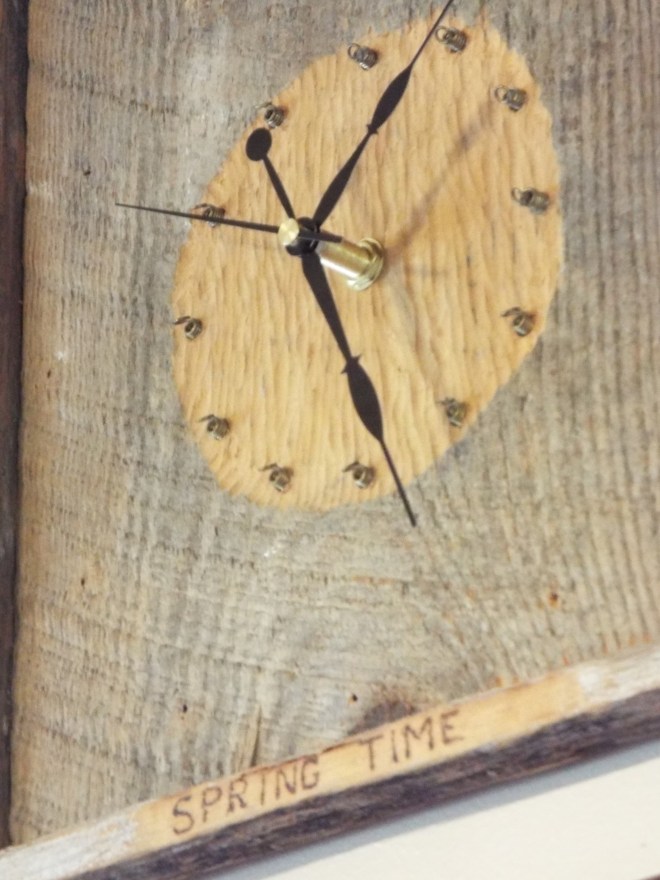
5. My dad took up woodworking in retirement, following in the footsteps of a couple of his brothers. He carved walking sticks, made wooden chimes, turned earrings from exotic woods. I especially liked the clocks he made of aged barn wood. He enjoyed coming up with corny themes for them. (Corn was one of his specialties.) On the frame of mine, he etched, “Spring Time.” Each numeral is represented by a small metal spring. It makes me chuckle. It’s just so Dad.  

6. After decades of filling up precious bookshelf space with my old college textbooks (not to mention hauling them move after move), I finally admitted I no longer had a use for them. Gosh, the psychology texts were embarrassingly outdated. But there’s just something about those old books: their look, their heft, their scent. The slick pages alone send me into paroxysms of nostalgic joy. No doubt part of the allure is the childhood memory of my dad’s sole surviving college text. When I was eight years old, I tortured my younger brother with “school,” while I, as teacher, busily underlined sentences full of words I didn’t understand in that chicken husbandry book.

Still, I knew it was time. Wistfully and semi-regretfully, I began packing my old books in a donation box. Then I came upon my treasured Milton text. I temporarily set it to the side. Not for its content—I tried rereading a few lines. Crikey! No, it was for what it represents: a small seminar class where I was fully present. I loved the challenge of it. I dared to speak out. I got listened to, I belonged, I thrived.

I kept the book.

I could go on and on, but you get my drift. Sentimental trinkets, whose meaning often lies in what they represent rather than the objects themselves—these are the things I value. One of my favorite Top 40 hits during my teens was the song, “Little Things Mean A Lot,” sung by Joni James. “Blow me a kiss from across the room/Say I look nice when I’m not/Touch my hair as you pass my chair/Little things mean a lot . . . Don’t have to buy me diamonds and pearls/champagne, sables, and such/I never cared much for diamonds and pearls/’cause honestly honey they just cost money.” In spite of some fingernails-on-the-blackboard grammar, the song’s theme aligned with my ethos then and now.

I guess it shows.

What about you? Have you taken inventory of your most precious things? Where do they rank on the scale of monetary value? Do you love them for what they are or for what they signify? Or is it just me? Feel free to share in a comment.


Remembering the Forgotten

I’ve been participating in a social media challenge called 52 ancestors in 52 weeks. It’s an effort to encourage learning about and sharing our various family histories in small, doable chunks. Participants are given a weekly prompt to start them on their way. Earlier in the year, one of the prompts was “census.” This is what I wrote.

(Disclaimer: I am not descended from Hardy Watkins. In fact, it’s unlikely he had any descendants. That’s why I want to tell his story. When Granddaddy became the superintendent of the Johnston County, NC, County Home (aka poorhouse) in 1930, Hardy was already there.)

If Hardy was like most folks who were relegated to the poorhouse, no one ever came to see him. Maybe he had no family at all. But neither the absence of visitors from the outside world nor his developmental disability did anything to dampen his enthusiasm for life. He was a good-natured, cheerful sort—until he was pushed too far. Then he’d curse a blue streak. He never missed a service at the nearby church—always sat in the front row. He couldn’t carry a tune in the proverbial bucket, but he sang his heart out on every hymn, always with hymnal in hand, even though he couldn’t read the words.

I grew up hearing tales about Hardy from my dad and his brothers, who lived in the poorhouse during Granddaddy’s tenure there. Whenever our family gathered for reunions, Hardy’s name inevitably came up. He was discussed with animated affection.

This is the tale they shared most frequently. On the rare occasion the boys could scrape a few coins together, they thought it was a hoot to offer Hardy a choice between a penny and a dime. He always chose the penny because it was bigger. At least that’s what they thought. They were grown before they figured out what he surely had understood all along: if he’d ever taken the dime, they’d have stopped playing the game. Instead, he maintained a growing collection of their pennies. It took a while, but with that realization, the brothers finally got their comeuppance.

I got curious about Hardy. I asked my genealogy-savvy husband to check the poorhouse census records. All these years I had thought Hardy was a kid near my dad’s age. But we discovered that when my then nine-year-old dad showed up at the County Home with the rest of his family, Hardy was forty-seven. He was born in 1883. Why, Hardy was even older than Granddaddy! We also learned that Hardy had arrived at the poorhouse long ago—sometime between 1900 and 1910. So, he had been there at least twenty years, perhaps closer to thirty, when Daddy’s family moved in.

According to newspaper reports, poor nutrition marked poorhouse fare in the early years of the twentieth century. Before Granddaddy took over management of Johnston County’s poorhouse, fruits, eggs, milk, and other dairy products were a rarity for the residents. Surely, such a diet would have a negative effect on one’s longevity. I already knew that for the average person born in the late 1800s, like Hardy, the average life expectancy was only forty-two or forty-three years. That got me to wondering what happened to Hardy.

Census records from 1940, the most recent available, showed Hardy was still living at the County Home. He would have been fifty-seven at that time. He had already defied the odds. Further exploration led to the discovery that, in spite of all the cards stacked against him, Hardy lived to the ripe old age of eighty-nine.

At the time of his death, Hardy was still in an institution. The poorhouse was no more. But the building was still there, having transitioned to a privately-operated care home for the aged and infirm in the mid-1950s. So, though the operation of the facility changed hands, it’s quite possible that Hardy stayed put. My bet is he lived all his days since arriving at the poorhouse in the same place, maybe even the same room. (Well, not quite. A new building had been constructed in the early 1920s so he would have moved at least once, though only a few hundred feet.)

Over time, poorhouse records seem to have disappeared. Only the rare newspaper article and a few official reports remain to provide any poorhouse history at all. Hardly anyone is left to tell the stories of the people who lived there.

If he’d had a chance, I wonder what Hardy might have told me about his life at the poorhouse, about his family, about his relationship with my dad and his brothers. About how he defied the odds. What was the rest of his story? Just like the rest of us, Hardy—and everyone else who lived at the poorhouse—had stories to tell. We’ll never know what they were. But they deserve to be honored.

The former County Home in Johnston County, NC, is currently an assisted living facility. You can learn more about Hardy, other poorhouse residents, and the County Home itself in my book, Boyhood Daze and Other Stories: Growing Up Happy During the Great Depression.


Confederacy

(May 10 is the anniversary of the death of Confederate army general ‘Stonewall’ Jackson (1863) and the capture of Jefferson Davis (1865). It is no longer a state holiday in my state, but there are still some local observances of “Confederate Memorial Day” on this date.) 

CONFEDERACY

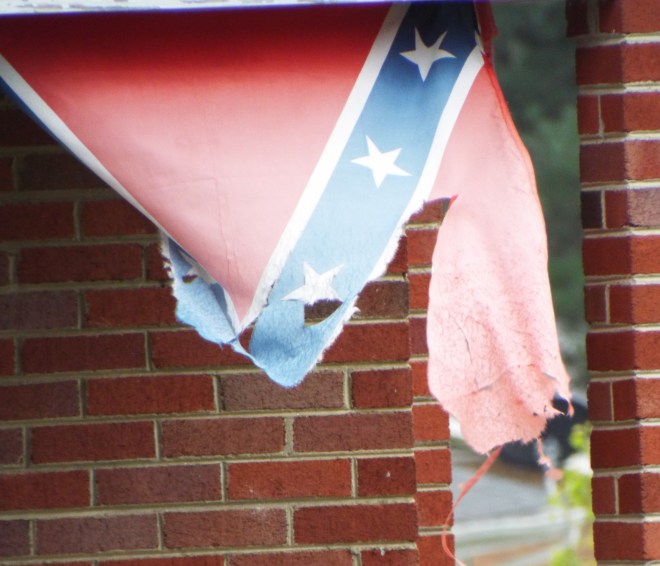
Saw a confederate flag
on display today
hanging on someone’s porch banister—
sinister.

That’s how they always seem to me:
menacing, taunting, ominous;
synonymous
with hate and fear,

jeering at me.
Obtrusive, abusive.
But something was different here—
torn, worn, shredded, frayed.

A charade, I thought.
A symbol perhaps unintended,
decreeing in its degenerate state
that it’s time to stop.

Swap your misplaced anger.
Anchor your feelings in love instead.
Spread the word: its time is over.
Done.

Miscellany of Memories

In honor of my Dillard grandparents on the hundredth anniversary of their wedding day, June 2, 1918:

Miscellany of Memories

No typical grandmother, she,
playful as a kitten in clover,*
cheating at cards, giggling
behind cupped hands at her own subversions.

I gathered warm eggs from the nests
while she rounded up a hen to chop off its head.
Together we plucked pinfeathers
before the evening’s fried chicken dinner.

Gizzards she kept for herself alone
as if I might want such awful offal.
Or was she claiming
sacrifice as privilege?

She practically forced me to be creative.
Sometimes I balked, but I still have
my embroidered aprons and copper tooling
to share with another generation.

Taciturnity described him,
but I knew—I knew he adored me.
With his twinkling eyes and gruff nuzzle
against my cheek, no words were needed.

He teased me with his cow jokes:
Black cows give chocolate milk.
Mountain cows have two short legs
and two long—keeps ’em from falling.

It’s late! Time to get up, he bawled
when dawn had hardly cracked.
Why? I laughed and pulled the covers higher.
He couldn’t sleep—why should I?

Was he lonely, awake alone?
Or did he want to cram
every possible moment with me
into our too-short weekends?

Her father spent his last days
with them, mind long gone, bedridden.
Wasn’t Boston Blackie on the radio
when the final call came?


My grandparents, William Garland and Georgia Olive Stillwell Dillard at their fiftieth wedding anniversary celebration


(* With thanks to my cousin, Jan Lazurri, for this perfect line unrepentantly lifted from her poem honoring Georgia)


Spring Has Sprung!

In this yet another crazy weather year, the entire month of February was one cruel joke: such sunny, springlike weather that some of the wildflowers began to bloom. It gave us a too-early taste of the beauty and hope of spring. And then, winter returned—with a vengeance. It must have decided it liked it here because it stayed and stayed. Those heavy winter coats we wanted to put away back in February were called into frequent action all through April.

I wondered if spring would ever come. Seriously, I began to have my doubts. Back in April, my Facebook memories taunted me. There I was with a healthy handful of asparagus in early April a few years ago. This year, though, not the tiniest hint of an asparagus spear more than a full month later. Next, a three-year-old memory popped up showing our big rhododendron bursting with beautiful clusters of pink. That was a few weeks ago. Meanwhile, our rhodie remained bereft of color.

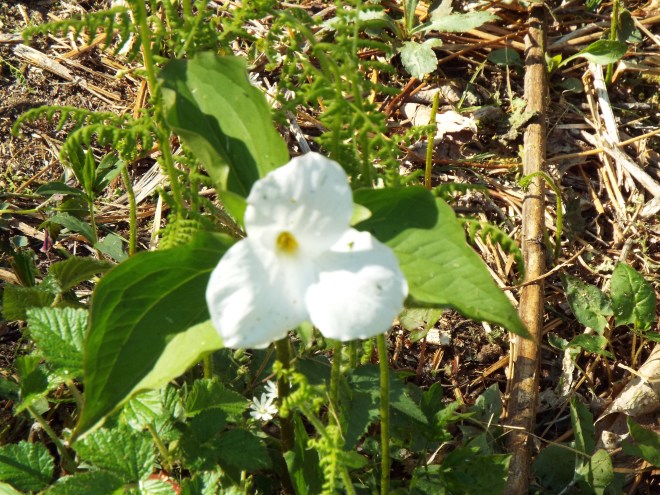
Finally, of course, spring did decide to emerge, and when it did it came on like a house afire. Pretty, white trillium flowers began dotting our forest landscape. One day the ground broke in a couple of spots in our asparagus bed. The next, we were deluged with asparagus. (I am not complaining.) We hadn’t been able to get our early crops planted as early as usual this year. It was either too cold or too wet. When we did have a decent break in the weather, our schedules demanded something else of our time.

Now we’re making up for it. We took to the garden on the first clear day of May. We may have gotten a little ahead of ourselves—our last average frost date is May 25th, but the long-range forecasts look so hopeful we’re taking a chance. We’ve forced ourselves to hold off on the things that demand more heat, but we couldn’t wait to get most everything else in the ground, even those seeds that say not to plant until there’s no more danger of frost. At this point, I’m okay with replanting if some of our seedlings get zapped by a late frost. It just felt too good to get out there and get dirt under my fingernails.

So far, we’ve planted onions, spinach, radishes, carrots, parsnips, rutabaga, kohlrabi, cucamelon, shelling and snow peas, runner beans, potatoes (purple and yellow), yellow squash, zucchini, lots of herbs, cabbage, broccoli, eggplant, beets, and more, as well as new raspberries, blueberries, and blackberries. Still to come: Christmas limas, scarlet runners, tomatoes, green beans, okra, and cukes.

Here are a few photos of long-awaited growing things—both wild and from the garden.

We’re eating asparagus everything these days!

DSCF1898

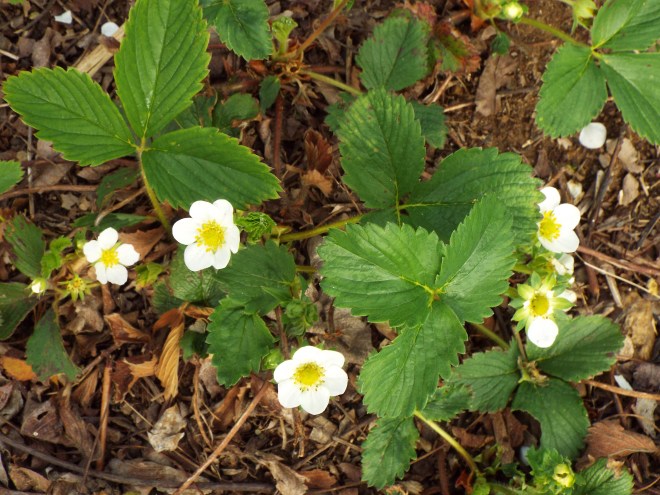
Lots of strawberry blossoms—yum!

DSCF1911

The peas are up.

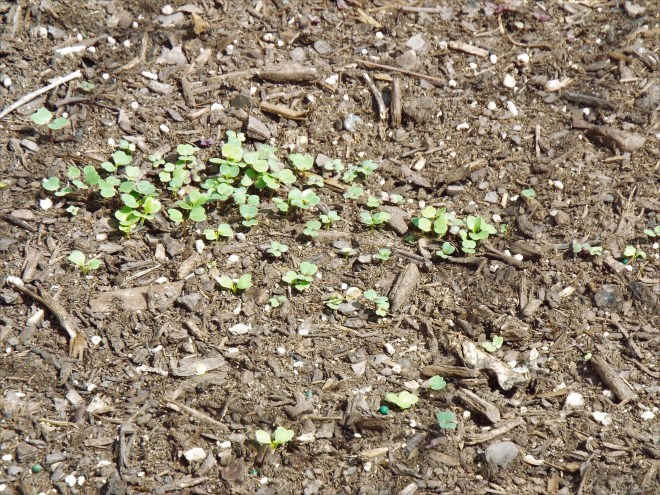
So are our salad greens—already they need thinning. Fine by me.

We’re giving Jerusalem artichokes a try this year, safe and secure in their own little bed so they don’t take over the whole garden.

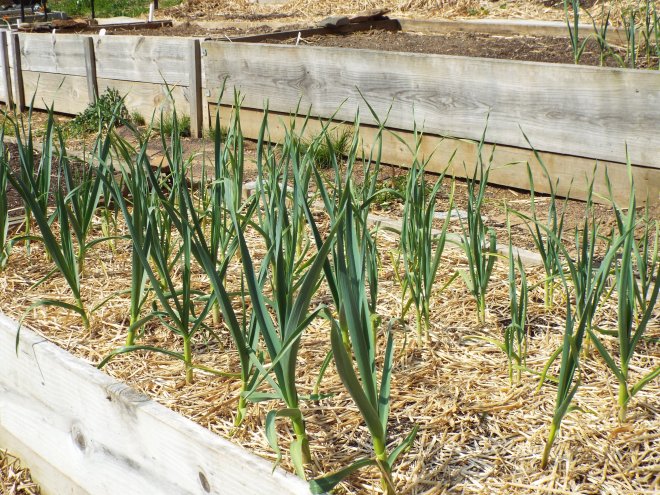
Garlic is so special—plant it in the fall and forget it. It’s the first thing to appear in spring.

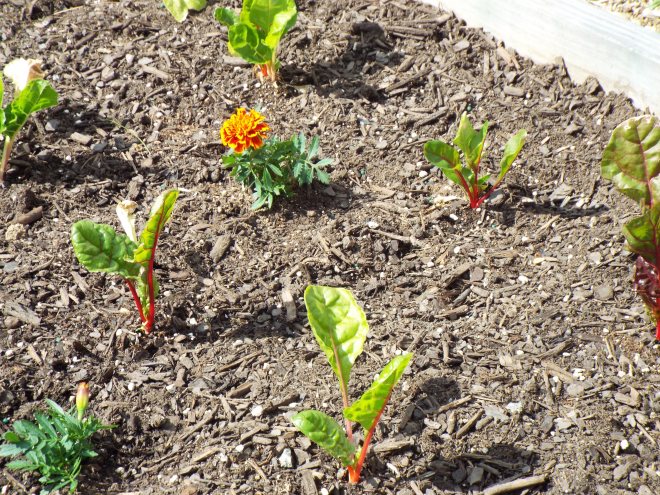
Bright Lights chard with stems in beautiful rainbow hues, interplanted with marigolds for even more color

Edible wildflowers–what a gift! Violets (sugared, for jelly, or in salads); wild mustard flowers and leaves add color and tang to salads; star chickweed is another salad option; mayflowers grow a sort of apple-like fruit that can be used in pies—assuming you can get to them before the deer. We never have.


Trillium—they have three of everything, it seems. And they’re all over the place right now.


Showy columbine


Just Wondering


My grandfather, Joseph Bezzel Coates, b. 05/21/1895

My grampa was a fiend for learning.
Immediately he knew
radio’s potential
for education,
calling his boys
from their play
when “Music Appreciation Hour” aired.

Grampa was a fiend for hard work, too.
Too little of it
and the devil might
set up his workshop—
that’s the way Grampa saw it. Besides,
too much work needed doing
to trifle with idleness.

Hard work was like play for him
so he was known to say,
during an afternoon break from working in tobacco
or cotton or corn and the heat from the sun
blew the top off thermometers,
“Boys, while you’re resting,
let’s go shuck some corn.”

So, I wonder how Grampa would handle
the age of social media.
Surely he’d see the potential for good,
the opportunity for learning.
But day after day, hour upon hour
playing games on smartphones, scouring Facebook, or texting friends?
Would Grampa put up with that?

WWGD?
(What would Grampa do?)

Resilience and Grace

She never asked to be a widow—hoped not to be. Yet, she fully expected it. She was up on gender and life expectancies, so she knew the odds were strong that she’d outlive him by some years.

It wasn’t that she was happy about it, but I wanted to stamp my feet every time Mother made some comment about living longer than Dad. To me, it felt like a self-fulfilling prophecy, and one I didn’t want to think about. But Mother was simply being realistic.

And though she went straight from her parents’ home to sixty years with him, she somehow knew how to survive on her own when at eighty-one she found herself alone for the very first time in her life. They’d been married for sixty years.

A couple of years later when she broke her hip and had to spend more than two days in a hospital bed awaiting surgery, she found the tiniest movement excruciating. Yet, she was loath to press her buzzer regardless of her need—didn’t want to bother anyone. She couldn’t help emitting a groan, though a tiny and apologetic one, when it was time to change the sheets or reposition her. But instead of complaining and bemoaning her constant pain, she made it her purpose to bring laughter to the nurses, aides, and others who looked after her. One nurse aide regularly took refuge in Mother’s room because it was such a pleasant and safe place to be.

My mom has always looked life straight in the face and taken it on wholeheartedly. Tears are so rare I can count the times I’ve seen them on one hand and still have a finger left over. The first was when I was six years old; the last more than fifty years later when Dad’s ashes were delivered to her. Instead of focusing on what’s sad, she looks for things that bring delight—a sunset, a newly discovered flower, a snowfall. I remember her saying she couldn’t imagine anyone being unhappy—sad, occasionally, but not unhappy.

The last thing she ever wanted to do was leave her home for assisted living, but once the decision was made she never complained, never looked back. Again, she began looking around her to see which worker needed a smile or a word of encouragement. (Needless to say, she’s a staff favorite.)

Once, on the phone from her one-room confines, she said to me, “I’ll bet there aren’t many ninety-two year-olds as lucky as I am,” reveling in the birds at her feeder, her books, her crossword puzzles, the cats who frequent her room, and memories of her family and happy marriage. She continues to offer similar sentiments two years later. If she’s ever had a regret, I don’t know about it.

Her job as a mother is never-ending. Though in many ways over the last few years our roles have reversed, she’s still teaching me, especially in the art of aging well and with joy. May I learn her lessons well.


Best Laid Plans

(This year marks the 250th anniversary of Daniel Boone’s first trip to Kentucky from North Carolina. The trip was filled with adversity. It reminded me of our own journey—especially since our path was similar to Boone’s except in reverse.)

Two hundred and twelve years after Daniel Boone left western North Carolina for his first foray into Kentucky, our family of two adults and two young children made its way from Kentucky to a new life in western North Carolina. Our adventures weren’t nearly such a hardship as the Boone band’s, but plenty hard, nonetheless.

Our plan was simple: camp out on our newly purchased land while we hand built—all by ourselves—our forever home. Reality was a little more complicated. For one thing, we had no jobs. For another, we had almost no money. Our budget was shoestring for sure.
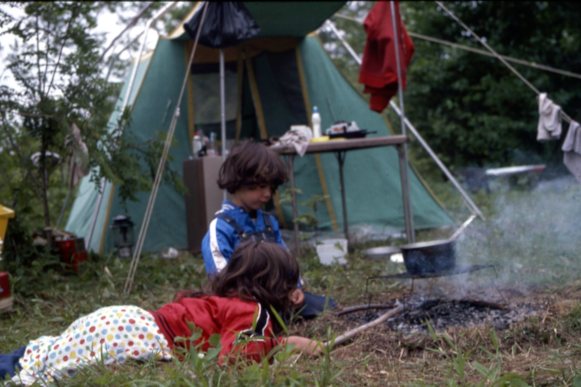
For the younger campers, the best part of our earliest days of adventure revolved around the campfire.


The excitement of tent-camping in the wild far outweighed the inconvenience of having neither water nor electricity. We cooked over a campfire. A rhododendron thicket was the perfect spot for a pit toilet. We drove to a roadside spring to collect water. We hiked to a creek in the woods when we were desperate for an all-over, if frigid, bath. The return hike uphill sweated off our clean.

Daily thunderstorms sent us to the relative safety of our steamy car. Soppy sleeping bags regularly sent us to a laundromat in town. The effort of camping precluded any progress on building. We had to make alternative plans.

Instead of building our house, we built a very temporary shelter. It was all of 8′x12′, barely large enough to hold two cots and a double sleeping bag. The plywood floor kept us off the ground. We wrapped the lumber framework with inexpensive clear plastic for make-do walls and roof. Instead of a door, we had an opening covered with a tarp.

Our “kitchen” is outside on left end of shed. The doorway is also on the left end. Look carefully and you can see a suitcase and canned goods lined up along our front “wall.”

During the day our shed, as we called our new quarters, was a stifling greenhouse. Mountain nights were a different matter. We wrapped ourselves in sweaters under our blankets. Then the rains came, and the winds, in the form of an inland hurricane. Our  “walls” were decimated. The black plastic “roof” caved in. We were forced to invest in slightly sturdier materials.
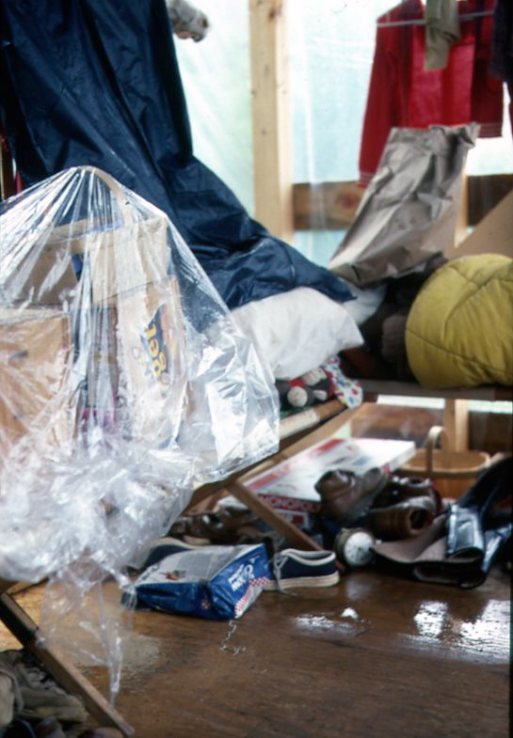
It was a mess!

Finally, we could complete our building plans, which meant we could have a temporary power pole installed. Electricity made it ever so much easier to build, though the only power tools we had were a drill and a couple of circular saws. Nonetheless, progress was slow with two novices working on our first significant building project, learning as we went.

As the nights turned colder, we used a space heater to keep relatively warm, but with no door, much of the heat escaped. December’s bitter cold found us huddled over the heater more often than pounding nails.

Finally, it became too much. At 1:00 pm on December 20th, when the temperature dipped to five degrees and was heading lower and our water containers and canned goods were frozen solid, we faced the inevitable and moved into a one-bedroom apartment in town until warmer weather descended.
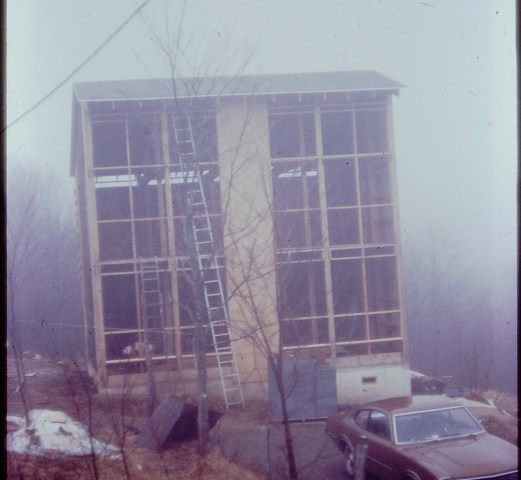
The state of things when the weather got the better of us.

In spite of the cold, we managed to get some work done on the house throughout the winter. Four months later when we returned to our mountain place, we moved into our home, a structure that barely qualified as a shell. Loose plywood covered the floor joists. Blackboard sheathing was the extent of our walls—no siding, no insulation, no drywall. Our plan called for lots of south-facing windows, but we had no windows. Once again, we used plastic to protect us from critters and the elements. A construction site heater warmed us during our morning bathing and dressing routines. We still had no running water and what little electricity we had access to still came from the temporary pole. Of course, we didn’t have a phone.

Except for the plastic we installed over the window openings, this is how the house looked when we moved in.

It would be another year before we got those modern conveniences and many more until our house was what most folks would consider properly finished. But we persevered.

Other than a coat of paint on the window trim (see where we’d started, upper right) and vent openings below windows, this was as finished as our house got until thirty or so years later when it got a total facelift–standard windows, horizontal siding, awnings, and more.

Almost forty years later, our daughter says our years of living in the wild brought our family closer together and notes that her somewhat unusual childhood always makes for a good conversation starter. Our son, wanting his own children to experience the kind of life he had as a kid, has begun a homebuilding venture of his own. The Gnome and I are still here, still working on our dream home. We are here to stay.It was an undertaking of our own choosing, born of youthful enthusiasm and sheer ignorance. Had we known what we were getting into, we might still be in Kentucky today. But we’d have missed out on the adventure of a lifetime.

(To read more about our homebuilding adventure, check out the nine-part series beginning here. Unrelated posts are interspersed, but you can scroll past those if you choose.)