Winter, Reconsidered

My emotional connection with winter has a long history. It has rocked back and forth sometimes depending on my geographic circumstances. For the last few years our alliance has been strained.

This year, I’ve been trying to redefine my relationship to the season of short days and long nights, relentlessly prolonged and wrapped in gray in my neck of the woods.

During the coldest months, the sun’s rays rarely make an appearance and not just because of the brief period of daylight. Overcast is a generous word for many of our wintry days. Of the first fourteen days of this new year, we had perhaps two sunny days. That was the beginning of a season-long trend.

Even those rare days are frequently unhelpful when it comes to getting a dose of Vitamin D. The frigid temperatures allow for only a couple of small skin slivers—between toboggan and eyebrows and between lower eyelids and muffler. Even eyes may be covered with sunglasses, particularly when sun and snow combine to create blinding brightness. And sometimes the snow—especially if it’s deep, icy, or drifts high and unevenly—makes the outdoors a dangerous proposition, particularly for those of us who are more susceptible to breakage because of age.

Nonetheless, I’m taking measures.

  • I treat all my senses: my most worn sweater that wraps me like a cocoon, thick, soft socks, and a plush comforter make me feel as if I’m burrowing into the neck of a friendly Old English Sheepdog.
  • I surround myself with the soft glow and herbal scent of candles. I play soothing music that lifts my spirit—mostly classical, folk, and Celtic.
  • I try to hold an intentional smile, if only as subtle as the Madonna’s. It brings comfort to those around me, and my spirits unconsciously lift.
  • I sip tea, slowly, and look at the outdoors. Really look at it, noticing all the nuances of winter’s offerings, playing with words to find the most descriptive—and life-affirming—ways to describe the scene before me.

The work is all-encompassing. But so far it has proven worth the effort. Winter will still be around for a while up here on the diagonal, so I’m still working at it.

Our society has a tendency to think of winter as a time of death. Green grass and summer wildflowers have ‘died;’ leaves have fallen and dried making deciduous trees look dead. I’ve challenged myself this year to look at nature differently.

Lawns may no longer be emerald, but they will regrow; the grass is not dead. We have a tendency to overlook the subtle tan shades of tall grasses, but they provide rustling interest on a winter day, even more when they wave gently in a breeze.

Winter isn’t a braggart. Its marvels are less noticeable than the lushness of spring and the vibrancy of summer. In those seasons, winter’s elusive wonders are hidden. But now—now they surround us. Now is the time to revel in them.

When I manage to get out of doors, whether for a walk in the woods or a scenic drive, I look again. I search for positive words, alternatives to bleak, dreary, and overcast. Words like contemplative, silver-tinged skies, reflective, pensive. Winter calls us to introspection. Is that why we resist it?

On one typically cold but unusually bright morning, the roofs of the houses we passed on our way to town were covered with the thinnest veneer of frost. As we rode by, sunlight played on the icy crystals, creating a glittery shimmer, as if the shingles were made of twinkling fairy lights.

The skeletal trees, bare of their green camouflage, fill the landscape with sculptural architecture. Their nakedness allows me to appreciate aspects hidden at other times of the year.

The branches of some reach upward, as if in praise of the sky. Some trees are encircled by draping branches, reminiscent of welcoming arms ready to enfold me and offer comfort. Some trees are so gnarled and craggy it’s easy to imagine they sit on the edge of an enchanted forest.

About now, with trees looking as bereft of life as they have for months, the sap begins rising, an event which will go entirely unnoticed except for syrup makers and those who happen to fell a tree at that crucial time, but pivotal to the reemergence of the verdant leaves we long for.

Subtle color variations and not-so-subtle textural differences in tree bark differentiate one species from another. Touch a sycamore or crape myrtle, with bark as smooth as the proverbial baby’s bottom.
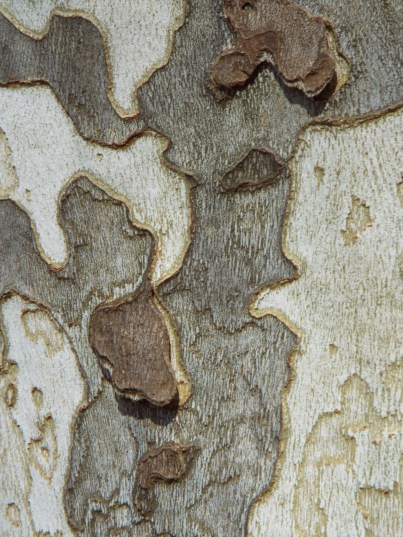
Consider the trees with peeling bark—paper thin birches and rugged shagbark hickories, or the finely ribbed bark of the pin oak and the thick, deeply furrowed bark of the black locust. Bark with overlapping plates, like black birch, make me think of armadillos and scaly dinosaurs.

As I look more closely at trees, I see mosses as dark as midnight and lichens, some the palest green, eerily fluorescent in the dark. In the woods outside my kitchen window sits the tree stump. Over time, moss has begun to creep upwards, slowly covering its sides. Today, I saw for the first time that the entire stump is blanketed in moss as soft as down, hinting at a fairyland.

There are trees with burls and hidey holes. Who goes there?
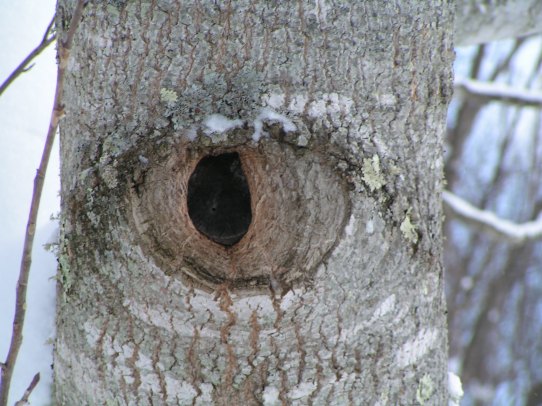
A cyclops tree?

Winter serves a purpose. Plants store up their reserves, ready to explode with new life as warmer weather and more hours of sunlight appear. The flora does what it needs to do during winter. Animals know how to handle winter, too. Some, like plants, go dormant to preserve strength, feeding off stores of fat until nature is ready to provide its bounty.

What if we humans were to welcome winter in all its aspects and live with it, not against it, as the rest of nature seems to do so well? What if we turned off the electronics, indeed perhaps electric lights when the sun goes down. What if we did those quiet chores best done in front of a fire or by candlelight with a cup of hot chocolate or tea at our sides? What if, instead of staring at some screen, we talked to each other, played games together, put together a jigsaw puzzle, corresponded with relatives and other friends, read aloud or silently, wrote, contemplated? What if we used winter to restore ourselves, to create, to maintain?

Would our family and internal lives be richer? I think they might. Would we welcome winter as we welcome spring? Would we be better primed for what life brings in the next season? We might begin to treasure and even look forward to long winter evenings as a time of personal and family enrichment.

We can’t beat winter. Why not join it?


Proud Mountain Woman

(This essay was first published in the 2018 issue of Gateways Creative Arts Journal, themed Remembering and Forgetting.)

Not again!” she snapped. Until this moment, it had been a perfect morning. But when she turned on the tap to fill the coffee pot, nothing. Dadgum it! Preparing a hearty breakfast before seeing Braxton off to work was one of the many ways she strove to be the best wife she could possibly be. This thing with the water was getting to be a nuisance. All she asked of the Harwell boy was that he wait just a measly half-hour to divert the water supply to the cattle trough so Brack could get a pre-workday shower and she could fix his breakfast.

Today was one time too many. In a flash of huff, she trounced across the kitchen, slammed the screen door behind her, stomped across the sandy back yard in her pink and blue flowered pajamas, climbed over the barbed wire fence into the neighbors’ pasture, and turned off the cows’ water supply with a sharp wrist twist.

She marched triumphantly back to the kitchen, still mad, but smug. Today there would be coffee.

Who is this woman? What is her story? Her name is Pam Dillard Coates. I know this true life episode because the four-year-old me was in the kitchen when it happened. No doubt, the only reason this long-ago moment stands so clearly in my memory is that such a display of temper and venom was so unlike the quiet, gentle woman I knew as my mother.

That woman would never snap, never slam, and never, ever leave the house in her pajamas.

At the time, our young family of four was living in Mars Bluff, South Carolina, about eight miles east of Florence. My parents rented an old farmhouse from the Harwells who lived next door in what has been described as one of the finest examples of Greek Revival antebellum architecture in South Carolina. Even I knew it was pretty impressive encircled as it was with twenty-two Doric columns (not that I knew to call them that).

By contrast, our small wood frame house stood atop brick pillars, in the way of many houses of its era. The open space under the house was intended to keep things cooler in the hot southern summertime. Perhaps the nearby presence of “The Columns,” as the Harwell home was known, made our little house look shabby to the lady who came calling one day to welcome us to church. Mother did not like the sense she got that this matron felt sorry for us and that she looked down on us. It was a slight Mother never forgot.

But our home wasn’t nearly as pitiful as the two-room unpainted wooden shanty occupied by a tenant-farming couple. I walked across the fields to visit them on occasion. It was a tiny space, even by four-year-old standards. I walked into the small area designated as a kitchen with room for a wooden counter top on one side of the door and an old-fashioned icebox on the other. An open doorway led into the combination living-bedroom. The place was dismally spare. At least our house had electricity—and running water, sometimes.

We lived a couple hundred miles and a world apart from Mother’s hometown in the mountains of southwestern North Carolina. The people of sandy eastern South Carolina thought her mountain accent was quaint. By one means or another, someone was always calling attention to her differentness. She felt out of place, patronized, and she was rightly sensitive to any hint of disdain.

In the mountains, she was in her element. Her family was well-respected. Her parents were leaders in the small community. It was home.

She didn’t realize just how much. Though she was unaware of it, all of Mother’s ancestors had settled the area when it was first opened up via cession by the Cherokee. Every single one of them came to this country no later than the 1700s, some earlier. Like today’s immigrants, they were mostly poor folk who left their home countries in search of a better life. For the most part, they found it.

The Stillwells, Loves, Dillards, and Nortons were some of the first to move to western North Carolina as it opened up for settlement. The rest came not long after. Some made their way from Virginia through eastern Tennessee. A few moved from points further east in North Carolina, and more came from bordering counties in South Carolina and Georgia.

In other words, Mother’s mountain heritage included the very deepest roots among European settlers. And though she is still the sweet, gentle woman I remember from my childhood, I now understand that she is—and has always been—so much more. She shares many of the traits commonly attributed to Southern Highland mountaineers: self-reliance, persistence, and stoicism borne of necessity; reticence, independence, and individualism borne of isolation; and a hefty dose of mountain pride that demands to be treated with dignity.

Today she’s even more proud of her mountain heritage than she was as a twenty-something young mother. So am I.

The Other Side of Snow

In eastern South Carolina where I grew up, about an hour’s drive from Myrtle Beach, a snowfall was a unexpected and exciting gift from Mother Nature. I remember one particularly bountiful snow—enough to build a snowman! That was a true rarity. My brothers and I went all out, rolling three balls of snow, each larger than the one before. We rolled and we rolled. How proud we were to be able to make a huge snow statement.

We rolled the huge bottom section where we wanted to build our snowperson. We rolled the next one over, but when we tried to lift it into place, it didn’t budge. That’s how little we knew about snow. Finally, Dad’s strength and ingenuity solved our conundrum.

Now I live in a place that gets snow most every winter, some years more than others. I enjoy the variation of the seasons, so I welcome snow. Sometimes.

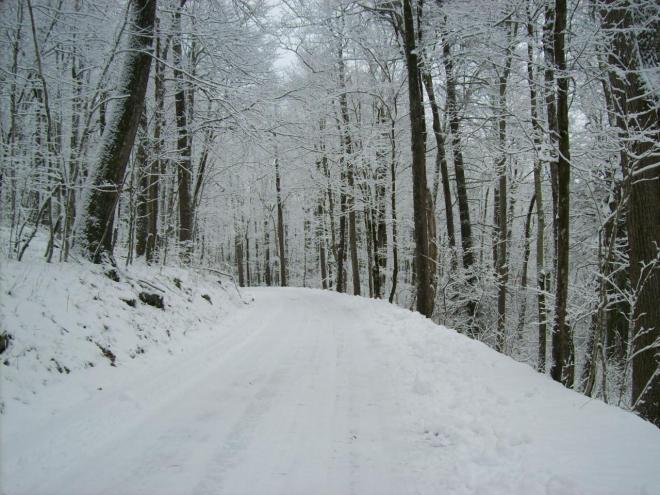
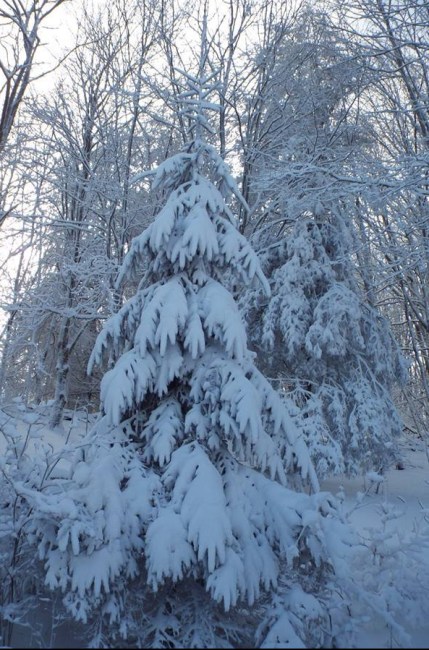
In the right conditions, a snowfall can be breathtakingly beautiful. If the temperature hovers near the freezing mark, the snow is usually heavy and wet, turning every outdoor thing into a pearlescent sculptural wonder.


Snow paw and snow antlers


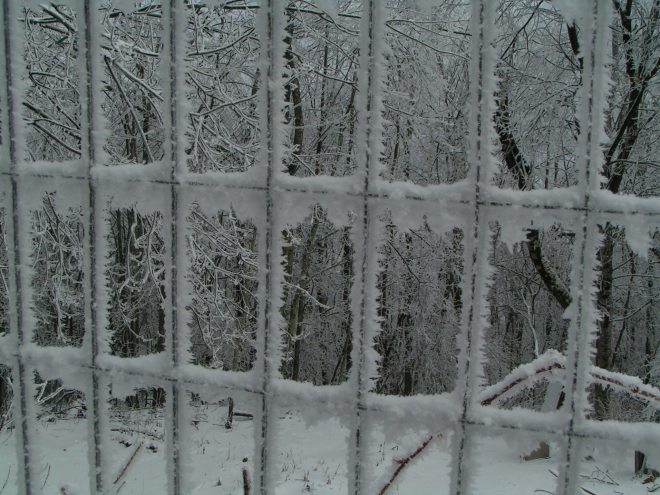
Snow fences

Stopping by woods on a snowy evening

The tiny, dry flakes created by brisker winter temperatures sparkle when the sun comes out as if billions of diamonds fell from the sky.

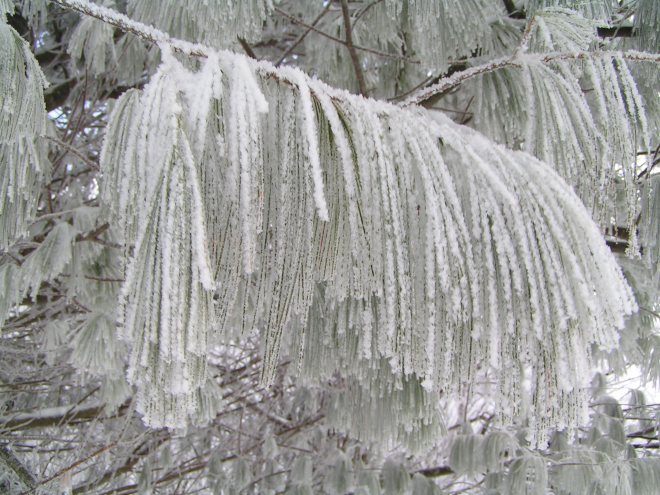
If the snow is preceded by hoar frost, feathery ice crystals that attach themselves to every outdoor surface, the whole world becomes white—every branch of every tree, every pine needle, every fence post and metal structure, everything. It almost makes my heart ache.

Clothespins on clothesline

Tree with hoar frost against blue sky

Abandoned bed springs

Garden fence


Pine branch


Even cobwebs are appealing when covered in hoar frost.


But snow has another side. The excitement grows old when winter comes early and refuses to leave center stage so colorful spring can make a long-awaited debut. And that’s not all.

When even a modest snow is accompanied by strong winds, as is so often the case on our mountainside, the snow piles into unplowable drifts. We’ve been known to pack snowshoes, a shovel in case we get stuck, and a plastic sled in our car and park at the bottom of our nearly half-mile gravel drive in anticipation of such an event. On more than a few occasions, we’ve slogged up that mountain road pulling a sled full of groceries, bags of pet food and birdseed, book bags, and more.

Sometimes we’ve been caught off guard. Without snowshoes or the shovel that spends most of the winter in the car, walking in can be a real trial, especially in a deep snow where each step means lifting one’s knees waist high or higher with every step. And climbing uphill, at that. Conversely, we’ve been completely snowed in for four or five days at a time. An adventure at first, but gnawing anxieties grow with each day as we begin considering the possibilities of being trapped in the event of an emergency.

And then there’s that dreaded word, ice. At just the right—or wrong—temperature, snow is preceded by rain which freezes on roads. Sometimes the reverse happens and rain or sleet falls after the snow. Walking and driving in either condition is treacherous. Add steep, curvy, and sometimes narrow mountain roads for a bigger thrill than any theme park ride.


Icicles can be fascinating, though, especially when the wind blows.

In normal times, we may only have one ‘good’ snow a year, and it doesn’t usually hang around long. A day or two later, the sun’s rays melt most of it away. We’ve had a few exceptional years, though. Real doozies.

In 1993, snow totaled more than three feet in just over two days. We were under curfew for forty-eight hours straight. Locals fondly remember it as the Blizzard of ’93 (and yes, it was an actual blizzard). At the time, it was called ‘the storm of the century.’ The National Weather Service named it a superstorm.

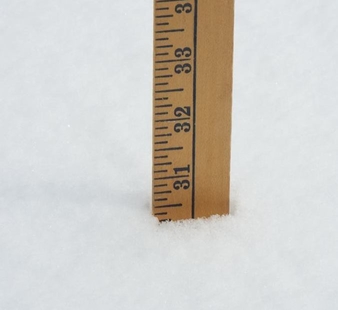
The 2009-10 winter brought us more than nine feet of snow—and since temps remained below freezing for the duration, none of it had a chance to melt. For more than three months, the only outdoor colors we saw were white and gray.

Once we could drive around our mountain road,  2010

Snow field

Fifty years earlier, way back in 1960 (well before we lived here), it only snowed seven feet, all of it falling in a just over a month. Every other day it snowed. Temperatures never rose. The winds were fierce. What snowplows cleared one day, howling winds turned into another drift the next. Children missed a month of school; helicopters dropped food, medicine, and cattle feed to isolated rural households.

Now, I know our snow totals are nothing compared to the country’s northernmost areas and tallest peaks. But, hey, I’m in the south. Most folks don’t typically associate such snow totals in the land they think of as all sunshine and beaches.

But don’t feel sorry for us. We mountaineers take a kind of perverse pleasure in our extreme weather. It’s like a badge of honor and we wear it (read: talk about it) all the time, as if we somehow deserve credit for weather’s natural occurrences. We proudly claim our snow.

MINOLTA DIGITAL CAMERA

Among the trees

MINOLTA DIGITAL CAMERA

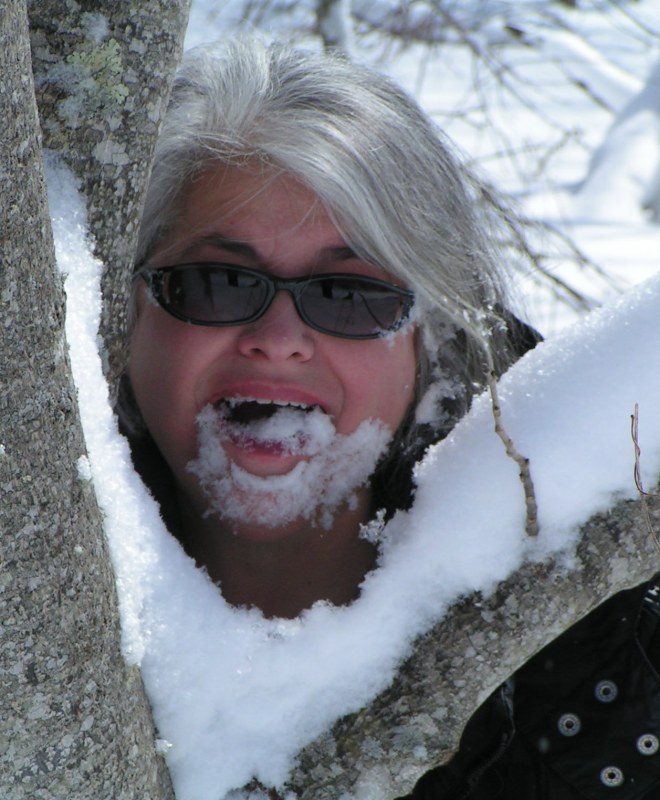
Taking a bite out of snow

Bragging rights

Back in my high school days, when every snowflake sent us running to the windows in gobsmacked awe, we were naively oblivious to snow’s downsides. All we knew was that even a relatively deep snowfall would disappear within hours, the reason we wasted no time getting outside.

During spring break of my senior year, our high school chorus went on tour. We were headed to New York. We spent a night in New York City, the first time most of us had ever seen a skyscraper. Then we traveled upstate to perform. We were excited to see snow on the ground. But what were those humongous ugly mountains of grayish-black, sludgy-looking stuff at nearly every corner? Yeck! Why, I wondered, didn’t these northerners care enough to keep their snow clean and pristine? How could they let it sit around and get so dirty, so totally ruinous to the landscape of purest white?

Now I know.


Recent snow scene

That Feel Good Moment (Another Kind of Love Story)

We woke up to another glorious snowfall, this one a fluffy six inches deep and preceded by hoar frost that made all outdoors a glittery white. We bundled up in warm layers and snow boots in preparation for a trip to town for a few errands.

On the porch, the Gnome was fumbling with boxes destined for the recycling bin while I was busy locking the door. I turned around to see what looked like an apparition of Amber, one of our beloved pets of yore.

The dog was beguiling with her golden plume of a tail wagging in youthful enthusiasm. Where had she come from? We live far from a public road. How long had she been out? She must be hungry and cold.

For a moment we thought we’d once again been adopted. But she was wearing a harness. She must have been with her humans recently. Surely she hadn’t been abandoned by the side of the road.

As the Gnome held tightly to her harness, he felt for a tag. Appropriately, it read, “Not all who wander are lost, but I might be.” There was a phone number. I was already digging for my cell phone.

“Hello,” the male voice answered.

“Hi, we have a dog here whose tag has this phone number attached.”

I could hear deep worry quickly replaced by relief as he told me he and his wife were out looking for her at that very moment. We exchanged information; they were less than half a mile away. I told him we’d pile her in the car and meet them in a few minutes.

But they weren’t about to hang around waiting. Before we got to the road, we saw them hiking up the mountain on our very long, climbing, gravel road. Red-faced, wet-haired, and with tears rolling down their cheeks, they hugged each other, they hugged the dog, they hugged the Gnome. (I’m sure they would have hugged me, too, but I was still buckled up in the car at the moment.)

Turns out this young couple had been out on a romp with their barely one-year-old pup. They’d practiced letting her off leash at home for a few weeks with no problems and decided today, on the remote path they were hiking, would be a good time to try it further afield. But they turned away for a mere second. That was all it took for her to disappear. Probably spotted a rabbit or maybe a deer.

They’d been searching for a couple of hours, climbing ever higher in the deepening snow—exhausted, worried, with no idea if they were going in the right direction, and about to give up when the phone rang. In the few minutes she’d been in our custody, we’d already fallen a little in love with the dog, but our infatuation couldn’t hold a candle to the adoration this young couple showed for their furbaby.

Even though they insisted they could walk, we couldn’t let them trek another half mile home. They were on a natural high but obviously overheated and exhausted. We piled the humans in the car, too, with the dog safely ensconced between them.

After we dropped them off, I realized how full my heart was. I looked at the Gnome and said, “Doesn’t it feel good to do a good deed!” We had smiles on our faces, smiles in our hearts, and livelier springs in our steps the rest of the day.

Have you found your good deed for today? This day devoted to love is the perfect time to reach out. You’ll be glad you did.
Selecting the Airbnb that’s Right for You

(Read this to see why I like traveling with Airbnb.)

If you’ve wondered about Airbnb but been too uneasy to give it a go, read this post for tips to make traveling with Airbnb safe, easy, and fun. (Airbnb’s website changes from time to time, so things may be a little different when you try it, but these guidelines should still be useful.)


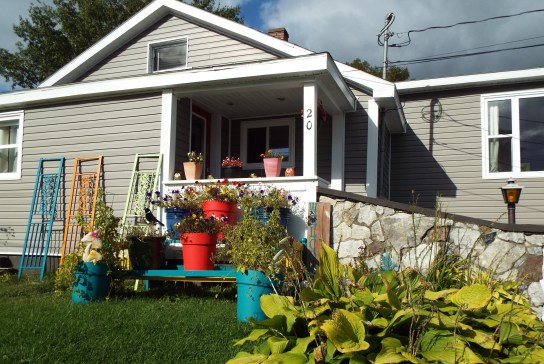
What a cheery studio apartment this was, attached to our host’s home but with a private entrance.

1. In the search bar at the top of the page, type the name of a location. (You can go through the entire process up to reserving a space to see how it works.) Additional options will appear including number of guests, type of place you’re looking for, and price range. These options help narrow your search, saving considerable time.

2. A list of places matching your needs will pop up along with a map showing the general location of each rental. So, if you’re looking for a place in the heart of a city, you won’t accidentally end up thirty miles away. You’ll see the per night price and, in smaller print, the total price, which accounts for cleaning, service fees, and taxes, so it’s all inclusive. Keeping this in mind, don’t let the nightly rate fool you. Sometimes the one that looks more expensive at first glance costs less overall because the fees can vary significantly.

3. When you select a property, click on the photo at the top of the page for a slideshow of the place. I don’t advise staying somewhere that doesn’t provide enough pictures—interior and exterior—to size up the place.

4. Close the slideshow to read the description and list of amenities. Each has a ‘read more’ option. For the record, all the Airbnbs I’ve stayed at had all the promised amenities and often others missing from the written list.

5. Scroll down fora diagram of sleeping arrangements. In addition to the slideshow, this shows where and what type of sleeping arrangements are available (bed, futon, air mattress).

6. Even farther down the page are guest reviews. I’m highly unlikely to stay in an Airbnb so new that there are no reviews. Sorry, but I don’t want to be the guinea pig. In fact, I like to see plenty of reviews. That way, I’m guaranteed a good cross section of experiences and perspectives.

7. The listing also has a host photo and usually a brief host bio. There’s even a place where you can contact the host if you have questions or need any clarification.

8. Lastly, you’ll see a neighborhood description. What you won’t find, for security reasons, is a street address. That’s provided one or two days before your arrival, along with instructions on how to get in. Some hosts will greet you in person to show you around. Others offer a keypad or lock box.

9. Read it all. Reread it. Just like real estate ads, you might find code words. If they give you pause, jump to the next listing. However, I’ve almost always found that the pictures and descriptions are entirely accurate. Hosts have a vested interest in portraying their sites accurately. After all, if you arrive with a set of expectations that aren’t met, your host can expect a negative review for all to see.

10. On the right side of the page you’ll see pricing detail and the chance to book. It’s an easy process.


This New Mexico casita was one of our early Aibnb experiments. We were astounded at the low price. Fresh, airy, filled with original art, it’s a mother-in-law home which the host rents out when she isn’t visiting. The patio was  perfect for taking in the mountain view. 

11. For each rental, there is a heart at the top right. Click on that if you’re interested but not ready to make a commitment. You’ll be creating a sort of wish list to choose from. By the way, each time you click on a listing, it opens a new tab, so you don’t lose the original.

12. Another menu item, ‘Trips,’ shows the places you’ve stayed before in case you want to return. Still another lets you message your hosts as your arrival date nears or even when it’s over. Who knows? You might start up a lifelong friendship.

13. A day or so after your visit, Airbnb will ask you to complete a questionnaire and review. Please do this. It helps others like you. All reviews are posted on the listing’s site. If you have a complaint, the host may respond. You also have a chance to give Airbnb private information which allows them to follow up.

More Tips

Consider your ethos. If green is paramount, you may be able to find it. If it’s community investment, you’ll want to shy away from hosts who hollow out neighborhoods by buying up multiple properties for short-term rentals. How about diversity? Airbnb hosts can’t state that they discriminate, but some make abundantly clear that they don’t, stating for instance that they’re LGTB-friendly.

You can change or cancel a reservation, though hosts have individual rules for when and whether you lose some portion of your payment. Airbnb may also deduct the service fee. Most of the time, nothing is paid up front. These details are on the website.

Respect the host’s rules, also posted. If something doesn’t appeal to you, simply pass.  Sometimes, hosts may want you to strip the bed or put used towels in a designated spot before you leave. If you rent an entire house, they’ll certainly want you to wash any dishes you use. They won’t ask you to vacuum or actually change the linens, but they’ll want you to leave the place basically as you found it—as you would with family or friends, right?

The view from our Ingonish Beach, Nova Scotia, Airbnb included  both water and mountains. Best of all worlds.

Always, always remember that you’re staying at someone’s private property, whether or not they’re in the next room, and treat the space with the respect you want your own home to receive. If you accidentally break something, say so. Your host will probably be understanding, certainly more so than if you slink off without saying a word.

Planning a trip with Airbnb may take a while longer than making a reservation with your favorite hotel chain. But if you’re someone who comparison shops for lodging anyway, one process may not take longer than the other, though it’s easy to become infatuated with some of the Airbnb options. You may find so many desirable choices that you forget the original purpose of your travels.

In the end, Airbnb is a means, not an end. At some point, you may need to rein in your impulses and remember your travel goals. But if unique travel opportunities and adventure figure into those goals, Airbnb is one way to realize them.

Almost all the Airbnbs we’ve visited cost less—often significantly less—than any hotel or roadside motel we could have found, and were ever so much more interesting.


A few more places we’ve stayed with Airbnb. Sometimes you get amazing views, sometimes a hammock or even your own Airbnb cat. (Don’t worry, hosts make it very clear if animals are on the premises, at least in our experience. But you can always ask in a message, a good idea if you have allergies).

Have you tried Airbnb?

Why I Use Airbnb—Sometimes

Does the notion of using Airbnb sound a little scary to you? It did to me. But a couple of years ago when the Gnome and I took an adventurous cross country road trip, we decided to add one more adventure and selected three Airbnbs to add to our nights with relatives, old-fashioned Bed and Breakfast inns, and roadside motels.

We found we liked this relatively new lodging alternative and used it another time or two with equally good results. So, when we made another road trip last fall, this time to Nova Scotia, we decided we could happily and safely use Airbnb almost exclusively.

Airbnbs may be chic, quirky (waterfall Jacuzzi, anyone?) or rustic. (Click individual pictures to see a larger image.)

Happily and safely—those are the key words. The trick is to know how. In this post, I share a few of the reasons we sometimes choose Airbnb. But first, a disclaimer: I have absolutely no stake, financial or otherwise, in Airbnb—except to give it money in exchange for a good night’s sleep.

1. In our experience, Airbnb is a less expensive form of travel with a higher comfort level than hotels.

2. We’ve found Airbnb to be a homier option. There’s usually a choice of comfy upholstered furniture to relax your tired bones. We specifically look for this benefit.

3. Meeting Airbnb hosts is a good way to get to know the area. They’ll give you the local lowdown. If you’re in town for longer than a night or two, getting to know some locals gives your stay a whole new dimension. What better way to do that than stay in someone’s home? (However, if privacy is what you crave, hosts generally respect that.) Sometimes, the hosts don’t live on site, and you may never see them. Even so, many provide brochures or other information about areas of interest, nearby restaurants, etc. Some even have a three-ring binder chock full of helpful info.

4. Depending on your needs and wants, you can rent an entire house, a bedroom in a private home (with or without a private entrance), or even a shared room. Haven’t given that last one a try; don’t intend to. I’m not that adventurous!

5. If you’re traveling with family or friends, sharing a house, apartment, or condo cuts the price even further, and it’s so much more fun to spend your evenings relaxing together in a living room than stuffed into one or another’s hotel room.

6. Depending on your Airbnb selection, you can prepare your own meals. You can eat in your pjs if you want and even save a little extra money and time. Often, the hosts stock the fridge or pantry with a few essentials, but don’t count on more than coffee makings and maybe salt and pepper. Previous guests sometimes leave what they didn’t use, so you might find cooking oil, mayo, or other condiments. You never know.

7. Airbnb hosts provide most, if not all, the amenities hotels do: bed linens, towels, soap, shampoo. In my experience, hairdryers and irons have also been universally available. One place even had a selection of condoms and feminine hygiene products. (Again, you never know!) Sometimes there’s a washer and dryer, a real convenience on longer trips.

8. Typically, Airbnb hosts do not provide a hot breakfast, though we’ve experienced a couple of happy exceptions. However, they almost always provide a coffee maker with coffee and tea bags as well as breakfast bars and sometimes fruit or other snacks. You might even find a choice of yogurts, instant oatmeal, or muffins. We stayed at one place that stocked the fridge with soft drinks, and had an entire tray full of prepackaged baked goods on the counter. Another host left us some homemade whole wheat rolls. Yum!

9. With Airbnb, you’re almost certainly putting money into the local economy, often helping a self-employed craftsperson or a young family supplement their income. That feels a lot better than lining the pockets of faceless corporations to me.

10. Airbnb is always an adventure, in our experience a happy one filled with little surprises, homey touches, unique decorating styles, and other treats. Think about how different the homes of your various friends and family are; be prepared for a quirk or two. It all makes for much more interesting travels. If you’re not a person who can go with the flow, the Airbnb experience may not be for you.

This welcoming two-bedroom home is one of the least expensive places we’ve stayed, even though we had the whole place to ourselves.

To be sure the experience is a positive one, it’s important to do your homework and make your Airbnb selection judiciously. In my next post, I’ll share tips on selecting an Airbnb site that fits you to a T. Stay tuned.

Need a Winter Project?

I’m tickled pink, purple, and every hue of the rainbow to announce that the current Winter issue of Heirloom Gardener includes an article by none other than moi! It’s all about making a personalized garden journal—an excellent day-brightening project for the short, dark winter months. 

Now, you could go out and search for Heirloom Gardener at your local newsstand, but you can also read the article online using this link. You’ll find my article front and center under the “Current Issue” section. If you’re into gardening, whether veggies, flowers, or fruits and nuts, you may want to check it out.


Nova Scotia: Land of Kindness and Humor

If you’ve ever watched the TV series Due South, you know the running joke about the uber politeness of  Benton Fraser, the Canadian Mountie assigned to work in Chicago. (If you haven’t seen it, do yourself a favor and watch.) The nice Canadian is such a tired stereotype that I’m a little embarrassed to acknowledge I found it to be true, at least as far as Nova Scotia is concerned—-New Brunswick, too, which we passed through on our way to and from.

Not just polite, but downright nice. Folks struck up conversations with us from the next table in a restaurant, on hiking trails, at roadside overlooks. It was more than politeness; there was a real genuineness to their overtures. The bonhomie was contagious—everyone seemed friendlier in Nova Scotia. We had long, delightful chats with folks from the Philippines, China, New Zealand, and Scotland. It’s hard to define, but the truth of it was amplified as soon as we returned to the States. After 2 1/2 weeks in Nova Scotia, a Maine “I’m sorry” uttered after an accidental brush sounded mechanical, almost brusque, by comparison.

Sorry to my Canadian friends if you’re sick of hearing this cliché, but there are far worse character traits to be had. After all, niceness is a moral virtue. And I thank you for it. You brought out my best self.

Speaking of niceness, I found it particularly touching that from the first Canadian we met to the last, as soon as someone knew we were from North Carolina, the first words out of their mouths were about Hurricane Florence. Almost to a person. They’d been following the news, they’d mourned the losses, they commiserated with us.  Even though the Gnome and I were virtually unaffected by the hurricane’s wrath, we were comforted by this display of concern and caring.

Kindness in Nova Scotia extends to the environment. A friend of mine once noted about our outdoor clothesline that she didn’t know anyone else who had one. Well, if she lived in Nova Scotia, she would! Every dry day in every part of the province, we saw laundry drying in the breeze. And I was impressed to see that almost every public trash receptacle in Nova Scotia was accompanied by not one but two, and usually three, recycling units, including one for food waste. Note how well-maintained they are.


Containers for almost all ready-to-serve beverages, not just soft drinks, are recycled. Got a half-gallon orange juice carton? An individual apple juice carton? Recyclable. They’ve been doing this for more than twenty years! (We didn’t realize until too late that we’d been paying deposits on all our containers and could have gotten refunds. Guess we’ll  file that info away till our next visit.)

Nova Scotians are serious about their recycling. Every Airbnb, every restaurant, every attraction we visited featured recycling bins. Good for them.

And what could be more hospitable than to discover a set of red Adirondack chairs waiting for you at random scenic spots? The red chair program was first put into place by Canada’s national park system. Now, it seems to be a ubiquitous trend. We found them at other public venues as well as in the backyards of several of our Airbnb hosts. We relaxed in them every chance we got. Is there a better way to invite your guests to stay a while?

Even the postal boxes are festive and welcoming.

There’s another side to the people of Nova Scotia: their sense of humor. We encountered it over and over. There was the sign at the entrance to the Telegraph House in Baddeck exhorting guests to avoid trying to close the screen door, stating that “he is lazy and will close in his own time.”

There were more examples. For instance . . .

This public sculpture on the Halifax Boardwalk, titled Got Drunk, Fell Down, features not only the ‘drunk’ lamp post but its friend whose head hangs in embarrassment and (a little further away but unseen in this photo) a less engaged post who’s trying to ignore the whole thing.) Poignant, yes, but also funny.

Granted, this Disney cruise ship isn’t from Nova Scotia, but that’s where we saw it. We couldn’t help smiling at this scene.

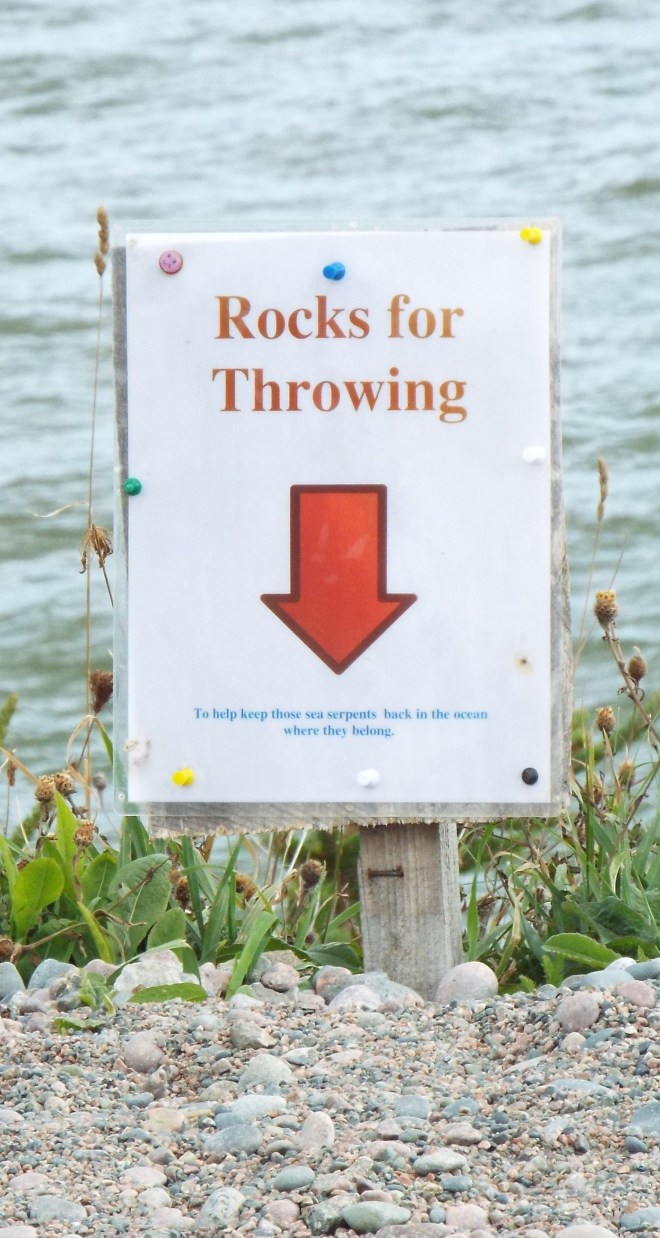
I have no idea why we happened to pull off the road at this particular spot, but when we did, we came upon this sign. I’m glad we stopped. It gave us a chance to . . .

DSCF5152

do our part to keep the sea serpents at bay.

Pitch perfect sign on the bathroom door of a Yarmouth restaurant

We’d gotten used to seeing Nova Scotia houses painted in happy reds, purples, greens, and yellows. But this is the only one we saw that actually IS a painting. Gotta love the whimsy of it.

And then we saw this ‘news’ notice in the North Shore Community Museum—a new take on fascinators that highlights the amount of snow likely to be found in that part of Cape Breton.

With that chuckle, I say a nostalgic goodbye to our Nova Scotia road trip and will return to my usual fare of Living on the Diagonal miscellany.


The Heart of Dixie: A Holiday Story

(Originally published 12/21/2017)

A little preface may be called for here. Way back in the last century—in the mid-70s—our local chapter of the National Organization for Women (NOW) established a number of consciousness-raising groups. Those of us who were interested were randomly assigned to one group or another.

C-R meetings were safe spaces where women could share our deepest secrets, questions, fears, and issues as women. Initially, C-R groups were meant to be a mass-organizing tool for broad political action, but consciousness raising quickly became a form of political action in its own right.

At C-R gatherings, our sense of isolation imploded as we each discovered our individual experiences were anything but unique, anything but small. As we discussed problems and events from our own lives, our stories became a tool for change. We gained strength and courage to take on systemic, structural sexism wherever it existed—sometimes in our own heads. It’s an on-going process, but one where we learned that indeed the personal is political, a truth we still see in today’s various human rights struggles. And though C-R groups were sometimes pooh-poohed as nothing more than group navel gazing, those who benefited from the institution of sexism soon found the results a power to be reckoned with.

*****

We were eight or nine in number, almost all strangers when our Consciousness-Raising group had been formed. In our short time together, we’d tackled all manner of topics, from workplace discrimination to deeply personal and painful issues to women’s health care to daily gender-based slights. It didn’t take long to bond. We were tight.

Dixie volunteered to host our December meeting, more a holiday celebration than a discussion of feminist politics. We had agreed in advance that, in lieu of tangible gifts, we’d each read a favored poem or essay—any subject. I chose Rod McKuen’s “A Cat Named Sloopy.”

It was an appropriate selection on several levels. I’d always been a cat lover and was owned by two of them at the time. And at our very first group meeting, one of the members observed that I reminded her of a cat with my easy movements and my quiet, sensitive manner.

After the rest of us had read our pieces, it was Dixie’s turn. Instead of pulling out a book, she asked to be excused for a minute. When she returned, she was wearing a big grin and carrying a basket full of small, white gift boxes. Cries of “Oh, Dixie” and the like filled the room. The rest of us had followed our mutual agreement—why was she giving out presents?

But, for reasons of her own, Dixie needed to bring an offering. And it was obvious from the pleased exclamations and laughter as we opened our little boxes and pulled out identical items that what she chose was perfect.

Dixie gave us each an egg. More accurately stated, she gave us each an eggshell, an egg whose contents had been carefully blown out. With red ink, Dixie had drawn facial features on each egg and encircled each one with a fat piece of red yarn tied into a bow at its narrowed top. An ornament hook was stuck into the bow’s knot. My name was written on the back of my egg.

It had to have been a tedious, time-consuming process, likely with more than a few failed attempts. It was a gift of thoughtfulness and love. Dixie found a clever, personal expression of our shared womanhood—the very essence of our relationship.

That was almost forty-five years ago. I still have my egg. The ink has faded, yet it’s an unrivaled possession, safely stored with other treasured holiday ornaments and always ready to play a starring role when it’s brought out for special occasions. In the intervening years, I’ve given a few of my own.

dixie egg

My prized vintage egg from Dixie

My egg reminds me of more than that heady time and those extraordinary women. It reminds me of change, of the unexpected. My egg has traveled with me across two states; through a wild adventure of leaving behind almost everything I knew to hand-build a home with my soulmate; it’s been with me through child-rearing, a career, and now my life’s vintage chapter.

My fragile, yet enduring, egg is a symbol of the strength of perseverance, courage, and tenacity. It symbolizes the power of knowledge and community of spirit. It symbolizes friendship and freedom of thought. It symbolizes time and all the experience that accompanies it. And it epitomizes the exquisite purity of giving from the heart.

Wherever you are today, dear Dixie, thank you for breaking the rules, thank you for your generous heart, and thank you for opening mine a little wider.

Joggins and Home

(The end of this reprise of our 2018 trip to Nova Scotia comes to a close with this post. But stay tuned for a couple of extras coming soon. To ‘travel’ virtually with us from the beginning, click here.)

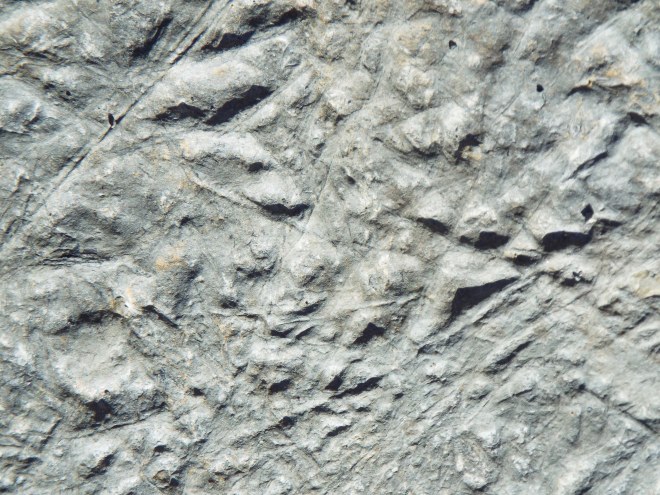
Bittersweet is the best that can be said for what was to be our last day in Nova Scotia. To ensure as much time as possible in Cape Breton, we had planned this to be a long travel day. It would take us practically to the border with New Brunswick, in the tiny rural community of Joggins. So tiny that AAA couldn’t find it to map out this portion of our trip. So tiny even a number of Nova Scotians didn’t recognize the name. Yet Joggins is home to yet another UNESCO World Heritage site. The Joggins Fossil Cliffs contain the most complete fossil record of life during the Coal Age, 300 million years ago. That’s a full hundred million years before the dinosaurs, so these fossils, preserved in the very place they lived, are the dinosaurs’ ancestors. Some of the fossils found here are giant insects. According to the Joggins Fossil Cliffs website, this is the only place on earth where you can view these rare plant and animal fossils in situ. Well, I was impressed! 

The tide is out at Joggins Fossil Cliffs. It will rise by an astounding 43 feet at high tide, cutting off access to the beach area.

See the tiny person in the middle foreground. You must walk down many, many steps from the top of the cliffs to reach the beach, something like 75, as I recall. That’s about six or seven stories! But we did it.

Giant insect?

We stayed the night at a true bed and breakfast inn, though we’d found it through Airbnb. We were joined by a young couple driving from Halifax to be with family for Canada’s Thanksgiving weekend. The four of us enjoyed a visit in the living room where we shared our respective’ backgrounds and learned a bit about cultural similarities and differences while enjoying some of our host’s homemade wine. Not only does Bridget own and run the B&B and make wine, but she’s also begun a business manufacturing buckwheat pillows—and she’s a former international professional singer, besides. (And her breakfast was fabulous!)

Crab Apple Inn, Joggins, Nova Scotia

The next day saw us driving across New Brunswick and into Maine. Though the leaves had only just begun changing color in Nova Scotia, they were really showing off in New Brunswick.

Not be the sharpest photos ever taken, but hey . . .

we were going 110! (in kilometers, of course)

Crossing the border back into the States was harrowing—at least the waiting was. We’d read that we needed to itemize all our purchases and have them and all receipts readily available for inspection, so we’d spent a long couple of evenings getting our documentation and souvenirs organized. Though we’d practically sailed into Canada (no lines and only a single benign question by the border agent), we waited here for close to forty-five minutes. Plenty of time for us to begin feeling guilty for merely imagined offenses. Cameras were watching from every angle. We tried to look innocent and nonchalant. Did that make us look like crooks instead? Our unease only increased when the border patrol unlocked and entered the RV in line in front of us.

Finally, it was our turn. We were asked the nature of our visit, if we’d enjoyed our stay, and whether we’d purchased anything other than souvenirs, personal gifts, and incidentals. That was it. A lot of worry for nothing.

In Maine, we made a little detour to stay in Seal Harbor, right at an entrance to Acadia National Park, a place I’ve always yearned to visit. Was it exhaustion as we were nearing the end of our travels? Was it being surrounded by so many leaf-peekers and their vehicles after so much Nova Scotia tranquility? Whatever the reason, we were underwhelmed. It was the only disappointment of our twenty-five-day journey, but it was about to be made up for in a big way!

We made one last detour before the big push to get home. When we’d come across an Airbnb listing in the small village of Newbury, Vermont, we added a day to our itinerary just so we could take it in. Everything about our host, her home, her village seemed so iconically New England.

And so it turned out to be. The home we stayed in is almost two hundred years old on a street of similarly aged residences, mostly modest clapboard homes with gabled fronts. Most of the village’s structures were built either between 1790 and 1860 or in the ten years following a devastating fire in 1913.

Not every residential neighborhood is on a town’s Main Street, which, in this case, is also Vermont Highway 5. Never was there a quieter thoroughfare. Between the residences is the core of the village, the Village Common, a large green space for public use. The village hall, village school, and Methodist Church sit on one edge of the Common. The entire village, flanked by the Connecticut River, is a historic district.

Simply idyllic. Just our style.

Linda, our host, is a professional photographer. She works in black and white, uses old cameras with actual film, and has her own darkroom. Like the Gnome, she collects cameras. (I told her she should count them before we left–wink, wink.)

She was kind enough to take us on a walking tour of her charming village the next morning. We passed the Village Common, the school, the church, the post office, the village hall, the public library. We stopped for chats with other morning strollers. We talked about the village’s history and Vermont’s fabled town meetings. We took in the village store (the oldest country store in Vermont) for a steaming cup of coffee and yummy homemade cinnamon rolls, then sat on the steps to chow down. We dropped in at the bank to study old black and white pictures of the fire.

The bank is closed on Saturdays, but our host has a key. (It seems that the few villagers who lock their doors share their keys with the neighbors.) Linda loves her hometown and its history, and it shows.

Unfortunately, sometime between our return home and getting to this point in my travel diary, the last two hundred or so photos mysteriously disappeared from our camera. I had to resort to Google to find a couple of photos to share. 

Newbury Village Store. Photo credit: redjar [CC BY-SA 2.0 (https://creativecommons.org/licenses/by-sa/2.0)%5D, via Wikimedia Commons


Tenney Public Library, Newbury Village, VT. Photo credit: Magicpiano [CC BY-SA 3.0 (https://creativecommons.org/licenses/by-sa/3.0)%5D, from Wikimedia Commons

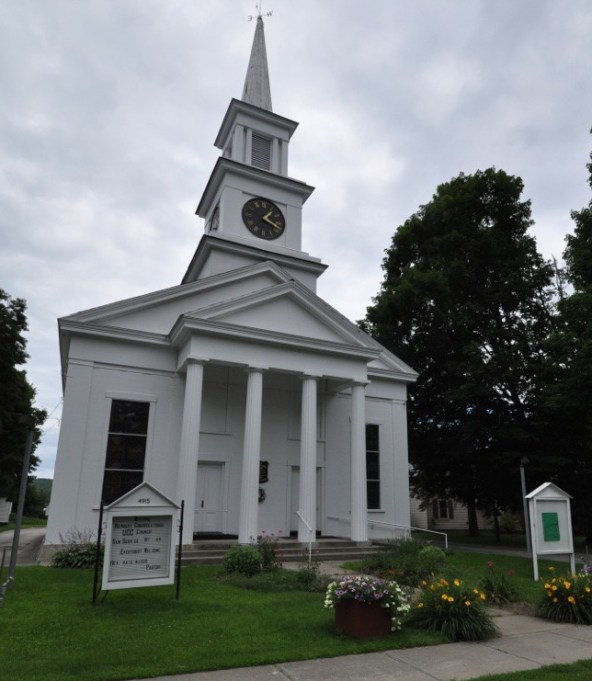
Newbury Village UCC Church. Photo credit: wikimedia.org/wikipedia/commons/5/56/NewburyVT_UCCChurch.jpg

Just because our travels are over, don’t think I’m through writing about Nova Scotia, There are still a couple of reflective posts (and, of course, photos), so I hope you’ll come back to see what they are.