Never Too Old To Learn

Well, I learned something new the other day!  When we moved to the North Carolina mountains several decades ago, the Gnome and I were taken with the many new-to-us wildflowers growing along roadsides. One, we were told, was phlox, also known as summer phlox, tall phlox, or garden phlox. Phlox paniculata.

Now, we knew about phlox—creeping phox, that is, otherwise known to us as thrift—those mounds of pinks, blues, and violets that cascade over rock walls. Quite a ground cover. Phlox subulata.

This tall phlox  was new to us. Same colors, it grows in clusters on tall, slender stems. Every year we see them brightening up already bright spring days. (Or so we thought.)

What–this isn’t phlox?!

This year, they seem to  be growing in particular abundance–on road shoulders, next to creek beds, on hillsides. But, it turns out, this spring wildflower I’ve been admiring isn’t phlox at all. How about that? What I’ve been admiring this spring is dame’s rocket, sometimes known as gilliflower. Hesperis matronalis, if you’re interested.

I think I can be forgiven for confusing these plants. To the casual—or not so casual—observer, they look identical. Same growth pattern, same height (around two to four feet), same color palette, they grow in similar environments. There are subtle differences, though, and you’d have to get a much closer look than you can when you’re driving past. Dame’s rocket has four petals, while phlox has five. (An easy mnemonic: dame = four letters; phlox = five letters. How convenient!)

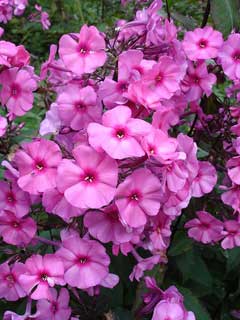
This one is phlox.     http://commons.wikimedia.org/wiki/User:Epibase

There’s an easier way to recognize the difference in these two flowers, and it has nothing to do with the appearance of the blossoms: dame’s rocket is a spring flower; phlox blooms later in the summer.

Both are fragrant in the evenings and relatively scentless earlier in the day. The flowers of both dame’s rocket and Phlox paniculata (but not annual or creeping phlox) are edible with a mild, spicy-sweet flavor. Dame’s rocket is a close relative of arugula and mustard and, like them, its leaves (which are best eaten before the flowers blossom) have a slightly bitter taste. Flowers and leaves would make a lovely addition to salads. Sprouted dame’s rocket seeds are also edible.

Moreover, dame’s rocket has been used for medicinal purposes, and it’s also known as an aphrodisiac. Who knew? (Not me. I didn’t even know its name!)

Sad to say, this spring bloomer is considered an invasive species in most states. Seems it has a take-charge attitude, pushing aside more polite plants. So, I won’t be buying any dame’s rocket seeds or digging up roadside plants to pretty up my place. But I’m sure going to enjoy them on country drives. And now that this ‘old dog’  has learned the difference between dame’s rocket and phlox, I think may appreciate both of them even more.


Nothin’ But a Hound Dog (Or a Hundred or So)

The Gnome and I took a day off last weekend. In theory, we can do that every day of the year now that we are repurposed. Reality is a bit different. We’re each working on major projects, and we push ourselves as if the world will end if we don’t finish sooner rather than later. Actually, that’s the truth—we have way more days behind us than we could ever hope to have in front of us. One day our time will run out and chances are we’ll still have more than a few unfinished projects lying about.

I think that’s the way I prefer it. Much better to be in the middle of something I care about, anticipating the results, than twiddling my thumbs feeling that there’s nothing left to do.

But back to our day off. We decided to visit a small, picturesque waterfall in the small county that borders ours. I’d never seen it, never in our almost forty years here even heard about it until a few months ago. In his work, the Gnome had driven past but, zipping by in a car, he hadn’t had a chance to stop and enjoy it, either.

Falls and a swallowtail at Newland’s Waterfalls Park (Photos by Ron Wynn)

After soaking in the beauty of the place for half an hour or so, we decided to continue on the same rural road to a popular general store, dipping and climbing on curvy mountain roads. Our route took us through the unincorporated community of Cranberry, population 500 or so. (Even before it was settled in 1850, Cranberry was known for having one of the largest veins of iron ore in the United States.)

We passed the grounds of the former high school, which is now being used for occasional community events. The place was crammed with cars and trucks, mostly trucks. A metal yard sign next to the road read, “Heritage Day.”

That sounded like fun. We whipped the car around and headed back. As we drove onto the property, our ears were assaulted with barking, howling, yelping,  baying. We found ourselves surrounded by dogs, dogs, and more dogs. More than a hundred, we were sure. Dogs with their wiggly noses sticking out of car windows, crated dogs in pickup truck beds, dogs pulling people on leashes, dogs tied to fence posts on the shaded lawn. They were not, not a one of them, sleepy yard dogs. These dogs were on the alert. They were, in the truest sense, rarin’ to go.

Hound dogs.

Have you ever heard a hundred hounds baying simultaneously? Well, let me tell you, it’s deafening, each dog with a distinctive and  urgent voice. We couldn’t help but smile.

This was a very particular breed of hound, a scent dog known as the Plott Hound. If you’re not a North Carolinian, maybe just a Western North Carolinian, you may not be familiar with this breed. The dogs were brought to North Carolina by Johannes Plott when he emigrated from Germany in the 1700s. In the early part of the next century, his son Henry moved with his family to the mountain range that bears the family name: the Plott Balsams in Jackson and Haywood Counties in the southwestern corner of the state. Henry continued to breed the dogs, mostly for bear and wild boar hunting. The Plott Hound was named the state dog of North Carolina in 1988.

As it turns out, my mother was born and raised in the shadow of the Plott Balsams, and I’m interested in anything related to that heritage.

plott balsams wikimedia commons

View of the Plott Balsams (courtesy of Wikipedia Commons (wikimedia.org/wikipedia/commons/7/70/Plott-balsams-pb-ll-nc1.jpg)

Somehow, we had landed in the middle of a Plott Hound barking competition. (Never heard of that before.) What a stroke of luck! We followed the dogs.

In the far corner of a temporarily fenced-in section of the school grounds stood a cage, ever so slightly camouflaged. Inside the cage was a bear. Not a real one, thank goodness. But it moved. And it growled. I’m willing to bet bear scent had been sprayed around the cage, too.

In the near corner, dog handlers were hanging on to the leashes of their dogs. From the looks of it, that was some kind of hard work. When the whistle blew, three dogs at a time were turned loose and inevitably flew straight to the cage where they positioned themselves, barked, repositioned, and barked some more, stopping only when the timer blew his whistle and the keepers releashed their dogs, leaving the arena for the next trio to advance.

We didn’t fully understand how the process worked and we left before trophies were awarded. But from what we observed and overheard, we gathered this much. The event is timed. There are three judges. The judges are looking for degree of aggression, number of barks, and focus.

We looked, but if there was anything to Heritage Day other than the dog competition, it was well hidden. Never mind. Listening to the baying of a hundred eager hounds left us buoyant.

We almost always manage to come across some bit of serendipity—chance magic—when we’re out and about. Maybe a four-leaf clover, a funky art gallery, or longhorn cows in a meadow of buttercups. What a treat to happen upon a Plott Hound barking competition.

Have you encountered a bit of serendipity this week?

(Take a listen to the Plott Hounds.)


A Belated Mother’s Day Story

I look to you for courage in my life
And I promise it’s not just foolish idolatry
That makes me gaze at you in wonder.

–Holly Near, “Something About the Women”

My mom’s a Smoky Mountain gal, and I’m in the process of writing a book about her life and times. I’m happy to finally be able to say I’m on the downhill side of the project, but it’s still a long ride. Thought I’d share a little of her backstory in her honor during this Mother’s Day week.

Mother as a teenager–at 4-H camp

Mother’s ancestors arrived in the Smokies with little more than they could carry. Those early pioneers spent their days working the land. The mainstay meat product was pork—hogs were more numerous than all other livestock combined, with farmers killing a hog or two annually for their families to live on until next hog-killing season. It was the era of subsistence farming. Most of the necessities of life were produced in the home or on the farm, and most exchange was by barter. There was little contact with the outside world, even in one’s own county. That’s how scarce roads were.

A record of early settlers’ homes and the sturdy, industrious people who built and occupied them was summarized by Edgar H. Stillwell, Mother’s second cousin once removed and former history professor at what is now Western Carolina University.
Stillwell wrote that no sooner were their rough, one-room cabins built than the pioneers began clearing the cheap, plentiful land for cultivation, making their crude farm implements themselves from whatever was available. He added, “All other necessaries were manufactured by hand . . . ” It was a world of do it yourself or do without.

Such were the conditions in the 1820s, when the family of Mother’s third-great-grandparents, Mary Nicholson and Barak Norton, were the first settlers of Whiteside Cove in the Cashiers community, which is now part of Jackson County. Barak lived to be 92, Mary to 95. Her 1883 obituary stated that she never had need of a doctor until her last year.

Barak and Mary Nicholson Norton

Meanwhile, other of Pam’s ancestors were moving into other sections of southwestern NC, most notably a bit north in the Oconaluftee area, most of it now lying within the Great Smoky Mountains National Park. Soon after Sarah and Jacob Mingus settled the area in the earliest years of the 1800s, the Stillwells arrived, and then the Holdens.

In the isolated coves where they settled, religious services were typically conducted in private homes, as was the case with Lufty Baptist Church founded in 1836. Lufty’s early meetings were held in the home of Dr. John Mingus, whose parents (Jacob and Sarah), Mother’s third-great-grandparents, were among the very earliest settlers in the region.

The Minguses were described by one old-timer in an oral history interview with the park historian. “They are ordinarily large, heavy built with a ruddy complexion having broad faces with a slightly Roman nose. They have soft blue or gray eyes, a grave expression yet comical. They are honest and thrifty. They as a whole delight in paying every penny they owe but it almost kills them to pay an unjust debt. They have a high explosive temper easily offended but quick to forgive . . . Most of the Minguses I ever knew was law abiding and God fearing people. I was raised on the Ocona Lufty river and her tributaries and I never saw a drunk Mingus in all my life . . . They use very little profanity. They have few habits. The women folks are mostly good housekeepers and cooks. They all work and teach their children to work.”

Mingus Mill, Great Smoky Mountains National Park–        Creative Commons photo courtesy of Brian Stansberry [CC BY-SA 3.0 (http://creativecommons.org/licenses/by-sa/3.0/)%5D

John Preston Arthur, in his History of Western North Carolina, said, “It was the women who were the true heroines of this section. The hardships and constant toil to which they were generally subjected were blighting and exacting in the extreme. If their lord and master could find time to hunt and fish, go to the Big Musters, spend Saturdays loafing or drinking in the settlement or about the country ‘stores,’ as the shops were and still are called, their wives could scarcely, if ever, find a moment they could call their own.”
Edgar Stillwell added, “. . . at last, tired and worn out with the long day’s duties, [they fell] on the bed for a well-earned night’s repose, which was often broken by the cries of a sick baby or the return of some male member of the family late in the night. Thus our great great grandmothers served from day to day; thus they labored without honor, often with little reward, and always unselfishly. Heroines indeed they were.”

Indeed.

With few exceptions, not much is known of these women beyond what can be gleaned from various census records. That so little information is available may be due—aside from patriarchy—to the poor state of things like roads and communication systems in western North Carolina in its early, and not so early, days.

Even in this remote area, a few morsels of Mother’s matrilineage did make it into print or oral history.

In 1775 or so, a fort was raised on the land of Mother’s third-great-grandparents, William and Rebecca Cathey in what is now McDowell County, NC, to protect their family and neighbors against Cherokee raids during the Revolutionary War period. It was the westernmost military outpost in the state. A historical marker sits along Highway 221/226.

From that battle came this tale about Catheys Fort and the mother of one of the Cathey men, whose specific identity I’ve not yet been able to confirm. The Catheys were familiar with Cherokee attacks on their property and fort. Mrs. Cathey knew there had been attacks on several nearby communities by the Cherokee/Tory Army, led by Dragging Canoe, war chief of the Chickamauga Cherokee, “and she dang well was ready to alarm McDowell residents” of the coming danger, so she mounted a horse in her stable “astride and at quarter speed” to warn the settlement to flee to the fort.

They barely made it to relative safety before the fighting began. Then one of the defending party cried out that all the powder was gone, an admission that could have spelled doom for the fort’s occupants. At that point, “old Mrs. Cathey” (I’m not sure if this was Rebecca or another family member) once again came to the rescue. She “pulled off a pair of red flannel pockets and called out that there was powder aplenty.” At just that moment one of the attackers was shot and the invaders retreated. The ploy was a ruse—her pockets were empty, but “the bravery and quick wit of Mrs. Cathey saved the party.”

Though there is some confusion, the woman in this photo may be Catherine Cathey (Mother’s second-great-grandmother), daughter of William and Rebecca.

When John Holden left to fight in the Civil War in 1862, Mother’s maternal great-grandmother, Arminda, was left to care for their five young children, ages 5 months to 7 years, give birth to another, and manage all aspects of the family home and farm on her own. After John’s return in 1865, Arminda gave birth to another eight children. That was fourteen children over twenty-six years.

John and Arminda Norton Holden

Mother’s grandmother, Martha Jane Henry Dillard was only eleven when her older brothers went off to war, their father having died that same year. That left Martha Jane, her nine-year-old brother, and their mother, Sarah Elliott Henry to fend for themselves during those dangerous times.

Martha Jane Henry Dillard with grandchildren–Mother is the baby, bottom left

And back to Mary Norton. According to John Preston Arthur, “It is a well authenticated fact that Mrs. Norton, then living in Cashier’s Valley, was awakened one night while her husband was away from home, by hearing a great commotion and the squealing of hogs at the hog-pen nearby. Her children were small and there was no ‘man pusson’ about the place. The night was cold and she had no time to clothe herself, but, rushing from the cabin in her night dress and with bare feet, she snatched an axe from the wood-pile and hastening to the hog-pen, saw a large black bear in the act of killing one of her pet ‘fattening hogs.’ She did not hesitate an instant, but went on and aiming a well directed blow at Bruin’s cranium, split it from ears to chin and so had bear meat for breakfast instead of furnishing pork for the daring marauder.”

Such is the stock from which Pam Dillard Coates comes.

Mother in her late sixties
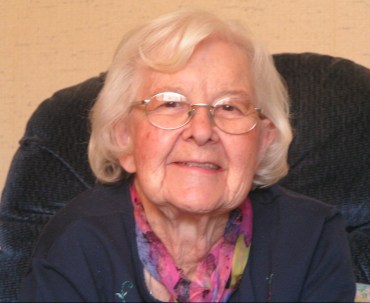
Mother in her upper eighties

I suspect most, if not all, of us have similar stories somewhere in our family histories, even though we may not know them. So, on behalf of children everywhere, thank you to the mothers of the ages—today and every day—for your struggles, your determination and strength, your survival, and the amazing genes that you carried and passed on. We’re here because of you.
 

Weeds Are Flowers, Too!

“Weeds are flowers too, once you get to know them.” ―A.A. Milne

I love this quote, and it’s so true. Another equally true saying is “Weeds are plants whose virtues we haven’t yet learned.” Many decades ago, The Gnome and I discovered that the hundreds of wild purple violets popping up in our back yard could be turned into jelly, as delicately eye-popping as it was tasty.

Dandelion is the bane of many a gardener and lawn-lover, but it is actually an herb worthy of respect—a cheery little plant with more uses than you can count on all your fingers, whether culinary, medicinal, or otherwise. You can use virtually all parts of the plant, though you’ll want to avoid the sticky stems.

Dandelions are packed with vitamins, minerals, and antioxidants. With the leaves, you can make everything from salad greens to classic Irish colconnon to quiche.

Did you know dandelions aren’t native to the U. S., but were imported by European immigrants for their culinary and medicinal uses?

Last year, we made the most exquisitely subtle syrup from the flowers. I’d have been hard pressed to tell it apart from honey. Dandelion tea and wine are other favorites. Dry the root for a coffee substitute. Fresh roots can be used instead of or alongside other root crops. Make a hand lotion or moisturizer from the flowers. Pollinators love dandelions.  And who can forget the sheer joy of blowing on a dandelion puff?

Lamb’s quarters fill the fields with buttery yellow blossoms in springtime. Just before they get to that stage, the stems can be harvested and eaten as a broccoli substitute. And the young leaves make an excellent addition to a green salad.

Chickweed, invasive as it can be, is another nutritious green. Add spinach-y chickweed stems, flowers, and leaves to salads or cook them up like other greens.

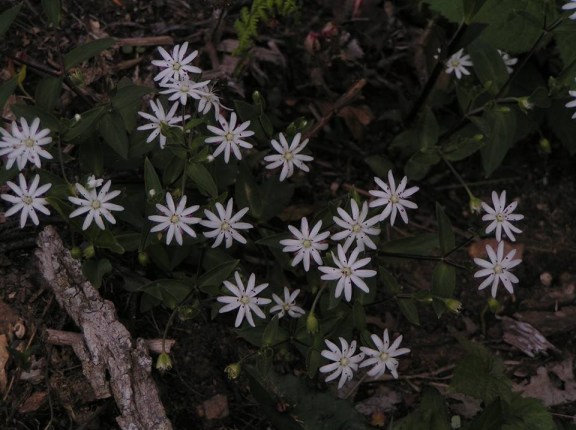
Star chickweed is only one of  twenty-five varieties of Stellaria, a member of the carnation family. All are edible and all except the mouse-eared variety can be eaten raw. 

By looking at so-called weeds through a different lens, we can find beauty, peace of mind, and functionality. Not to mention a veritable grocery store in our own back yards.

* If you’re thinking of joining the foraging movement, find yourself a good field guide that will also alert you to similar-looking but unfriendly plants. You’ll also want to (1) ask permission before foraging on private property; and (2) avoid areas that have been exposed to chemical pesticides or herbicides as well as roadsides. They retain automotive emissions you wouldn’t want to ingest.


Found Poetry, Part IV

(For more Found Poetry, click here, here, and here. I’d love to hear what you think.)

Merlin’s Last Voyage

crystal moon
out of the mist
ancient evening
entering the mystery
of a hidden world

dark falls the night
on the island cathedral


Night Sight

northern lights
swimming
o’er the land, o’er the sea
casting out darkness


Earthdream

sunshine on a meadow
the smile of a breeze
breathing light
between two worlds

Again with the Found Poetry!

(Unlike my first two rounds of SXM Found Poetry—here and here—these short pieces are titled. I look forward to hearing your thoughts.)

DSCF4886


Dreamless

kindle a flame
before the last leaf falls
on the shores of time
be at peace


Contemplation

tears in the rain
flowing into formlessness
roll on forever


Scenes of Reflection

rainbow visions
cloudscapes
canopy of stars
between sacred mountains


And Evening Falls

silver cloud shimmer
almost full moon
serenade of the night sky


More SXM Found Poetry

(For more about my latest foray with Found Poetry, click here. And leave a comment if you find a favorite, please.)


I.
waters of time
cast out the darkness
of a thousand teardrops
in the rhythm of the night


II.
through the blue
rainshadow sky
the river dances
drifting toward a dream
of canyon sounds
in a western wind


III.
out of the mist
promises
memories of comfort


IV.
first snow
ocean peace
bamboo forest
in the deep distance
I kiss the quiet


V.
breath of sky
sunshine on a stony path
frost on an empty field
summer’s end


VI.
the light in your eyes
lifts me on a weightless
incandescent voyage
you are my home

Winter, Reconsidered

My emotional connection with winter has a long history. It has rocked back and forth sometimes depending on my geographic circumstances. For the last few years our alliance has been strained.

This year, I’ve been trying to redefine my relationship to the season of short days and long nights, relentlessly prolonged and wrapped in gray in my neck of the woods.

During the coldest months, the sun’s rays rarely make an appearance and not just because of the brief period of daylight. Overcast is a generous word for many of our wintry days. Of the first fourteen days of this new year, we had perhaps two sunny days. That was the beginning of a season-long trend.

Even those rare days are frequently unhelpful when it comes to getting a dose of Vitamin D. The frigid temperatures allow for only a couple of small skin slivers—between toboggan and eyebrows and between lower eyelids and muffler. Even eyes may be covered with sunglasses, particularly when sun and snow combine to create blinding brightness. And sometimes the snow—especially if it’s deep, icy, or drifts high and unevenly—makes the outdoors a dangerous proposition, particularly for those of us who are more susceptible to breakage because of age.

Nonetheless, I’m taking measures.

  • I treat all my senses: my most worn sweater that wraps me like a cocoon, thick, soft socks, and a plush comforter make me feel as if I’m burrowing into the neck of a friendly Old English Sheepdog.
  • I surround myself with the soft glow and herbal scent of candles. I play soothing music that lifts my spirit—mostly classical, folk, and Celtic.
  • I try to hold an intentional smile, if only as subtle as the Madonna’s. It brings comfort to those around me, and my spirits unconsciously lift.
  • I sip tea, slowly, and look at the outdoors. Really look at it, noticing all the nuances of winter’s offerings, playing with words to find the most descriptive—and life-affirming—ways to describe the scene before me.

The work is all-encompassing. But so far it has proven worth the effort. Winter will still be around for a while up here on the diagonal, so I’m still working at it.

Our society has a tendency to think of winter as a time of death. Green grass and summer wildflowers have ‘died;’ leaves have fallen and dried making deciduous trees look dead. I’ve challenged myself this year to look at nature differently.

Lawns may no longer be emerald, but they will regrow; the grass is not dead. We have a tendency to overlook the subtle tan shades of tall grasses, but they provide rustling interest on a winter day, even more when they wave gently in a breeze.

Winter isn’t a braggart. Its marvels are less noticeable than the lushness of spring and the vibrancy of summer. In those seasons, winter’s elusive wonders are hidden. But now—now they surround us. Now is the time to revel in them.

When I manage to get out of doors, whether for a walk in the woods or a scenic drive, I look again. I search for positive words, alternatives to bleak, dreary, and overcast. Words like contemplative, silver-tinged skies, reflective, pensive. Winter calls us to introspection. Is that why we resist it?

On one typically cold but unusually bright morning, the roofs of the houses we passed on our way to town were covered with the thinnest veneer of frost. As we rode by, sunlight played on the icy crystals, creating a glittery shimmer, as if the shingles were made of twinkling fairy lights.

The skeletal trees, bare of their green camouflage, fill the landscape with sculptural architecture. Their nakedness allows me to appreciate aspects hidden at other times of the year.

The branches of some reach upward, as if in praise of the sky. Some trees are encircled by draping branches, reminiscent of welcoming arms ready to enfold me and offer comfort. Some trees are so gnarled and craggy it’s easy to imagine they sit on the edge of an enchanted forest.

About now, with trees looking as bereft of life as they have for months, the sap begins rising, an event which will go entirely unnoticed except for syrup makers and those who happen to fell a tree at that crucial time, but pivotal to the reemergence of the verdant leaves we long for.

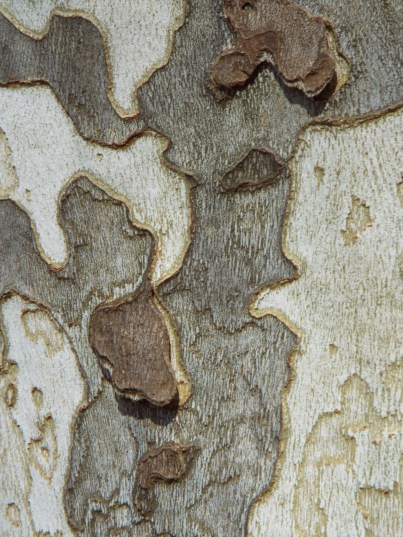
Subtle color variations and not-so-subtle textural differences in tree bark differentiate one species from another. Touch a sycamore or crape myrtle, with bark as smooth as the proverbial baby’s bottom.

Consider the trees with peeling bark—paper thin birches and rugged shagbark hickories, or the finely ribbed bark of the pin oak and the thick, deeply furrowed bark of the black locust. Bark with overlapping plates, like black birch, make me think of armadillos and scaly dinosaurs.

As I look more closely at trees, I see mosses as dark as midnight and lichens, some the palest green, eerily fluorescent in the dark. In the woods outside my kitchen window sits the tree stump. Over time, moss has begun to creep upwards, slowly covering its sides. Today, I saw for the first time that the entire stump is blanketed in moss as soft as down, hinting at a fairyland.

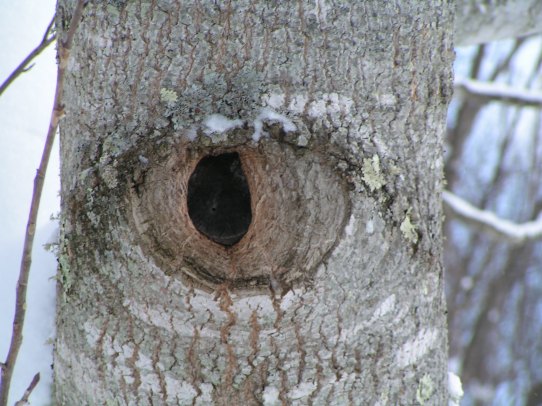
There are trees with burls and hidey holes. Who goes there?

A cyclops tree?

Winter serves a purpose. Plants store up their reserves, ready to explode with new life as warmer weather and more hours of sunlight appear. The flora does what it needs to do during winter. Animals know how to handle winter, too. Some, like plants, go dormant to preserve strength, feeding off stores of fat until nature is ready to provide its bounty.

What if we humans were to welcome winter in all its aspects and live with it, not against it, as the rest of nature seems to do so well? What if we turned off the electronics, indeed perhaps electric lights when the sun goes down. What if we did those quiet chores best done in front of a fire or by candlelight with a cup of hot chocolate or tea at our sides? What if, instead of staring at some screen, we talked to each other, played games together, put together a jigsaw puzzle, corresponded with relatives and other friends, read aloud or silently, wrote, contemplated? What if we used winter to restore ourselves, to create, to maintain?

Would our family and internal lives be richer? I think they might. Would we welcome winter as we welcome spring? Would we be better primed for what life brings in the next season? We might begin to treasure and even look forward to long winter evenings as a time of personal and family enrichment.

We can’t beat winter. Why not join it?


Proud Mountain Woman

(This essay was first published in the 2018 issue of Gateways Creative Arts Journal, themed Remembering and Forgetting.)

Not again!” she snapped. Until this moment, it had been a perfect morning. But when she turned on the tap to fill the coffee pot, nothing. Dadgum it! Preparing a hearty breakfast before seeing Braxton off to work was one of the many ways she strove to be the best wife she could possibly be. This thing with the water was getting to be a nuisance. All she asked of the Harwell boy was that he wait just a measly half-hour to divert the water supply to the cattle trough so Brack could get a pre-workday shower and she could fix his breakfast.

Today was one time too many. In a flash of huff, she trounced across the kitchen, slammed the screen door behind her, stomped across the sandy back yard in her pink and blue flowered pajamas, climbed over the barbed wire fence into the neighbors’ pasture, and turned off the cows’ water supply with a sharp wrist twist.

She marched triumphantly back to the kitchen, still mad, but smug. Today there would be coffee.

Who is this woman? What is her story? Her name is Pam Dillard Coates. I know this true life episode because the four-year-old me was in the kitchen when it happened. No doubt, the only reason this long-ago moment stands so clearly in my memory is that such a display of temper and venom was so unlike the quiet, gentle woman I knew as my mother.

That woman would never snap, never slam, and never, ever leave the house in her pajamas.

At the time, our young family of four was living in Mars Bluff, South Carolina, about eight miles east of Florence. My parents rented an old farmhouse from the Harwells who lived next door in what has been described as one of the finest examples of Greek Revival antebellum architecture in South Carolina. Even I knew it was pretty impressive encircled as it was with twenty-two Doric columns (not that I knew to call them that).

By contrast, our small wood frame house stood atop brick pillars, in the way of many houses of its era. The open space under the house was intended to keep things cooler in the hot southern summertime. Perhaps the nearby presence of “The Columns,” as the Harwell home was known, made our little house look shabby to the lady who came calling one day to welcome us to church. Mother did not like the sense she got that this matron felt sorry for us and that she looked down on us. It was a slight Mother never forgot.

But our home wasn’t nearly as pitiful as the two-room unpainted wooden shanty occupied by a tenant-farming couple. I walked across the fields to visit them on occasion. It was a tiny space, even by four-year-old standards. I walked into the small area designated as a kitchen with room for a wooden counter top on one side of the door and an old-fashioned icebox on the other. An open doorway led into the combination living-bedroom. The place was dismally spare. At least our house had electricity—and running water, sometimes.

We lived a couple hundred miles and a world apart from Mother’s hometown in the mountains of southwestern North Carolina. The people of sandy eastern South Carolina thought her mountain accent was quaint. By one means or another, someone was always calling attention to her differentness. She felt out of place, patronized, and she was rightly sensitive to any hint of disdain.

In the mountains, she was in her element. Her family was well-respected. Her parents were leaders in the small community. It was home.

She didn’t realize just how much. Though she was unaware of it, all of Mother’s ancestors had settled the area when it was first opened up via cession by the Cherokee. Every single one of them came to this country no later than the 1700s, some earlier. Like today’s immigrants, they were mostly poor folk who left their home countries in search of a better life. For the most part, they found it.

The Stillwells, Loves, Dillards, and Nortons were some of the first to move to western North Carolina as it opened up for settlement. The rest came not long after. Some made their way from Virginia through eastern Tennessee. A few moved from points further east in North Carolina, and more came from bordering counties in South Carolina and Georgia.

In other words, Mother’s mountain heritage included the very deepest roots among European settlers. And though she is still the sweet, gentle woman I remember from my childhood, I now understand that she is—and has always been—so much more. She shares many of the traits commonly attributed to Southern Highland mountaineers: self-reliance, persistence, and stoicism borne of necessity; reticence, independence, and individualism borne of isolation; and a hefty dose of mountain pride that demands to be treated with dignity.

Today she’s even more proud of her mountain heritage than she was as a twenty-something young mother. So am I.

The Other Side of Snow

In eastern South Carolina where I grew up, about an hour’s drive from Myrtle Beach, a snowfall was a unexpected and exciting gift from Mother Nature. I remember one particularly bountiful snow—enough to build a snowman! That was a true rarity. My brothers and I went all out, rolling three balls of snow, each larger than the one before. We rolled and we rolled. How proud we were to be able to make a huge snow statement.

We rolled the huge bottom section where we wanted to build our snowperson. We rolled the next one over, but when we tried to lift it into place, it didn’t budge. That’s how little we knew about snow. Finally, Dad’s strength and ingenuity solved our conundrum.

Now I live in a place that gets snow most every winter, some years more than others. I enjoy the variation of the seasons, so I welcome snow. Sometimes.

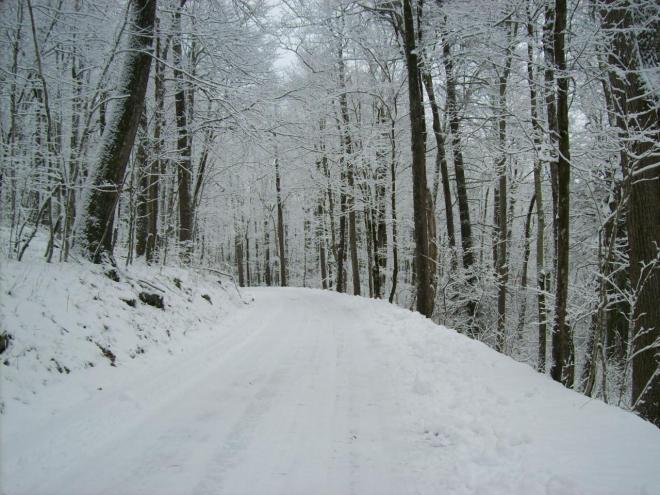
In the right conditions, a snowfall can be breathtakingly beautiful. If the temperature hovers near the freezing mark, the snow is usually heavy and wet, turning every outdoor thing into a pearlescent sculptural wonder.


Snow paw and snow antlers


Snow fences

Stopping by woods on a snowy evening

The tiny, dry flakes created by brisker winter temperatures sparkle when the sun comes out as if billions of diamonds fell from the sky.

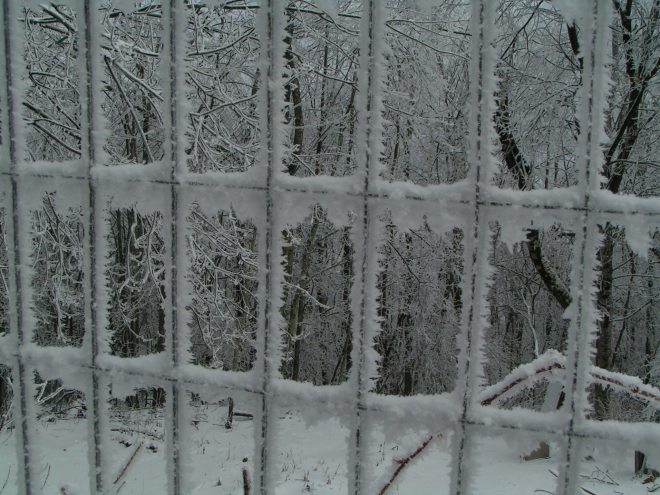
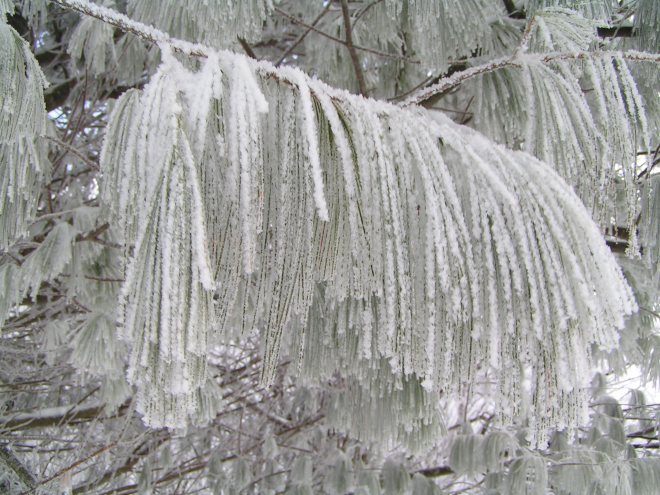
If the snow is preceded by hoar frost, feathery ice crystals that attach themselves to every outdoor surface, the whole world becomes white—every branch of every tree, every pine needle, every fence post and metal structure, everything. It almost makes my heart ache.

Clothespins on clothesline

Tree with hoar frost against blue sky

Abandoned bed springs

Garden fence


Pine branch


Even cobwebs are appealing when covered in hoar frost.


But snow has another side. The excitement grows old when winter comes early and refuses to leave center stage so colorful spring can make a long-awaited debut. And that’s not all.

When even a modest snow is accompanied by strong winds, as is so often the case on our mountainside, the snow piles into unplowable drifts. We’ve been known to pack snowshoes, a shovel in case we get stuck, and a plastic sled in our car and park at the bottom of our nearly half-mile gravel drive in anticipation of such an event. On more than a few occasions, we’ve slogged up that mountain road pulling a sled full of groceries, bags of pet food and birdseed, book bags, and more.

Sometimes we’ve been caught off guard. Without snowshoes or the shovel that spends most of the winter in the car, walking in can be a real trial, especially in a deep snow where each step means lifting one’s knees waist high or higher with every step. And climbing uphill, at that. Conversely, we’ve been completely snowed in for four or five days at a time. An adventure at first, but gnawing anxieties grow with each day as we begin considering the possibilities of being trapped in the event of an emergency.

And then there’s that dreaded word, ice. At just the right—or wrong—temperature, snow is preceded by rain which freezes on roads. Sometimes the reverse happens and rain or sleet falls after the snow. Walking and driving in either condition is treacherous. Add steep, curvy, and sometimes narrow mountain roads for a bigger thrill than any theme park ride.


Icicles can be fascinating, though, especially when the wind blows.

In normal times, we may only have one ‘good’ snow a year, and it doesn’t usually hang around long. A day or two later, the sun’s rays melt most of it away. We’ve had a few exceptional years, though. Real doozies.

In 1993, snow totaled more than three feet in just over two days. We were under curfew for forty-eight hours straight. Locals fondly remember it as the Blizzard of ’93 (and yes, it was an actual blizzard). At the time, it was called ‘the storm of the century.’ The National Weather Service named it a superstorm.

The 2009-10 winter brought us more than nine feet of snow—and since temps remained below freezing for the duration, none of it had a chance to melt. For more than three months, the only outdoor colors we saw were white and gray.

Once we could drive around our mountain road,  2010

Snow field

Fifty years earlier, way back in 1960 (well before we lived here), it only snowed seven feet, all of it falling in a just over a month. Every other day it snowed. Temperatures never rose. The winds were fierce. What snowplows cleared one day, howling winds turned into another drift the next. Children missed a month of school; helicopters dropped food, medicine, and cattle feed to isolated rural households.

Now, I know our snow totals are nothing compared to the country’s northernmost areas and tallest peaks. But, hey, I’m in the south. Most folks don’t typically associate such snow totals in the land they think of as all sunshine and beaches.

But don’t feel sorry for us. We mountaineers take a kind of perverse pleasure in our extreme weather. It’s like a badge of honor and we wear it (read: talk about it) all the time, as if we somehow deserve credit for weather’s natural occurrences. We proudly claim our snow.

MINOLTA DIGITAL CAMERA

Among the trees

MINOLTA DIGITAL CAMERA

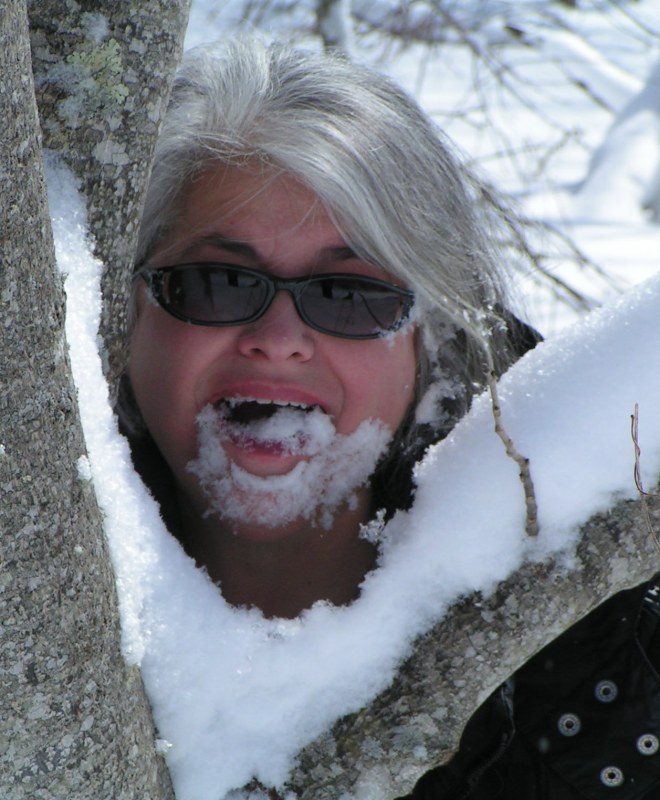
Taking a bite out of snow

Bragging rights

Back in my high school days, when every snowflake sent us running to the windows in gobsmacked awe, we were naively oblivious to snow’s downsides. All we knew was that even a relatively deep snowfall would disappear within hours, the reason we wasted no time getting outside.

During spring break of my senior year, our high school chorus went on tour. We were headed to New York. We spent a night in New York City, the first time most of us had ever seen a skyscraper. Then we traveled upstate to perform. We were excited to see snow on the ground. But what were those humongous ugly mountains of grayish-black, sludgy-looking stuff at nearly every corner? Yeck! Why, I wondered, didn’t these northerners care enough to keep their snow clean and pristine? How could they let it sit around and get so dirty, so totally ruinous to the landscape of purest white?

Now I know.


Recent snow scene